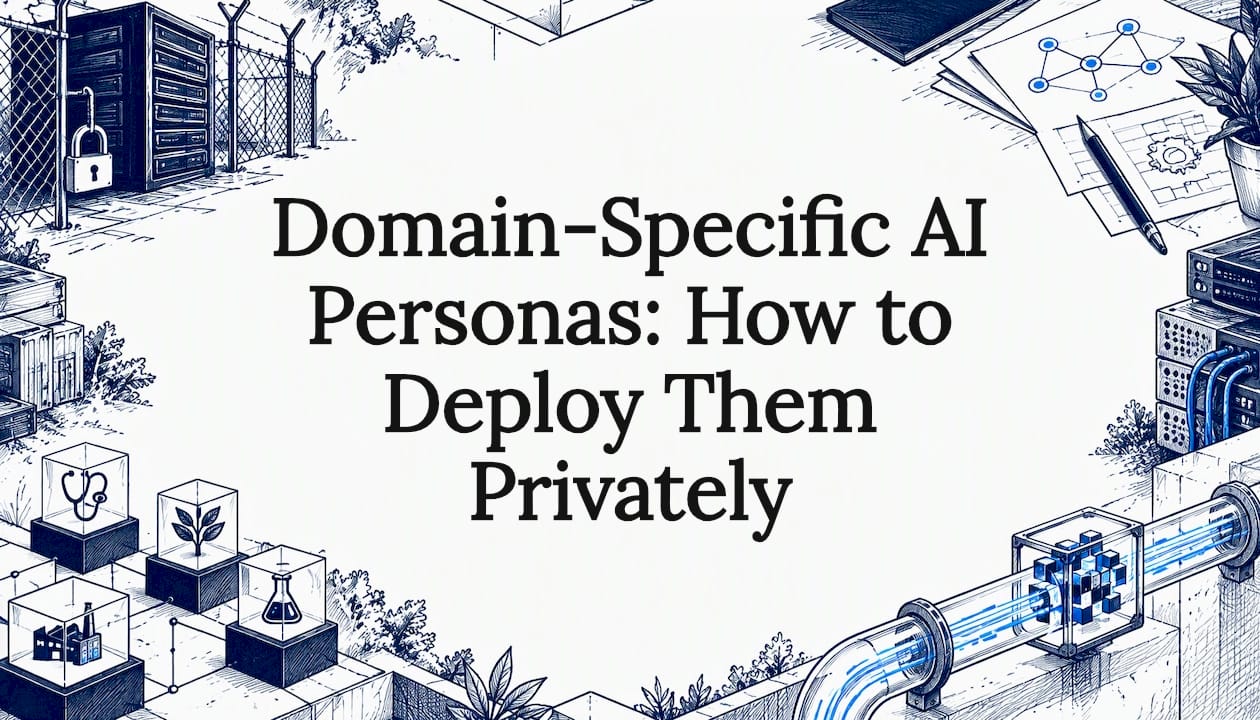
A domain-specific AI persona is an AI expert scoped to one role, workflow or body of knowledge, such as maintenance planning, compliance review or procurement. It is built from your organization’s own documents and judgment rather than from the open web. For regulated enterprises, the real question is not whether personas work. It is where they run, what they can touch and who can audit them. This guide covers all three, and what a private deployment looks like in practice.
TL;DR
- A domain-specific persona focuses on one role or workflow and reflects the knowledge inside your teams. A general-purpose assistant tries to answer everything.
- The strongest designs pair a persona’s flexible reasoning with deterministic, verified tools, so a drifting agent cannot break a safety constraint.
- In regulated sectors, personas should run where the data already lives: a data center, an edge site or an air-gapped network.
- Map persona controls to the NIST AI Risk Management Framework (Govern, Map, Measure, Manage) from day one.
- Forge AI Deployment designs, deploys and operates webAI’s local-first platform, including Personas, the Intelligence Delivery Network and webAI Frontline, inside infrastructure you control.
Table of Contents
- What a domain-specific persona actually is
- Why the deployment location matters more than the model
- What good persona architecture looks like
- Governing personas: a practical NIST-aligned approach
- A deployment checklist for your first persona
- Our perspective
- How Forge deploys personas for your organization
- Common mistakes to avoid
- FAQ
- Sources
What a domain-specific persona actually is
The term gets used for two very different things. In marketing and UX, a persona is a fictional customer profile, and many of the pages ranking for this phrase are about that. Here we mean something else: an AI system with a defined job.
webAI, the platform Forge deploys, describes Personas as domain experts built from what only you know. Instead of one general model, each Persona focuses on a specific role, workflow or domain. That is the same idea researchers call vertical agents. A survey of the field describes vertical AI agents as tailored to specific industries, using reasoning engines fine-tuned for specialized knowledge and workflows.
The practical difference shows up in three places:
- Scope. A persona for aircraft maintenance knows maintenance manuals and procedures. It is not expected to draft marketing copy.
- Grounding. Answers come from your controlled document library, and good ones point back to the source page.
- Accountability. Because the job is narrow, you can test it against known questions, set an owner and decide what it may never do.
The same idea applies to the other phrase readers use, domain-specific agents. A persona is the expert face of the agent: its knowledge, its tone and its boundaries. The agent machinery behind it (tools, orchestration, permissions) determines what it can do.
Why the deployment location matters more than the model
Most conversations about personas start with model quality. In finance, defense, energy, logistics and manufacturing, they should start with the perimeter.
A persona is only useful if it is fed the documents that make it an expert: engineering records, internal procedures, contracts, incident histories. That is exactly the material a security team does not want sent to a hosted API. When the sanctioned tool is slow or locked down, people route around it. A governance framework for local-LLM adoption in high-compliance environments describes this “Shadow AI” problem: operational staff bypass complex security protocols to use cloud-based models.
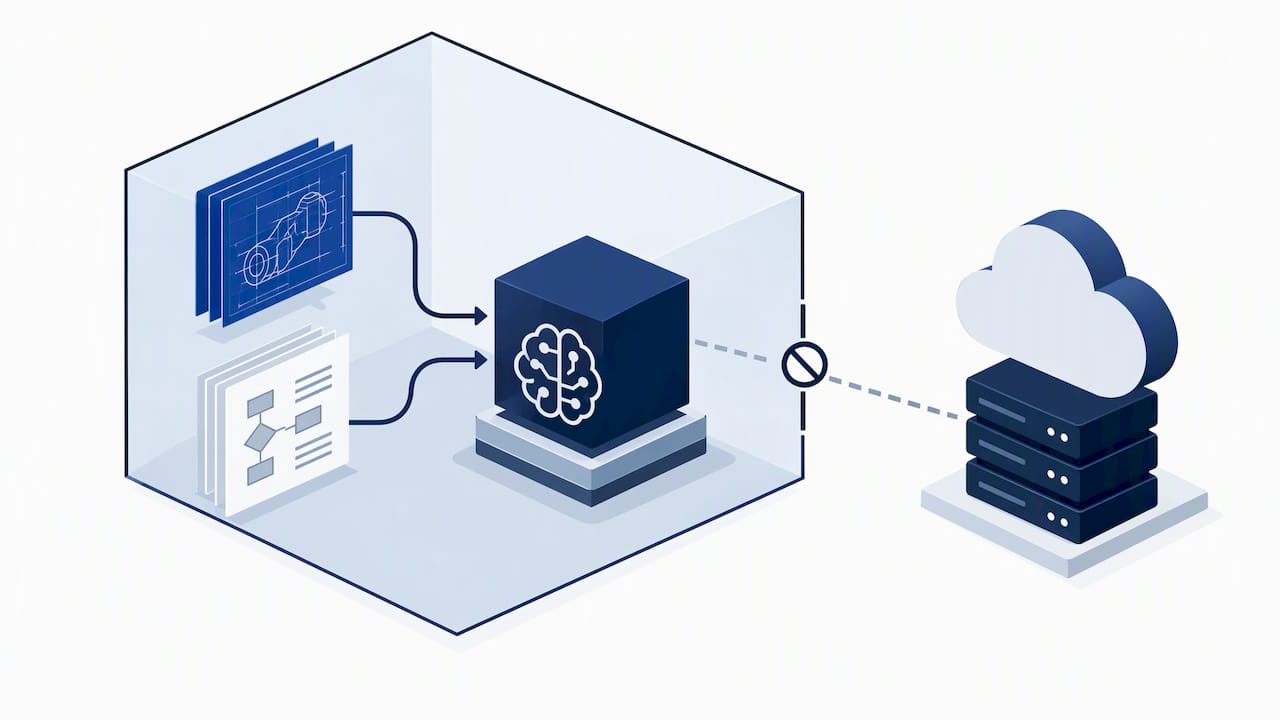
A private deployment removes the trade-off. The model comes to the data instead of the data going to the model. If you want the deeper risk picture, our piece on six paths for enterprise AI data leakage walks through where sensitive information escapes, and our guide to sovereign AI deployment lists the agency checks to run before anything goes live.
Three places a persona can run
| Environment | Typical fit | What to plan for |
|---|---|---|
| Enterprise data center | Finance, insurance, large manufacturers with existing GPU or server estates | Capacity, network segmentation, model update process |
| Edge site | Plants, depots, hangars, field offices with limited connectivity | Device management, local retrieval, sync policy |
| Air-gapped network | Defense, classified or safety-critical systems | Offline model and update delivery, strict import controls, audit evidence |
The design questions differ per row, but the principle is constant: data, models and domain intelligence stay inside the boundary you define.
What good persona architecture looks like
One orchestrator, many specialists
A single all-knowing agent is hard to test and hard to govern. The pattern that scales is modular. Industry practitioners describe an orchestrator that delegates to specialized agents for functions such as procurement, compliance and scheduling. The argument is that this lets an enterprise expand across many distinct functions without retraining a central foundation model each time. Treat that as an industry perspective rather than a guarantee, but the design logic holds: small, owned, testable units.
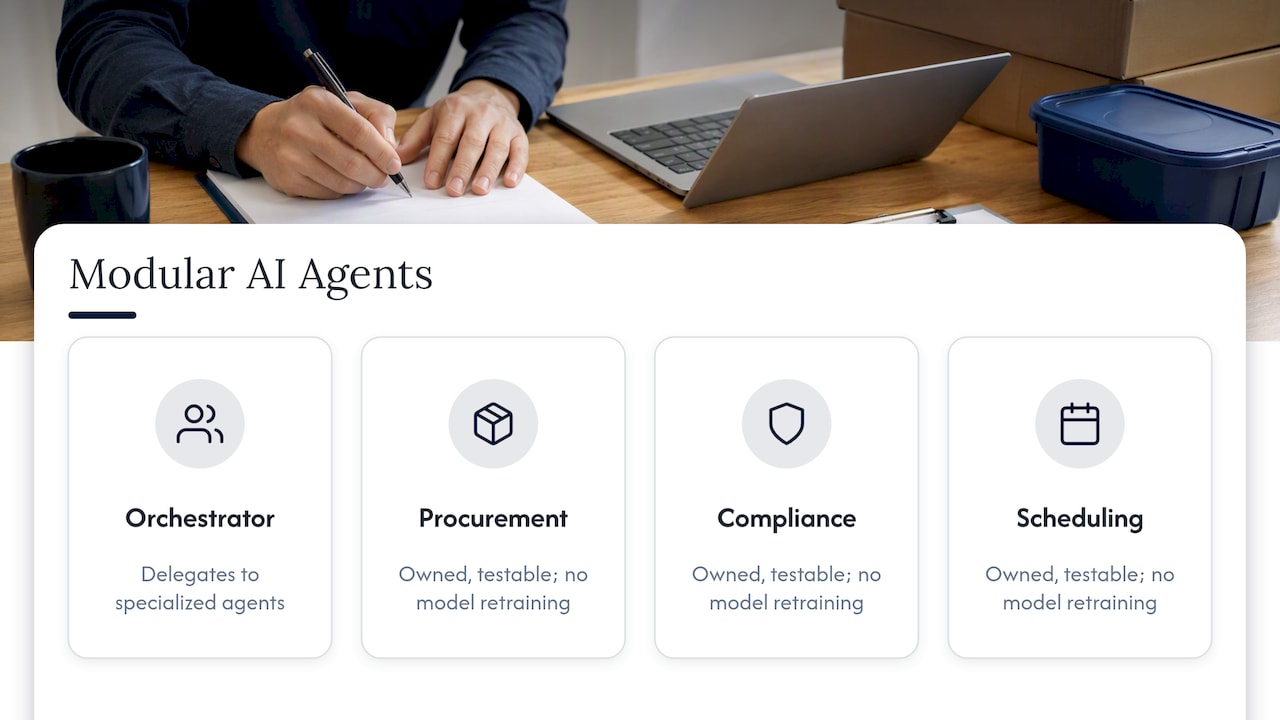
webAI’s Intelligence Delivery Network fits this pattern. It is described as the connective layer that lets intelligence built in one environment run elsewhere, locally, without moving sensitive data. A Persona built by one team can be made available to others while the underlying documents stay where they are.
Keep reasoning flexible and execution deterministic
This is the rule we would put in front of any safety-critical team. Research on agentic engineering analysis from Chalmers University of Technology addresses a familiar problem: automation breaks when tool interfaces and data formats change. The adaptive part, interpreting a request and deciding which tool to call, belongs to the agent. The part that computes, enforces limits or touches a controlled system belongs to verified, hard-coded tools. If the agent drifts, it still cannot cross a safety constraint.
In practice that means a persona may propose a maintenance step, but the system that records the work order or applies a limit is deterministic and checked.
Answers that cite their source
In technical work, an answer without a page reference is a liability. webAI Frontline is built around cited answers: it turns the documentation you own into an expert on an iPad, with cited answers from large technical libraries, fully offline. webAI reports an airline maintenance pilot in which a task that took about 16 hours of manual search per engine change dropped to about 20 minutes. That is a vendor-reported pilot, not a promise for your documents, so measure it on your own library before you plan around it.
For a technician at a hangar door or a remote plant with no signal, the value is simple: ask the manual, get the answer and the page, and no document leaves the device.

A conversational interface that people actually use
Security that people avoid is not security. The local-LLM governance paper above argues for an anthropomorphic user experience: a conversational, agent-based interface rather than a command line. The point is to improve adoption of secure, air-gapped systems while keeping a strict zero-trust posture. Persona design, meaning name, role, tone and a clear sense of what it covers, is part of the security architecture, not decoration.
Governing personas: a practical NIST-aligned approach
Personas are AI systems, so they inherit AI risk. The most widely used US reference is the NIST AI Risk Management Framework. NIST’s Generative AI Profile, AI 600-1, published in July 2024, adapts the framework to generative AI, identifies 12 risk areas specific to it and maps more than 400 suggested actions to the Govern, Map, Measure and Manage functions.
Here is how those four functions translate to a persona program:
- Govern. Name an owner for each persona. Define what data it may read, what actions it may request and who approves changes.
- Map. Document the persona’s purpose, users, data sources and failure modes before launch. Inventory models and data, not just applications.
- Measure. Build a test set of real questions with known answers. Track accuracy, refusal behavior and source citation quality over time.
- Manage. Set monitoring, rollback and incident procedures. Retire personas that no longer earn their place.
One published perspective on operationalizing the NIST AI RMF for LLMs goes further, describing implementable controls and evidence artifacts for each function, including policy maps and model and data inventories. For a step-by-step version, see our six steps to operationalize NIST AI risk management.
On the security side, Europe’s cybersecurity agency ENISA argues that securing domain-specific AI takes a holistic approach across standardization, development, deployment and operation. It also recommends an assume-breached mindset for agentic endpoints, treating them as new attack surfaces that need real-time detection and segmentation. ENISA is an EU body, so treat it as a strong reference rather than a US requirement. Its advice still maps well onto a runtime zero-trust design, which we cover in mapping NIST and OWASP into runtime zero trust for AI.
A deployment checklist for your first persona
Start with one persona, one team and one document library. A sequence that works:
- Pick a job with clear stakes and clear sources. Maintenance lookups, policy questions or procurement checks beat open-ended brainstorming.
- Classify the data. Decide which documents are in scope and which are not, before ingestion.
- Choose the environment. Data center, edge device or air-gapped network, based on where the work happens and what the data requires.
- Define the boundary of action. List what the persona can answer, what it can request and what must go through deterministic tools or a human.
- Build the evaluation set. Collect 50 to 100 real questions with approved answers from the people who do the job. Test against them before and after every change.
- Plan provenance. Know where every model and dependency came from. Our note on AI supply chain security covers provenance first.
- Prepare incident response. Decide in advance how you would detect and contain a misbehaving persona. See our three-stage AI incident response playbook.
- Run it, then operate it. Models, documents and policies change. Someone has to own tuning, updates and monitoring after launch day.
If you handle protected health information, the compliance layer adds steps. Our HIPAA AI compliance guide covers procurement through deployment.
Our perspective
We see the same pattern in nearly every conversation with a regulated organization. The pilot works on a laptop with a cloud model, then stalls when security asks where the documents went. The persona was never the hard part. The perimeter was.
So we start from the perimeter. At Forge, our leadership brings more than 20 years in high-consequence and Fortune 100 environments, and that shapes how we work: operational discipline first, tooling second. We are an official webAI systems integrator. The platform, including Personas, the Intelligence Delivery Network and Frontline, is webAI’s. Our job is to bring it into production inside your infrastructure and keep it running: architecture, secure deployment, model integration and ongoing operation.
Three convictions guide the work. First, narrow personas beat broad ones, because you can test and own them. Second, anything that can cause harm should be executed by deterministic, verified tooling, not by a model’s judgment. Third, a deployment is not done at go-live. It is done when someone is accountable for it in month eighteen.
We design deployments so that all data, models and domain intelligence remain inside your infrastructure, validated for privacy and auditability. That is the standard we hold ourselves to.
— John Ezzell, Founder
How Forge deploys personas for your organization
Forge AI Deployment designs, deploys and operates private AI systems inside infrastructure you control, whether that is an enterprise data center, an edge site or an air-gapped network. For personas, that typically means:
- private and air-gapped deployment of webAI’s local-first platform;
- domain-specific webAI Personas built around your roles and document libraries;
- the Intelligence Delivery Network to connect Personas across teams and sites without centralizing sensitive data;
- webAI Frontline for fast, source-backed answers from large technical libraries, fully offline on a single device;
- model integration, sovereign MLOps and runtime orchestration, performance tuning and ongoing operations.
Engagements are scoped to your environment, and we do not publish prices. You can see the full service list on our solutions page, read how the platform fits in on the webAI partnership page, or start from the Forge AI Deployment home page.
Common mistakes to avoid
- Building a persona for everything. Breadth makes testing impossible. Start narrow.
- Skipping the evaluation set. Without known answers, you cannot tell improvement from drift.
- Letting the agent execute critical actions. Keep enforcement in deterministic tools.
- Treating the interface as an afterthought. If staff find the secure tool awkward, they will use an insecure one.
- Forgetting operations. Persona knowledge goes stale as procedures change. Budget for upkeep. Our overview of NIST-aligned private LLM deployment covers runtime policy enforcement.
FAQ
What is the difference between an AI persona and a generic chatbot?
A persona is scoped to a role, workflow or domain and grounded in your own knowledge. A generic chatbot answers broadly from general training. The narrower scope makes a persona easier to test, govern and trust for specialized work.
Can domain-specific personas run fully offline?
Yes, when the platform is built for it. webAI Frontline, for example, is designed to give cited answers from technical libraries fully offline on a single device. Air-gapped networks need extra planning for how models and updates are imported and verified.
Do domain-specific agents need retraining whenever the business changes?
Not necessarily. In a modular design, an orchestrator delegates to specialized agents, so you can add or change one function without retraining a central foundation model. Your documents and test sets still need regular updating.
Which framework should I use to govern personas in the US?
The NIST AI Risk Management Framework and its Generative AI Profile are the common starting point. Your sector may add its own requirements, so confirm with your compliance and legal teams.
Sources
- webAI Intelligence Delivery Network
- webAI Frontline
- Agentic Systems: A Guide to Transforming Industries with Vertical AI Agents
- Mitigating Data Leakage in High-Compliance Environments: A Governance Framework for Local-LLM Adoption
- Plataine: why agentic AI is transforming aerospace and defense manufacturing planning
- DUCTILE: Agentic LLM Orchestration of Engineering Analysis (Chalmers)
- NIST Generative AI Profile (AI 600-1)
- Operationalizing NIST AI RMF for LLMs
- ENISA view on cybersecurity in the frontier AI era