AI can touch protected health information under HIPAA, but only when the deployment earns it. That means a documented Privacy Rule basis for the use, business associate agreements that explicitly cover the AI workflow, Security Rule safeguards across the entire data path, and a live inventory paired with an incident plan. HHS’s proposed Security Rule update raises the bar further, expecting covered entities to inventory every technology, including AI, that touches electronic PHI.
TL;DR:
- HIPAA compliance for AI requires explicit contractual safeguards, such as a detailed business associate agreement, covering data use, destruction, and subcontractor flow-downs.
- Organizations must maintain a comprehensive inventory of all AI systems touching ePHI, including embedded features and third-party plug-ins, with ongoing risk analysis and mitigation documentation.
- Technical safeguards include encryption of prompts and outputs, role-based access controls, full interaction logging, environment separation, and verification of API data flows before deployment.
- AI-related breach scenarios, such as prompt leaks, log exposure, and model inversion, demand tailored incident response plans aligned with HIPAA breach notification procedures.
- Deployments should include thorough vendor and subcontractor validation, documented risk assessments, and controlled, possibly air-gapped, environments to ensure compliance and reduce third-party risks.
Table of Contents
- What HIPAA AI Compliance Actually Requires: A Quick Checklist
- How HIPAA Applies to AI Workflows
- Technical Safeguards Across the AI Data Path
- Governance, Risk Analysis, and Inventories
- BAAs and Vendor Flow-Down Obligations
- De-Identification vs. Training Data: Where the Line Sits
- Incident Response and Breach Notification for AI Systems
- Procurement-to-Production Checklist for AI Deployments
- Where Sovereign, Air-Gapped Deployment Fits the Compliance Picture
- Governance Beats Speed in AI Deployment
- How Forge AI Deployment Supports a Defensible AI Deployment
- Sources
- FAQ
What HIPAA AI Compliance Actually Requires: A Quick Checklist
Before you sign a vendor contract or push a model to production, run through this list. Skipping any item is how organizations end up explaining themselves to the HHS Office for Civil Rights after the fact.
- BAA coverage: Confirm the business associate agreement names the specific AI tool and includes clauses on training data use, subcontractor flow-down, and destruction of model artifacts, not just “services generally.”
- Technology inventory: List every AI instance that creates, receives, maintains, or transmits ePHI, including embedded features inside EHR platforms and third-party plug-ins staff may not realize touch patient data.
- Risk analysis and mitigation backlog: Document threats specific to the AI system (prompt injection, model drift, output leakage) alongside your standard Security Rule risk analysis, and track open remediation items.
- Technical safeguards from vendors: Require encryption in transit and at rest, role-based access, and audit logging as contract terms, not assumed defaults.
- Pre-go-live validation: Test the system in your actual environment before production, and assign a named person to monitor outputs and access logs on an ongoing basis.
Each of these gets more detail below, but this is the list a privacy officer should be able to check off from memory during an audit.
How HIPAA Applies to AI Workflows
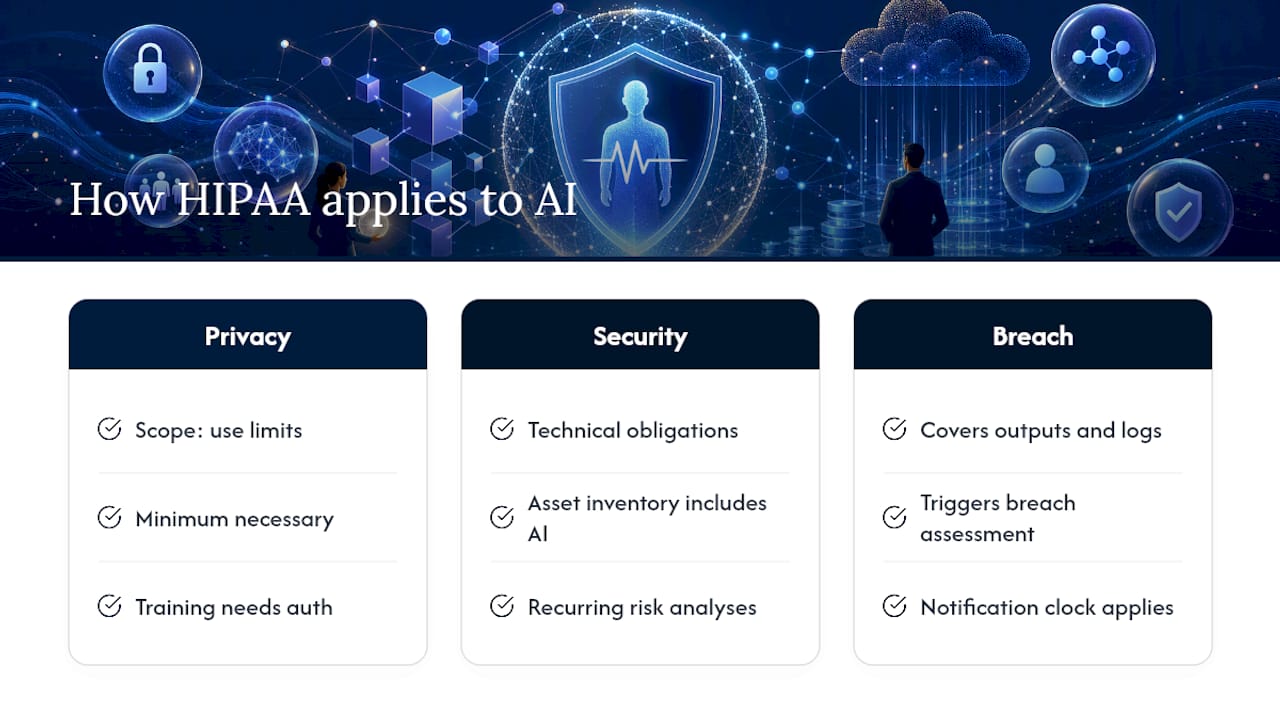
HIPAA does not have a separate “AI rule.” Instead, the Privacy Rule, Security Rule, and Breach Notification Rule apply the moment an AI system creates, receives, maintains, or transmits protected health information, exactly as they would for any other system. That trigger point matters because it means “HIPAA compliant AI” is not something a vendor can slap on a product label. It’s a property of how you deploy and govern that specific instance of the tool.
The Privacy Rule constrains what the AI can actually do with the data. The minimum necessary standard applies: if a clinical documentation assistant only needs a patient’s current visit notes, it should not have standing access to the entire longitudinal record. Using patient data to train or fine-tune a model is a distinct use case from using it to generate a single output, and it typically requires either a valid authorization or a clear fit within a permitted use like healthcare operations, something many organizations get wrong when they assume any internal AI project automatically qualifies.
The Security Rule is where most of the technical obligations live, and it’s also where the ground is shifting. HHS’s proposed Security Rule update from January 2025 would require covered entities to maintain a technology asset inventory that explicitly captures AI systems interacting with ePHI, and to conduct risk analyses on a defined, recurring schedule rather than treating it as a one-time exercise. Organizations that already run tight inventories and annual risk analyses are simply extending existing practice to a new category of system. Those that don’t have this in place face a heavier lift than they expect.
The Breach Notification Rule applies to AI outputs and logs the same way it applies to any other ePHI. A misconfigured prompt log that exposes patient identifiers, or a model that inadvertently surfaces one patient’s data in another user’s session, triggers the same breach risk assessment and notification clock as a stolen laptop. Treating AI-generated logs as somehow exempt from breach analysis is a mistake that shows up repeatedly in vendor risk assessments.
Technical Safeguards Across the AI Data Path
Every point where data enters, moves through, or exits an AI system is a place where the Security Rule’s technical safeguards apply. Mapping the full data path, not just the model itself, is what separates a defensible deployment from a vulnerable one.
Encryption has to cover more than the obvious. Prompts, model outputs, and training datasets need encryption both in transit and at rest, and that includes intermediate storage like cached embeddings or vector databases that many teams forget to inventory. A model artifact sitting unencrypted on a shared drive is just as exposed as an unencrypted database of patient records.
Access has to be role-based and genuinely least-privilege, not just password-protected. That means separating who can query the model from who can view raw logs, from who can modify the model or its configuration. A developer with production access to fine-tune a model shouldn’t automatically have standing access to the underlying PHI used to train it.
Audit logs need to capture the full interaction, not just system uptime. That means logging prompts, outputs, and administrative actions like configuration changes or access grants, with retention that meets your organization’s documented schedule and immutability that prevents tampering after the fact.
Environment separation matters more with AI than with traditional software because model updates happen more frequently and less predictably. Development and testing environments should never touch production PHI, and any patch or model update needs a documented rollback path before it reaches the live system.
API calls to external inference services deserve particular scrutiny. Many consumer-facing AI APIs are not covered by a BAA, and sending PHI to a public inference tier, even accidentally through a poorly configured integration, is a breach waiting to happen. HHS’s cloud computing guidance makes clear that cloud and API-based AI tools are permissible only when covered by an appropriate BAA and backed by a documented risk analysis.
Pro Tip: Ask any AI vendor for a data flow diagram before signing anything. If they can’t show you exactly where prompts, outputs, and logs travel and where they’re stored, you can’t verify the safeguards you’re contractually requiring.
- Encrypt data in transit and at rest, including cached and intermediate storage
- Enforce role-based, least-privilege access separately for querying, viewing logs, and modifying models
- Log every prompt, output, and administrative action with immutable, scheduled retention
- Keep development and testing environments fully separate from production PHI
- Block PHI from reaching any inference API or subcontractor tier not covered by a BAA
Governance, Risk Analysis, and Inventories
A technology inventory is the foundation everything else builds on, and it needs to name every AI system touching ePHI specifically, not describe them in general categories. “Clinical documentation software” is not an inventory entry; “Ambient Scribe v4.2, vendor X, covers outpatient encounters, BAA signed March 2026” is.
Once the inventory exists, each entry needs a lifecycle risk analysis, not a one-time checkbox. That means identifying how the system is actually used, what threats are specific to it (model drift, prompt injection, unauthorized retraining), how likely each threat is, what the impact would be, and what mitigations and monitoring are in place. Peer-reviewed analysis of AI chatbots in healthcare settings recommends exactly this kind of lifecycle approach, paired with ongoing human oversight, because static risk assessments quickly go stale as models get updated or repurposed.
Governance can’t sit with one person. An AI governance committee that includes privacy, security, clinical, and IT stakeholders is what turns risk analysis from a paperwork exercise into an actual decision-making process. For higher-risk systems, that committee should run something like a formal impact assessment before deployment, documenting the intended use, oversight design, and mitigation plan for bias, safety, and privacy risks. This kind of documented governance record is exactly what regulators expect to see when they ask how a high-risk decision was made.
The NIST AI Risk Management Framework gives this process a structure that maps cleanly onto HIPAA obligations. Its core functions, govern, map, measure, and manage, correspond almost directly to what a Security Rule risk analysis already asks for, and using the framework’s vocabulary in your documentation makes it easier to answer OCR inquiries because you’re speaking a language regulators already recognize.
None of this is optional under the direction HHS is heading. The proposed Security Rule update signals that “we didn’t know AI was touching PHI” will not be an acceptable answer during an investigation.
BAAs and Vendor Flow-Down Obligations
A BAA is required any time a vendor’s AI system creates, receives, maintains, or transmits PHI on your behalf, full stop. That includes AI features bundled into software you already use, which is where organizations most often get caught. An EHR add-on that summarizes visit notes using a third-party language model needs its own BAA coverage or explicit inclusion in the platform’s existing agreement, not an assumption that it’s already covered.
The flow-down obligation is where a lot of contracts fail. If your AI vendor uses a subcontractor for inference, hosting, or fine-tuning, that subcontractor needs its own BAA with terms at least as protective as the one you signed. Legal analysis of AI integration in healthcare points out that using PHI to train a model without explicit contractual permission is often impermissible, even when the vendor’s general BAA covers standard processing, because model training is a functionally different use of the data.
Your BAA language needs to address, specifically:
- Whether PHI can be used to train or fine-tune models, and under what conditions
- The exact de-identification method used if training is permitted on de-identified data
- Data destruction procedures that explicitly cover model artifacts and embeddings, not just source files
- Breach notification timelines that meet or align with your organization’s own regulatory requirements
Beyond the signed contract, verify vendor claims annually. Written attestations, SOC 2 or ISO 27001 reports where available, and audit evidence give you something concrete to point to if OCR asks how you validated a vendor’s security posture. HHS’s sample BAA provisions are a useful baseline, but AI relationships need language those templates don’t fully anticipate. Build in termination rights tied specifically to noncompliance with these AI clauses, not just general contract breach.
De-Identification vs. Training Data: Where the Line Sits
De-identified data isn’t PHI, and that distinction is what determines whether you need HIPAA safeguards at all for a given training dataset. Under 45 CFR § 164.514, there are two paths: Safe Harbor, which requires removing 18 specific identifier categories, and Expert Determination, where a qualified statistician certifies that re-identification risk is very small using accepted methods.
For model training specifically, Safe Harbor is often too blunt an instrument. Free-text clinical notes routinely contain identifiers scattered throughout sentences, and naive redaction can miss context clues that still make re-identification possible. Expert Determination tends to fit large-scale training datasets better because it accounts for the specific risk profile of how the data will be used and shared.
Even properly de-identified data isn’t risk-free once it feeds a model. Differential privacy techniques add mathematical noise during training to prevent the model from memorizing and later regurgitating specific patient details. Data minimization limits training sets to only what’s needed for the task. Synthetic data generation avoids the re-identification question by never using real patient records at all, though it needs its own validation to confirm it doesn’t leak patterns from the source data it was derived from.
Whatever method you choose, document it. If an auditor asks how a training dataset was de-identified, “we used a vendor’s standard process” is not an answer. You need the specific method, who certified it, and when.
Incident Response and Breach Notification for AI Systems
AI introduces breach scenarios that traditional incident response plans don’t always anticipate. Prompt leaks happen when a system exposes one user’s input to another. Inference log exposure happens when logging systems store PHI-laden prompts without the same access controls as the primary application. Model inversion, where an attacker reconstructs training data from a model’s outputs, is a newer risk category that most existing incident playbooks simply don’t cover.
When something happens, the immediate containment steps look familiar: suspend the model or API access, revoke compromised credentials, and preserve logs and system images before anyone starts troubleshooting. The instinct to fix the problem fast can destroy the evidence you need for the breach risk assessment.
From there, run the standard HIPAA breach risk assessment: what data was involved, who accessed or could have accessed it, was it actually acquired or viewed, and how has the risk been mitigated. That assessment determines your notification obligations and timing under the Breach Notification Rule, exactly as it would for a non-AI incident.
Close the loop by documenting root cause and remediation, and update your risk analysis to reflect what you learned. If a vendor’s subcontractor caused the exposure, that’s also a contract enforcement moment, not just a technical fix. OCR’s enforcement priorities have consistently focused on organizations that fail to update their risk analysis after an incident, treating each breach as isolated rather than as new information about a systemic gap.
Procurement-to-Production Checklist for AI Deployments
Getting an AI system from vendor pitch to safe production use follows a sequence, and skipping steps is how gaps get baked in permanently.
- Require BAA and security documentation upfront. Don’t let procurement move forward on verbal assurances. Get the BAA, security attestations, and technical architecture documentation before any pilot begins.
- Map subcontractor flow-down explicitly. Ask the vendor to name every subcontractor that will touch PHI and confirm each has an equivalent BAA in place.
- Validate in your own environment before go-live. A model that performs well in a vendor demo may behave differently against your actual data and integration points. Test it there first.
- Build an explainability check into validation. If clinical or administrative staff need to trust the AI’s output, they need some visibility into how it reached a conclusion, even a simplified dashboard showing confidence scores or source citations.
- Assign a named person for ongoing oversight. Someone specific, not “the compliance team” generically, owns monitoring this system’s outputs and access logs.
- Set a patch and update cadence. Model updates need the same change control as any other production system, including a rollback plan.
- Schedule periodic risk reassessment. Annual is a floor, not a ceiling, for high-risk systems that touch large volumes of PHI or make consequential decisions.
- Prioritize by risk and auditability. A system that only summarizes internal notes for a single clinician carries different risk than one making triage recommendations across a patient population. Weight your oversight accordingly.
Where Sovereign, Air-Gapped Deployment Fits the Compliance Picture
Many of the technical safeguards above become simpler to prove when the AI system never leaves infrastructure you control. Air-gapped deployments keep model artifacts, prompts, and training data entirely inside client infrastructure, which eliminates concerns about subcontractor inference tiers and their BAA coverage by avoiding external inference tiers altogether.

Certain technologies allow models to run efficiently without a cloud dependency, which directly addresses environment separation and API exposure concerns covered above. Local hosting under sovereign MLOps orchestration means audit logs, access controls, and encryption live inside infrastructure your security team already governs, rather than depending on a vendor’s own attestations about a system you can’t directly inspect.
This isn’t a substitute for the governance and contract work covered earlier in this guide. Reduced third-party exposure through local deployment doesn’t eliminate the need for a technology inventory, a documented risk analysis, or an internal governance process. It changes which risks are relevant. Organizations evaluating this kind of deployment should still verify vendor claims independently, request documentation of the security architecture, and confirm the approach fits their specific regulatory obligations before treating it as a complete answer.
Governance Beats Speed in AI Deployment
The organizations that get into trouble with AI and HIPAA aren’t usually the ones moving slowly. They’re the ones that let a single department stand up an AI tool without looping in privacy, security, and legal until after it’s already processing patient data.
The most common failure isn’t a missing safeguard. It’s a BAA that vaguely covers “the platform” without naming the specific AI feature, or a subcontractor flow-down that nobody checked because the primary vendor’s sales team said “don’t worry, we’ve got that covered.” Ambiguous contract language is where enforcement risk actually lives, more than any single technical gap.
Multidisciplinary governance sounds like bureaucracy until the first incident, when it becomes the reason you can explain exactly who approved what and why. Build that structure before the pressure to ship arrives, not after.
— John Ezzell, Founder
How Forge Supports a Defensible AI Deployment
Forge is a different route to HIPAA-ready AI than assembling a stack of cloud vendors, BAAs, and subcontractor agreements one by one. Instead of chasing flow-down assurances from every API you connect to, Forge’s secure local and air-gapped deployment keeps model artifacts, prompts, and training data inside your own infrastructure from the start, which removes an entire category of vendor risk this guide walks through above.
Some services map directly onto the checklist in this article: custom model integration and optimization for specific environments, sovereign MLOps and runtime orchestration for patch management and monitoring cadence, and a private AI assistant rollout designed to avoid sending PHI to any public inference tier. For teams that want independent verification before committing, Forge publishes a VPAT accessibility conformance report and documentation on why organizations choose a sovereign deployment approach over conventional cloud AI. If you’re evaluating an AI deployment against the requirements in this guide, request a security brief from Forge and walk through your specific compliance gaps before you sign anything.
Sources
Keep these on hand for audits and vendor reviews: HHS OCR guidance, the Security Rule NPRM in the Federal Register, the NIST AI Risk Management Framework, and HHS’s sample BAA provisions. Saving these links documents exactly which guidance informed your decisions.
This article is general information, not a substitute for advice from a qualified doctor. Consult a qualified healthcare professional about your own circumstances before acting on anything here.
- HHS Office for Civil Rights (OCR)
- NIST — AI Risk Management Framework
- AI Chatbots and Challenges of HIPAA Compliance for AI Developers and Vendors (PMC)
- Vanderbilt Law — AI integration and regulatory compliance in healthcare
FAQ
Is there a HIPAA-compliant AI tool?
No single AI tool is inherently “HIPAA compliant” on its own. Compliance depends on the deployment, a signed BAA covering the specific AI workflow, proper safeguards, and documented risk analysis, which is why the same underlying model can be compliant in one setup and a liability in another.
What is the 30% rule in AI?
There’s no established “30% rule” recognized under HIPAA or federal AI guidance; this appears to be a misconception or a term specific to another context. Organizations should rely on documented frameworks like the NIST AI RMF and HHS Security Rule requirements rather than informal rules of thumb.
What is the new HIPAA rule for AI in 2026?
There is no finalized HIPAA rule specific to AI as of 2026. HHS proposed a Security Rule update in January 2025 that would require inventorying technology assets, including AI systems, and conducting more rigorous, recurring risk analyses, but organizations should track the rule’s final status rather than assume it’s already in force.
Is AI prohibited in all forms under HIPAA?
No, HIPAA does not prohibit AI. It requires that any AI system creating, receiving, maintaining, or transmitting PHI operate under the same Privacy Rule, Security Rule, and Breach Notification Rule obligations as any other technology, backed by a BAA and appropriate safeguards.
Do I need a separate BAA for an AI feature built into my existing software?
Yes, if that AI feature processes PHI using a different vendor, model, or subcontractor than your existing agreement covers. Many embedded AI features rely on third-party models that aren’t automatically included in your platform’s original business associate agreement.