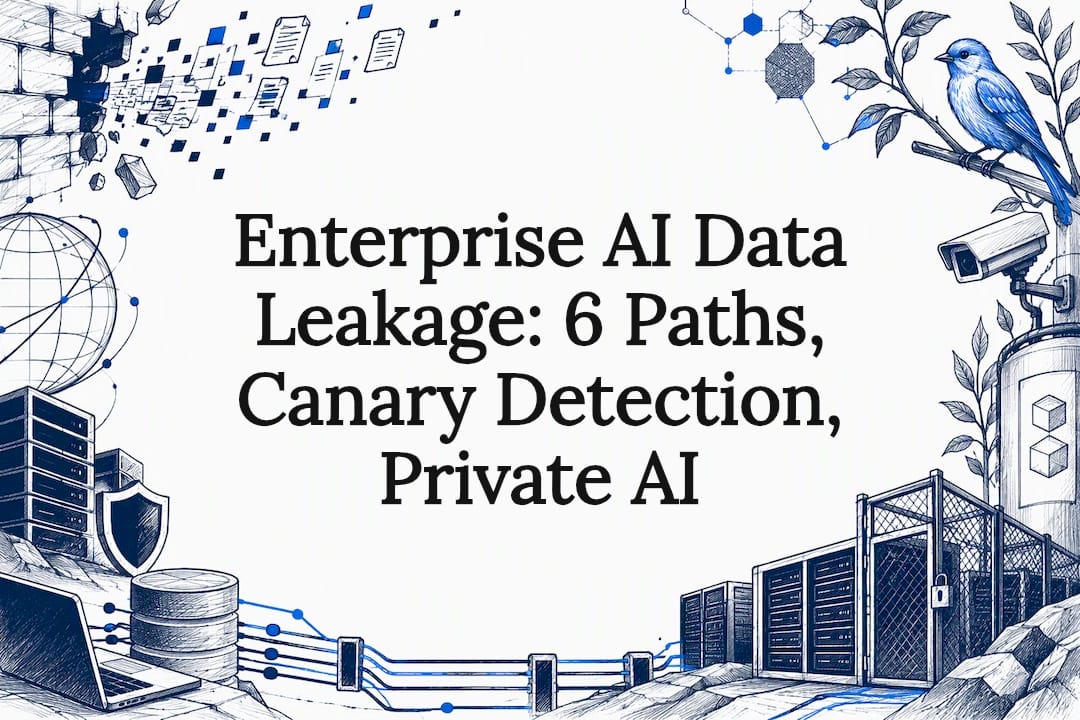
Preventing AI data leakage requires a layered program: minimize and sanitize data before it ever reaches a model, enforce runtime guardrails that treat every input and output as untrusted, lock down third-party persistence through contracts and architecture, and monitor continuously with canary tokens and telemetry. Guidance from NIST and OWASP converges on this same structure, and for the most sensitive workloads, private deployment through a partner like Forge AI Deployment removes third-party exposure entirely.
TL;DR:
- Classify data across databases, file shares, and vector stores, then mask, redact, or tokenize sensitive fields before ingestion; embeddings remain sensitive.
- Keep authorization outside the model: system prompts can be leaked or bypassed, and retrieved documents must be treated as untrusted input.
- For hosted models, ban vendor training on customer data and require either zero storage or a stated deletion deadline; use private endpoints for regulated workloads.
- Run canary scans continuously, route alerts into SOC workflows for rapid action, and rehearse leakage response with prompt injection, memory poisoning, and retrieval tampering tests.
Table of Contents
- AI-era leakage vectors and what assets are at risk
- Pre-ingest and data hygiene controls: discovery, minimization, sanitization, and access
- Runtime protections for LLMs and agents: I/O filtering, memory controls, and detection
- Safe use of third-party model endpoints and cloud AI
- Operationalizing DLP&D for AI: monitoring, SOC integration, playbooks, and testing
- Forge’s practical option: private, sovereign AI deployments and operational guarantees
- Author perspective: priorities for CISOs operating AI at scale
- How to engage Forge for an assessment and sovereign deployment
- FAQ
- Sources
AI-era leakage vectors and what assets are at risk
Generative AI did not invent data leakage, but it multiplied the paths it can travel. A single chatbot integration now touches session data, training corpora, vector embeddings, and model artifacts, each with its own failure mode.
Security teams building a defense need to account for the full range of exposure points, not just the obvious ones:
- Prompt exfiltration, where a user crafts input designed to extract system instructions or prior context from an LLM session.
- Model memorization, where training data resurfaces verbatim in outputs, a known risk flagged in OWASP’s sensitive information disclosure guidance.
- RAG retrieval leakage, where a retrieval-augmented generation pipeline pulls restricted documents into a response the requester should never see.
- Agent and tool egress, where an autonomous agent with API or file access moves data outside its intended boundary.
- Memory poisoning, where persisted conversation memory is manipulated to leak information to a later session or user.
- Supply-chain pivot, where a compromised plugin, connector, or third-party model endpoint becomes a route into adjacent systems.
What makes this moment different is speed. ENISA’s analysis of cybersecurity in the frontier AI era finds that AI compresses the attacker lifecycle, shrinking the window between initial access and data exfiltration. That compression pushes security operations centers toward near-real-time detection and automated response, because mean time to detect and mean time to respond that worked against human-paced attackers no longer hold against AI-assisted ones.
The assets worth protecting fall into four buckets: live session data moving through prompts and responses, the training datasets used to fine-tune or ground a model, the embeddings stored in vector databases, and the model artifacts and weights themselves. Each needs a different control, which is why a single tool rarely covers the whole surface.
Pre-ingest and data hygiene controls: discovery, minimization, sanitization, and access
Most leakage incidents trace back to a decision made long before any prompt was typed: what data was allowed to reach the pipeline in the first place. Pre-ingest controls are where prevention is cheapest and most durable.
- Run automated discovery and classification across structured databases, file shares, and vector stores to find sensitive data before it gets pulled into any AI workflow.
- Apply data minimization by deciding, use case by use case, what data a model actually needs rather than what is simply available.
- Sanitize before ingestion using masking, redaction, tokenization, and schema validation so sensitive fields never reach training or retrieval pipelines in raw form.
- Enforce least privilege and role-based access control on every corpus feeding an AI system, paired with encryption at rest and in transit.
- Segment storage so high-sensitivity corpora sit in isolated environments rather than shared data lakes accessible to every downstream AI job.
- Automate the transformation pipeline so sanitization happens as a mandatory step, not a manual review someone can skip under deadline pressure.
Microsoft’s guidance on preventing data leaks to shadow AI makes a point worth repeating here: a large share of exposure comes from unsanctioned AI tools employees adopt on their own, often because sanctioned options feel slower or more restrictive. Discovery of these shadow AI apps, and governance over what data flows into them, has to run alongside formal pipeline controls, not after them.
Sanitization deserves a closer look because teams often treat it as a single step when it is really three. Masking swaps sensitive values for realistic but fake equivalents, useful for development and testing environments. Redaction removes sensitive fields outright, appropriate when a field has no analytical value for the model’s task. Tokenization replaces sensitive values with reversible tokens, useful when a downstream process legitimately needs the original value restored under controlled conditions. Schema validation then checks that whatever reaches the model matches an expected structure, catching the cases where a sanitization rule missed a field.
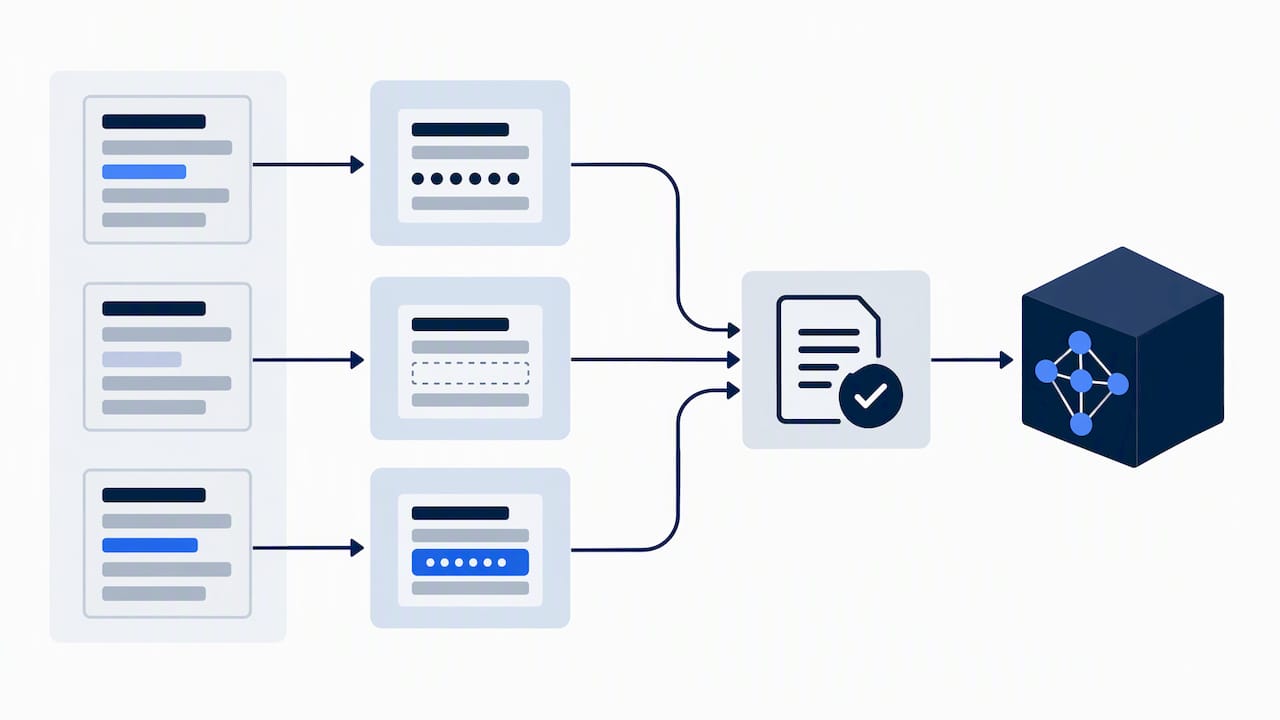
For retrieval-augmented generation specifically, the same discipline applies to vector stores. An embedding derived from a sensitive document is still sensitive, even though it looks like a string of numbers, and a vector database without access controls is functionally an unguarded copy of whatever it indexed.
Pro Tip: Build sanitization into the data pipeline as a gate the data cannot bypass, not a checklist item a data scientist runs manually before a deadline.
Runtime protections for LLMs and agents: I/O filtering, memory controls, and detection
Pre-ingest controls reduce what can leak. Runtime controls reduce what gets through once a model is live and answering real requests. The starting principle, stated plainly in OWASP’s guidance on system prompt leakage, is that system prompts and model steering are not security controls. A system prompt can be leaked, bypassed, or manipulated, so critical authorization and access decisions must be enforced outside the model, in deterministic code the model cannot talk its way around.
From there, several practices reduce runtime exposure:
- Treat all input as untrusted, including documents retrieved by a RAG pipeline, and sanitize that content before it enters a prompt.
- Enforce structured outputs and schema validation so a model cannot return arbitrary free text where a constrained, machine-checked format would do.
- Deploy canary tokens and data fingerprinting inside sensitive datasets, so a token appearing in an unexpected output or external channel signals an exfiltration attempt before damage compounds, a technique FINOS’s AI governance framework recommends as a repeatable detection method.
- Isolate and expire persisted memory so conversation history does not silently accumulate sensitive context across sessions, and audit what memory stores actually retain.
- Instrument everything: structured logging, anomaly detection on prompt and output patterns, and alert thresholds tuned to catch deviations fast.
That last point matters because of timing. AI-era attacks compress the time between access and exfiltration, according to ENISA’s frontier AI cybersecurity assessment, which means detection systems tuned for human-paced intrusions will catch an AI-assisted one too late. Canaries and fingerprints only help if the scan for them runs continuously, not on a weekly batch job.
Safe use of third-party model endpoints and cloud AI
Every enterprise using a hosted model or cloud AI service is extending trust to a vendor’s infrastructure, and that trust needs boundaries written into contracts and architecture, not assumed from a privacy page.
A few controls carry the most weight:
- Require zero or time-bound data persistence in vendor contracts, and explicitly prohibit the vendor from training on customer data.
- Prefer private endpoints, dedicated clusters, or VPC-isolated deployments for any workload touching regulated or high-sensitivity data, rather than shared multi-tenant infrastructure.
- Control access to vector stores the same way you control access to the databases they were built from, with authentication and row-level permissions, not open retrieval.
- Vet retrieval sources and sanitize retrieved passages before they reach a prompt, since OWASP’s sensitive information disclosure guidance treats RAG as a supply-chain-like risk where any indexed document is a potential attack vector.
Deciding when a private or air-gapped deployment is warranted usually comes down to three signals: a regulatory requirement for data residency or auditability, intellectual property sensitive enough that any third-party exposure is unacceptable, or a compliance regime that demands proof every data touchpoint stayed inside a defined boundary. Background on shadow AI adoption patterns from OmniPulse’s analysis of shadow AI risks is a useful read for teams still mapping how much unsanctioned third-party exposure already exists inside their organization.
Operationalizing DLP&D for AI: monitoring, SOC integration, playbooks, and testing
Controls without an operating model decay. Turning prevention into a program means treating AI data loss prevention and detection the way mature SOCs treat any other high-priority risk category, with metrics, playbooks, and recurring tests.
- Feed AI telemetry into existing SOC tooling and automate as much of the triage as possible, since ENISA’s guidance on AI-speed threats ties faster detection and response directly to automation maturity.
- Write a specific playbook for suspected model leakage, covering immediate containment, a canary token scan, quarantine of the affected retrieval store, and forensic review of the prompts involved.
- Red-team the system regularly with prompt-injection attempts, memory-poisoning simulations, and RAG tampering tests, rather than relying on a one-time launch review.
- Classify AI assets by impact and maintain a risk register that tracks which models, datasets, and pipelines carry the highest consequence if compromised.
FINOS’s AI governance framework frames this as defense-in-depth applied across the full data lifecycle: minimization, sanitization, runtime filtering, and continuous monitoring, backed by strong third-party risk management rather than any single control carrying the whole burden. Operational maturity also means assuming breach rather than waiting for one. A canary token program only earns its keep when alerts route to someone who acts on them within minutes, not when a report surfaces the match during a quarterly review.
Pro Tip: Run a tabletop exercise for AI-specific leakage at least twice a year, since the playbook steps for a leaked model differ enough from a standard data breach that teams need the rehearsal.
Forge’s practical option: private, sovereign AI deployments and operational guarantees
For organizations where a regulatory mandate, IP sensitivity, or audit requirement rules out any third-party data exposure, private deployment removes the persistence question entirely: data that never leaves the client’s environment cannot be retained by a vendor, trained into a shared model, or exposed through a multi-tenant breach.
We design, deploy, and operate sovereign AI systems inside infrastructure controlled by the client, including enterprise data centers, edge sites, and air-gapped networks. We bring webAI’s local-first platform into production, offering private and air-gapped deployment, domain-specific webAI Personas, the Intelligence Delivery Network, and webAI Frontline, which provides frontline teams with fast, source-backed answers from large technical document libraries fully offline on a single device. Our leadership brings extensive experience in high-consequence and Fortune 100 environments, which shapes how we build auditability into every deployment rather than treating it as an afterthought.
Teams evaluating a private deployment path can review our solutions page or read more about deployment postures for regulated enterprises building private AI assistants.
Author perspective: priorities for CISOs operating AI at scale
Three things matter more than the rest right now. First, triage your AI assets by consequence, not by novelty: a marketing chatbot and a clinical decision tool do not belong on the same risk tier. Second, roll out runtime guardrails before you roll out new AI features, not after an incident forces the sequence. Third, build a concrete plan for sovereign deployment wherever regulation or IP sensitivity makes third-party exposure unacceptable, rather than treating it as a someday upgrade.
Innovation speed and data control pull against each other, and governance is the function that keeps that tension from becoming a breach. My steering advice: decide what you cannot afford to leak before you decide what model to adopt.
— John Ezzell, Founder
How to engage Forge for an assessment and sovereign deployment
Getting started follows a straightforward sequence: an assessment of your current data flows and AI use cases, architecture design for the deployment model that fits your risk profile, implementation inside your own infrastructure, and ongoing operational support once the system is live.
If your organization is weighing private or air-gapped AI deployment against continued reliance on third-party endpoints, our solutions page outlines the services involved, from private deployment and custom model integration to sovereign MLOps and performance tuning. Visit Forge AI Deployment to start a conversation about what a sovereign deployment would look like inside your environment.
FAQ
How to prevent AI data leakage?
Preventing AI data leakage takes layered controls: discover and classify sensitive data before it reaches any AI pipeline, sanitize it through masking or tokenization, enforce runtime guardrails that treat model inputs and outputs as untrusted, and monitor continuously with canary tokens and fingerprinting, as outlined in FINOS’s AI governance guidance. For the highest-sensitivity data, private or air-gapped deployment removes third-party persistence risk entirely.
How can data leakage be prevented?
Data leakage prevention generally combines data minimization, access controls, encryption, and continuous monitoring across the full data lifecycle. In AI systems specifically, this extends to sanitizing training and retrieval data and treating every model output as a potential disclosure point, per OWASP’s sensitive information disclosure guidance.
What is the 30% rule for AI?
Definitions of this kind circulate informally online, but readers should rely on documented frameworks like NIST’s COSAiS control overlays rather than an unverified rule of thumb.
Can AI leak your data?
Yes: AI systems can expose sensitive data through model memorization, prompt-based exfiltration, unauthorized API access, or shadow AI tools employees adopt without IT oversight, as detailed in Microsoft’s shadow AI guidance. Layered controls across data handling, runtime filtering, and third-party management reduce this risk substantially.
Sources
- Prevent data leak to shadow AI | Microsoft Learn
- FINOS — AI data leakage prevention and detection
- ENISA view on cybersecurity in the frontier AI era
- OWASP LLM06: Sensitive information disclosure