A private AI assistant is a sovereign on-premise AI system deployed so that data, models, and audit logs never leave your control. It fits your organization if you face a regulatory ban on third-party APIs, handle data too sensitive for any external processor or need to reconstruct exactly how the assistant reached a decision months later. If none of those apply, a managed cloud service may serve you fine. The sections below cover topology, governance, and cost so you can decide with evidence, not guesswork.
TL;DR:
- The deployment topology must be matched to specific regulatory requirements, with on-premises and air-gapped options offering the highest data control.
- Keeping data fully local involves local model hosting, a private vector store without internet access, and strict network egress controls, verified through traffic capture and exfiltration testing.
- Regulatory audits demand detailed evidence such as cryptographically pinned models, complete dependency documentation, operator-specific logs, and integration into security information and event management systems.
- Air-gapped assistants require signed artifacts, dual-authorization for transfers, and staged updates, which extend patching timelines but significantly reduce exfiltration risks.
- Choosing a private assistant hinges on data sensitivity and legal obligations, with hybrid approaches often providing a balance between security and operational flexibility.
Table of Contents
- Which Deployment Topology Fits a Private AI Assistant?
- How Do You Keep the Data Path Fully Local?
- What Governance and Audit Evidence Do Regulators Expect?
- How Do Air-Gapped Assistants Handle Updates?
- How Should Identity and Access Work Inside the AI Perimeter?
- What Does a Private AI Assistant Cost and How Long Does It Take?
- How Does an Integrator Actually Deliver a Sovereign Assistant?
- When Should You Choose a Private Assistant Over Alternatives?
- Get a Readiness Assessment for Your Sovereign Deployment
- Sources
- FAQ
Which Deployment Topology Fits a Private AI Assistant?
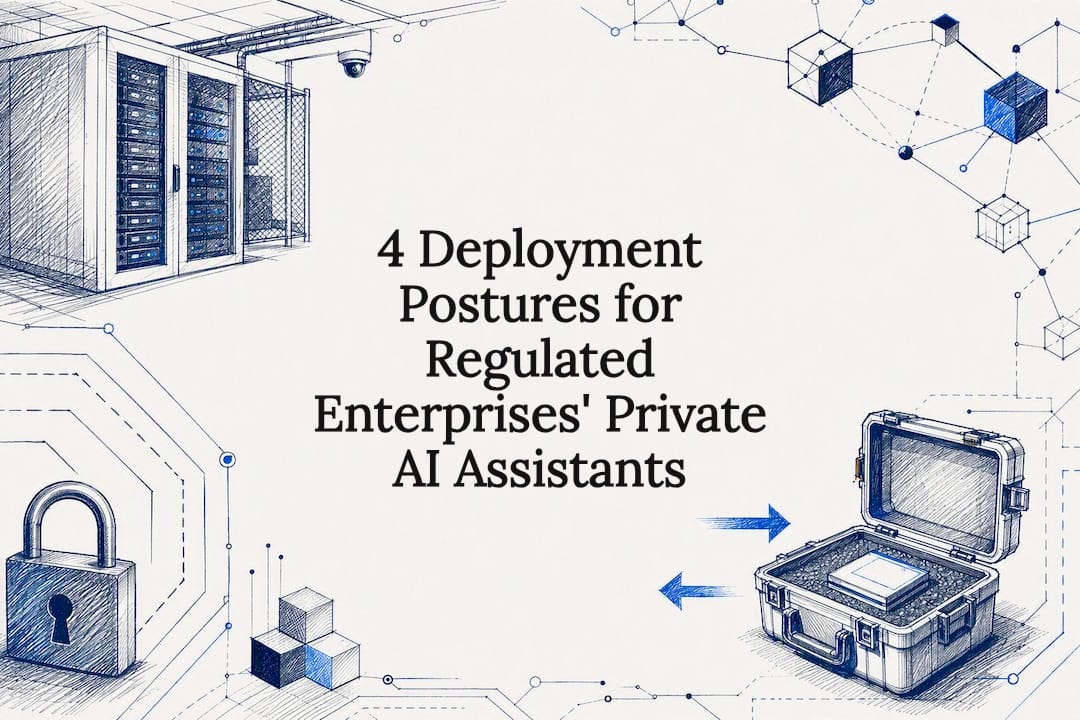
Four postures cover almost every regulated deployment, and picking the wrong one either overspends your budget or underprotects your data.
- On-premises: hardware lives in your data center, under your operational staff, with no dependency on outside connectivity.
- Private or sovereign cloud: dedicated infrastructure inside a cloud provider’s region, still under contractual and jurisdictional guarantees that data stays put.
- Hybrid estates: sensitive workloads run locally while lower-risk tasks use external compute, with a hard boundary enforced between the two.
- Air-gapped: physically disconnected from any external network, the strictest posture and the one auditors trust most by default.
Jurisdictional mandates, classified data handling, or contractual clauses barring third-party processors usually force you toward air-gapped or strict on-premises setups. Sovereignty in practice means data stays inside, the infrastructure is yours, the operator answers to your jurisdiction, and the system keeps working without any international connectivity, according to Yukon Labs. Hybrid and private cloud options trade some of that rigor for faster updates and lower staffing overhead.
Pro Tip: Don’t default to air-gapped because it sounds safest. Match the posture to your actual regulatory obligation. Over-engineering the topology burns budget you’ll need for governance and operations later.
How Do You Keep the Data Path Fully Local?
Most sovereignty claims fail here, not at the model layer. Teams self-host the language model correctly, then quietly pipe embeddings or retrieval queries through a hosted vector database. That single decision leaks the exact data the deployment was supposed to protect, a failure mode Yukon Labs flags as one of the most common on-premise mistakes.
Closing the path takes three architectural moves:
- Run the embedding model locally, next to the language model, not as an external API call.
- Deploy a local vector store inside the same network perimeter, with no outbound route to a hosted retrieval service.
- Enforce egress-deny policies at the network layer and mirror any package registries the system needs, so nothing pulls dependencies from the open internet during operation.
Test for this directly. Run traffic captures during inference, retrieval, and model updates, then confirm zero outbound connections outside your allow list. Attempt a deliberate exfiltration test with fake sensitive data and watch whether anything crosses the boundary.
Pro Tip: Audit your vector database configuration separately from your model hosting. Teams pass model-level security reviews constantly while their retrieval layer quietly phones home.

What Governance and Audit Evidence Do Regulators Expect?
Auditors don’t just want a secure system. They want to reconstruct exactly how any given output was produced, which is why pinned models and local logging have become the default expectation rather than a nice-to-have.
Sovereign AI, by definition, keeps compute, models, storage, and logs inside your infrastructure and legal jurisdiction so you can point to where inference happened and produce a record on demand per Lyzr’s enterprise guide. Building that record requires specific artifacts:
- Model version pinning with cryptographic hashes, so you know exactly which weights produced which output.
- An MLBOM (machine learning bill of materials) documenting every model, dataset, and dependency in the pipeline.
- Prompt and response logging mapped to individual operator identities, not shared service accounts.
- Evidence routed into a SIEM or internal evidence store, queryable the same way you’d query any other security log.
Regulators increasingly demand what amounts to supervisory answerability: proof you can reconstruct a decision path on request, not just an assurance that you could. That expectation is reshaping how audit teams scope AI reviews entirely.
How Do Air-Gapped Assistants Handle Updates?
Disconnected infrastructure removes entire categories of exfiltration risk, but it replaces network security with process discipline. Every update has to move by physical or controlled transfer, and every artifact needs a paper trail before it touches production.
- Package model weights and code into signed bundles before transfer, with cryptographic signatures verified on both ends.
- Require two-person authorization for any physical transfer into the air-gapped environment, logged with timestamps and identities.
- Verify each artifact against its MLBOM entry during ingestion, rejecting anything that doesn’t match its expected hash.
- Run verification testing in a staging replica before promoting any update to live systems.
Air-gapped deployments remove classes of exfiltration risk but demand formal transfer procedures and hashed, signed artifacts for every update, as Tianpan’s air-gapped LLM blueprint lays out. The tradeoff shows up in patching cadence. Emergency fixes that would take minutes over the internet can take days when every update needs manual transfer and re-verification.
Pro Tip: Build your emergency patch process before you need it. Discovering your two-person transfer protocol takes six hours during an active vulnerability is the wrong time to learn that.
How Should Identity and Access Work Inside the AI Perimeter?
Every action inside a private AI assistant should trace back to a real, named identity. Shared service accounts and blanket admin access are exactly what turn a well-architected sovereign system into an unauditable black box.
- Integrate model and agent access with your existing directory groups and enforce role-based access control at the API layer, not just the application layer.
- Use workload identity patterns similar to SPIFFE for service-to-service authentication, so machine identities are as traceable as human ones.
- Require just-in-time elevation for any administrative task touching model weights, logs, or configuration, with the elevation itself logged.
- Segment the inference cluster from the rest of the network, limiting lateral movement if any single component is compromised.
Security teams should treat the AI platform as part of the regulated control plane, assigning explicit ownership for model, data, and agent risk rather than treating AI infrastructure as a bolt-on IT project, according to NHIMG’s governance guidance. That framing changes who signs off on changes and how incident response gets scoped.
What Does a Private AI Assistant Cost and How Long Does It Take?
Self-hosted deployments carry higher upfront and operational costs than a hosted subscription. They pay off when data legally cannot leave your environment, regulatory exposure rules out hosted APIs, or inference volume is high enough that owned hardware beats per-call pricing over two to three years, per Yukon Labs.
- Memory, not raw compute, usually drives sizing: model weights plus KV cache and concurrent user load determine your hardware floor.
- Quantization techniques cut memory requirements substantially, which is why running a capable model on-premise needs less hardware than most procurement teams initially budget for.
- Update cadence is a major cost driver. Frequent model refreshes multiply the labor cost of the verification and transfer process described above.
A realistic project runs through readiness assessment, a scoped pilot, signed-artifact deployment and a transition into ongoing sovereign operations, typically spanning several months from kickoff to live production use.
How Does an Integrator Actually Deliver a Sovereign Assistant?
Getting from architecture diagram to a running, auditable assistant is where most internal projects stall. It takes coordinated work across infrastructure, model engineering, and compliance documentation, done in a specific order.
A responsible engagement typically runs through these stages:
- Readiness assessment: mapping your data classification, network topology, and regulatory obligations against deployment options.
- Scoped pilot: a contained deployment proving the architecture before full rollout, using signed-artifact processes from day one rather than retrofitting them later.
- Production deployment: full integration into your existing infrastructure and identity systems.
- Sovereign MLOps support: ongoing operations covering updates, monitoring, and performance tuning after go-live.
Forge AI Deployment builds air-gapped deployments where data, models, and domain intelligence stay inside client infrastructure throughout that process, using Entropy-Weighted Quantization to keep hardware requirements lower without sending anything to the cloud. A responsible integrator hands you the audit trail alongside the deployment itself: signed model hashes, a complete MLBOM, prompt and response logs mapped to operators, and documentation your compliance team can hand to an examiner without translation.
Pro Tip: Ask any integrator for a sample MLBOM and log schema before signing. If they can’t show you one from a prior engagement, they haven’t operationalized governance, they’ve just described it.
When Should You Choose a Private Assistant Over Alternatives?
The decision comes down to data sensitivity, legal exposure, and economics, in that order. If none forces your hand, a hybrid posture, sovereign for the sensitive workloads, hosted for the rest, often beats going fully air-gapped everywhere. The most common failure isn’t picking the wrong topology. It’s assuming self-hosting alone equals sovereignty while embeddings, telemetry, or a forgotten API call quietly leave the perimeter.
— John Ezzell, Founder
Get a Readiness Assessment for Your Sovereign Deployment
Forge is the alternative to piecing together your own air-gapped stack from scratch: instead of assembling infrastructure, model tuning, and compliance documentation as three separate projects, you get one integrator who has already solved the handoffs between them.
The engagement covers what this article just walked through: secure local and air-gapped deployment, custom model integration and optimization, private AI assistant rollout, and sovereign MLOps and runtime orchestration once you’re live. Experience in high-security operational environments shapes how pilots are scoped, with signed artifacts and audit-ready logging intended from the first deployment rather than added later. If you’re weighing whether your organization needs full air-gapped sovereignty or a hybrid posture, a readiness assessment is the concrete next step. It maps your regulatory obligations against deployment options before you commit budget to either direction.
Sources
For procurement and audit reference, review the NIST AI Risk Management Framework, the OWASP Agentic AI Top 10, and MITRE ATLAS alongside the sovereignty and air-gapped deployment guidance cited throughout this article.
- Sovereign AI: The 2026 Enterprise Guide for Regulated Industries — Lyzr
- Sovereign AI: Why Banks Deploy On‑Premise — Yukon Labs
- How should security teams govern AI workloads in air-gapped environments? — NHIMG
FAQ
What Makes an AI Assistant “Private” Versus Just Self-Hosted?
A private AI assistant keeps compute, models, storage, and logs inside your infrastructure and jurisdiction, producing an auditable record of where inference happened. Self-hosting alone doesn’t guarantee this if embeddings or retrieval calls still route through hosted services.
Do Air-Gapped Deployments Slow Down Model Updates?
Yes. Updates require signed bundles, two-person transfer verification, and staging tests before promotion, which extends patching timelines compared to networked systems.
How Much Hardware Does an On-Premise AI Assistant Need?
Less than most teams assume. Memory for model weights and KV cache, plus concurrent user load, drives sizing more than raw compute, and quantization techniques reduce those requirements further.
Does Forge Offer Pricing on Its Website?
Forge’s services, including private AI assistant rollout and sovereign MLOps, don’t carry published pricing. Current rates are available by contacting Forge directly for a scoped engagement.
What Documentation Should an Integrator Provide for Audits?
Expect signed model hashes, a complete MLBOM, prompt and response logs mapped to operator identities, and operational documentation covering the deployment’s chain of custody.