Air-gapped AI is inference running on hardware with no runtime network path in or out, so a language model can answer questions using an organization’s own data without that data or its queries ever touching the internet. The primary benefit is eliminating network-mediated exfiltration: there’s no API call, telemetry ping, or update channel an attacker or vendor can intercept. True air-gapping is required for classified workloads, DoD Impact Level 4/5 systems, and certain regulated data environments. Most other enterprise use cases can get by with a strong network isolation model instead.
TL;DR:
- True air-gapped AI environments have no network connection during operation, requiring manual updates and artifact transfers to meet accreditation standards.
- Hardware data diodes provide the strongest assurance by enforcing unidirectional data flow, eliminating the risk of exfiltration or lateral movement.
- Building and maintaining an air-gapped system involves strict processes for artifact mirroring, hash verification, chain-of-custody, and rigorous validation before deployment.
- Deployment costs and complexity are higher for air-gapping, and it is primarily justified for workloads involving classified, government, or critical infrastructure data.
- Forge AI Deployment offers tailored air-gapped deployment services, including assessment, pilot setup, and ongoing sovereign operations, aligned with strict compliance and security requirements.
Table of Contents
- What Does Air-Gapped Mean, and How Does It Differ From Isolated or Offline?
- Core Architecture and Components That Must Live Inside an Air-Gapped Enclave
- When Do You Actually Need a Full Air-Gap?
- The Deployment Workflow: From Online Staging to Offline Ingest
- Security Primitives: Data Diodes, Chain-of-Custody, and Threat-Model Reduction
- Hardware, Quantization, and Performance Trade-Offs
- Keeping an Air-Gapped System Running: Operations and Maintenance
- How Forge Approaches Air-Gapped AI Deployments
- Risk Assessment and Threat Modeling for Air-Gapped Deployments
- Best Practices for Secure Data Transfer Beyond Snapshot Methods
- Compliance Standards and Certification for Air-Gapped AI
- Real-World Examples of Air-Gapped AI in Practice
- Air-Gapping vs. Virtual Enclaves and Secure Multiparty Computation
- A Pragmatic Path for Decision-Makers Weighing Security Against Speed
- Deploying Air-Gapped AI With Forge
- Sources
- FAQ
What Does Air-Gapped Mean, and How Does It Differ From Isolated or Offline?
The three terms get used interchangeably in vendor decks, and that sloppiness causes real accreditation problems. Air-gapped means the AI environment has no runtime network connection to any external system, physically or logically. Isolated usually means segmented, with controlled and monitored egress, like a locked-down VPC with an allowlist of outbound endpoints. Offline is looser still, often just describing a single laptop or workstation disconnected from Wi-Fi for a session, with no guarantee about what happens the next time it’s plugged in.
The distinction matters because each model changes what components you can safely run and what an auditor will accept.
- Air-gapped: no telemetry, no cloud-based model registry, no live retrieval-augmented generation (RAG) connectors to external APIs. Everything, including the vector database and embedding model, lives inside the enclave.
- Isolated: telemetry may flow to an internal SIEM but never leaves the organization’s network; RAG connectors can reach approved internal data sources through a proxy with logging.
- Offline: often just means the device isn’t connected right now. Model weights, dependencies, and any RAG index may have been pulled from the internet earlier and could sync again later.
That last point is where a lot of “air-gapped” claims fall apart under scrutiny. A workstation that gets reconnected weekly for updates isn’t air-gapped in any accreditation sense. It’s a periodically-online system with a disconnected mode, and treating it otherwise during a security review is a fast way to fail an audit. Accreditation bodies care about the threat surface at every point in time, not just during the demo.
The operational implication is straightforward: air-gapped systems have a smaller, more static threat surface, but they cost more to build and maintain because every dependency, model update, and data feed has to be moved manually through a controlled process. Isolated systems trade some of that assurance for operational convenience. Choosing between them is really a question of what your compliance regime and risk tolerance actually demand, not what sounds most secure on a slide.
Core Architecture and Components That Must Live Inside an Air-Gapped Enclave
A true air-gapped enclave has to be self-sufficient. Nothing inside it can depend on reaching outside for updates, licensing checks, telemetry, or model weights during normal operation. That requirement shapes the whole stack.
The components that commonly go inside the boundary:
- Inference runtime: a serving engine like vLLM, which handles batching, KV-cache management, and multi-request scheduling for the model without needing outbound calls once weights are loaded.
- Local embedding model: for retrieval-augmented generation, the embedding model that turns documents into vectors has to run locally too. A RAG pipeline that calls out to a cloud embedding API defeats the entire premise of the air-gap.
- Vector database: stores those embeddings for retrieval, running entirely within the enclave’s network segment.
- Internal model registry / artifact mirror: a private container registry, whether that’s Harbor, JFrog Artifactory, or an internal Nexus instance, holds every container image, model checkpoint, and Python package the environment needs. This is the single point where new artifacts enter the system, and it needs the tightest access controls in the whole architecture.
- Local certificate authority and TLS: internal services still need encrypted transport between components, which means running your own CA rather than relying on a public one that expects internet-based revocation checks.
- Audit logging and observability: dashboards, metrics, and logs all have to be generated, stored, and reviewed internally, since nothing gets shipped to an external monitoring service.
- Identity integration: Active Directory or LDAPS integration lets the enclave use existing enterprise identity and access controls instead of standing up a parallel authentication system.
The transport mechanism enforcing the boundary is where assurance levels diverge sharply. A hardware data diode is a physical device that permits data flow in only one direction, typically inbound to the enclave, using optical or electrical designs that make the reverse path physically impossible rather than merely disallowed by policy. A receive-only broadcast setup, sometimes called datacasting, pushes updates outward to many air-gapped terminals without any of them being able to respond, which is useful for fleet deployments like distributed edge sites. A policy-enforced one-way channel relies on firewall rules and software configuration to block outbound traffic, which works until someone misconfigures a rule or a compromised process finds a way around it.
Pro Tip: Treat your artifact mirrors write access with the same rigor as a production database’s admin credentials. Every unauthorized write to that registry is a potential path for a poisoned model or a backdoored dependency to enter an environment that otherwise has no other way in.
Design the mirroring and certificate lifecycle before you design the model-serving layer. Teams that build the inference stack first and figure out artifact updates later usually end up retrofitting a fragile, manual process that becomes the weakest link in the whole deployment.
When Do You Actually Need a Full Air-Gap?
Not every sensitive workload needs a true air-gap, and building one when a strong isolation model would do wastes budget and slows delivery. The workloads that genuinely require it tend to share a common trait: the cost of a single data leak is measured in national security terms or catastrophic regulatory exposure, not just reputational damage.
High-assurance use cases include:
- Classified intelligence analysis and defense operational planning
- National security and critical infrastructure SCADA/OT environments where a network compromise can affect physical systems
- Healthcare workloads involving genomic or research data under strict institutional review board constraints
- Financial services handling material non-public information where insider trading exposure is a factor
The regulatory signals to watch for are FedRAMP High authorization requirements, DoD Impact Level 4 or 5 designations, sovereign-cloud mandates in certain jurisdictions, and physical SCIF (Sensitive Compartmented Information Facility) constraints that prohibit network connections by design. Government adoption of AI agents is accelerating fast enough that Gartner expects most governments will deploy AI agents for routine decision-making by 2028, which means more of these workloads are heading toward the air-gap decision point, not away from it.
For everything else, a well-monitored isolated network with controlled egress, logged API calls, and strict data residency often satisfies the actual risk. The mistake enterprises make most often is defaulting to the strictest, most expensive option because it sounds safer, when a properly isolated architecture would pass the same audit at a fraction of the operational overhead.
The Deployment Workflow: From Online Staging to Offline Ingest
Moving an AI stack across a physical air-gap boundary is a discipline problem more than a technical one. The workflow breaks into four phases, and skipping steps in any of them is how compromised artifacts or corrupted data end up inside an enclave that has no way to phone home and check.
- Online phase. On a connected staging system, pull every dependency: container base images, Python packages, model weights, and any tools the enclave will need. NVIDIA’s own guidance for air-gapped NIM deployments documents this exact pattern: download model assets and build a local model store while still connected, before any transfer happens.
- Snapshot phase. Package everything into transportable form. This typically means
docker savefor container images,pip downloadfor Python wheels, and tarballs for model checkpoints and configuration. The goal is a complete, self-contained bundle that needs nothing else to run. - Secure transfer. Move the signed archive across the boundary using a controlled method, whether that’s encrypted physical media meeting FIPS 140-3 validation, an optical one-way channel, or a tightly scoped
rsync/scpsession where policy explicitly allows it. Every transfer gets logged with a documented chain-of-custody record: who prepared it, who carried it, who received it, and when. - Offline ingest and validation. Once inside the enclave, verify every artifact’s integrity before it touches production. Checksum and GPG signature verification catch tampering or corruption in transit. Permissioning determines who can actually deploy the verified artifact into the running environment.
The reference architecture published for enterprise air-gapped LLM deployments walks through this same online-to-offline transition on real legacy hardware, including the artifact mirroring and hash verification steps that keep the process auditable rather than ad hoc.
Failure modes matter as much as the happy path. A checksum mismatch should halt the ingest automatically, not trigger a manual override under deadline pressure, which is exactly the kind of shortcut that later shows up in an incident report. Build a rollback procedure for every artifact type before you need one: if a new model version fails validation or behaves unexpectedly after deployment, you need a tested path back to the last known-good state without waiting for another physical transfer cycle. Log the ingest event itself, separate from the application logs, so auditors can reconstruct exactly what entered the environment and when, independent of whether the deployment succeeded.
The organizations that get burned here usually treat the transfer step as the hard part and treat validation as a formality. In practice, validation is where a compromised update gets caught, and it deserves at least as much rigor as the encryption on the transfer medium itself.
Security Primitives: Data Diodes, Chain-of-Custody, and Threat-Model Reduction
The assurance an air-gap provides depends entirely on how the “no outbound” boundary is actually enforced, and that’s where a lot of self-described air-gapped systems quietly fall short.
A formal analysis of unidirectional broadcast architectures makes the underlying argument precisely: a physically unidirectional inbound channel doesn’t just make network-mediated attacks harder, it removes entire classes of them by construction.
Hardware-enforced unidirectionality eliminates lateral movement, worm propagation, and botnet enrollment as viable attack paths, because the physical layer itself provides no reverse channel for a response, command, or exfiltrated payload to travel. This is a structural reduction of the threat model, not a policy control that can be misconfigured or bypassed.
That distinction, hardware enforcement versus policy enforcement, is the single biggest gap between marketing claims and actual assurance in this space. A firewall rule blocking outbound traffic is a policy control: it works as long as every engineer configures it correctly and nothing ever changes it, intentionally or through compromise. A hardware data diode makes the reverse path physically nonexistent. There’s no configuration to drift, no rule to accidentally loosen during a maintenance window.
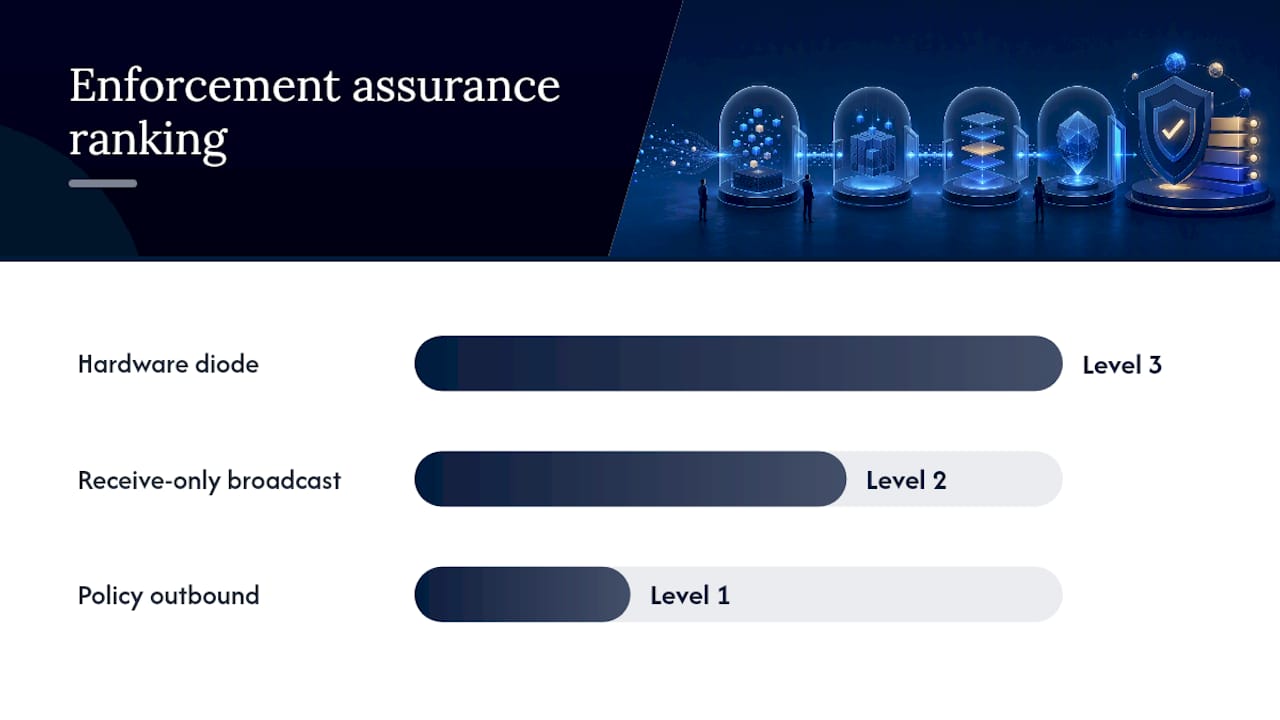
Enforcement levels, ranked by assurance strength:
- Hardware data diode: physically unidirectional, cannot be reconfigured to allow return traffic without replacing the hardware.
- Receive-only broadcast/datacasting: strong assurance for one-to-many update distribution, though it depends on correct implementation at the receiving terminal.
- Policy-enforced outbound disablement: software firewall rules and network segmentation; weaker because it depends on correct, unchanging configuration across every layer.
Supply-chain protection matters just as much as the transport boundary, since a clean network boundary means nothing if a poisoned artifact walks through the front door on approved media. Signed update bundles verified with GPG, reproducible builds that let you confirm a binary matches its published source, and a software bill of materials (SBOM) for every container image give auditors something concrete to check against. OWASP’s governance checklist for LLM applications covers exactly this kind of supply-chain diligence, and it’s worth treating as a baseline expectation for any auditor reviewing an air-gapped deployment, not just a nice-to-have.
Hardware, Quantization, and Performance Trade-Offs
Air-gapped environments almost never get the newest GPUs. Procurement cycles in regulated organizations move slowly, security reviews add months to any hardware purchase, and by the time a cluster is accredited it’s often running on GPUs that were current two procurement cycles ago. That reality shapes every model decision that follows.
A rough rule of thumb: a 7B parameter model in 16-bit precision needs roughly 14GB of VRAM just for weights, before accounting for KV-cache and batch overhead. Quantizing to 8-bit roughly halves that footprint, and 4-bit quantization can push a 13B model onto a single 24GB card. That math is why quantization isn’t optional in most air-gapped deployments. It’s the difference between a model that fits on the hardware you’re accredited to run and one that doesn’t fit at all.
- Techniques like AWQ and GPTQ compress model weights while trying to preserve output quality; these techniques are commonly used to fit larger models onto constrained GPUs.
- Mixture-of-experts (MoE) architectures activate only a fraction of total parameters per token, which can improve throughput on legacy hardware without the same accuracy trade-offs as aggressive quantization.
- Entropy-Weighted Quantization, the approach Forge applies in its deployments, allocates precision non-uniformly based on each weight’s contribution to output entropy, keeping accuracy closer to the full-precision baseline while still shrinking the memory footprint enough to run on constrained enterprise GPUs.
The trade-off is real and worth being honest about: more aggressive quantization saves memory and increases throughput, but it can degrade output quality on tasks that need precise numerical reasoning or long-context coherence. The right calibration depends on the workload, not a universal setting.
Reference deployments on legacy hardware, including Dell R740 servers paired with older-generation Turing GPUs running a vLLM-based serving stack, demonstrate that acceptable throughput is achievable without waiting for a new procurement cycle, provided the quantization strategy matches the hardware constraints rather than fighting them.
Keeping an Air-Gapped System Running: Operations and Maintenance
An air-gapped AI system that works on day one and degrades by month six isn’t actually solving the problem it was built for. Operational discipline after deployment matters as much as the initial architecture.
Backup strategy needs to account for the fact that nothing syncs to an external cloud backup service. RAID configurations at the storage layer protect against drive failure, but scheduled internal dumps of model checkpoints, vector database indexes, and configuration state need their own retention policy and their own tested restore procedure. Air-gapped storage is widely recognized as one of the stronger defenses against ransomware specifically because there’s no live network path for encryption malware to reach the backup itself, but that protection only holds if the backup process is disciplined and the restore path is actually tested, not just assumed to work.
Observability without outbound telemetry means building internal dashboards fed by the enclave’s own logging pipeline, since there’s no vendor analytics platform to lean on.
- Snapshot cadence for model state and vector indexes, tested restore drills on a fixed schedule, not just after an incident
- Internal dashboards for GPU utilization, inference latency, and queue depth, all fed by in-enclave logging
- Staged rollouts for any new model or dependency version, with rollback checkpoints defined before deployment, not improvised after a failure
- AD/LDAPS integration for access control, paired with audit logs granular enough to reconstruct who touched what during an incident review
Pro Tip: Run a full restore drill from your backups at least quarterly, not just an integrity check. Backups that have never been restored are a hypothesis, not a plan, and an air-gapped environment gives you zero fallback if the untested restore fails during an actual incident.
Offline patching follows the same online-to-offline discipline as initial deployment: new versions get staged through the internal artifact mirror, verified, and rolled out incrementally rather than pushed everywhere at once.
How Forge Approaches Air-Gapped AI Deployments
Forge builds air-gapped and sovereign AI deployments as end-to-end engagements, not software licenses. The services map directly to the architecture and workflow covered above: secure local and air-gapped deployment, custom model integration and optimization, private AI assistant rollout, sovereign MLOps and runtime orchestration, and ongoing performance tuning once the system is live.
Experience in securing high-consequence operational environments shapes how engagements like these run, often including artifact-mirroring discipline built into the deployment from day one, integration into existing enterprise identity systems like Active Directory, and applying advanced quantization techniques where hardware constraints demand it, all designed so data, models, and domain intelligence stay inside the client’s own infrastructure.
Before engaging any integrator for a project like this, procurement and security teams should ask a specific set of questions:
- Who controls the artifact mirror after initial deployment, and what’s the process for adding a new model version?
- What’s the documented chain-of-custody procedure for physical media crossing the air-gap boundary?
- How does the vendor handle Active Directory or LDAPS integration without introducing an external dependency?
- What accreditation support does the vendor provide during the audit process itself, not just at handoff?
Forge’s own positioning on sovereignty and accreditation experience addresses most of these directly, and any credible integrator should be able to answer all four without hesitation.
Risk Assessment and Threat Modeling for Air-Gapped Deployments
Threat modeling an air-gapped system starts from a different premise than a networked one: the primary risk isn’t remote exploitation, it’s the human and physical processes that move data and artifacts across the boundary. That shift changes where the risk assessment effort should actually go.

Insider threat becomes proportionally more significant once the network vector is closed off, because anyone with physical access to the transfer media or the enclave itself represents a larger share of the remaining attack surface. A rigorous risk model treats the chain-of-custody process, not the network perimeter, as the primary control point, since a compromised courier or an unverified USB drive can undo the assurance that the air-gap was built to provide.
Supply-chain risk deserves equal weight. Every model checkpoint, container image, and dependency that enters the enclave was built somewhere else, on infrastructure the organization doesn’t control. A poisoned base image or a backdoored package doesn’t need a network connection to cause damage once it’s inside; it just needs to get through ingest validation once.
Physical security risk includes the obvious, controlled facility access, but also the less obvious: what happens to decommissioned hardware that once held classified model weights, or a failed drive that gets sent out for warranty replacement without a sanitization step first. A complete threat model for an air-gapped deployment covers the full lifecycle of every piece of hardware and every artifact that touches it, not just the moment of initial deployment.
Best Practices for Secure Data Transfer Beyond Snapshot Methods
Snapshot-based transfer, staging artifacts online and moving a signed bundle across the boundary, covers most deployment and update scenarios, but it’s not the only pattern worth knowing. Some workloads need ongoing data injection into an already-deployed enclave, which is a different problem than a one-time model transfer.
For recurring data feeds, such as periodic intelligence updates or sensor data from an OT environment, a receive-only broadcast channel avoids the manual overhead of physical media transfer for every update cycle. This works well when the same data needs to reach multiple air-gapped terminals simultaneously, since one broadcast serves the entire fleet rather than requiring individual transfers to each site.
For lower-frequency but higher-sensitivity injections, controlled and heavily logged file transfer through a mediated gateway, sometimes called a “transfer station” or “guard” in defense contexts, allows specific file types through after automated content inspection and manual approval. This is slower than a broadcast channel but provides tighter control for data that needs individual review before it enters the enclave.
Whatever the method, the same validation discipline applies: hash or signature verification before any injected data touches production, a documented approval chain for who authorized the transfer, and an audit log entry independent of the application’s own logging. The mistake to avoid is treating any transfer method as inherently safe because it isn’t a full network connection. A gateway with weak content inspection is still a path for malicious data to enter an environment that otherwise has none.
Compliance Standards and Certification for Air-Gapped AI
Certification for an air-gapped AI system rarely comes from a single standard. It’s usually a composite of general security frameworks and sector-specific accreditation requirements, and knowing which applies to your workload early saves months of rework later.
NIST frameworks, particularly the NIST AI Risk Management Framework and NIST 800-53 security controls, provide the general foundation most auditors will expect to see referenced, regardless of sector. For federal and defense-adjacent workloads, FedRAMP High authorization or DoD Impact Level 4/5 designation set specific technical and procedural requirements that directly shape enclave architecture, including exactly the kind of artifact-mirroring and chain-of-custody discipline covered earlier in this piece.
Sector-specific requirements layer on top. Healthcare workloads touching genomic or research data may need institutional review board sign-off in addition to standard security certification. Financial services workloads handling material non-public information carry their own regulatory expectations around access logging and insider risk that go beyond a generic security audit.
OWASP’s governance checklist for large language model applications gives teams a practical starting point for the security and governance controls auditors will look for, covering threat modeling and supply-chain protections that map directly onto the security primitives discussed earlier in this piece. Treat it as a baseline gap-analysis tool before a formal audit, not a substitute for the sector-specific certification your workload actually requires.
Real-World Examples of Air-Gapped AI in Practice
The clearest evidence that air-gapped AI has moved from theory to operational reality comes from the reference architectures now published for public review rather than kept proprietary. The production-grade enterprise air-gapped LLM stack documented on legacy Dell R740 hardware with Turing-generation GPUs shows a working deployment running vLLM-based inference entirely disconnected from the internet, using the online-to-offline transition discipline covered earlier in this piece, artifact mirroring, hash verification, and a documented ingest process.
NVIDIA’s own air-gap deployment documentation for its NIM microservices reflects a similar pattern at vendor scale: government and enterprise customers running large language models in classified or restricted environments where no outbound API call to NVIDIA’s cloud services is possible, using a two-phase workflow that stages assets online before transferring them into the disconnected environment.
The common thread across every working deployment isn’t a specific model or GPU choice. It’s the discipline of the transfer process itself: teams that treat the online-to-offline boundary as a formal, auditable procedure end up with systems that pass accreditation and stay maintainable. Teams that treat it as an occasional manual task tend to accumulate drift between what’s documented and what’s actually running, which is exactly the gap an auditor is trained to find.
Air-Gapping vs. Virtual Enclaves and Secure Multiparty Computation
Air-gapping isn’t the only isolation approach on the table, and for a meaningful share of regulated workloads, it’s not even the right one. Understanding where it sits relative to the alternatives helps decision-makers avoid over-building.
Virtual enclaves, such as confidential computing environments using hardware-based trusted execution (Intel SGX, AMD SEV, or cloud confidential computing offerings), encrypt data in use, not just at rest or in transit, so that even the cloud provider or host operating system can’t inspect it during processing. Confidential computing AI approaches this problem differently than air-gapping: instead of physically removing the network connection, it cryptographically isolates the workload from everything around it, including the infrastructure operator. Confidential computing vs air gap is really a question of trust model. Confidential computing trusts the hardware’s cryptographic guarantees; air-gapping trusts the absence of a network path at all. For workloads that need cloud elasticity but can’t accept operator visibility into the data, confidential computing is often the better fit. For workloads where no external infrastructure, trusted or not, is acceptable, air-gapping remains the stricter answer.
Secure multiparty computation (SMPC) allows multiple parties to jointly compute a function over their combined data without any party revealing their individual inputs to the others. It solves a different problem entirely: collaborative computation across organizational boundaries, rather than protecting a single organization’s data from external access. SMPC adds substantial computational overhead and isn’t a practical substitute for air-gapping in classified or IL4/IL5 contexts, but it’s genuinely useful when the actual requirement is multi-party collaboration on sensitive data rather than absolute isolation.
The practical decision rule: if the requirement is “no external party or infrastructure operator can ever see this data or model,” air-gapping is the strictest and most auditable answer. If the requirement is “this data must be processed on infrastructure I don’t fully trust, but I need cryptographic guarantees,” confidential computing AI approaches deserve serious consideration instead.
A Pragmatic Path for Decision-Makers Weighing Security Against Speed
The organizations that get air-gapped AI right rarely start with a full production rollout. They start with a pilot enclave, small enough to build fast, real enough to test the actual online-to-offline workflow against a genuine accreditation package, not a theoretical one.
Procurement cycles and total cost of ownership deserve honest scrutiny before committing to a full air-gap. It’s a more expensive path than a well-isolated network architecture, and that expense is only justified when the compliance regime or risk profile genuinely demands it. Pilot first, get the accreditation package reviewed by your actual auditors, and only then scale to a full rollout once the workflow has survived contact with real approval processes.
Governance ownership matters more than most technical decisions in this space. A program without a clear owner, someone accountable across security, infrastructure, and compliance, tends to stall between departments right at the accreditation stage, which is the most expensive place for a project to stall. Bring your ISSO, platform engineering lead, and compliance officer into the room before the first line of infrastructure code gets written, not after the pilot is already built.
— John Ezzell, Founder
Deploying Air-Gapped AI With Forge
The alternative to building this yourself from scratch is engaging a team that has already solved the artifact-mirroring, chain-of-custody, and accreditation problems this article covers. Such engagements typically follow a structured path: assessment, pilot enclave, full deployment, then ongoing sovereign operations, helping teams avoid reinventing the online-to-offline workflow from first principles.
Every engagement is scoped around your existing infrastructure and accreditation requirements rather than a one-size-fits-all package, covering everything from secure local and air-gapped deployment through sovereign MLOps and performance tuning once the system is live. Because this is professional services and custom integration work rather than software resale, pricing and scope are set per engagement based on your environment and compliance needs. If your organization is weighing a pilot enclave or already has an accreditation deadline on the calendar, start a conversation about your deployment to see what a scoped assessment looks like for your infrastructure.
Sources
- Broadcast Zero-Trust Edge Computing: Formal Threat Model Reduction for Air-Gapped AI Terminals via Physically Unidirectional Broadcast Datacasting
- MinIO — What is an air gap and why it matters for AI storage
FAQ
What Is Air Gapping in AI?
Air gapping in AI means running inference and storing data on hardware with no runtime network connection to any external system, so a language model operates entirely on isolated infrastructure. It removes the possibility of network-mediated data exfiltration, which is why regulated and defense-adjacent organizations rely on it for their most sensitive workloads.
What Does Air Gap Mean?
An air gap is a physical or complete logical separation between a system and any external network, meaning there’s no wire, wireless signal, or software path connecting the two. The term originated in physical security and now applies broadly to any environment, AI included, that needs guaranteed isolation from outside access.
What Does Air-Gapped Mean in Tech?
In technology contexts, air-gapped describes hardware or a network segment that has zero live connection to the internet or any other outside network, whether at the physical layer or through any software-defined channel. Data and updates can only enter through manual, controlled transfer, typically involving physical media and a documented chain-of-custody process.
What Is the Difference Between Air-Gapped and Offline?
Air-gapped means a system has no network connection by design and stays that way as a persistent architectural state, while offline often just describes a temporary disconnection that could reverse the next time someone plugs in a cable. Accreditation bodies generally only recognize the air-gapped designation for systems with no path back to a network under any normal operating condition, not devices that go offline occasionally.
Does Forge Offer Air-Gapped AI Deployment Services?
Yes. Forge provides secure local and air-gapped deployment as a core service, alongside sovereign MLOps, custom model optimization, and ongoing operational support for regulated organizations. Pricing is scoped per engagement and available on request through the Forge solutions page.