Prioritize three controls if you do nothing else this quarter: verify provenance on every model and dataset entering your environment, treat third-party AI components as untrusted by default, and run continuous integrity monitoring after deployment. Start by inventorying every model and dataset in use, requiring cryptographic hashes or vendor attestations before go-live, and drafting an emergency rollback plan for compromised artifacts.
TL;DR:
- Verifying cryptographic hashes and requesting model provenance documentation before deployment ensures early detection of tampered models and untrusted data sources.
- Continuous validation of weights and model origin logs is crucial, as models can be swapped or modified after initial approval despite prior checks.
- Treat third-party models as high-risk assets by isolating them in sandbox environments and enforcing strict segmentation to prevent lateral movement if compromised.
- Implementing air-gapped, on-premises deployments can eliminate external attack vectors but still requires rigorous provenance and integrity controls.
- Procurement questions should include data provenance, change notification clauses, and ML SBOM requests, with ongoing monitoring to detect vendor and dependency drift.
Table of Contents
- Key AI supply chain risks security teams must map and prioritize
- Provenance, SBOMs, and tamper-evident traceability for models and datasets
- Secure design and development controls specific to AI pipelines
- Third-party and vendor risk management for AI: due diligence, contracts, and monitoring
- Operational monitoring, KPIs, and incident response for AI supply chain compromise
- How sovereign, air-gapped deployments reduce AI supply chain risk
- Supply chain risk assessment methodologies tailored for AI components
- Strategies for supply chain resilience and recovery planning in AI systems
- Role of hardware security in AI supply chain protection
- Compliance and regulatory requirements impacting AI supply chain security
- Prioritization advice for security leaders: where to invest first
- Forge AI solutions for organizations that need sovereign, auditable AI deployments
- Sources
- FAQ
Key AI supply chain risks security teams must map and prioritize
AI supply chains introduce failure modes that traditional software risk registers rarely capture. Data poisoning lets an attacker corrupt training or fine-tuning data so a model learns a backdoor or a biased output, often without any code ever being touched. Model tampering targets the serialized weight files themselves: an attacker who swaps or modifies a checkpoint can plant behavior that survives normal code review because nobody inspects binary tensors line by line.
Dependency risk extends this further. Model hubs, pretrained checkpoints, and open source libraries all carry the same trojan risks that plague traditional software, but with far less tooling maturity. Vendor products often embed AI features that procurement never flagged as AI, creating a visibility gap known as the Nth-party problem, where risk hides two or three vendors deep.
- Data poisoning can corrupt labels or embeddings during training or fine-tuning.
- Tampered weight files can introduce backdoors invisible to conventional code scanning.
- Model hubs and open source dependencies inherit the same trojan risks as traditional software supply chains.
- Embedded AI in vendor products often goes undetected by standard procurement questionnaires.
Traditional software supply chain controls assume static, versioned artifacts. AI models retrain, fine-tune, and update continuously, so a control designed for annual audits misses drift that happens weekly.
Provenance, SBOMs, and tamper-evident traceability for models and datasets
Model provenance is the evidence trail proving where a model came from, what data trained it, and whether it changed since release. Practical signals include metadata records, tokenizer fingerprints, and weight-level hashes, and combining these layers is more reliable than trusting any single signal. Authoritative guidance recommends tamper-evident records of origin, authorship, and training data specifically to counter poisoning, tampering, and embedded malicious code.
An ML Bill of Materials extends the familiar SBOM concept to model cards and dataset cards, letting vendors disclose lineage selectively so intellectual property stays protected while auditors still get the evidence they need. NIST’s 2026 traceability framework recommends cryptographic linkage and decentralized trust models to make this selective disclosure verifiable rather than just promised.
- Request an ML SBOM or model card at intake, before any integration work begins.
- Require cryptographic hashes or signatures on weight files, computed immediately after training completes.
- Validate hashes at every deployment stage, not just once at procurement.
- Log provenance checks in a tamper-evident record your auditors can query later.
Production testing of black-box provenance verification found roughly 90 to 95% precision and 80 to 90% recall identifying derived models across parameter ranges from 30 million to 4 billion, which suggests provenance verification is workable at scale, not just theoretical.
Pro Tip: Pair a lightweight metadata check for everyday deployments with a deeper weight-level fingerprint scan reserved for high-risk or high-privilege models.
Secure design and development controls specific to AI pipelines
Treat every third-party model file the same way you treat unvetted code: as something that runs with your data and your compute, and therefore deserves the same isolation discipline. The NCSC’s guidance on machine learning supply chains advises treating untrusted data and models as high risk by default and favoring trusted data sources over trying to sanitize suspect data after the fact.
Threat modeling for AI needs its own failure-mode inventory: poisoned fine-tuning sets, backdoored checkpoints, prompt injection through retrieved documents, and compromised inference dependencies all belong on the list alongside conventional application threats.
- Sandbox any externally sourced model in an isolated environment before it touches production data.
- Segregate training, staging, and inference environments so a compromised artifact in one cannot reach the others.
- Build secure defaults into ML pipelines, including deny-by-default network egress for model containers.
- Stage rollouts gradually and verify cryptographic signatures at each promotion gate.
Continuous validation matters more than one-time review, because a model that passed integrity checks at intake can still be swapped later in a hub or registry.
Third-party and vendor risk management for AI: due diligence, contracts, and monitoring
Extending traditional third-party risk management to AI means asking vendors questions procurement teams have not historically asked: where did the training data originate, who has access to retrain or fine-tune the model, and what is the retention policy for data submitted during inference? CISA’s joint guidance with Australian partners recommends demanding vendor transparency, SBOMs, and contractual clauses that control data usage, alongside the ability to operate on-premises or disable risky features entirely.
Contracts should lock in change notification whenever a vendor updates or retrains a model in production, audit rights that let your team inspect provenance evidence on request, and a documented path to disable a feature or run it locally if risk assessment demands it.
- Require training-data provenance and access-control documentation before signing.
- Negotiate model change notification clauses so silent retraining never surprises your risk team.
- Map fourth and Nth-party dependencies to catch concentration risk hiding behind a single vendor relationship.
- Set continuous monitoring KPIs and a clear escalation threshold for vendor drift.
Practitioner guidance recommends folding AI-specific due diligence into existing third-party risk processes rather than standing up a parallel track, since a separate AI review tends to get skipped under deadline pressure.
Operational monitoring, KPIs, and incident response for AI supply chain compromise
Detecting AI supply chain compromise requires watching for signals that do not resemble classic intrusion indicators: anomalous model outputs, failed integrity checks on deployed weights, unusual query patterns against an inference endpoint, and unexpected data egress from a model server.
- Track an integrity-pass rate across all deployed models, flagging any drop for immediate review.
- Monitor output drift against a known-good baseline on a fixed cadence.
- Alert on inference traffic patterns that deviate from historical volume or destination.
- Log every model promotion event with its verified hash for forensic replay later.
A production study found black-box provenance checks reached roughly 90 to 95% precision and 80 to 90% recall on models between 30 million and 4 billion parameters, meaning integrity monitoring built on this approach catches most tampering attempts without excessive false positives.
When compromise is confirmed, the playbook mirrors traditional incident response with AI-specific steps layered in: revoke access immediately, restore the model from its last verified hash, preserve the tampered artifact for forensic analysis, and notify regulators or customers if the incident touched their data. Failover planning should define in advance when a team reverts to a non-AI control path and how often that fallback gets tested, since an untested failover is not a real one.
How sovereign, air-gapped deployments reduce AI supply chain risk
An air-gapped deployment removes the external attack surface that most AI supply chain guidance is written to defend against, since a model that never connects to an outside network cannot exfiltrate data or silently pull a poisoned update. Some providers build sovereign deployments where models, weights, and domain data stay inside the client’s own infrastructure, with provenance controlled from the first integration step rather than inherited from a cloud vendor’s opaque pipeline.
Operationally, this looks like local model optimization using Entropy-Weighted Quantization to keep performance high without cloud dependence, paired with orchestration that keeps every artifact auditable inside the client’s environment. That approach draws on decades of experience securing high-consequence operations, applied to the discipline of validated, in-scope deployment rather than software resale.
Supply chain risk assessment methodologies tailored for AI components
Standard vendor risk questionnaires miss AI-specific failure modes because they were built for static software, not models that retrain themselves. A tailored methodology starts by classifying each AI component by its blast radius: a model that only summarizes internal documents carries different risk than one that makes automated decisions affecting customers or safety systems.
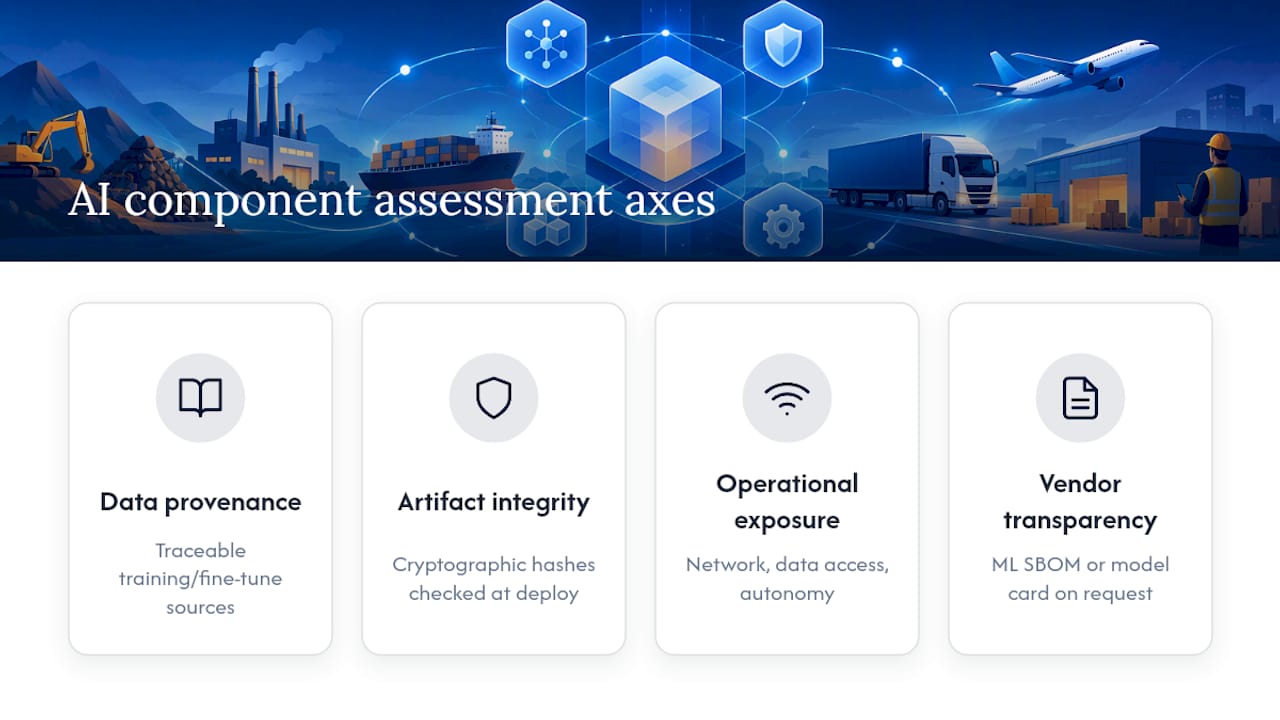
From there, assessment should score four dimensions separately rather than collapsing them into one vendor risk number. First, data provenance: where the training and fine-tuning data originated and whether it can be traced back to a trusted source. Second, artifact integrity: whether cryptographic hashes exist and are checked at every deployment stage. Third, operational exposure: how much network access, data access, and autonomy the model has in production. Fourth, vendor transparency: whether the provider will supply an ML SBOM or model card on request, and how quickly.
The NCSC’s machine learning supply chain guidance recommends favoring trusted data sources over attempting to sanitize data of unknown origin, which should inform how a risk methodology scores data provenance: a model trained on unverifiable scraped data should score lower than one trained on a documented, licensed corpus regardless of how well it performs in testing.
Reassessment cadence matters as much as the initial score. A model that passed review six months ago may have been retrained since, so the methodology needs a trigger, tied to vendor change notifications or scheduled quarterly checks, that forces a rescore rather than assuming a one-time approval holds indefinitely. Concentration risk deserves its own line item: if three critical business functions all depend on the same foundation model provider, that dependency is a risk factor independent of how secure any single deployment looks.
Strategies for supply chain resilience and recovery planning in AI systems
Resilience for AI supply chains means assuming a compromise will eventually happen and building the capacity to recover quickly rather than betting everything on prevention. The foundation is a verified-good baseline: every deployed model’s hash, version, and configuration recorded somewhere an attacker cannot alter, so a rollback has something trustworthy to roll back to.
Recovery planning should define specific triggers for reverting to a previous model version, separate from the broader incident response playbook, since an AI-specific rollback often needs to happen faster than a full forensic investigation can complete. A staged rollback path, where a suspect model is pulled from production traffic immediately while a verified prior version takes over, limits damage without requiring the full incident timeline to close first.
Redundancy also matters differently for AI than for conventional infrastructure. Running a single foundation model provider across every business-critical function means a single vendor incident becomes an enterprise-wide outage. Maintaining a validated fallback model, even a smaller or less capable one, gives operations a path to keep functioning while the primary system is investigated and restored.
Recovery plans should be tested on a schedule, not just written and filed. A tabletop exercise that walks through a poisoned fine-tuning dataset discovered in production, or a compromised checkpoint pulled from a public hub, exposes gaps in escalation authority and communication steps long before a real incident forces the team to improvise. Documentation from that exercise becomes the basis for updating the playbook, closing the loop between resilience planning and the monitoring signals described earlier.
Role of hardware security in AI supply chain protection
Hardware sits underneath every provenance and integrity control described so far, and a compromised chip or firmware layer can undermine all of them regardless of how well the software-level checks are designed. Trusted execution environments and secure enclaves give a model a place to run where even a compromised operating system cannot easily inspect or alter the weights in memory, which matters most for high-privilege inference workloads handling sensitive data.
Hardware-rooted attestation extends the provenance chain one layer deeper than a software hash alone can reach. A cryptographic signature on a model file proves the file has not changed since signing, but hardware attestation can additionally prove the file is running on infrastructure that has not been tampered with at the firmware or boot level, closing a gap that pure software verification leaves open.
Air-gapped and on-premises deployments carry a hardware security advantage that cloud-hosted inference cannot fully replicate: physical control over the machine running the model removes an entire category of remote tampering vectors, since an attacker needs physical access rather than network access to compromise the hardware layer. For regulated sectors evaluating where to draw the line between cloud convenience and hardware-level assurance, this physical control is often the deciding factor.
Supply chain integrity for the hardware itself deserves the same scrutiny given to models and data. Chips, accelerators, and firmware sourced from unverified suppliers introduce risk before a single model ever loads, so procurement processes for AI infrastructure should apply the same provenance and attestation standards to hardware vendors that this guide recommends for model and data vendors.
Compliance and regulatory requirements impacting AI supply chain security
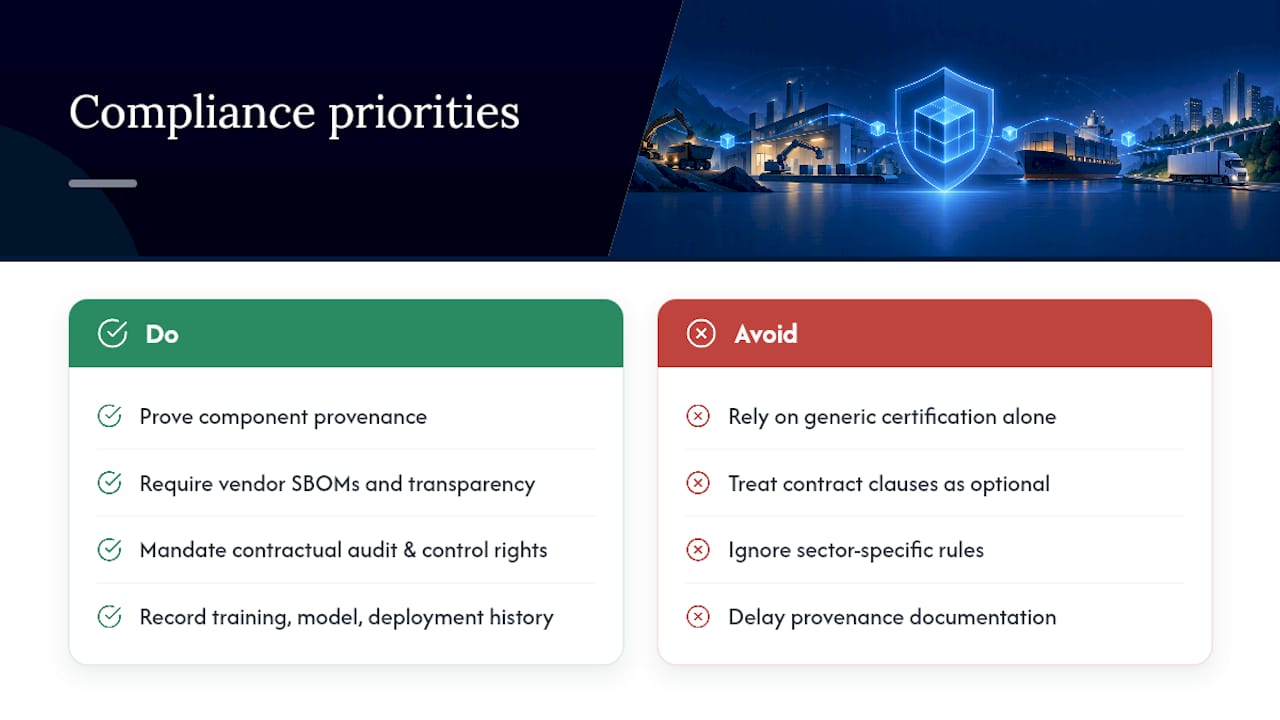
Regulatory expectations for AI supply chain security are converging on the same core demand that security teams already recognize from traditional software compliance: prove where your components came from and show you can control them. CISA’s joint guidance with Australian partners frames AI integration into operational technology as high-consequence, and recommends vendor transparency, SBOMs, and contractual clauses controlling data usage as baseline expectations rather than optional hardening.
Sector-specific regulation compounds these baseline expectations. Financial services, healthcare, defense, and critical infrastructure operators each carry their own data residency, audit, and incident disclosure rules, and AI systems processing regulated data inherit every one of those obligations regardless of whether the model itself was purpose-built for the sector. A security team evaluating an AI vendor for a regulated workload needs to confirm the vendor’s compliance posture matches the specific regulatory regime the data falls under, not just a generic security certification.
Contractual and audit rights are becoming a compliance necessity rather than a negotiating preference. The ability to inspect provenance evidence, receive advance notice of model changes, and disable or localize a feature on demand increasingly shows up in regulatory guidance as an expected control, which means procurement and legal teams need to treat these clauses as standard requirements for any AI vendor handling regulated data.
Documentation discipline ties compliance back to the provenance and monitoring controls covered earlier in this guide. Regulators increasingly expect a traceable record connecting training data, model versions, and deployment history, which is exactly the tamper-evident record an ML SBOM and cryptographic hash workflow already produce. Building that documentation habit into deployment from day one avoids a scramble when an auditor asks for it later.
Prioritization advice for security leaders: where to invest first
The instinct to buy a monitoring tool first is backward. An asset inventory and provenance verification program has to come before continuous monitoring means anything, because you cannot detect drift in a model you never catalogued. Procurement gates and contractual attestation requirements come next, closing the door on unacceptable vendor risk before it enters the environment. Only then does monitoring and failover planning earn its budget. Governance first, vendor controls second, detection last.
— John Ezzell, Founder
Forge AI solutions for organizations that need sovereign, auditable AI deployments
Every control in this guide gets easier when the model never leaves your infrastructure in the first place. Forge AI builds secure local and air-gapped deployments, custom model integration, and sovereign MLOps orchestration so regulated organizations in finance, defense, logistics, energy, and manufacturing can run AI without handing provenance and control to an external cloud. If your risk team is weighing on-prem deployment against continued cloud exposure, explore Forge’s solutions to see what an audited, in-scope deployment looks like for your environment.
Sources
- Same same but also different: Google guidance on AI supply chain security
- arXiv: Model provenance verification (2025)
- CISA joint guidance: Principles for the secure integration of AI in OT
- NCSC: Secure supply chain for machine learning
- NIST IR 8536: Manufacturing supply chain traceability meta-framework (2026)
FAQ
What is AI supply chain security?
AI supply chain security covers protecting the models, training data, dependencies, and infrastructure that feed an AI system from tampering, poisoning, or unauthorized access. It extends traditional software supply chain security to cover model weights, datasets, and the vendors that provide them.
How do you verify model provenance?
Model provenance verification combines metadata review, tokenizer analysis, and cryptographic weight hashing to confirm a model’s origin and detect unauthorized changes. Production testing found this approach reaches roughly 90 to 95% precision on models between 30 million and 4 billion parameters, making it practical for routine use.
What is an ML SBOM?
An ML Bill of Materials extends the traditional software bill of materials to cover model cards, dataset cards, and training lineage, letting vendors disclose provenance selectively without exposing proprietary details. NIST’s traceability framework recommends cryptographic linkage to make these disclosures verifiable.
Can air-gapped deployment eliminate AI supply chain risk?
Air-gapped deployment removes external network attack vectors like data exfiltration and silent remote model updates, but it does not eliminate risk from tampered artifacts introduced before deployment. Organizations still need provenance checks and integrity verification even in a fully isolated environment, which is a core part of how Forge AI structures its sovereign deployments.
What should third-party risk questionnaires ask about AI vendors?
Questionnaires should ask about training data provenance, who can access or retrain the model, data retention policies, and whether the vendor will provide an ML SBOM or cryptographic hashes on request. Practitioner guidance recommends folding these questions into existing third-party risk processes rather than running a separate AI-specific review.