Zero Trust for AI means treating every model, agent, and memory store as an untrusted, individually accountable identity, not a trusted extension of your application. The immediate priorities: inventory every AI agent and model in production, force privileged operations through application-mediated APIs instead of direct tool access, and validate every model output before it triggers a real-world action. Skip any of those three and the rest of your Zero Trust program is mere decoration.
TL;DR:
- Trusted identities for AI agents must be registered with short-lived credentials and attested at startup to prevent impersonation or malicious activity.
- Every AI output that triggers an external action should be validated in real-time to prevent prompt injection, data leaks, or unintended operations.
- Deployment controls must enforce policy at each action point, routing traffic through inspectable gateways rather than direct connections, ensuring continuous verification.
- Maintaining an inventory of all AI assets, including provenance and versioning, is essential for effective enforcement and risk assessment.
- Air-gapped, local infrastructure deployment can eliminate exfiltration risks and help organizations enforce rigorous identity and provenance standards.
Table of Contents
- Why Zero Trust for AI Demands New Rules, Not Just New Tools
- Mapping the AI Pillar Onto Your Existing Zero Trust Architecture
- What Actual Controls Look Like: Identity, Validation, and Supply Chain
- Building the Assessment and Roadmap: From Inventory to Remediation
- Governance That Keeps AI Systems Auditable Over Time
- How Forge Applies This in Practice
- What Most Zero Trust Programs Get Backwards
- Where Forge AI Deployment Fits Into Your Zero Trust Rollout
- Sources
- FAQ
Why Zero Trust for AI Demands New Rules, Not Just New Tools
Traditional Zero Trust assumes the thing requesting access is either a human with credentials or a service with a fixed, auditable code path. AI systems break that assumption. A large language model doesn’t just request data, it generates instructions on the fly, sometimes from content an attacker planted specifically to hijack it. That’s the core problem behind prompt injection, which the OWASP Top 10 for LLM Applications 2026 still ranks as the number one risk to generative AI systems, with sensitive information disclosure close behind at number two.
The riskier shift is agentic. Once a model can call tools, write to a database, or send an email on its own, OWASP’s list flags excessive agency as an emergent, high-consequence category, because the trust surface no longer ends at the model. It extends to every action the model is permitted to take.
This is where identity-only or network-only Zero Trust falls short. A firewall rule doesn’t know the difference between a legitimate customer query and a malicious instruction buried inside a PDF the model just summarized. Static role-based access control doesn’t know that an agent’s next action was shaped by text it read five minutes ago, not by the user who launched it. Instruction-as-data attacks exploit exactly that blind spot.
Three implications follow directly from this:
- Enforcement has to happen at the point of action, not just at login, because the threat originates inside the session.
- Every model output that triggers a tool call, database write, or external message needs validation before execution, not after.
- Policy engines need to evaluate intent and context in real time, since a request that looked safe at authentication can turn hostile mid conversation.
Zero Trust for AI, in practice, means moving enforcement from “who logged in” to “what is this agent trying to do right now, and should it be allowed to.”
Mapping the AI Pillar Onto Your Existing Zero Trust Architecture
Microsoft’s approach to this problem adds AI as an explicit pillar sitting alongside identity, data, network, and DevSecOps, rather than bolting AI security on as an afterthought. Its Zero Trust for AI guidance updates its assessment tooling specifically to check for AI controls and patterns most organizations haven’t built yet.
That AI pillar doesn’t operate independently. It threads through the pillars you already have:
- Identity: every agent and model gets a distinct, registered identity with short-lived credentials, not a shared service account borrowed from the application layer.
- Data: retrieval sources, training data, and memory stores get classified and access-gated the same way you’d gate a production database, with provenance tracked at ingestion.
- Network: traffic between agents, tools, and models routes through inspectable, policy-enforced paths rather than direct, unmediated calls.
- DevSecOps: model updates, prompt changes, and tool integrations go through the same gated pipeline as application code, with AI-specific tests added.
Runtime enforcement is where this becomes real rather than aspirational. NIST SP 800-207A describes the pattern for cloud-native workloads generally: identity-tier policies enforced through API gateways, sidecar proxies, and service identities like SPIFFE/SVID, evaluated by a policy decision point (PDP) that consults policy information points (PIPs) and is configured through a policy administration point (PAP). Apply that same triad to AI, and the API gateway becomes the checkpoint where every tool call an agent makes gets evaluated against its registered permissions before it executes.
A practical checklist per pillar looks like this: confirm every agent has a unique registered identity (not shared credentials), confirm data sources feeding a model carry provenance metadata, confirm agent-to-tool traffic passes through a gateway rather than a direct connection, and confirm model changes require the same code review and testing gates as any other production deployment.
What Actual Controls Look Like: Identity, Validation, and Supply Chain
Reference architecture tells you where controls belong. These are the controls that go there.
- Agent identity and attestation. Every autonomous agent needs a registry entry mapping it to an accountable human or process, short-lived credentials instead of static API keys, and attestation at startup confirming it’s running approved code. Cisco’s guidance on zero trust for agentic AI frames this as centralized registration of non-human identities with intent-based authorization checked per action, not per session.
- Capability budgeting and the Rule of Two. An agent should never simultaneously hold access to untrusted input, sensitive data, and an external communication channel. If it needs all three for a task, split the task across separate agents or insert a human checkpoint between steps.
- Input and output validation. Strip invisible characters, normalize encoding, and validate every output against a strict schema before it’s allowed to trigger an action. Multimodal filtering matters here too. Prompt injection increasingly hides in images and audio, not just text.
- RAG and vector store protections. Index content with provenance metadata, gate retrieval by the same access controls as the underlying source data, and monitor for anomalous query patterns that suggest someone is probing the index rather than using it.
- Model and supply chain integrity. Treat model weights, LoRA adapters, and fine-tuned checkpoints like executable code. Pull from private, signed registries, pin versions, and maintain a manifest documenting where every component came from, a pattern OWASP’s supply chain guidance for LLMs treats as non-negotiable for production systems.
- DevSecOps integration. Add AI-specific checks (prompt injection tests, output schema validation, jailbreak resistance) into CI/CD, allowlist which developer tools can call models directly, and require red-team sign-off before any agent with write access ships.
Pro Tip: Treat memory writes as a privileged operation, not a side effect. An agent that can silently persist information into its own long-term memory can be manipulated once and compromised indefinitely. Require the same approval gate for memory writes that you’d require for a database schema change.
Building the Assessment and Roadmap: From Inventory to Remediation
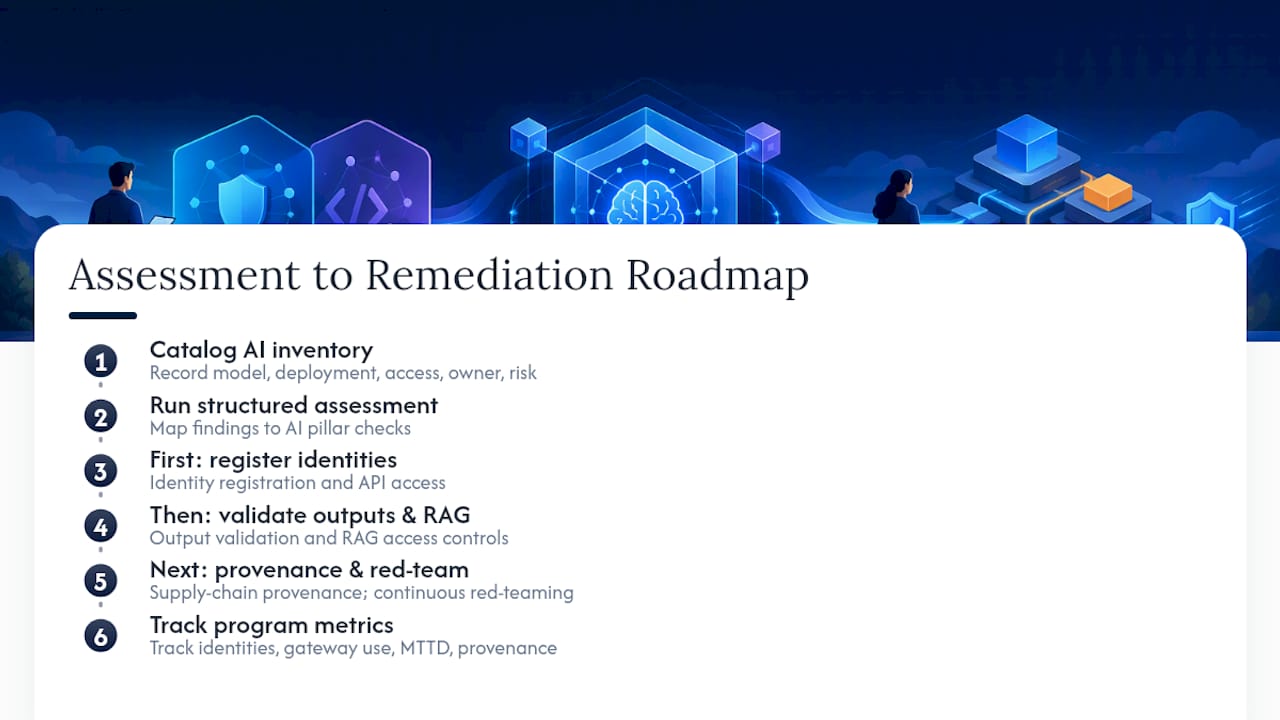
You can’t secure what you haven’t inventoried, and most organizations discover during their first AI assessment that they have far more agents and model integrations running than anyone tracked. Start by cataloging every AI asset with these fields: model provenance and version, deployment mode (cloud API, self-hosted, embedded), access scope, accountable owner, and a risk tier based on what the agent is permitted to touch as recommended by the Panora for Clinics AI wellness layer.
Microsoft’s workshop model offers a workable template: run a structured assessment against the AI pillar’s checks, then convert findings into a First, Then, Next roadmap spanning roughly 12 to 24 months rather than trying to fix everything simultaneously. First covers identity registration and API-mediated access for your highest-risk agents. Then covers output validation and RAG access controls across the broader fleet. Next covers full supply chain provenance and continuous red-teaming.
Testing has to assume an adaptive adversary, not a static one. OWASP’s guidance on red-teaming and adaptive attacker testing points out that static-only defense testing reports artificially low attack success rates, because it doesn’t account for attackers who adjust their approach after the first attempt fails. Baseline against known frameworks like AgentDojo and JailbreakBench, then move to full-disclosure red-team engagements where the testers know your defenses and try to route around them anyway.
Track a handful of metrics as your program matures: percentage of agents with registered identities and short-lived credentials, percentage of tool calls passing through a mediated gateway versus direct access, mean time to detect an anomalous agent action, and the number of production models with a complete provenance manifest. Programs that can’t report these numbers usually can’t tell you whether they’re actually more secure than they were six months ago.
Governance That Keeps AI Systems Auditable Over Time
Architecture and controls only hold up if governance keeps them honest as models get updated, retrained, or replaced. The NIST AI RMF’s Generative AI profile requires documented transparency and provenance policies for training data, plus red-teaming and validation before any generative system goes into production. That’s not a one-time checklist. It’s a standing requirement that has to be revisited every time a model gets fine-tuned or swapped.
A few governance actions carry the most weight in practice:
- Document provenance for every training and fine-tuning dataset, and require the same documentation before accepting a third-party model update.
- Write explicit policies for what an agent’s memory can retain, how long, and who can review or purge it.
- Require human sign-off for any privileged action an agent takes that affects finances, customer data, or external communications.
- Extend procurement reviews to cover model artifacts specifically, including signed provenance and continuous monitoring for supply chain compromise after deployment, not just at purchase.
- Feed AI-specific telemetry (agent action logs, output validation failures, anomalous retrieval patterns) directly into your existing SecOps pipeline instead of building a parallel monitoring stack nobody checks.
Skipping that last point is one of the more common gaps. Security teams build excellent AI-specific logging and then never wire it into the incident response playbook, which means an AI-driven breach gets discovered days later through a support ticket instead of an alert.
How Forge Applies This in Practice
Air-gapped, locally hosted deployment removes an entire category of exfiltration risk that no amount of policy tuning can fully close in a cloud-connected environment. When a model and its data never leave client infrastructure, provenance tracking and access enforcement happen inside a boundary the organization fully controls, not across a third-party API it has to trust blindly.
Forge builds this around agent registration, private model registries, and Entropy-Weighted Quantization, which keeps models efficient enough to run on-premises without the performance trade-offs that usually push teams back toward the cloud. That combination lets security teams enforce the same identity and provenance discipline NIST and OWASP describe, without depending on an external vendor’s trust boundary. For organizations in finance, defense, or energy, that distinction between “trust the cloud provider” and “control the infrastructure directly” often decides whether Zero Trust for AI is enforceable at all, or just aspirational.
What Most Zero Trust Programs Get Backwards
Most organizations treat AI security as an identity problem first and a behavior problem second. That’s backwards. Registering an agent’s identity tells you who’s acting. It tells you nothing about whether the action it’s about to take was shaped by a legitimate instruction or one smuggled in through a document it just read. The research here is consistent: prompt injection and excessive agency dominate the risk list precisely because identity verification happens before the compromise, not during it.
The conventional advice, bolt a policy engine onto your existing IAM stack and call it done, undersells how much runtime enforcement actually costs to build correctly. Output validation, capability budgeting, and memory-write approval gates are engineering work, not configuration work. Teams that skip straight to “we have an AI governance policy” without building those enforcement points end up with a document, not a defense.
If you’re starting from zero, don’t start with governance paperwork. Start with the inventory. You cannot enforce least privilege on an agent you don’t know exists, and most security teams are surprised by how many they find.
— John Ezzell, Founder
Where Forge Fits Into Your Zero Trust Rollout
Forge is the alternative to trusting a third-party cloud API with your model weights and your data. It exists for organizations that read a guide like this one and realize the strongest way to enforce identity, provenance, and output validation is to control the infrastructure those controls run on.
Forge’s services support secure local and air-gapped deployment, model integration and optimization, AI assistant rollout, MLOps and runtime orchestration, and ongoing performance tuning. Each engagement starts with an assessment of your current AI footprint, similar to the inventory step described earlier, then moves into a prioritized deployment plan built around your actual risk tier rather than a generic template. If you’re evaluating whether your organization needs sovereign infrastructure to make Zero Trust for AI enforceable rather than theoretical, the solutions page outlines each service, and requesting an assessment is the practical next step before committing to a deployment path.
Sources
- OWASP Top 10 for LLM Applications 2026
- Artificial Intelligence Risk Management Framework (Generative AI profile)
- New tools and guidance: Announcing Zero Trust for AI | Microsoft Security Blog
- NIST SP 800-207A: Zero Trust Architecture for cloud-native apps
FAQ
What Did Bill Gates Warn About AI?
Bill Gates has publicly cautioned about the pace of AI development outstripping the safeguards built to control it, particularly around autonomous systems acting without adequate human oversight. That concern lines up directly with what OWASP flags as excessive agency, the risk category covering AI systems permitted to take real-world actions without sufficient checks.
What Are the 7 Pillars of Zero Trust?
Zero Trust frameworks typically organize around pillars covering identity, devices, networks, applications and workloads, data, visibility and analytics, and automation and orchestration. Microsoft’s extended model adds AI as its own pillar, reflecting how agents and models introduce risks the original pillars weren’t designed to catch, as described in its Zero Trust for AI guidance.
Is There a Reason Not to Trust AI by Default?
Yes. AI models generate actions from instructions they encounter at runtime, including instructions an attacker planted deliberately, which is exactly what makes prompt injection the top-ranked risk in the OWASP Top 10 for LLM Applications. Treating a model’s output as trustworthy by default, without validation, ignores how that risk actually plays out in production systems.
Is Zero Trust Still Relevant With AI Systems?
Zero Trust is more relevant with AI, not less, because AI expands the number of entities capable of taking action inside your systems. The core principle, never trust by default and verify continuously, applies directly to agents and models; what changes is where and how you enforce it, shifting toward runtime validation of actions rather than one-time login checks.
How Does Forge Support Zero Trust for AI Specifically?
Forge deploys AI systems inside a client’s own infrastructure through air-gapped and locally hosted setups, removing the exfiltration risk that comes with sending data to a third-party cloud API. Pricing for services like sovereign MLOps and private assistant rollout is available on request through the Forge solutions page.