When an AI system misbehaves, responders have a limited window to contain the immediate harm, not to find the root cause. AI incident response adapts traditional cybersecurity workflows with staged remediation: block the exploit path first, expand containment across related systems next, then fix the underlying model or data pipeline over days or weeks. This guide covers the adapted lifecycle, detection signals, playbook archetypes, team roles, and the standards that now govern reporting.
TL;DR:
- Immediate containment actions should be taken within the first hour by blocking exploit inputs and disabling vulnerable interfaces.
- Expand the fix within 24 hours by hunting for related patterns, applying temporary rollbacks, and purging poisoned data when confirmed.
- Long-term resolution involves retraining models, updating classifiers, and validating fixes across diverse input sets before full reinstatement.
- Telemetry logs must include full prompt/response pairs, confidence scores, and inference traces to detect and analyze probabilistic failures effectively.
- Cross-disciplinary teams with ML expertise are essential for timely incident response, and structured playbooks help standardize reactions across archetypes.
Table of Contents
- Why AI incidents differ from traditional incidents
- The AI-adapted incident response lifecycle and staged remediation
- Detection, observability, and telemetry checklist
- Containment and remediation tactics from the first hour to long-term fixes
- Roles, staffing, and cross-functional coordination
- Playbooks and archetypes you can adopt
- Standards, reporting, and interoperable incident records
- Post-incident metrics, after-action review, and continuous improvement
- How sovereign and air-gapped deployments change incident response
- Integration of AI incident response with traditional cybersecurity incident response
- Legal and regulatory implications specific to AI incidents
- Communication strategies and stakeholder management during AI incidents
- Author perspective and tradeoffs security leaders must accept
- A sovereign alternative for reducing certain incident surfaces
- Sources
- FAQ
Why AI incidents differ from traditional incidents
Traditional security incidents usually have a deterministic cause: a patched vulnerability, a stolen credential, a misconfigured firewall rule. AI incidents rarely work that way. A model’s outputs are probabilistic, so the same prompt can produce a safe answer nine times and a harmful one on the tenth try, which makes reproducibility, and therefore root cause analysis, much harder to pin down.
Severity is also context dependent. A hallucinated fact in a marketing chatbot is a nuisance; the same failure mode in a clinical decision support tool is a safety incident. New harm categories have emerged alongside this shift, including prompt injection, memory or context poisoning, retrieval-augmented generation (RAG) poisoning, and agentic cascade failures where one compromised agent triggers actions in downstream systems.
Compounding the problem, many organizations lack the telemetry to even see these failures happening, partly because privacy-by-design logging defaults strip out the prompt and output data investigators need. The operational implication is straightforward: classify incidents by the harm caused and the deployment domain affected, not by raw event counts, since a single high-severity manipulation matters more than a thousand low-risk anomalies.
The AI-adapted incident response lifecycle and staged remediation
The core structure of NIST SP 800-61 still applies: preparation, detection and analysis, containment and eradication, recovery, and post-incident review. What changes for AI systems is the containment phase, which needs to happen in stages because a single fix rarely resolves a probabilistic failure.
- Stage 1, the first hour: apply immediate containment, such as blocking known exploit inputs, disabling a vulnerable interface, or activating emergency content filters.
- Stage 2, within 24 hours: expand and strengthen the fix by hunting for related patterns across other model endpoints and applying temporary rollbacks where the blast radius justifies it.
- Stage 3, days to weeks: fix at the source through retraining, safety classifier updates, or data pipeline patches, validated across a diverse input set rather than a single replay test.
Each stage needs a decision gate with a named owner (a RACI matrix works well here) and a target SLA, for example a 60-minute window for Stage 1 containment and a 24-hour window for Stage 2 expansion. Documenting who approved each gate and why is what makes a playbook auditable after the fact rather than just a checklist someone followed informally.
Detection, observability, and telemetry checklist
You cannot contain what you cannot see, and AI systems generate a different kind of blind spot than traditional infrastructure. The telemetry that matters most includes prompt logs, model outputs, confidence scores, inference traces, and, for agentic or memory-enabled systems, memory state changes and retrieval logs.
- Prompt and output logs: capture the full input/output pair, not a summary, so responders can replay the interaction.
- Confidence and anomaly signals: track classifier confidence shifts and output anomalies as early indicators of drift or manipulation.
- Tool execution traces: log every action an agent takes, since agentic cascades often start with one silent tool call.
- User-report spikes: a sudden jump in flagged responses is often the first human-detected signal, well before automated monitoring catches it.
Retaining this data safely and honoring privacy requires access controls that limit who can query raw prompts, paired with retention windows long enough to support an investigation. Practitioners building AI observability generally treat output anomalies, confidence drift, and report-volume spikes as the three earliest warning metrics worth alerting on, since each tends to move before a full-blown incident is confirmed.
Containment and remediation tactics from the first hour to long-term fixes
Time-phasing your response keeps a chaotic first hour from turning into a chaotic first week. The sequence below mirrors the staged model but adds concrete tactical detail.
- Immediate triage (minutes to one hour): disable the affected interface or endpoint, block the specific exploit input pattern, engage any emergency content filters, and isolate the compromised component from dependent systems.
- 24-hour response: run automated pattern hunting across logs to find related exploit attempts, apply temporary model rollbacks, and purge vector database entries when poisoning is confirmed and the purge is justified by evidence, not suspicion.
- Longer-term fixes: retrain or fine-tune the affected model, update safety classifiers, patch the data ingestion pipeline, and validate the fix against a broad, diverse input set rather than the original failing example alone.
- Watch period before reinstatement: run canary testing on a limited population before restoring full traffic, and hold the fix in observation long enough to confirm the anomaly does not resurface.
Pro Tip: Treat every allow/block list as a temporary patch, not a fix. If a tactical filter remains your primary defense for an extended period after the incident, the root cause has not been addressed.
Roles, staffing, and cross-functional coordination
AI incidents cut across disciplines that rarely sit in the same room during a traditional security incident. Getting the composition right shortens containment time far more than any single tool.
- Incident commander: owns the decision gates and keeps the response on schedule.
- SecOps and IT security: handle containment actions on infrastructure and access control.
- ML engineers and data scientists: interpret model-state changes, confidence drift, and causal hypotheses that non-specialists cannot read from logs alone.
- SRE and infrastructure: manage rollbacks, canary deployments, and system isolation.
- Legal and communications: assess regulatory exposure and manage external messaging.
Cross-functional teams that include ML expertise are better positioned to diagnose subtle failures like memory poisoning that a standard security analyst would likely miss. Responder wellbeing matters too: build in rotation schedules, cognitive breaks during extended incidents, and peer mentoring for less experienced responders. Run at least one AI-specific tabletop exercise annually so the team has practiced these roles before a real incident forces the issue.
Playbooks and archetypes you can adopt
Grouping incidents by archetype, rather than treating every event as unique, gives responders a known sequence of actions to reach for instead of improvising under pressure.
- Prompt injection and jailbreak attempts, where crafted inputs bypass intended behavior constraints.
- Memory or context poisoning, where an attacker corrupts persistent state a model relies on.
- RAG or data poisoning, where the retrieval corpus itself is compromised.
- Model extraction, where an adversary reconstructs model weights or behavior through repeated querying.
- Credential-driven cloud abuse, where stolen access keys are used to manipulate model infrastructure.
- Agentic cascade failures, where one compromised agent triggers unintended actions downstream.
Each playbook should specify an objective, the triggers that activate it, the containment actions, the decision gate and its owner, the evidence to preserve, the communications plan, and clear exit criteria. Codifying these in a structured format such as OASIS CACAO, or an equivalent internal runbook system, makes the playbook machine-readable and auditable. A response-centric taxonomy grouped by containment workflow reduces the cognitive load on responders during a live incident and has shown improved resolution times in controlled evaluations compared with ad hoc handling.
Standards, reporting, and interoperable incident records
Aligning with published standards is what turns an internal playbook into something regulators and partner organizations can trust.
- NIST: SP 800-61 provides the base incident response lifecycle, while NIST’s AI-specific guidance recommends classifying incidents by harm category and deployment domain.
- ETSI AICIE: the AI Common Incident Expression defines a standardized container format, modeled after CVE-style records, for sharing structured AI incident data across organizations.
- OWASP GenAI: its incident response guidance treats prompts as a primary attack surface and recommends unified logging of model inputs, outputs, and pipeline events.
- Reporting practice: decide redaction rules before an incident happens, since AICIE’s structured fields allow selective redaction for legal reasons while still preserving enough detail for community learning.
Post-incident metrics, after-action review, and continuous improvement
Close every incident with a written record covering evidence captured, root cause hypotheses, and how durable the remediation proved during the watch period. Track mean time to detect, time to contain, time to full remediation, and recurrence rate over subsequent months. Feed the findings into your AI asset inventory and risk register, and revisit playbooks after every tabletop or real incident so the next response starts from a stronger baseline.
How sovereign and air-gapped deployments change incident response
Air-gapped deployments change the containment calculus: there is no external network path for data to exfiltrate through, which narrows several harm categories before an incident even starts. Forge AI’s approach keeps data, models, and telemetry inside the client’s own infrastructure. The tradeoff is that remote debugging and vendor-side updates need local equivalents. Checklist: verify telemetry retention, offline runbook capability, local canary testing, and audit trails before relying on this model.
Integration of AI incident response with traditional cybersecurity incident response
AI incident response is not a separate discipline that replaces traditional security operations, it extends the existing incident response function. A prompt injection attack that leads to a compromised API key is, at that point, a standard credential abuse incident that your existing SecOps playbooks already cover. The AI-specific layer sits upstream of that: detecting the injection, understanding why the model was vulnerable to it, and containing the immediate output-level harm before the incident becomes a conventional breach.
Practically, this means your security operations center needs a shared escalation path between AI-specific monitoring (confidence drift, output anomalies) and traditional SIEM alerting (unusual API traffic, credential misuse). Treating them as two disconnected pipelines creates blind spots, because an agentic cascade failure can start as a model-level anomaly and end as a full infrastructure compromise if a compromised agent has write access to production systems.
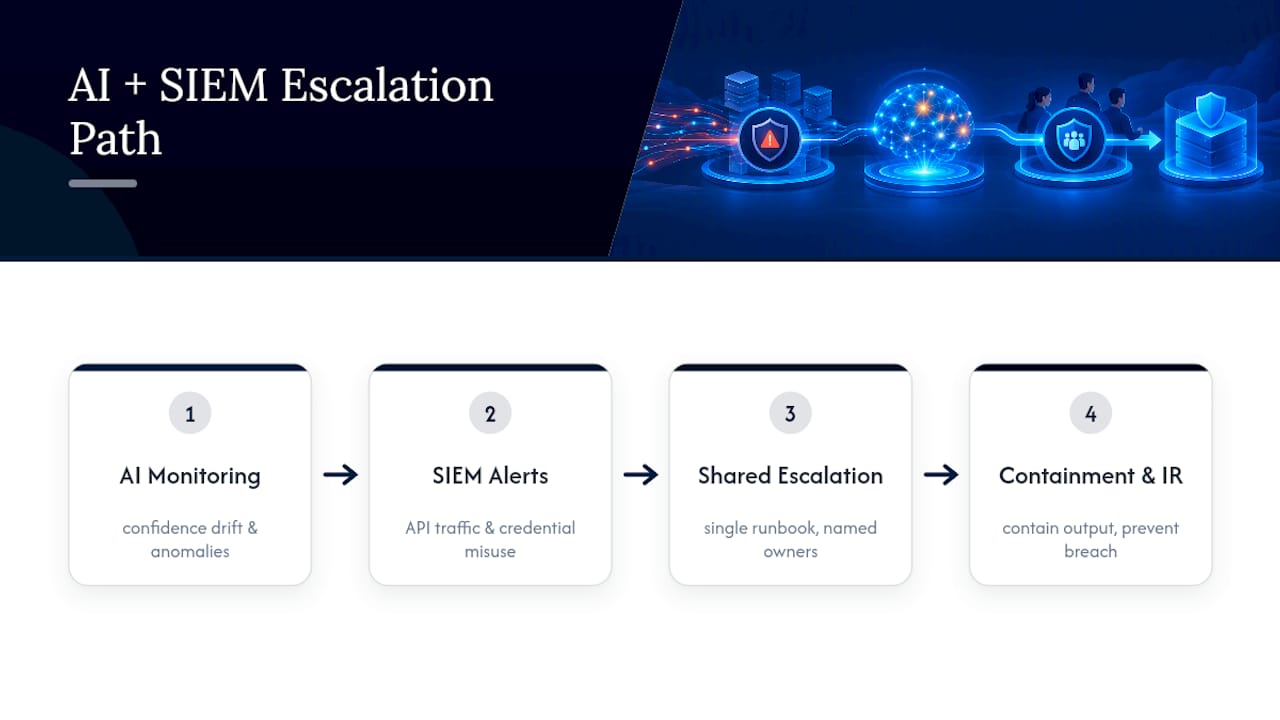
The RACI structure should reflect this overlap. Your incident commander and SecOps lead need visibility into both tracks, and your ML engineers need a direct line into the traditional IR team rather than being consulted only after containment decisions are already made. Organizations that run AI incident response as a bolt-on function, separate from their existing SOC, tend to lose time in the handoff between “this is a model problem” and “this is now also an infrastructure problem.” Building a single escalation runbook that names both the AI-specific and traditional response owners at each decision gate closes that gap and keeps the staged remediation model moving without a restart in a different team’s queue.
Legal and regulatory implications specific to AI incidents
AI incidents carry legal exposure that traditional breaches do not always trigger. A model that produces discriminatory outputs, leaks training data, or causes physical or financial harm through automated decisions can create liability even when no traditional data breach occurred, because the harm comes from the model’s behavior rather than from unauthorized access to a system.
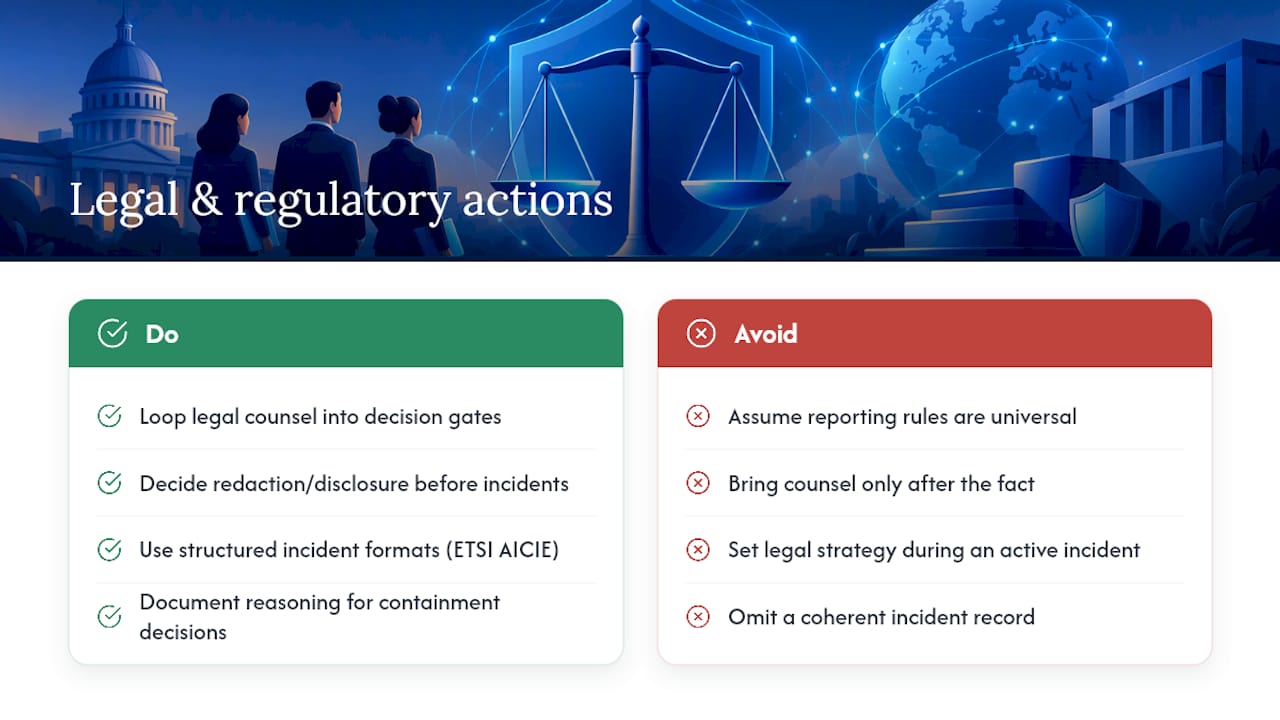
Regulatory obligations vary significantly by jurisdiction and sector, so treat any specific reporting deadline, disclosure threshold, or liability standard as a matter for your legal counsel and the primary regulator governing your market, rather than as a universal rule. What is consistent across frameworks is the expectation that organizations can produce a coherent incident record. This is precisely what structured formats like ETSI’s AICIE are designed to support: a container format detailed enough to satisfy a regulator’s request for evidence while still allowing selective redaction of sensitive fields.
Legal counsel should be looped into the decision gates for any incident touching personal data, automated decision-making, or a regulated sector such as finance or healthcare, not brought in only after the fact. Decide your redaction and disclosure approach before an incident happens rather than during one, since the pressure of an active incident is the wrong time to be settling on legal strategy for the first time. Document the reasoning behind every containment decision, since that record is often what demonstrates reasonable care if the incident is later reviewed by a regulator or in litigation.
Communication strategies and stakeholder management during AI incidents
Communication during an AI incident has to satisfy audiences with very different needs at the same time: internal engineering teams need technical specifics, executives need a clear risk summary, and any external users affected need plain language they can act on. Trying to write one message for all three usually satisfies none of them.
Internally, the incident commander should issue short, frequent updates tied to each decision gate rather than waiting for a complete picture, since AI incidents often take longer to fully diagnose than to contain. Executives need to know the business impact and the current containment status, not the technical mechanism of a classifier confidence shift. Give them a one-line risk statement updated at each stage, not a raw telemetry dump.
External communication, when required, should be reviewed jointly by legal and communications before release, since a premature technical explanation can create liability if the root cause hypothesis later turns out to be wrong. Where users were affected by a harmful or incorrect output, transparency about what happened tends to preserve trust better than a vague statement, provided the explanation has been legally reviewed first. Keep a single source of truth for the incident timeline that all stakeholder communications draw from, so that internal updates, executive briefings, and any external statement stay consistent with each other as the incident evolves.
Author perspective and tradeoffs security leaders must accept
Staged remediation and watch periods are not optional extras, they are the only realistic way to handle probabilistic failure. Investing in ML expertise on the IR team consistently shortens containment because someone needs to read model-state signals that a generalist analyst cannot. The real constraint is not technology but governance buy-in and the ongoing tension between privacy-by-design logging and the telemetry investigators actually need.
— John Ezzell, Founder
A sovereign alternative for reducing certain incident surfaces
Some incident categories, particularly data exfiltration and cloud-side model manipulation, are structurally harder to trigger when data never leaves your own infrastructure. For organizations weighing that tradeoff, sovereign, air-gapped deployments are one option worth a closer look.
Forge AI builds these deployments end to end, including secure local and air-gapped rollout, custom model integration, and ongoing operations support. If sovereignty and auditability matter more to your incident response posture than convenience, a capabilities discussion is a reasonable next step.
Sources
- Defending AI Systems: A New Framework for Incident Response in the Age of Intelligent Technology
- Respond to incidents in AI systems
- ETSI TS 104 158-1: AI Common Incident Expression (AICIE) Global Framework
FAQ
What counts as an AI incident?
An AI incident is any event where a model’s behavior, outputs, or underlying data cause harm, including prompt injection, data or memory poisoning, discriminatory outputs, or unauthorized data exposure. The CoSAI framework recommends classifying these by harm category and affected population rather than by event count alone.
How is AI incident response different from standard incident response?
AI incident response adapts the traditional lifecycle with staged remediation rather than a single containment step, since AI failures are probabilistic and rarely have one reproducible cause. Microsoft’s guidance describes this as an immediate containment, expand and strengthen, and fix at source sequence.
What telemetry should teams collect for AI systems?
Teams need prompt and output logs, confidence scores, inference traces, and for agentic systems, memory state and tool execution histories. OWASP’s GenAI guidance treats unified logging of model inputs and outputs as essential for both detection and post-incident forensics.
Who should be on an AI incident response team?
An effective team includes an incident commander, SecOps, ML engineers, data scientists, infrastructure or SRE staff, legal, and communications. Cross-functional frameworks emphasize that ML and data science presence is necessary to interpret model-state and memory poisoning signals that generalist analysts often miss.
What standards apply to AI incident reporting?
NIST provides the base lifecycle and AI-specific harm classification, while ETSI’s AICIE framework defines a structured container format for sharing incident records across organizations. OWASP GenAI guidance complements both with practical logging and taxonomy recommendations for generative systems specifically.