AI model governance is the set of policies, roles, and technical controls that tell you which models are running, what data they touch, who approved them, how they are monitored, and how you can prove all of it to an auditor. Policies alone do not get you there. The strongest programs enforce governance in the infrastructure where the models run, and that is far easier when the models, data, and logs sit inside a perimeter you control.
This guide covers what model governance includes, how it differs from broader AI governance, which frameworks matter in the US and beyond, and how to build a program that survives an audit. It is written for risk, security, and platform leaders at regulated enterprises.
TL;DR
- Model governance covers the model lifecycle: inventory, documentation, approval, monitoring, audit trail, and retirement. AI governance is the wider umbrella that also covers ethics, policy, and organizational accountability.
- Start with the NIST AI Risk Management Framework for structure and ISO/IEC 42001 if you need a certifiable management system.
- US banks should note that the April 2026 SR 26-2 guidance replaced SR 11-7, and that generative and agentic AI sit outside its stated scope, so your own governance has to fill the gap.
- Controls that live in the runtime (identity, encryption, logging) beat controls that live in documents.
- Keeping models, data, and logs inside infrastructure you control makes evidence simpler to produce and data exfiltration easier to rule out.
Table of Contents
- What AI model governance actually covers
- The frameworks worth knowing
- From policy to runtime: where governance usually fails
- A working governance program in seven steps
- Why the deployment environment decides how hard governance is
- Our perspective: governance is an operating discipline
- Common mistakes to avoid
- Putting governance into production with Forge
- FAQ
- Sources
What AI model governance actually covers
Most definitions agree on the core: the policies, processes, and controls used to document, monitor, audit, and control models across their life. In practice, that breaks into six working parts.
- Inventory. A living register of every model in use, including fine-tuned variants, embedded vendor models, and the “shadow” assistants teams adopted on their own.
- Documentation. Model cards or equivalent records: purpose, training and grounding data, known limits, evaluation results, owner.
- Approval gates. Who signs off before a model reaches production, and what evidence they need.
- Access control. Which people, services, and agents can call the model, and which data sources it may read.
- Monitoring. Drift, accuracy, hallucination rates, misuse, and security events, tracked against thresholds you set in advance.
- Audit trail and retirement. Records that let you reconstruct how a model was used in a specific decision, and a process to decommission it.
Model governance is narrower than AI governance. AI governance also sets organizational principles, decision rights, and investment priorities. Model governance is where those principles become something an engineer can implement and an auditor can test.
The frameworks worth knowing
You do not need to adopt every framework. You need to pick one as your backbone and map the others to it.
| Framework | Type | Best for | Note |
|---|---|---|---|
| NIST AI RMF 1.0 | Voluntary, sector-agnostic | US enterprises building a risk program | Four functions: Govern, Map, Measure, Manage |
| NIST AI 600-1 | Generative AI profile | Teams running LLMs | Covers confabulation, data privacy, value chain risk |
| ISO/IEC 42001:2023 | Certifiable management system standard | Organizations that need external assurance | Plan-Do-Check-Act structure |
| SR 26-2 | US bank supervisory guidance | Banking organizations | Replaces SR 11-7 |
| EU AI Act | Binding regulation | Anyone placing AI on the EU market | Phased through 2028 |
| OECD AI Principles | Values-based principles | Policy language and board-level alignment | Five principles plus recommendations |
NIST AI RMF and the generative AI profile
The NIST AI Risk Management Framework was released in January 2023 as a voluntary, flexible approach. Organizations usually operationalize it through its four functions: Govern, Map, Measure, and Manage. In July 2024, NIST added a Generative AI Profile (AI 600-1) that addresses risks specific to large-scale models, such as confabulation and data privacy. If you are deploying language models, treat the profile as required reading. For a step-by-step approach, see our guide to operationalizing NIST AI risk management.
ISO/IEC 42001
ISO/IEC 42001:2023 is described by ISO as the first formal AI management system standard. It follows a Plan-Do-Check-Act cycle, which suits organizations that want governance to outlast individual pilots. If your leadership is asking how to make that cycle stick across teams, this walkthrough of change management before scaling AI is a useful companion, even though it is written with a Canadian business audience in mind.
SR 26-2 for US banks
On April 17, 2026, the Federal Reserve, with the OCC and FDIC, issued SR 26-2, revised model risk management guidance that replaces SR 11-7. It takes a risk-based approach and is aimed mainly at banking organizations with more than $30 billion in total assets.
The detail that matters for AI teams: according to one analysis of the guidance, a scope footnote says generative and agentic AI models are novel and rapidly evolving, and so fall outside the guidance. Banks are told to rely on their own risk management and governance practices for those systems. That does not make them ungoverned. It means your internal program is the control, and examiners will expect to see it. Read the guidance itself and confirm the scope with your compliance and legal teams before you rely on any summary, including this one.
EU AI Act
If you operate in or sell into the EU, the AI Act timeline is progressive, with a full roll-out foreseen by August 2, 2028. Rules for general-purpose AI models have applied since August 2, 2025. Annex III high-risk systems, such as those in employment or critical infrastructure, face a December 2, 2027 deadline, and those embedded in regulated products have until August 2, 2028. Timelines have been amended before, so check the official page for current dates. Our role-based EU AI Act roadmap breaks down who owes what.
OECD principles
The OECD AI Principles give you the vocabulary for board-level policy: inclusive growth and well-being, human-centered values and fairness, transparency and explainability, robustness and security, and accountability. They are meant to be read together across the whole lifecycle, not picked from like a menu.
From policy to runtime: where governance usually fails
The common failure is a governance program that lives in slide decks and spreadsheets while the models run somewhere else, behind an API, with logs held by a third party. When an auditor asks who queried what, the answer takes weeks to assemble.
Practitioners writing on model risk in banking make the same point: compliance has moved from a paper exercise to a runtime requirement, with identity, encryption, and audit controls built into the AI infrastructure rather than layered on afterward. The same source flags audit trail requirements as a specific gap: you need records that let you reconstruct how a model was used in any particular decision. For LLMs, that means retaining prompts, retrieved sources, and outputs, which are exactly the records many hosted tools do not give you.
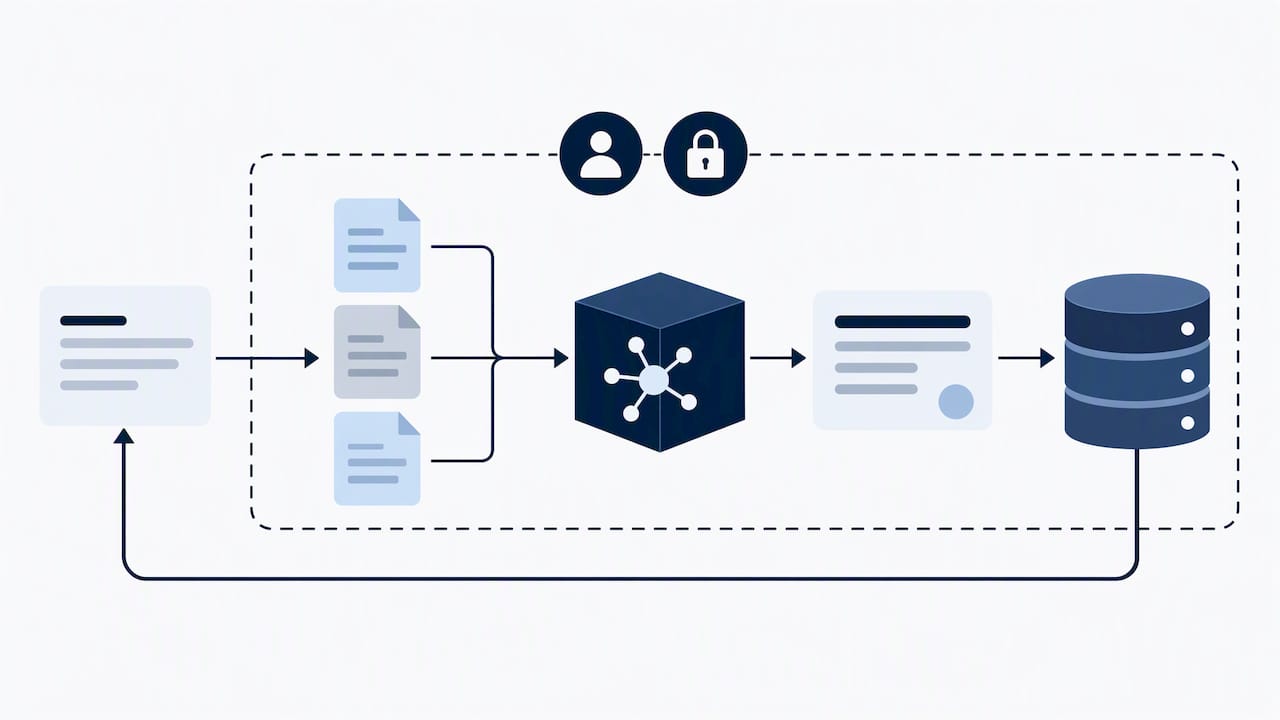
The same logic appears in regulated life sciences. A guide to air-gapped private LLMs in pharma notes that recording what outputs were generated falls under Part 11-style rules, and that model usage must be limited to authorized personnel, with managerial sign-off for high-stakes uses.
A working governance program in seven steps
- Build the inventory first. Include every model, version, and the data sources each one can read. You cannot govern what you have not found.
- Assign owners. Every model gets a named business owner and a named technical owner. Governance without owners becomes a committee.
- Tier by risk. A model that summarizes internal manuals is not the same as one that influences credit, safety, or hiring decisions. Tier them and scale the evidence required.
- Set approval gates. Define the evidence for each tier: evaluation results, red-team findings, data lineage, privacy review.
- Restrict data access by design. Give the model only the sources its users are already entitled to see. Access-controlled retrieval is a governance control as much as a quality one.
- Log everything that matters. Prompts, sources retrieved, outputs, user identity, model version, and configuration changes, stored where you control retention.
- Review on a schedule. Re-evaluate on a fixed cadence and after any model, data, or prompt change, then retire what no longer earns its place.
Grounding is a governance lever
Architecture choices change your risk profile. One experimental study of a secure air-gapped LLM framework reported that rigorous retrieval grounding against access-controlled local knowledge cut hallucination rates from 38.7% to 12.2% in a high-capacity model deployment. That is one study in one setting, not a promise for your environment, but the lesson transfers: how a model is grounded often matters more than how large it is, and grounded answers that cite sources are far easier to audit.
Why the deployment environment decides how hard governance is
Governance is about evidence. Where models run determines how much evidence you can get and how much you must take on trust.
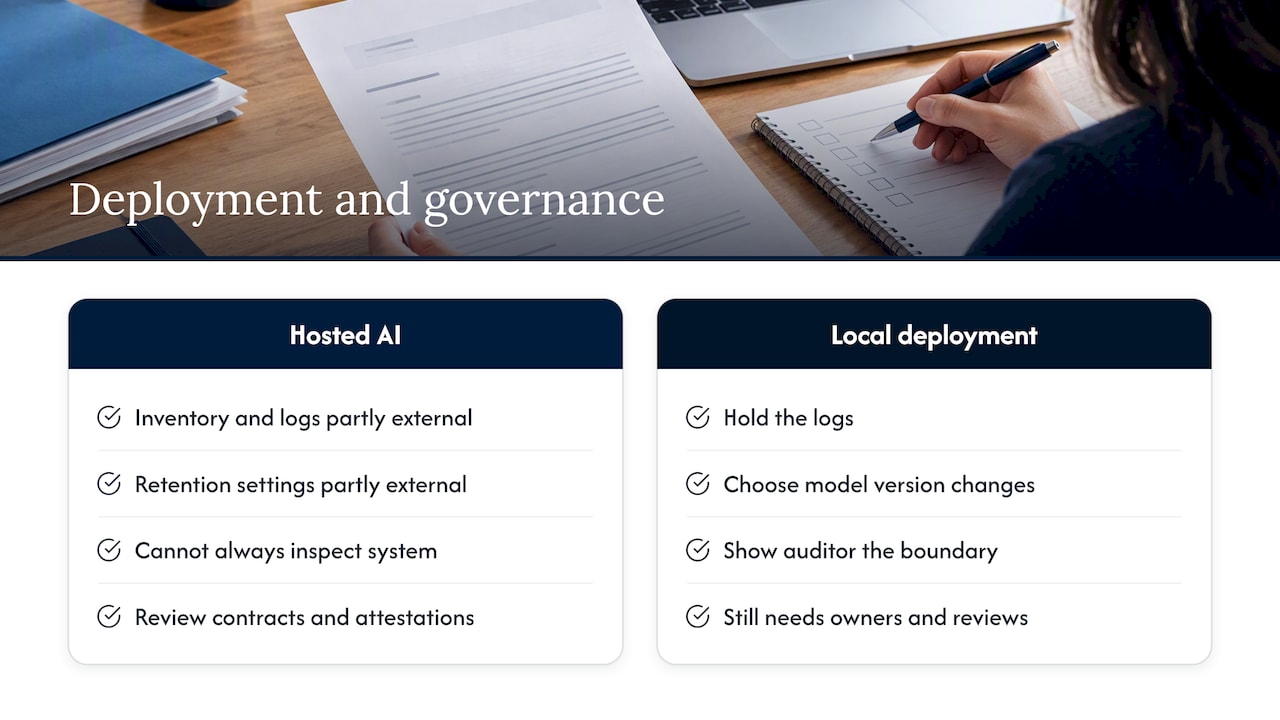
With a hosted AI service, your inventory, logs, retention settings, and model updates are partly in someone else’s hands. You can negotiate contracts and review attestations, but you cannot always inspect the system. With models deployed inside your own data center, edge sites, or an air-gapped network, you hold the logs, you decide when a model version changes, and you can show an auditor the boundary. That is why regulated organizations increasingly treat deployment location as a governance decision. Related reading: the six paths enterprise AI data leaks take, AI supply chain provenance, and mapping NIST and OWASP into runtime zero trust.
None of this makes on-premises AI automatically compliant. You still need the inventory, the owners, the tiers, and the reviews. What local deployment does is remove a category of unknowns.
Our perspective: governance is an operating discipline
We see the same pattern in high-consequence environments. Teams write a thoughtful policy, then discover that the system it describes cannot produce the evidence the policy demands. The fix is rarely more paperwork. It is designing the deployment so the evidence is a byproduct of operation.
At Forge AI Deployment, our leadership brings more than 20 years of experience in high-consequence and Fortune 100 environments, and that shapes how we approach this. We deploy and operate webAI’s local-first platform as an official webAI systems integrator. That includes private and air-gapped deployment, specialized AI Personas, the Intelligence Delivery Network, and webAI Frontline, which gives frontline teams fast, source-backed answers from large technical document libraries, fully offline on a single device. We do not treat these as software to hand over and walk away from. We design the architecture, deploy it, and run it, so that data, models, and domain intelligence stay inside the customer’s infrastructure.
Our advice: decide where your evidence will come from before you pick a model. If answers must cite their sources, if access must follow existing entitlements, and if logs must stay in your custody, those requirements will narrow your architecture options early, which is where you want them to.
— John Ezzell, Founder
Common mistakes to avoid
- Governing only the model, not the pipeline. Retrieval sources, prompts, and tool permissions change behavior as much as weights do.
- Treating the framework as the program. Mapping to NIST or ISO is a start. Auditors test whether controls operate.
- Assuming guidance covers generative AI. As SR 26-2 shows, regulators may explicitly leave it to your own practices.
- Ignoring people. Staff who do not trust or understand the approved tool will use an unapproved one. See our piece on when to air gap and how to bring people along.
- Skipping retirement. Unused models with live data connections are quiet liabilities.
Putting governance into production with Forge
If your governance requirements point toward keeping models and data inside your own perimeter, that is the work we do. Forge AI Deployment handles secure local and air-gapped deployment, custom model integration, private AI assistant rollout, sovereign MLOps and runtime orchestration, and ongoing operations. You can review the full scope on our solutions page, read how the webAI platform fits into our deployments, or start with our checklist of five checks before sovereign AI goes live.
FAQ
What is the difference between AI governance and AI model governance?
AI governance is the broad organizational layer: principles, decision rights, risk appetite, and compliance. Model governance is the operational layer within it, focused on the lifecycle of specific models: inventory, documentation, approval, monitoring, and audit. You need both, and the second is how the first gets enforced.
Does SR 11-7 still apply to AI models at banks?
SR 11-7 was replaced by SR 26-2 on April 17, 2026. Its principles still apply to traditional statistical and non-generative models, but generative and agentic AI are described as outside its scope. Confirm your obligations with your compliance team and primary regulator.
Which framework should we start with?
For most US enterprises, start with the NIST AI RMF and its generative AI profile because they are voluntary, flexible, and widely recognized. Add ISO/IEC 42001 if customers or regulators want a certifiable management system. Add the EU AI Act mapping if you serve EU markets.
Can on-premises AI meet governance requirements better than cloud AI?
It can make evidence easier to collect, because you control logs, model versions, and data boundaries. It does not replace the program itself. You still need owners, risk tiers, approval gates, and regular review.
Sources
- NIST AI Risk Management Framework
- NIST Generative AI Profile (AI 600-1)
- ISO/IEC 42001:2023
- Federal Reserve SR 26-2
- SR 26-2 analysis, CIMCON Software
- EU AI Act implementation timeline
- OECD Recommendation on Artificial Intelligence
- AI Model Risk Management: SR 11-7 for LLMs, EVE Core
- Private LLM in Pharma: Air-Gapped AI Architecture Guide, IntuitionLabs
- Secure Air-Gapped LLM-Based Intelligence Analysis Framework, Sciety