The NIST AI Risk Management Framework (AI RMF) is a voluntary, non-sector-specific system built around four key functions commonly applied to help organizations identify and reduce risks in AI systems. It applies to any organization building, buying, or deploying AI, and it scales down or up depending on how much of it you adopt. The first move is not a document. It’s naming a governance owner and scoping which AI systems actually exist inside your organization.
TL;DR:
- Most organizations must tailor the AI RMF’s governance, measurement, and risk management activities to fit their specific AI systems and operational context.
- Continuous mapping, testing, and updating are essential, especially in high-security environments where offline procedures and strict change controls are required.
- Proper ownership, clear documentation, and integration with existing risk and compliance processes prevent fragmented efforts and ensure effective risk reduction.
- Measurement should include performance, fairness, safety, and security metrics, with regular review cadences to detect drift and address new risks.
- Deploying within secure, air-gapped infrastructures often necessitates specialized tools and partners, such as Forge AI Deployment, to maintain governance without data exfiltration.
Table of Contents
- What Is the NIST AI Risk Management Framework?
- AI RMF Core Functions: What Govern, Map, Measure, and Manage Actually Require
- How Do You Actually Implement the NIST AI RMF?
- What Should You Measure, and How Often?
- Aligning the AI RMF With Existing Governance, Procurement, and Audit
- Profiles, Generative AI Risks, and Keeping Up With Framework Updates
- Common Pitfalls When Adopting the AI RMF
- What Successful AI RMF Adoption Looks Like in Practice
- Tools and Resources for Putting the AI RMF Into Practice
- Where to Go Next for Primary NIST Materials
- A Practitioner’s View on Making the RMF Work in High Security Environments
- How Forge Helps Operationalize the AI RMF Without Compromising Data Control
- Sources
- FAQ
What Is the NIST AI Risk Management Framework?
NIST published AI RMF 1.0 to give organizations a common structure for thinking about AI risk without dictating a single compliance checklist. It’s voluntary and non-prescriptive, which means no regulator is going to audit you against it directly, but plenty of procurement teams, insurers, and boards now treat it as the baseline vocabulary for AI governance conversations.
The Framework’s target audience is broad by design: engineering teams building models, executives setting risk appetite, procurement staff vetting vendors, and legal or compliance teams documenting decisions. NIST calls anyone involved in designing, developing, deploying, or using an AI system an “AI actor,” a term that spans data scientists, third-party vendors, and the business users who ultimately rely on a model’s output.
What makes the AI RMF different from a typical security framework is its focus on trustworthiness rather than pure risk avoidance. NIST defines trustworthy AI through a set of characteristics that organizations are expected to weigh against each other, since improving one can sometimes trade off against another:
- Valid and reliable — the system performs as intended, consistently, under expected conditions.
- Safe — it doesn’t create physical, psychological, or operational harm.
- Secure and resilient — it withstands adversarial manipulation and recovers from failure.
- Accountable and transparent — decisions and data lineage can be traced and explained.
- Explainable and interpretable — outputs can be understood by the humans relying on them.
- Privacy enhanced — data handling respects data minimization and consent principles.
- Fair, with harmful bias managed — outcomes don’t systematically disadvantage groups.
Two companion resources make the Framework usable rather than theoretical. The NIST AI RMF Playbook breaks each Core function into suggested actions, sample documentation, and references organizations can lift directly into their own procedures. The AI Risk Management Framework hub and the associated Trustworthy and Responsible AI Resource Center, known as AIRC, host use-case examples, crosswalks to other standards, and updates as NIST revises the guidance. Neither is optional reading if you’re serious about implementation. They’re the difference between reading a policy and actually operationalizing one.
AI RMF Core Functions: What Govern, Map, Measure, and Manage Actually Require
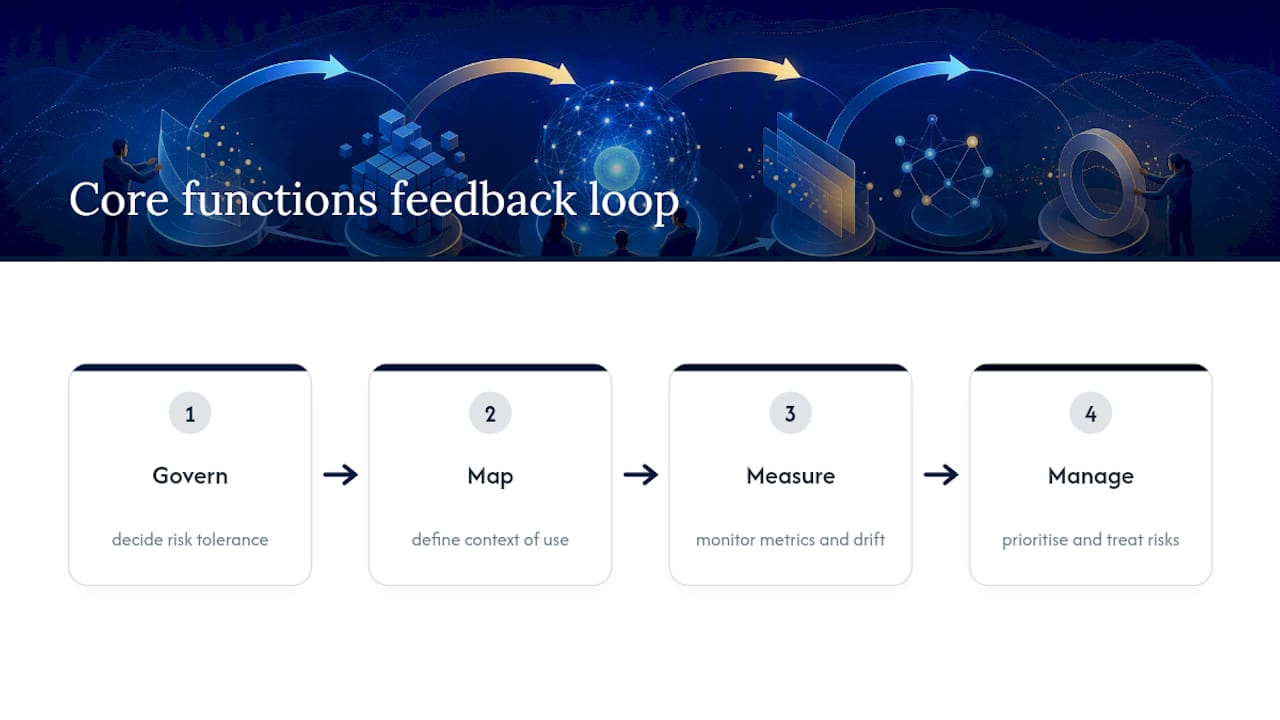
The AI RMF Core organizes everything into four functions, each split into categories and subcategories that organizations tailor to their own risk profile. NIST doesn’t intend these to run in strict sequence. Govern threads through the other three continuously, and Map, Measure, and Manage feed back into each other as systems evolve. Here’s what each function demands in practice.
Govern: setting the rules before you need them
Govern is the cross-cutting function, and NIST is explicit that it should be infused throughout the other three rather than treated as a one-time kickoff meeting. In practice, Govern means an organization has:
- A documented risk tolerance for AI, distinct from general IT risk tolerance.
- A named decision authority for approving, pausing, or retiring AI systems.
- Policies covering third-party and vendor AI risk, not just internally built models.
- A process for documenting decisions so they survive staff turnover and audits.
Without Govern in place first, the other three functions tend to produce inconsistent, undocumented judgment calls. One team measures bias, another doesn’t, and nobody can explain why.
Map: knowing what you actually have
Map is the inventory and context function. You cannot manage risk in a system you don’t know exists, and most organizations underestimate how many AI-driven tools are already running inside procurement, HR, and customer service workflows. Mapping involves:
- Cataloging every AI system in use, including embedded features inside third-party software.
- Documenting the intended use case, deployment context, and who is affected by the system’s outputs.
- Identifying stakeholders, including the people impacted by decisions the system makes or informs.
- Assessing the potential for both intended benefits and unintended impacts before deployment.
This is where most gaps show up first. A marketing team using a generative tool for customer email drafts and an underwriting team using a model to score risk look nothing alike in impact, yet both are “AI systems” that belong in the inventory.
Measure: testing claims instead of trusting them
Measure is where testing, evaluation, verification, and validation, TEVV for short, live. NIST’s guidance is blunt: measurement outcomes need to be repeatable, documented, and tied directly to decisions, and TEVV should follow scientific, legal, and ethical norms and be conducted transparently wherever possible. That rules out ad hoc spot checks as a substitute for a real measurement plan.
Measure activities typically include quantitative testing (accuracy, false positive and false negative rates, subgroup performance gaps) alongside qualitative review (red-teaming, user feedback, expert audits). Neither replaces the other. A model can pass every accuracy benchmark and still fail a fairness review once you look at outcomes by demographic group.
Manage: acting on what you find
Manage turns measurement results into treatment plans. This function covers prioritizing which risks get resourced first, building incident response procedures specific to AI failure modes (a chatbot hallucinating a policy, a scoring model drifting after a data source changes), and setting service-level expectations for how fast issues get triaged.
Manage is also where continuous improvement lives. Risk treatment isn’t a one-time fix; it’s a loop that feeds back into Map (did the context of use change?) and Measure (do we need new metrics now that the model is in production?).
Pro Tip: Build your risk register with a column for “which Core function last touched this risk.” It sounds bureaucratic, but it’s the fastest way to catch a risk that got measured once and never revisited.
The functions intersect constantly. A Measure finding (a fairness metric drifting) triggers a Manage response (retraining or restricting use), which then requires a Govern decision (does this cross our risk tolerance threshold?) and a Map update (has the context of use changed enough to warrant re-scoping?). Treating the four functions as a checklist to complete once, in order, is the single fastest way to misuse the Framework.
How Do You Actually Implement the NIST AI RMF?
Reading the Framework and implementing it are two different jobs, and the gap between them is where most AI governance programs stall. Here’s a sequence that turns the Core functions into working artifacts rather than a slide deck nobody revisits.
- Name a governance owner and assemble a cross-functional team. This person or small group needs authority to pause a deployment, not just advise on one. Pull in representatives from ML engineering, security, legal, and whichever business unit owns the use case.
- Inventory every AI system and map it to context of use. Include vendor tools and embedded AI features, not just custom-built models. For each entry, document who is affected, what decision or output the system produces, and what happens if it’s wrong.
- Select measurement methods matched to the risk level. A low-stakes internal tool needs lighter TEVV than a system influencing hiring, credit, or medical triage. Decide up front whether quantitative benchmarks, qualitative red-teaming, or a mix applies to each system in your inventory.
- Prioritize risks and attach them to real resources. A risk register entry without an owner, a deadline, and a budget line is a wish, not a plan. Tie each identified risk to a treatment plan with an actual service-level target for remediation.
- Pilot on one or two systems before rolling out broadly. Use the Playbook’s suggested actions as a starting checklist, adapt them to your environment, and collect evidence, documentation, test results, sign-offs, that you can show to auditors, customers, or your own board later.
- Iterate on a schedule, not just when something breaks. Set a recurring review cadence (quarterly for high-risk systems is common) and treat each review as a chance to update the Map based on real-world usage patterns.
The Playbook is explicitly designed as a menu rather than a mandate. Organizations that succeed tend to map its suggested actions onto processes they already run, existing change management, existing incident response, rather than standing up a parallel “AI governance” bureaucracy that duplicates work and confuses ownership.
Pro Tip: Skip the temptation to write one giant AI governance policy document. Write a short policy, then attach living artifacts, the inventory, the risk register, the measurement plan, that update on their own schedules. A 40-page PDF nobody edits again is worse than no policy at all.
For organizations with strict data residency or security requirements, this sequence shifts slightly. If systems run air-gapped or fully on-premise, your Measure and Manage steps need offline testing procedures and stricter change control before anything reaches production, since you lose the option of quietly patching a cloud endpoint after the fact.

What Should You Measure, and How Often?
Measurement is the function organizations most often shortchange, usually because it’s the hardest one to standardize across different types of AI systems. A fraud-detection model, a resume screener, and a customer support chatbot don’t share a measurement plan, and pretending they do is how blind spots form.
Useful candidate metrics fall into a few buckets:
- Performance metrics — accuracy, precision, recall, and error rates across relevant subgroups, not just in aggregate.
- Reliability metrics — consistency of outputs across repeated runs and stability under minor input changes.
- Fairness and bias metrics — disparate impact ratios, subgroup performance gaps, and outcome parity checks specific to the use case.
- Safety and security checks — adversarial robustness testing, prompt injection resistance for generative systems, and data leakage tests.
NIST’s TEVV guidance calls for measurement outcomes to be repeatable, documented, and directly connected to decisions, which rules out one-off testing that never gets logged anywhere useful. Quantitative testing works well for performance and fairness benchmarks with clear ground truth. Qualitative methods, red-teaming, structured user feedback, expert review panels, matter most for generative systems where “correct” output is harder to define numerically. Most mature programs run both, and treat a purely quantitative sign-off on a high-stakes system as a red flag rather than a green light.
Cadence matters as much as method. Pre-deployment testing catches obvious failures before launch. Continuous monitoring catches drift once a model is live and facing real-world data it wasn’t trained on. Trigger-based testing, kicked off by a data source change, a model update, or a reported incident, catches the failures that scheduled testing misses entirely.
Whatever you measure needs to flow directly into Manage decisions. A fairness metric that crosses a defined threshold should automatically open a risk register entry, not sit in a quarterly report that nobody acts on until the next audit cycle.
Aligning the AI RMF With Existing Governance, Procurement, and Audit
AI risk management fails fastest when it’s treated as a separate program running parallel to the risk and compliance work an organization already does. The more durable approach maps AI RMF categories directly onto the GRC structure you already have, so an AI risk register entry lands in the same system, with the same owners, as every other operational risk.
That alignment touches a few concrete areas:
- GRC ownership — assign each AI RMF category (governance, measurement, incident response) to the team that already owns the equivalent function for non-AI risk, rather than creating a new parallel structure.
- Procurement and vendor contracts — require AI vendors to disclose training data provenance, known limitations, and update schedules as standard contract language, not a special request.
- Documentation and version control — keep model cards, risk assessments, and test results in the same version-controlled system as other compliance evidence, so an audit trail exists without special effort at audit time.
- Resourcing and skills — most organizations underestimate the need for people who can bridge ML engineering and risk management; that hybrid skill set is often the actual bottleneck, more than tooling.
Governance artifacts need to be concrete to matter: a written risk appetite statement specific to AI, populated risk register entries, and a documented decision authority matrix showing who signs off on what. Funding and procurement processes should reference these artifacts directly, since governance that lives outside the budget and contracting process tends to get ignored the moment deadlines get tight.
Pro Tip: If your organization already runs a mature vendor risk management process for software procurement generally, extend its intake questionnaire with AI-specific questions rather than building a separate AI vendor review track. Duplicated processes are where governance programs quietly die.
Regulated environments add another layer. Teams working under frameworks like 21 CFR Part 11 for electronic records need AI RMF documentation practices, audit trails, and change control, to satisfy both frameworks simultaneously rather than maintaining two separate paper trails.
Profiles, Generative AI Risks, and Keeping Up With Framework Updates
Profiles narrow the general Framework down to a specific technology or sector, translating the four Core functions into guidance that is actually usable for a particular context rather than generically applicable to everything. NIST’s Generative AI Profile is the clearest example, and it addresses risks that barely existed in most organizations’ vocabulary five years ago:
- Prompt injection — adversarial inputs designed to override a system’s intended instructions.
- Hallucination — confident, fabricated output presented as fact, particularly dangerous in customer-facing or decision-support contexts.
- Misuse potential — generative tools being repurposed for phishing, disinformation, or generating harmful content at scale.
- Intellectual property and provenance issues — outputs that may reproduce training data too closely or obscure their sourcing.
Organizations deploying generative tools should treat the Generative AI Profile as required reading alongside the base Framework, not a nice-to-have supplement.
The Framework itself uses a two-number versioning system, and NIST has signaled it expects major reviews of the early iterations before 2028. That’s not a distant deadline to ignore. Build an internal review cycle, annually at minimum, that checks your governance artifacts against whatever NIST has published since your last update. Treating AI RMF adoption as a project with an end date rather than a living process is one of the more common and avoidable mistakes organizations make.
Common Pitfalls When Adopting the AI RMF
The most frequent failure mode is treating the AI RMF as a compliance checklist rather than integrating its outcomes into risk processes an organization already runs. Teams produce a document proving they “did AI RMF,” file it, and never revisit it, which defeats the entire point of a framework designed around continuous, iterative activity.
A second common pitfall is skipping Map entirely and jumping straight to Measure. Without a real inventory of AI systems and their context of use, measurement plans end up generic and disconnected from actual risk, testing accuracy on a chatbot with the same rigor as a low-stakes internal tool while a high-stakes underwriting model gets a cursory glance.
Underinvestment in the people problem shows up constantly, too. Organizations buy tooling for bias testing or model monitoring and then discover nobody on staff can interpret the output in a way that translates to a business decision. The Framework doesn’t fail here; the staffing plan around it does.
Fragmented ownership is the fourth recurring issue. When Govern sits with legal, Map sits with engineering, and Measure sits with a data science team that never talks to either, risk findings stall in translation. The fix isn’t more meetings. It’s a documented decision authority matrix that says explicitly who has power to act when a risk crosses a defined threshold, so findings don’t die in a inbox waiting for someone to claim ownership.
What Successful AI RMF Adoption Looks Like in Practice
NIST’s own resource center hosts use-case examples specifically because organizations tend to adopt the Framework unevenly across their AI portfolio, starting with a few pilot systems rather than a full-scale rollout on day one. That pattern shows up consistently: a governance team picks one or two high-visibility or high-risk systems, runs them through the full Govern, Map, Measure, Manage cycle, documents what worked, and then expands the process outward using that pilot as a template.
Organizations that treat the Playbook’s suggested actions as adaptable starting points, rather than a rigid script, tend to move faster. A financial services team, for instance, might adapt the Playbook’s fairness-testing suggestions to focus specifically on credit decisioning subgroups relevant to their regulatory obligations, while a logistics company applying AI to route optimization focuses its Measure activities on reliability and safety metrics instead, since fairness across demographic groups isn’t the primary risk in that use case.
The common thread across effective implementations isn’t the specific tooling chosen. It’s the discipline of mapping Framework outcomes onto processes that already exist, existing change management boards, existing vendor risk questionnaires, existing incident response teams, rather than standing up a separate AI governance function that duplicates effort and confuses accountability. Programs that skip this step tend to produce impressive documentation and very little actual risk reduction, because nobody with real authority over deployment decisions is looking at the output.
Tools and Resources for Putting the AI RMF Into Practice
Operationalizing the Framework doesn’t require expensive new software, though some organizations do adopt dedicated AI governance platforms as their inventory grows past a few dozen systems. What matters more than the tool is the underlying artifact: a risk register, a system inventory, and a measurement plan that gets updated, not just created once.
Templates drawn directly from the AI RMF Playbook cover suggested documentation for each Core function and are a faster starting point than building your own from scratch. The AIRC hosts crosswalks mapping the Framework to other standards, useful if your organization already complies with ISO or sector-specific frameworks and wants to avoid duplicating documentation.
For assessment methods, mixed-method TEVV, pairing quantitative benchmarks with structured qualitative review, tends to outperform either approach alone, particularly for generative systems where “correctness” resists a single numeric score. Explainability tooling and bias-detection libraries fill a real gap for the Measure function, but they’re only as useful as the team interpreting their output, which circles back to the staffing point raised earlier. For teams evaluating what genuinely verifiable AI output looks like, particularly in domains with strict citation or sourcing requirements, it’s worth studying how verifiable AI approaches source-level accountability in other regulated fields, since the underlying explainability problem is the same one the AI RMF asks organizations to solve.
Where to Go Next for Primary NIST Materials
The full text of AI RMF 1.0 is the document to read first if you haven’t already, since every summary, including this one, simplifies choices NIST deliberately left flexible. The AI RMF Playbook is the second stop, structured specifically for teams translating Core function outcomes into concrete actions and documentation templates.
The AI Risk Management Framework hub on NIST’s site links to the AIRC, where use-case examples, crosswalks to international standards, and Profile documents (including the Generative AI Profile) live and get updated on their own schedule. NIST also maintains channels for public feedback on the Framework, worth watching if your organization wants visibility into upcoming revisions before they land, particularly given the review cycle expected before 2028.
Bookmark the AIRC specifically rather than a static PDF. The Framework is a living document, and the version you download today may carry a different subcategory structure by the time your next annual review comes around.
A Practitioner’s View on Making the RMF Work in High Security Environments
Most guidance on the AI RMF assumes a fairly conventional deployment: cloud-hosted models, standard logging, vendors who’ll answer a security questionnaire. That assumption breaks down fast in defense, finance, energy, and other environments where data can’t leave a controlled perimeter, and I think that gap gets underserved in most explainers on this topic.
Air-gapped or fully on-premise deployments change how Map and Measure actually get executed. You lose the convenience of a vendor’s hosted monitoring dashboard, so TEVV has to run offline, with simulated adversarial testing standing in for live red-teaming, and change control needs to be stricter because there’s no quiet cloud-side patch to fall back on. Evidence chains matter more too: if a regulator or auditor asks how a model behaved six months ago, “our cloud provider logged it” isn’t an answer available to you.
This is precisely where an integration partner earns its keep rather than adding overhead. Forge works with organizations that need the Governance and Measure functions to hold up inside infrastructure that never touches an external network, building the documentation and TEVV discipline the Framework asks for without depending on a vendor’s cloud telemetry.
— John Ezzell, Founder
How Forge Helps Operationalize the AI RMF Without Compromising Data Control
Most AI governance advice assumes your models live in someone else’s cloud, which is exactly the assumption that breaks for finance, defense, logistics, and energy organizations that can’t let sensitive data leave their own infrastructure. Some providers specialize in deploying and integrating sovereign AI systems where governance, mapping, and measurement all happen inside environments fully controlled by the organization, with zero data exfiltration by design.
Building that internal capability from scratch, air-gapped infrastructure, custom model tuning, ongoing TEVV discipline, usually takes longer and costs more than most risk teams budget for. Forge’s services cover secure local and air-gapped deployment, custom model integration and optimization, private AI assistant rollout, and sovereign MLOps and runtime orchestration, built specifically so the Map and Measure functions can run against real production data without that data ever leaving your infrastructure. Advanced techniques can keep model performance efficient even without cloud dependence, so security doesn’t come at the cost of usability.
If your organization is scoping an AI RMF implementation for high-security or regulated systems and weighing whether to build the deployment capability internally or bring in a partner who’s already solved the sovereignty problem, start with a conversation about your specific environment on the Forge solutions page.
Sources
- Artificial Intelligence Risk Management Framework (AI RMF 1.0) — NIST AI 100-1
- AI RMF Core — AIRC (NIST)
- NIST AI RMF Playbook | NIST
FAQ
What are the NIST guidelines for managing AI risks?
NIST’s guidelines center on the AI RMF, a voluntary framework organized around the four functions: Govern, Map, Measure, and Manage; organizations tailor each function’s categories and subcategories to their own use cases rather than following a fixed checklist.
Can you explain the NIST AI Risk Management Framework (AI RMF)?
The AI RMF is a non-sector-specific framework that helps organizations identify, measure, and reduce risks in AI systems while promoting trustworthiness characteristics like validity, fairness, and explainability. It’s supported by the AI RMF Playbook, which offers suggested actions organizations can adapt to their own processes.
How is AI used in risk management?
AI itself can support risk management through automated anomaly detection, fraud scoring, and predictive monitoring, but the AI RMF specifically addresses the reverse question: how organizations manage the risks that AI systems themselves introduce. Both uses matter, but they solve different problems.
What is the NIST AI Risk Management Framework (AI RMF) best described as?
It’s best described as a voluntary, flexible governance structure, not a certification or a legal requirement, built to help any organization using or building AI systems manage risk consistently. Its four Core functions, Govern, Map, Measure, and Manage, apply whether you’re a five-person startup or a regulated enterprise.
Does Forge help with AI RMF implementation in secure environments?
Forge specializes in deploying sovereign, air-gapped AI systems for organizations where data can’t leave controlled infrastructure, which directly supports the Map and Measure functions in high-security contexts. Current service details and engagement options are listed on the Forge solutions page.