To capture value from AI, leaders must set an outcome-based North Star, lock in governance and trust, run tightly scoped pilots that measure business impact, and scale with targeted AI Consulting & Transformation as a Service upskilling. The World Economic Forum reports that many employers cite skills gaps as a primary barrier, and NIST’s AI Risk Management Framework offers a structure for pairing risk controls with adoption. What follows is a practical playbook and starter checklist for the first 180 days.
TL;DR:
- Limit the initial AI project scope to three or four high-value use cases that are nearly ready and aligned with measurable business impact.
- Establish a governance committee, acceptable-use policy, and role-based training within the first 30 days to build trust and accountability.
- Use short-term metrics and clear stop-and-go criteria to evaluate pilots every one to two weeks and scale only those showing measurable progress.
- Redesign workflows with joint business and technical owners early in pilots to embed AI into processes and clarify decision-making boundaries.
- Pursue sovereign AI deployment options for highly sensitive or regulated sectors to enhance trust, security, and data control during pilots.
Table of Contents
- Setting an outcome-focused North Star for AI adoption
- Building trust through AI governance, data access, and human oversight
- Redesigning workflows so AI works alongside your teams
- Closing the skills gap with targeted upskilling
- Piloting, measuring, and scaling without stalling out
- Leadership rituals that keep adoption on track
- Weaving change management into the AI lifecycle
- A six-step starter playbook leaders can begin today
- Where Forge AI’s sovereign approach fits the change picture
- Why people-first change matters more than the model you pick
- How Forge can help
- Sources
- FAQ
Setting an outcome-focused North Star for AI adoption
Most AI initiatives stall because leaders start with the tool instead of the outcome. A North Star statement should name the business result, not the technology: “Reduce claims processing time from 5 days to 2 days” reads very differently than “deploy a generative AI assistant.” The first version gives every team a metric to chase. The second gives them a vendor to install.
Write North Star statements using a simple template: [current state] moves to [target state] by [timeframe], measured by [specific metric]. This forces specificity before a single model gets selected.
Once the outcome is clear, filter candidate use cases against three criteria:
- Value: does solving this move a metric leadership already tracks, such as cycle time, error rate, or cost per transaction?
- Feasibility: is the data available, clean, and accessible without a multi-quarter integration project?
- Employee impact: does the change reduce drudgery for the people doing the work, or does it just shift risk onto them?
Limit the initial portfolio to three or four use cases. Spreading effort across a dozen pilots dilutes attention and makes it impossible to tell what actually worked. Sequence them by feasibility first: pick one nearly ready case to build organizational confidence, then layer in higher-value but harder cases once the team has a working pattern for governance, measurement, and rollout. A finance team, for example, might start with automating invoice matching before attempting a fully AI-driven forecasting workflow. The first builds trust and instrumented data, the second inherits both.
Building trust through AI governance, data access, and human oversight
Employees resist AI not because they dislike the technology but because they cannot see who is accountable when it goes wrong. Governance closes that gap. Concrete governance actions include:
- Standing up an oversight committee with representation from legal, IT, and the business units affected.
- Publishing an acceptable-use policy that names what data an AI system can touch and what decisions still require a human sign-off.
- Building human checkpoints into workflows for any decision with financial, legal, or safety consequences.
- Curating data access so teams can use AI on the data relevant to their job without exposing sensitive records they do not need.
A 2025 Prosci study found that 48% of change practitioners already use AI tools in their own change work, mostly to improve communication and speed up implementation. That adoption pattern inside the change function itself is a signal that governance and hands-on use can coexist when the guardrails are visible.
NIST’s AI RMF frames this work across GOVERN, MAP, MEASURE, and MANAGE functions, and recommends documenting stakeholder roles and change processes as part of the risk controls rather than as an afterthought. Mapping change activities directly onto those functions keeps risk management and adoption moving together instead of one blocking the other. A committee that only reviews risk after a tool is already in daily use is not governance, it is damage control.
Redesigning workflows so AI works alongside your teams
AI augmentation only sticks when the workflow itself changes, not just the tool sitting on top of it. McKinsey’s 2025 analysis found that successful programs pair a business owner with a technical owner early in the pilot, a structure often called two-in-the-box, so neither business outcomes nor technical feasibility dominates the design on its own.
- Pair early: assign a business lead and a technical lead to every use case before build work starts, with joint accountability for the outcome metric.
- Redesign the task, not just the tool: map the current workflow step by step and decide which steps AI handles, which stay human, and where the two hand off.
- Evolve in phases: start with AI drafting and a human approving, then move to AI executing routine cases with human review only on exceptions, once error rates justify it.
- Redraw organizational lines where needed: some teams benefit from minimum viable organizations (MVOs), small augmented teams that combine a handful of specialists with AI tools to do what used to require a much larger group.
- Set explicit role boundaries: document what decisions the AI system can make unsupervised and what stays with a named human owner, so accountability never becomes ambiguous mid-project.
This kind of restructuring is also where the choice of deployment platform matters. Teams working with sensitive or proprietary data need a runtime that supports this kind of tight technical and business pairing without exporting data to third-party clouds, which is part of why some organizations look at sovereign AI platforms built for local integration.
Closing the skills gap with targeted upskilling
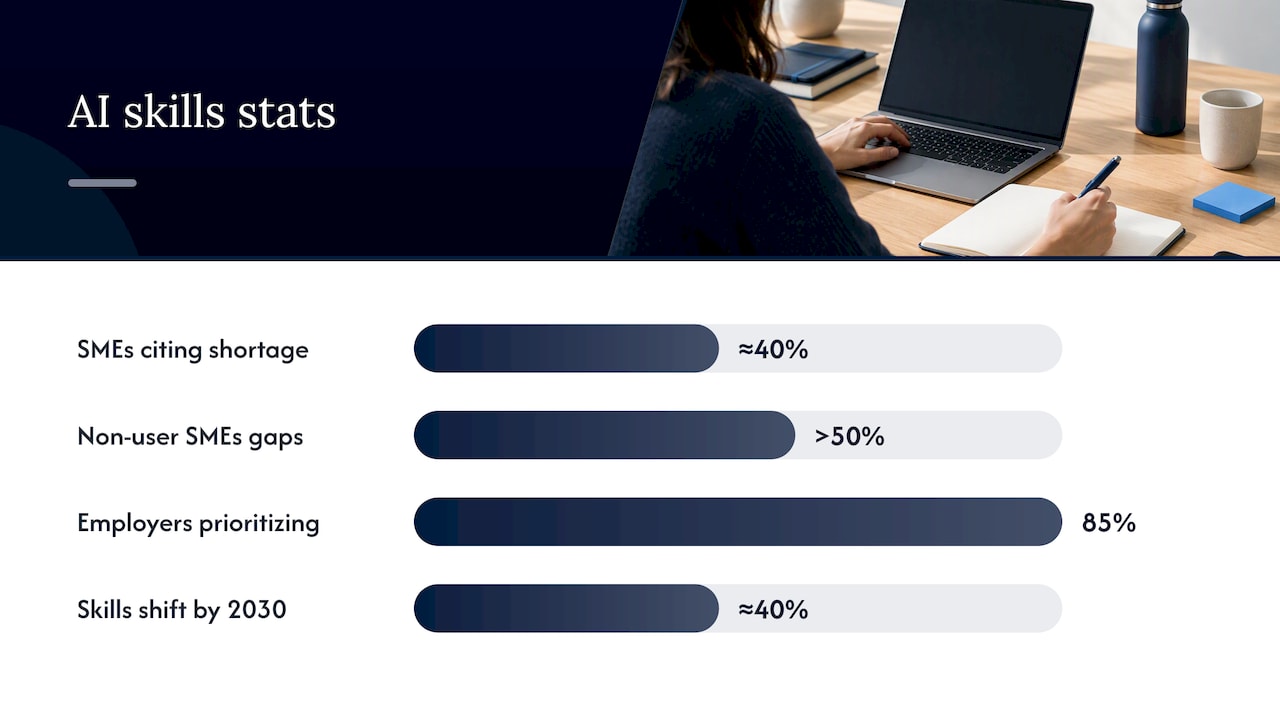
Workflow redesign fails without people who can operate inside it. OECD research from 2026 found that about 40% of SMEs in manufacturing and finance cite skills shortages as their main barrier to AI adoption, and among SMEs not yet using generative AI, more than half report skills gaps as a hindrance. The World Economic Forum reports employers plan to prioritize upskilling for 85% of their workforce as roughly 40% of job skills shift by 2030.
Translate that into a training plan tied to the use cases already selected:
- Differentiate technical training (prompt design, data handling) from oversight training (how to review AI output, when to escalate).
- Set a training cadence tied to rollout milestones, not a one-time onboarding session.
- Identify and support change champions in each team who can answer day-to-day questions before they become tickets.
- Track a simple reskilling target per role, tied to the workflow phases described above.
Pro Tip: Give change champions two hours a week protected on their calendar. Unprotected “extra duties” rarely survive a busy quarter.
Piloting, measuring, and scaling without stalling out
A pilot only earns the right to scale when it moves a business metric, not just when people say they like it. Pick metrics before the pilot starts:
- Choose one primary metric tied to the North Star, such as cycle time, error rate, or revenue per full-time employee.
- Set a review cadence of every one to two weeks rather than waiting for a quarterly report, so small failures get caught early.
- Define stop and go criteria in advance: a target improvement threshold, a maximum acceptable error rate, and a date by which the pilot must show movement.
- Capture and publicize small wins immediately, since momentum fades faster than most leaders expect.
Practitioner guidance also warns against treating every sentiment signal as a call to action. Usage and sentiment data are best read as a trend over weeks, not as a trigger for immediate changes, which helps avoid analysis paralysis while pilots are still finding their footing.
A 2025 Prosci study found AI tools are used primarily to improve communication (29%) and accelerate implementation (21%) inside change functions, which suggests the fastest wins often come from applying AI to the change process itself, not only to the target workflow.

Leadership rituals that keep adoption on track
Adoption holds together when leaders make it visible. Recommended rituals:
- Hold a short execution review every one to two weeks focused only on active pilots, not a broader status meeting.
- Have leaders use the AI tools themselves in visible, routine work, not just endorse them in a memo.
- Give middle managers a simple script for translating strategy into daily practice on their own teams.
- Replace abstract mission language with a “destiny story”: a plain account of what the team’s work looks like in a year and why the change gets them there.
Pro Tip: Ask each manager to share one specific example of AI changing their own task list. Vague endorsements convince no one.
Weaving change management into the AI lifecycle
NIST’s framework organizes AI risk management into MAP, MEASURE, and MANAGE functions, and each one has a change management counterpart:
- MAP: identify context and map stakeholders early, pairing every technical assessment with a list of the roles and teams the use case will touch.
- MEASURE: benchmark performance with both technical metrics and adoption signals, such as how many employees are actually using the tool as intended.
- MANAGE: resource ongoing support, build an incident response path for when the AI gets something wrong, and revisit training as the workflow matures.
Treating these as one integrated cycle, rather than a technical track and a people track running in parallel, keeps risk and adoption reinforcing each other instead of competing for attention.
A six-step starter playbook leaders can begin today
Start small and time-bound. This sequence fits inside 180 days:
- Days 1 to 30: write outcome statements and select three to four use cases.
- Days 1 to 30: stand up the governance committee and acceptable-use policy.
- Days 30 to 90: launch pilots with two-in-the-box pairing and a single primary metric each.
- Days 30 to 90: begin role-based training tied to the pilot workflows.
- Days 90 to 180: apply stop and go criteria, scale what works, retire what does not.
- Days 90 to 180: formalize leadership review cadence and publicize the first small wins.
| Milestone | Timeframe | What success looks like |
|---|---|---|
| North Star and use cases set | Day 30 | Three to four outcome statements with named metrics |
| Governance live | Day 30 | Committee meeting on the calendar, policy published |
| Pilots running | Day 90 | Each pilot has one metric and a two-in-the-box owner pair |
| Scale decisions made | Day 180 | At least one pilot scaled, one retired based on data |
Where Forge AI’s sovereign approach fits the change picture
Some of the governance and trust barriers described above get harder, not easier, once sensitive data is involved. Certain AI solutions focus on air-gapped, sovereign deployments that keep data, models, and domain intelligence inside a client’s own infrastructure, using advanced techniques to keep models efficient without cloud dependence. For organizations in regulated or high-security sectors, that architecture removes one of the biggest trust objections employees and legal teams raise during a pilot: where does our data actually go. Details on the security posture and accessibility conformance are documented on Forge’s own pages.
Why people-first change matters more than the model you pick
The technical debates around AI adoption get outsized attention while the harder problem sits in plain sight: most rollouts fail because nobody redesigned the actual job, not because the model was inadequate. Leaders who treat governance and upskilling as compliance checkboxes rather than trust-building tools consistently see slower adoption, regardless of how capable the underlying system is. The organizations that move fastest are the ones that make the change visible: a manager using the tool in front of their team, a metric posted where everyone can see it move. That is not a soft add-on to the technical rollout. It is the rollout.
— John Ezzell, Founder
How Forge can help
If data control is the barrier holding back your pilots, some providers offer sovereign, air-gapped deployments designed to keep proprietary data and models inside client infrastructure, addressing governance concerns that can stall adoption in regulated sectors. These services may include secure local deployment, custom model integration, private AI assistant rollout, MLOps orchestration, and ongoing operations support, typically billed as scoped engagements rather than software licenses.
Leaders exploring a sovereign deployment can review Forge’s solution offerings and reach out to scope a pilot that fits inside the 30 to 90 day window described above.
Sources
- Future of Jobs Report 2025 (WEF)
- AI and skills (OECD, 2026)
- AI for Change Management (Prosci)
- Reconfiguring work: Change management in the age of gen AI (McKinsey, 2025)
- AI Risk Management Framework (NIST)
FAQ
What is AI change management?
AI change management is the discipline of guiding people, workflows, and governance through the adoption of AI tools, rather than just installing the technology. It combines outcome-based planning, governance controls, and training so employees adopt new workflows instead of working around them.
How does AI change organizational change management practices?
AI adds new governance needs, such as data access controls and human-in-the-loop checkpoints, that traditional change programs did not need to address. It also lets change teams use AI themselves: a 2025 Prosci study found 48% of change practitioners already use AI tools, mainly to improve communication and speed implementation.
What are the biggest barriers to successful AI adoption?
Skills gaps are a leading barrier: the World Economic Forum found 63% of employers cite this as a primary challenge, and OECD data shows roughly 40% of SMEs in manufacturing and finance name skills shortages as their main obstacle. Governance gaps and unclear data controls are the other major friction point, since employees resist tools they cannot trust.
How do you measure success in an AI pilot?
Pick one primary business metric before the pilot starts, such as cycle time, error rate, or revenue per full-time employee, and review it on a short cadence of one to two weeks. Set stop and go thresholds in advance so the decision to scale or retire the pilot is based on data rather than momentum alone.
When does a private or air-gapped AI deployment make sense?
A sovereign or air-gapped deployment fits organizations in regulated or high-security sectors, such as finance, defense, or energy, where data cannot leave controlled infrastructure without violating policy or regulation. Forge AI, for example, builds these deployments specifically to keep data, models, and domain intelligence inside a client’s own environment.