
Multilingual private AI means an assistant that reads, retrieves and answers in several languages while the data, the models and the documents stay on infrastructure you control. It is achievable, but it is not the same job as installing an English model and switching on translation. Quality varies by language, retrieval is the usual weak point, and each language adds to your evaluation workload. This guide covers what to design, what to measure and where private deployments typically go wrong.
Forge AI Deployment designs, deploys and operates private AI systems in enterprise data centers, edge sites and air-gapped networks. We do it as an official webAI systems integrator. The advice below comes from that vantage point.
TL;DR
- Multilingual models perform unevenly. Research on long multilingual contexts shows a clear gap between high-resource and low-resource languages on reasoning-heavy tasks, so test every language you promise.
- Most multilingual failures are retrieval failures. A two-stage pipeline (retrieval, then a cross-encoder reranker) is the standard fix, and it runs fine offline.
- Evaluate retrieval and generation separately, and check that answers come back in the language the user asked in.
- Private, locally hosted systems make data residency and audit questions simpler, but you still need continuous governance. Check current EU AI Act dates before you plan around them.
- Start with the two or three languages that carry real business volume, then expand.
Table of Contents
- What multilingual private AI actually involves
- Why languages perform unevenly
- Multilingual RAG: where most systems break
- Designing the pipeline component by component
- How to evaluate it, in two stages
- Our perspective: scope languages like you scope security
- Compliance and governance across borders
- A phased path to a private multilingual assistant
- How Forge can help
- FAQ
- Sources
What multilingual private AI actually involves
A cloud chatbot hides most of the multilingual problem behind an API. A private deployment puts every part of it in your hands: the language model, the embedding model that turns text into searchable vectors, the reranker, the document store and the evaluation harness. That is the price of keeping data inside your perimeter, and also the source of the benefit. You choose each part, you can inspect each part, and nothing leaves.
The typical enterprise scenario looks like this:
- A defense contractor with maintenance manuals in English, German and Korean, used by technicians who read at different levels of English.
- A logistics operator whose customs, carrier and contract documents come in a dozen languages, some containing sensitive shipment data.
- A bank whose compliance team reads regulator guidance in the original language, and whose staff must not paste any of it into a public tool.
- A manufacturer with plants in several countries and work instructions that exist in only some of the local languages.
In each case, the question is not “does the model speak Spanish.” It is “does the system find the right paragraph in a Spanish, German or Thai document, and answer correctly in the language the person asked in.”
Why languages perform unevenly
Large language models are trained on text that is heavily skewed toward a few languages. The result shows up in benchmarks. A 2026 EACL paper on long-context evaluation argues that the popular needle-in-a-haystack test only measures whether a model can locate a fact, not whether it can reason over a long multilingual document. Reasoning-heavy tasks, such as combining facts spread across a long text, expose the gap between languages much more than simple lookup does.
The practical consequence is that a demo in English tells you little about how the system will behave in Slovak, Ukrainian or Vietnamese. Two other pieces of research point the same way:
- A Slovak embedding benchmark, SkMTEB, was built because existing multilingual benchmarks covered low-resource languages too thinly to guide model selection. The authors adapted models for the language and measured the result.
- The Ukrainian NLP workshop notes that language models translate competently even for lower-resourced languages, yet quality can suffer in specialized domains without adequate vocabulary and style coverage.
Domain matters as much as language. A model that handles everyday Ukrainian may stumble on turbine maintenance terminology in Ukrainian. If your documents are technical, test with your documents.
Multilingual RAG: where most systems break
Retrieval-augmented generation (RAG) is the pattern behind most private enterprise assistants. The system searches your document library, hands the best passages to the model and asks it to answer from them. It is the right pattern for private AI because the knowledge stays in your document store rather than being baked into model weights, and you can cite sources.
In multilingual settings, RAG adds three failure modes.
The query and the document are in different languages
A user asks in Portuguese, the best answer sits in an English manual. The embedding model has to place both in a shared semantic space. Some embedding models do this well for major languages and poorly for others. A survey of RAG in multilingual settings from the ACL Anthology describes the weaknesses of standard pipelines in this situation, including trouble retrieving accurate information in low-resource languages.
Retrieval returns plausible but wrong passages
Embedding search finds passages that look similar. It does not always find passages that answer the question. The remedy recommended in the literature is a two-stage pipeline: retrieve a broad candidate set, then rerank it with a cross-encoder that reads the question and each candidate together. The cost is a little latency. The gain is better precision, and that matters most in offline deployments where nobody can fall back on a web search.
The answer comes back in the wrong language
This one looks trivial and is not. A user asks in Spanish, the retrieved passages are English, and the model answers in English. Or it translates a part number. Language consistency has to be tested on purpose.
Designing the pipeline component by component
Private multilingual RAG works best when you treat it as modular parts rather than one black box. Research on low-resource languages supports this: the SkMTEB work reports that curated and adapted retrieval components can reach performance competitive with proprietary cloud APIs while remaining deployable locally.
| Component | What to decide | Multilingual question to ask |
|---|---|---|
| Document ingestion | Parsing, OCR, chunking, metadata | Does chunking respect each script and language’s sentence boundaries? Is the language tagged per document? |
| Embedding model | Which model, which dimensions | Does it support every language in your corpus, and cross-language search between them? |
| Retriever | Dense, keyword or hybrid | Does keyword search handle morphology and scripts such as Cyrillic, Arabic or CJK? |
| Reranker | Cross-encoder choice | Was it validated on your languages, not only English? |
| Generator | Which local model, how large | Does it answer in the user’s language and keep terminology and part numbers intact? |
| Evaluation | Test sets per language | Do you have real questions from real users in each language? |
Ingestion deserves more attention than it gets
Poor parsing quietly ruins everything downstream. Scanned PDFs, tables and mixed-language pages all need care. Ingestion also has a running cost, and it is worth measuring cost per record rather than only throughput when you plan to re-index large libraries as models change. In a private environment you will re-embed the corpus whenever you swap the embedding model, so plan for it.
Smaller models, tuned for your domain
You do not always need the largest model. Practitioners often get better results in a given language by fine-tuning on synthetic, domain-specific data. The Ukrainian NLP workshop and the Slovak embedding work both point to targeted adaptation as the way to close gaps in constrained, local-only environments. This is where integration work counts: choosing the base model, preparing the data inside the perimeter and validating the outcome.
How to evaluate it, in two stages
Microsoft’s data science team describes a two-stage approach to evaluating multilingual RAG: assess indexing and cross-language retrieval first, then assess generation quality, including whether the answer is in the language the user expects. We follow the same logic because it tells you which component to fix.
A workable evaluation plan:
- Collect real questions. Ask native speakers in each business unit for 50 to 100 questions they actually ask. Include questions whose answers sit in a different language than the question.
- Mark the correct passages. A subject-matter expert identifies which document sections answer each question.
- Score retrieval alone. Does the right passage appear in the top results? Run this per language and per language pair.
- Score generation alone. Given the right passage, is the answer correct, complete, faithful to the source and in the right language?
- Log failures by language. One weak language usually points to one weak component, often the embedding model or the reranker.
- Repeat after every change. Model swaps, new document batches and quantization or hardware changes can all move quality.
The BERGEN library is an open-source option for benchmarking RAG systems with multilingual queries or document stores, which can help a team get started on this kind of harness.
Do not forget cultural and geopolitical bias
For global operations, a single-language source set can skew answers. Research on culturally sensitive RAG benchmarks reports that bringing diverse multilingual perspectives into retrieval can improve robustness and reduce geopolitical bias compared with relying only on in-language sources. If your assistant summarizes news, trade rules or sanctions guidance, test for this explicitly.
Our perspective: scope languages like you scope security
We come at this problem from high-consequence environments, and our leadership has more than 20 years in them, including Fortune 100 settings. That background shapes one strong opinion: do not promise a language you have not measured.
Most organizations want “all languages” on day one. We advise against it. Pick the languages that carry the real volume or risk, build a test set for each, and let the numbers decide whether a language ships. A system that is excellent in four languages and honest about the fifth earns trust. A system that is mediocre in twelve gets abandoned.
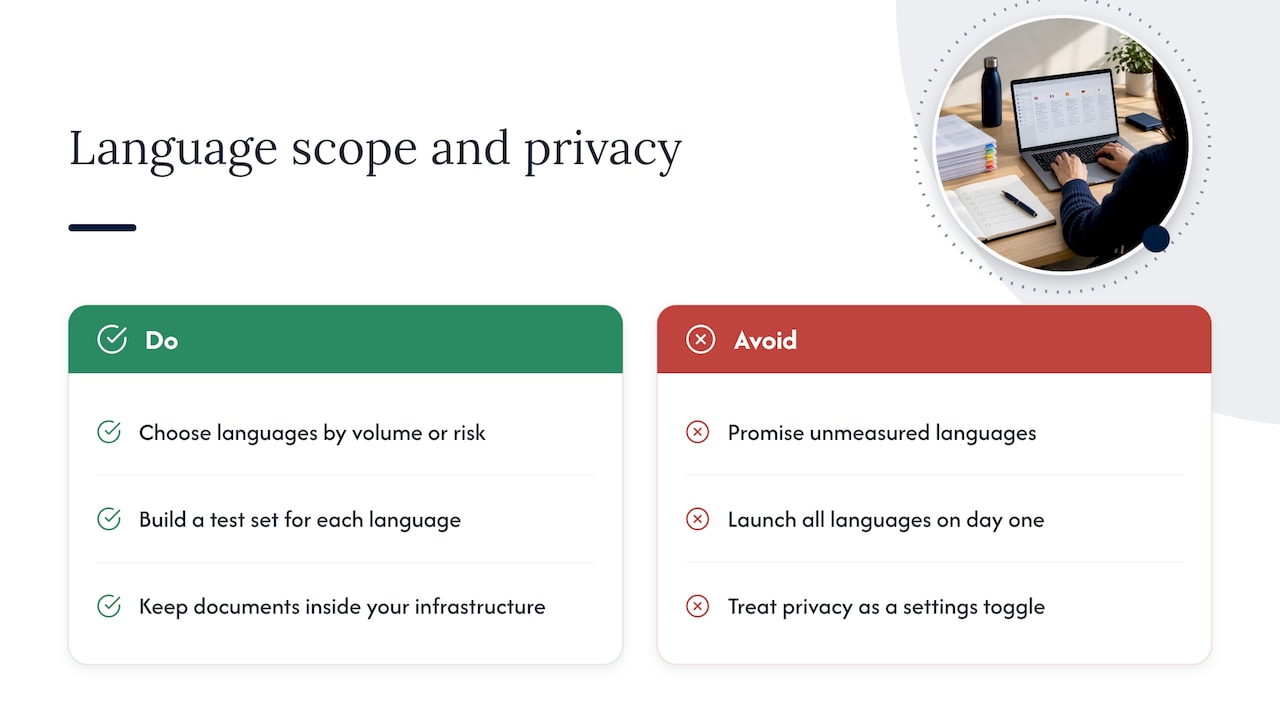
The second opinion concerns where the knowledge should live. In a private deployment, the document library is the asset. It should stay inside your infrastructure, searchable and citable, so a technician can see which manual and which page an answer came from. That is the idea behind webAI Frontline, which gives frontline teams fast, source-backed answers from large technical document libraries, fully offline on a single device. For a plant floor, a ship or a remote site with no connectivity, that matters more than any leaderboard score.
Third: privacy is a design property, not a settings toggle. When we deploy webAI’s platform for a customer, the goal is that data, models and domain intelligence stay inside the environment the customer controls, and the design is validated for privacy and auditability. We deploy and operate webAI’s technology as an integrator. We do not claim it as our own, and we put our effort into architecture, secure deployment, integration and operations.
— John Ezzell, Founder
Compliance and governance across borders
Multilingual usually means multinational, and multinational means more than one rulebook. Keeping data on infrastructure you control does not remove your obligations, but it makes several of them easier to demonstrate. A locally hosted system keeps data inside your own infrastructure, which can simplify conformity work, as the European Economic and Social Committee’s commentary on the Digital Omnibus notes.
Check the EU AI Act dates
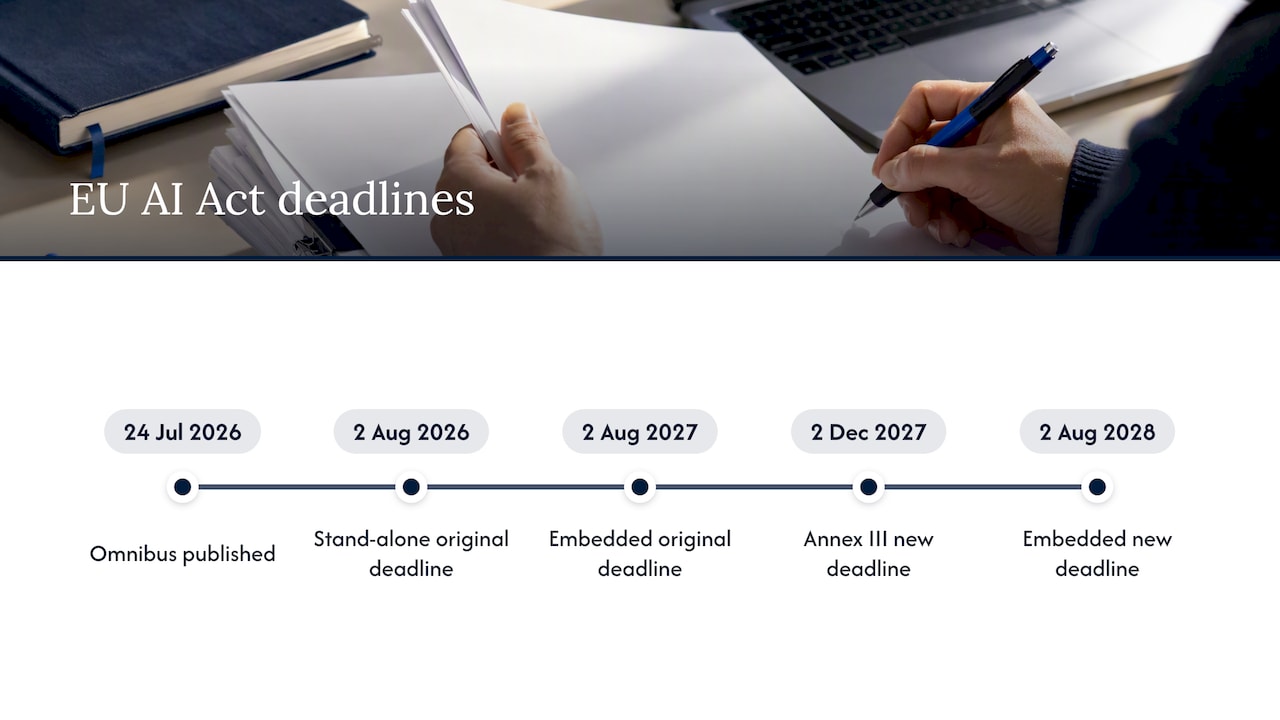
Dates are moving. The original schedule made obligations for stand-alone high-risk systems apply from 2 August 2026. According to a law firm summary of the Digital AI Omnibus, Regulation (EU) 2026/1744 was published on 24 July 2026 and moved that deadline to 2 December 2027 for Annex III systems such as those used in employment, education and law enforcement. Embedded safety-component systems moved from 2 August 2027 to 2 August 2028. The underlying law remains Regulation (EU) 2024/1689. Confirm the current text with your counsel before you fix a project plan around any date.
For a walk-through of roles and obligations, see our EU AI Act compliance roadmap for enterprises. For GDPR evidence from on-prem systems, see our guide to proving GDPR compliance for AI teams.
Governance is continuous
A one-time review is not enough. A NIST-hosted white paper on data ethics in public procurement of AI treats data ethics as a theme running through every component of trustworthy AI. For multilingual systems this means re-testing as languages, models and documents change, and keeping logs you can show an auditor.
Two more risks deserve a mention. Prompts and documents can leak through channels you did not think of, which we cover in six paths of enterprise AI data leakage. Models and components also arrive with their own provenance, so treat AI supply chain security as part of the deployment, especially when you pull open multilingual models from public hubs into an air-gapped network.
A phased path to a private multilingual assistant
- Inventory the corpus. Which languages, how many documents, which formats, which sensitivity levels, and which languages the users actually read and write.
- Choose the deployment envelope. Data center, edge site or fully air-gapped. This decides hardware, model size and update procedure.
- Pilot two or three languages. Build the test sets from step 1 of the evaluation plan above and set pass thresholds before the pilot, not after.
- Tune where the numbers say so. Swap embedding or reranker models first, since they are cheaper to change, then consider domain adaptation of the generator.
- Roll out to a real team. Give them source citations in every answer and a one-click way to flag a bad one.
- Operate it. Monitor retrieval quality per language, re-index on schedule, patch inside the perimeter and expand languages only after they pass.
What the right answer looks like varies by sector. Our write-up on sovereign AI without performance loss covers the tradeoff between control and capability, and our five agency checks before AI goes live is a useful go-live list.
How Forge can help
If you are planning a multilingual assistant that must run inside your own infrastructure, Forge handles the full path: architecture, secure local or air-gapped deployment, model integration, private assistant rollout, orchestration and ongoing operations. We bring webAI’s platform to production, including specialized Personas, the Intelligence Delivery Network and webAI Frontline for offline, source-backed answers from technical libraries. Engagements are scoped to your environment and no pricing is published. See the Forge solutions or read about the webAI relationship to start a conversation.
FAQ
Can a private AI system really match a cloud API in several languages?
It can on specific, measured tasks. Research on low-resource retrieval shows that curated, adapted components can be competitive with proprietary cloud APIs. The caveat is that you must test per language and per domain, because results do not transfer automatically.
Do I need a different model for each language?
Not necessarily. A multilingual embedding model and a multilingual generator often cover your main languages. A separate or adapted component is worth considering only when a test set shows a language falling short. Decide with data, not assumption.
Does the system work offline?
Yes, when it is designed that way. Every component, from the embedding model to the document store, must be installed locally, with updates delivered through your own approved process. webAI Frontline, for example, delivers source-backed answers from large technical document libraries fully offline on a single device.
Does keeping AI on-premises make us compliant with the EU AI Act or GDPR?
No. It reduces data exposure and simplifies evidence gathering, but your obligations depend on your use case, role and jurisdiction. Timelines have also shifted, so check the current text of the regulation with your legal team.
Sources
- Can LLMs reason over extended multilingual contexts? (EACL 2026)
- SkMTEB: Slovak Massive Text Embedding Benchmark and Model Adaptation
- Workshop on Ukrainian Natural Language Processing (2026)
- Retrieval-augmented generation in multilingual settings
- Building and evaluating multilingual RAG systems (Microsoft Data Science)
- Culturally sensitive RAG benchmarks (ACL Findings 2025)
- BERGEN: multilingual RAG documentation
- Digital Omnibus: simplification starts (EESC)
- Digital AI Omnibus delays key deadlines (Cooley)
- Regulation (EU) 2024/1689 (Artificial Intelligence Act)
- White Paper on Data Ethics in Public Procurement of AI