Yes, GDPR applies to AI projects that use personal data, whether for training, fine-tuning, or inference, unless you can demonstrate robust anonymization. Start by documenting your legal basis, scoping a Data Protection Impact Assessment, and enforcing data minimization and transparency from day one. Skipping these steps is the single biggest source of regulatory exposure in AI programs today.
TL;DR:
- Maintaining comprehensive records of data processing activities and involving a Data Protection Officer early are crucial for GDPR compliance throughout AI development.
- Automated decisions that produce significant effects require built-in human review, decision logs, and clear avenues for individuals to contest outcomes.
- Regulators expect detailed provenance documentation, DPIAs, and case-by-case anonymization assessments for training datasets and models, not just initial policies.
- Sovereign, air-gapped deployment architectures help ensure traceability and safeguard sensitive personal data against regulatory and exfiltration risks.
- As AI regulations evolve, organizations must continuously review and adapt their compliance efforts, prioritizing traceability and transparency over mere policy statements.
Table of Contents
- GDPR principles that shape every AI project
- When automated decisions trigger Article 22 safeguards
- What EDPB, EDPS, and CNIL guidance actually requires
- A practical compliance checklist across the AI lifecycle
- How sovereign, on-prem deployment supports GDPR evidence
- How emerging AI technology is reshaping GDPR enforcement
- Why most AI compliance advice misses the point
- Getting GDPR-ready AI deployed without the data-exfiltration risk
- FAQ
- Sources
GDPR principles that shape every AI project
GDPR does not carve out an exception for machine learning. The same core principles that govern a customer database apply to a training pipeline, just applied across a longer, messier data lifecycle.
Every project needs a documented legal basis before personal data enters a model. Consent works for some consumer-facing features, but it is fragile at scale and withdrawable at any time. Legitimate interest is more common in AI development, though it requires a documented justification rather than a one-line assertion. Contractual necessity and public task apply in narrower cases, typically within existing service relationships or statutory mandates.
Purpose limitation and data minimization do not stop at collection. They follow data through annotation, training, validation, and testing, which means a dataset gathered for one product cannot be quietly repurposed to train an unrelated model without reassessing the legal basis.
Accountability turns these principles into paperwork regulators can actually inspect:
- Maintain Article 30 records of processing covering AI-specific activities, including training data sources and retention periods.
- Involve your Data Protection Officer early, not after a model is already in production.
- Trigger a DPIA whenever processing is likely to result in high risk, which covers most large-scale AI training on personal data under GDPR.
Teams that treat these as checkboxes rather than living documents tend to fail audits, because the paperwork stops matching what the system actually does within a few release cycles.
When automated decisions trigger Article 22 safeguards
Article 22 of GDPR gives individuals the right not to be subject to a decision based solely on automated processing, including profiling, when that decision produces legal effects or similarly significant effects on them. Loan approvals, hiring screens, and automated eligibility determinations all fall squarely within this.
A decision is “solely automated” when no meaningful human judgment intervenes before it takes effect. A human who rubber-stamps model output without reviewing the underlying reasoning does not satisfy the safeguard, even if a person technically clicked approve.
Three things make Article 22 compliance operational rather than theoretical:
- Build real human intervention into the workflow, meaning a reviewer with the authority and context to override the model, not a formality.
- Log every automated decision with the input data, model version, confidence score, and any human override, so the record survives a later challenge or audit.
- Give people a clear path to contest a decision, including a plain-language explanation of the factors that drove it.
The GDPR text itself requires these safeguards wherever solely automated, significant decisions are permitted. Immutable decision logs that capture model version and reviewer annotations tend to be the difference between an audit that closes quickly and one that drags on for months, because they let a privacy team reconstruct exactly what happened without interviewing engineers from memory.
What EDPB, EDPS, and CNIL guidance actually requires
Regulators across Europe have converged on a few concrete expectations for AI, and none of them are satisfied by a generic privacy policy.
The European Data Protection Board’s Opinion 28/2024 confirms that legitimate interest can serve as a lawful basis for AI development, but only when the controller runs and documents a three-step test:
- Identify the specific interest being pursued, stated concretely rather than as a general business goal.
- Confirm the processing is necessary to achieve that interest, with no less intrusive alternative available.
- Balance that interest against the rights and expectations of the people whose data is used, documenting the outcome.
One structural fact worth internalizing is that trained models are assessed for anonymity on a case-by-case basis without a single bright-line test. The EDPB’s guidance makes clear that regulators assess anonymity case by case, expecting evidence such as re-identification testing, membership inference evaluations, and extraction attack resistance, not a self-certified claim.
The CNIL’s recommendations add a lifecycle angle: training datasets frequently contain personal data even when nobody intended them to, so controllers need provenance documentation and DPIAs before training starts, not retrofitted afterward. If an earlier stage of data collection was itself unlawful, that taint can carry forward into the deployed model, which is why regulators increasingly ask for lineage evidence covering the full pipeline, not just the final release.
A practical compliance checklist across the AI lifecycle
Compliance work splits naturally into three phases, and each one has distinct deliverables.
Pre-build
- Complete a legal-basis workbook for every dataset entering the project, naming the basis and the justification.
- Check supplier and data provenance, including contractual attestations about how training data was originally collected.
- Scope a DPIA early and bring in your DPO before architecture decisions lock in, since retrofitting a DPIA after launch rarely satisfies regulators.
Build and test
- Minimize datasets to what the model actually needs, dropping fields that do not improve performance.
- Pseudonymize identifiers wherever the pipeline allows it.
- Run re-identification and membership inference tests before claiming anonymization, and keep the results as evidence.
- Train and validate inside controlled, auditable environments where you can trace exactly which data touched which model version.
Deploy and operate
- Build rights-handling workflows that cover model outputs and derived data, not just the original input records.
- Retain Article 30 records and DPIA documentation, updating both after meaningful model or dataset changes.
- Monitor model behavior and data drift, since a model that shifts meaningfully from its DPIA assumptions may need a fresh risk assessment.
Pro Tip: Treat your DPIA as a living document tied to your model registry: every retraining event should trigger a review, not just a calendar reminder.
Mapping these controls to ISO/IEC 42001 and ISO/IEC 27001 gives auditors and boards a familiar structure to evaluate against. ISO/IEC 42001 addresses AI management specifically, while ISO/IEC 27001’s information security management system absorbs AI-specific risks into controls your security team already maintains, which shortens audit cycles considerably.
How sovereign, on-prem deployment supports GDPR evidence
High-risk AI use cases, sensitive personal data, and intellectual property protection all share a common friction point: regulators want to see where data went and who touched it, and cloud-dependent architectures make that harder to prove.
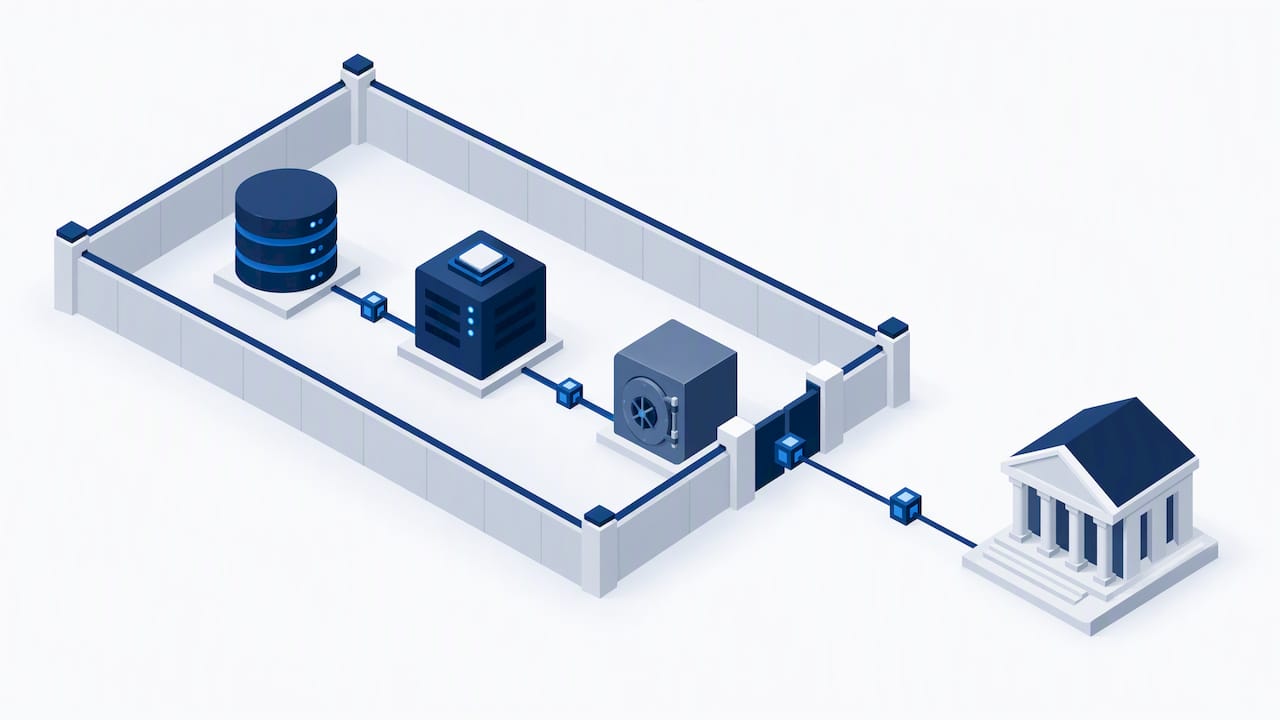
We design and operate private, air-gapped AI deployments where customer data and models stay inside infrastructure the customer controls, removing data exfiltration risk. As an official webAI systems integrator, we deploy webAI’s local-first platform features such as specialized AI Personas, the Intelligence Delivery Network, and webAI Frontline, providing fast, source-backed answers from large technical document libraries, fully offline on a single device.
That architecture supports several of the evidence categories regulators ask for directly:
- Full access to processing logs and traceability, since nothing leaves the controlled environment to be lost in a third-party system.
- Documentation and provenance controls that feed directly into DPIA inputs and records of processing.
- Operational practices built around DPO coordination rather than treated as an afterthought.
Consider sovereign deployment when you are working with high-risk AI, sensitive personal categories, regulatory-driven data residency requirements, or IP that cannot risk leaving your perimeter. Our why-forge page covers the sovereignty and security background behind that approach in more detail.
How emerging AI technology is reshaping GDPR enforcement
Generative AI has pushed regulators to clarify guidance faster than the legislative text itself changes. The EDPS orientations on generative AI state plainly that when generative AI systems process personal data, GDPR applies in full, with DPIAs and DPO consultation treated as baseline expectations rather than best practice.
That guidance matters because generative models complicate two things regulators care about most: knowing what personal data actually sits inside a trained model, and explaining to a data subject why a system produced a particular output. Neither problem existed in the same form with traditional statistical models.
The ICO’s AI guidance has responded with practical toolkits aimed at explainability, recognizing that organizations need concrete methods for documenting how a model reached a decision, not just a policy statement that one exists.
Expect this pattern to continue. As new model architectures emerge, regulators tend to issue interpretive guidance well before any statutory amendment, which means compliance teams should track EDPB, EDPS, CNIL, and ICO publications directly rather than waiting for the underlying regulation to catch up. The practical implication is that your compliance program needs a standing process for reviewing new guidance, not a one-time policy that gets filed away after launch.
Why most AI compliance advice misses the point
Most AI compliance content treats GDPR as a paperwork exercise: fill out a DPIA template, write a privacy notice, move on. That misses what regulators are actually testing for, which is whether your organization can produce evidence on demand. Opinion 28/2024 and the CNIL recommendations both point the same direction: a documented three-step test or a provenance record is worthless if nobody can locate it when an audit starts.
The conventional advice also underweights architecture. Teams spend enormous effort perfecting consent language while leaving training data scattered across cloud services with incomplete logs, which is backward. A well-structured system that makes data lineage traceable by design will survive a regulatory review far better than a beautifully worded policy sitting on top of an opaque pipeline.
If you take one thing from this, prioritize traceability before you polish documentation. Build the logging, versioning, and access records into your pipeline first, because that evidence is what every regulator guidance document, from the EDPB to the ICO, keeps asking for in different words.
— John Ezzell, Founder
Getting GDPR-ready AI deployed without the data-exfiltration risk
If the compliance work above convinced you that evidence and control matter more than policy wording, the deployment architecture you choose is where that gets decided. We design, deploy, and operate private, sovereign AI systems inside infrastructure our customers control, covering enterprise data centers, edge sites, and fully air-gapped networks.
As an official webAI systems integrator, we bring webAI’s local-first platform into production: specialized AI Personas for domain-specific tasks, the Intelligence Delivery Network, and webAI Frontline for fast, source-backed answers from large technical document libraries, fully offline. For organizations handling sensitive personal data or high-risk AI use cases, that means the provenance, logging, and traceability evidence regulators ask for exists inside your own perimeter rather than scattered across third-party cloud logs.
Our solutions page covers secure local and air-gapped deployment, custom model integration and optimization, private AI assistant rollout, sovereign MLOps and runtime orchestration, and ongoing operations support. Pricing details are available on our website. For a complementary look at third-party security validation that can support your documentation, see AtListen’s security practices. If sovereignty and auditable control are what your compliance team needs next, our solutions page is the place to start a conversation.
FAQ
Does AI have to comply with GDPR?
Yes, GDPR applies whenever an AI system processes personal data belonging to people in the EU, covering training, fine-tuning, and inference stages alike. The obligation only falls away when data is genuinely anonymized to the standard regulators expect, which the EDPB assesses case by case rather than through a fixed test.
What is the 30% rule for AI?
Definitions like this circulate informally online but are not grounded in the regulatory text; compliance decisions should rely on the actual legal-basis and DPIA requirements in GDPR instead.
Is GDPR compliance mandatory in the USA?
GDPR applies based on whose personal data is processed and where, not the processor’s home country, so US organizations are bound by it when they process data belonging to people in the EU. Separately, US companies handling sensitive or regulated AI workloads often adopt GDPR-style practices, such as DPIAs and documented legal bases, because they align with emerging global expectations.
What AI tools are GDPR compliant?
No AI tool is “GDPR compliant” on its own, since compliance depends on how an organization configures, documents, and operates it, including legal basis, DPIA, and data minimization choices. Organizations handling sensitive or high-risk AI workloads often look at sovereign, on-premise or air-gapped deployment models specifically because they make the provenance and logging evidence regulators request easier to produce.
Sources
- EDPB opinion on AI models: GDPR principles support responsible AI | European Data Protection Board
- Regulation (EU) 2016/679 (GDPR)
- EDPS orientations on generative AI and personal data protection
- AI system development: CNIL’s recommendations to comply with the GDPR
- Artificial intelligence (ICO guidance)
- ISO - AI and information security management package