Yes, large language models can and do expose sensitive training or runtime data, and the fix is not a single setting but a lifecycle engineering problem. Standards bodies including OWASP LLMSVS and NIST now treat leakage as a measurable risk across collection, training, and inference. We address this problem with a recommended first move: run a canary probe and a near-duplicate check before trusting a model’s outputs.
TL;DR:
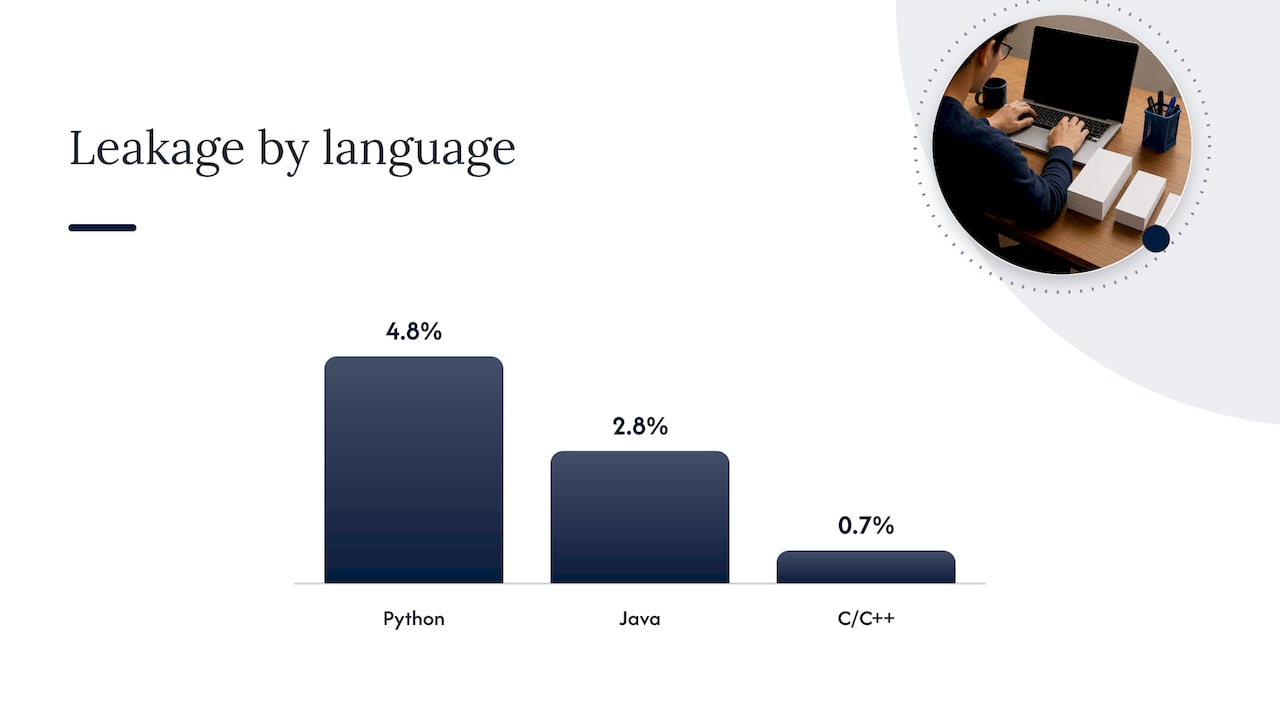
- LessLeak Bench found average leakage ratios of 4.8% in Python, 2.8% in Java, and 0.7% in C/C++, with individual benchmarks reaching 100%.
- ICLR 2025 attacks recovered more than 10,000 memorized training examples from aligned production model proxies, showing that refusal tests alone miss extraction risk.
- Because production training corpora are usually private, passing extraction probes only shows that the chosen prompts failed; it does not establish safety.
- For retrieval augmented generation, review and quarantine unapproved sources, enforce each user’s permissions, and audit embedding updates because removed documents can reappear silently.
- Differential privacy can reduce memorization but trades off model utility; small, high value fine tuning sets need extra scrutiny because individual records may resurface.
Table of Contents
- Memorization, Leakage, and Inference: Getting the Definitions Right
- Empirical Evidence and Measurement Methods
- How Leakage Happens in Practice: Attack Surfaces and Examples
- Practical Impacts: Privacy, IP, Research Validity, and Operational Exposure
- How to Detect Leakage: Canaries, Duplication Scans, and Monitoring
- Mitigations: Secure-by-Design Controls Across the Lifecycle
- Immediate Runbook: What to Do This Week
- Forge AI Deployment: How Operational Patterns Prevent Exfiltration
- Author Perspective: Priorities and Open Research
- How Forge Can Help: Secure, Sovereign LLM Deployments
- FAQ
- Sources
Memorization, Leakage, and Inference: Getting the Definitions Right
Practitioners often use “memorization,” “leakage,” and “inference” interchangeably, but they describe different failure modes with different fixes.
Memorization is when a model reproduces a training sequence verbatim or near-verbatim, a known property of large models that is not inherently a security failure until the memorized content is sensitive. Leakage is the broader outcome: sensitive information, whether memorized text, a retrieved document, or a system prompt, reaches a party who should not have it. Inference-based disclosure is subtler still: an attacker never sees raw training data but deduces facts about it (membership, attributes, or relationships) by probing model behavior.
The NIST Generative AI Profile frames leakage risk as extending across the full model lifecycle rather than sitting in one phase, and it flags retrieval-augmented generation as a vector that teams routinely underweight. The OWASP LLMSVS standard builds verification requirements around the same idea: every prompt, document, and retrieval result should be treated as untrusted input until proven otherwise.
Mapping leakage to lifecycle phase helps teams decide where to test and which controls apply:
- Collection: scraped or licensed data may already contain personal or proprietary information before training even starts.
- Pretraining: large-scale corpora can embed verbatim sequences that later resurface under the right prompt.
- Fine-tuning: small, high-signal datasets (support tickets, internal documents) are especially prone to memorization because they repeat fewer times across less data.
- Inference and RAG: retrieval pipelines can surface documents the user was never authorized to see, independent of what the base model memorized.
- Decommissioning: retired models, logs, and embeddings that are not properly destroyed remain an exposure path long after a project ends.
Empirical Evidence and Measurement Methods
The clearest recent evidence that leakage is not theoretical comes from LessLeak-Bench, a 2025 study examining 83 software engineering benchmarks for contamination. The researchers detected 606, 816, and 108 leaked samples in Python, Java, and C/C++ benchmarks respectively, with average leakage ratios of 4.8%, 2.8%, and 0.7% across languages, but high variance between individual benchmarks, with some, like QuixBugs, showing leakage ratios as high as 100%. The practical consequence is stark: on leaked samples, StarCoder-7B’s Pass@1 score was 4.9 times higher than on clean samples, meaning published benchmark results can dramatically overstate real model capability.
Measuring leakage requires a few established techniques, each with tradeoffs.
| Method | What it detects | Main limitation |
|---|---|---|
| MinHash plus LSH near-duplicate detection | Overlap between training corpora and benchmark or evaluation sets | Misses paraphrased or semantically altered duplicates |
| Membership inference attacks | Whether a specific record was part of training data | Accuracy varies by model family and sequence length |
| Extraction-rate metrics | Volume of verbatim text recoverable through targeted prompting | Undercounts risk when alignment suppresses but does not eliminate memorization |
| Canary token probes | Whether a planted secret resurfaces in outputs | Only as effective as the realism of the planted canary |
A survey of privacy attacks against language models traces how membership inference and extraction research has evolved, including techniques like min-k thresholding and perplexity-based detection, and a related analysis of per-sequence leakage argues that risk should be assessed sequence by sequence rather than through coarse aggregate rates, since extraction risk varies significantly by sequence and model family.
The biggest caveat across all of this work is opacity. Most production pretraining corpora are not published, so researchers and practitioners are often forced to measure leakage against proxies, benchmark overlap, or synthetic canaries rather than the actual training set. That gap produces false negatives: a clean-looking extraction test does not prove a model is safe, only that the specific probes used did not succeed. Our own playbook for detecting benchmark contamination walks through how to build a more rigorous test even without access to the full training corpus.
How Leakage Happens in Practice: Attack Surfaces and Examples
Leakage rarely comes from one dramatic exploit. It accumulates across several distinct attack surfaces, each requiring its own defense.
- Training-data contamination and benchmark leakage: evaluation sets get included directly in pretraining corpora, or overlap through scraped repositories, inflating reported performance, as LessLeak-Bench documents across software engineering benchmarks.
- Prompt injection: attackers embed instructions in user input (direct) or in a document the model retrieves (indirect via RAG), hijacking the model’s behavior or exfiltrating context it should not reveal.
- System-prompt extraction: carefully crafted queries coax a model into revealing its own configuration or hidden instructions, which often contain business logic or credentials.
- Alignment-bypass extraction attacks: divergence and finetuning-style attacks, demonstrated in ICLR 2025 research, recovered more than 10,000 memorized training examples from aligned production model proxies, showing that alignment tuning alone does not prevent extraction.
- Membership inference and data poisoning: attackers determine whether a specific record was used in training, or deliberately inject manipulated samples upstream to bias future outputs or create extraction backdoors.
Pro Tip: Add a divergence-style prompting probe and a finetuning-style extraction test to your red-team suite; simple refusal testing alone will systematically undercount how much a model can be made to reveal.
The common thread across these vectors is that they target different layers of the stack (data, prompt, model weights) so a defense built for one rarely covers another. A RAG filter does nothing against a divergence attack on the base model, and output filtering does nothing against a poisoned fine-tuning set.
Practical Impacts: Privacy, IP, Research Validity, and Operational Exposure
Leakage is not an abstract risk. It translates into concrete harm across four categories, and the right mitigation often depends on which category is at stake.
- Privacy harms: exposure of personally identifiable information, health or biometric data, or location history can enable de-anonymization and downstream harm to real people, not just reputational risk to the organization.
- Intellectual property and confidentiality: proprietary source code, internal documents, or trade secrets embedded in fine-tuning data or RAG knowledge bases can surface to users who were never meant to see them.
- Research and evaluation validity: as LessLeak-Bench shows, benchmark contamination inflates reported scores, undermining fair model comparison and misleading procurement decisions that rely on those scores.
- Operational exposure: leaked credentials or internal configuration details can enable lateral movement inside a network, turning a model-level leak into a broader security incident.
Regulatory exposure compounds all four. The EDPB’s 2025 guidance on privacy risks in LLMs notes that web-scraped data can still qualify as personal data under EU law even after it passes through a model, and that RAG systems specifically need to be tested for personal-data leakage rather than assumed safe because the base model was evaluated separately. Under frameworks like GDPR, that reclassification matters: a leak from a RAG pipeline can trigger the same breach-notification obligations as a leak from a traditional database, regardless of whether the underlying model was ever directly queried for that data.
How to Detect Leakage: Canaries, Duplication Scans, and Monitoring
Detection has to happen before and after deployment, not just once at launch. A practical sequence:
- Plant canary tokens in prompts, documents, and knowledge bases; a canary that resurfaces in an output is a direct signal of leakage, and OWASP LLMSVS recommends this as a core verification control.
- Run near-duplicate detection between your training or fine-tuning corpus and any benchmark or evaluation set you plan to report against, using MinHash plus LSH to catch overlap before it inflates your metrics.
- Sample extraction rates by running targeted extraction prompts against a holdout set of known training sequences, tracking what fraction comes back verbatim.
- Instrument layered logging, matching the OWASP LLMSVS pattern of sanitized client-facing responses paired with detailed server-side logs that retain enough detail to investigate a canary trigger after the fact.
- Red-team for alignment bypass, not just prompt refusal, since simple “will it say something bad” tests miss divergence and finetuning-style extraction entirely.
Canary tokens are a low-cost, high-signal experiment that most teams can deploy in an afternoon, and a single trigger event is a strong indicator that a retrieval path or prompt boundary has failed somewhere upstream.
The limitation to plan around is that red teaming built only around refusal testing systematically undercounts risk. The ICLR 2025 extraction work succeeded against models that passed conventional safety evaluations, which means a red-team program needs divergence prompting and finetuning-style probes built in from the start, not added after an incident. Our measurable red-teaming framework and low-overhead observability approach are built around exactly this gap: continuous signal collection rather than a one-time test.
Mitigations: Secure-by-Design Controls Across the Lifecycle
No single control closes the leakage gap. Effective programs layer defenses across data, training, runtime, and retrieval.
Data layer. Minimize what you collect before training even starts, since data you never ingest cannot leak later. Sanitize known PII patterns, track dataset provenance so you can answer “where did this come from” for any given record, and deduplicate aggressively against known benchmarks before reporting any evaluation result.
Training layer. Differential privacy techniques add calibrated noise during training to reduce the odds that any single record becomes memorizable, though they trade off some model utility and require careful tuning. Fine-tuning on small, high-value datasets (support transcripts, internal wikis) deserves extra scrutiny, since those datasets repeat fewer times and are disproportionately prone to verbatim memorization.
Runtime layer. Route all model traffic through an enterprise gateway rather than letting applications call model endpoints directly, since a gateway gives you one place to enforce prompt sanitation, output filtering, and rate limits consistently. Separate privileges so that a compromised prompt cannot escalate into broader data access, and apply output filters as a backstop, never as the only control.
- Data minimization and provenance tracking reduce the attack surface before training even begins.
- Differential privacy and careful fine-tuning governance limit memorization of small, high-signal datasets.
- Gateway routing with prompt sanitation and output filtering gives runtime traffic a single enforcement point.
- RAG source vetting and embedding-update policies stop retrieval pipelines from becoming an unmonitored backdoor.
- DPIAs, retention limits, and decommissioning protocols close the organizational gaps that technical controls alone miss.
RAG layer. Treat every retrieval source as a potential leak path: vet documents before they enter a knowledge base, quarantine new sources until reviewed, and apply access controls so a user’s permissions actually constrain what the retriever can surface to them. Embedding-update policies matter too, since a knowledge base that updates silently can reintroduce a removed document without anyone noticing. Our RAG security roadmap walks through a three-phase hardening process aligned to NIST and OWASP guidance, and our architecture-first approach to prompt injection defense addresses the indirect injection vector specifically, where a malicious instruction arrives inside a retrieved document rather than the user’s own prompt.
Organizational layer. Data protection impact assessments, clear retention policies, and a documented decommissioning plan for retired models and their logs are not paperwork exercises. The NIST Generative AI Profile specifically calls out decommissioning as a phase where leakage risk persists after a project has otherwise ended, and periodic audits are the only way to catch drift between what a policy says and what a deployment actually does.
Pro Tip: Schedule RAG source audits on the same cadence as your dependency updates: a knowledge base is a supply chain, and it should be treated like one.
Immediate Runbook: What to Do This Week
Mitigation only matters if someone actually runs it. A time-boxed sequence keeps a team from getting stuck in planning.
- This week: deploy canary tokens across prompts and knowledge bases, block or quarantine any RAG source that has not been reviewed, and route all model traffic through a gateway if it is not already.
- Next two weeks: run a near-duplicate scan between your training or fine-tuning data and any benchmark you report against, sample extraction rates against known training sequences, and evaluate whether differential privacy is feasible for your next training run.
- Within the quarter: update data governance policy to reflect lifecycle risk, put a red-team cycle on the calendar that specifically includes divergence and finetuning-style probes, and document a retention and decommissioning protocol for any model or dataset you plan to retire.
- Ongoing: involve security, legal, and ML engineering together, since canary triggers and extraction-rate changes are telemetry that only means something when all three groups see it at the same time.
Our 90-day roadmap for secure sovereign deployment lays out a longer version of this sequence for teams building a permanent testing and verification cadence rather than a one-time cleanup.
Forge AI Deployment: How Operational Patterns Prevent Exfiltration
Most of the controls above work best when data never leaves the organization’s own infrastructure in the first place. Deployments designed around this principle involve private and air-gapped environments where models, embeddings, and logs stay inside infrastructure controlled by the organization. These deployments utilize the webAI platform, including domain-specific webAI Personas, webAI’s Intelligence Delivery Network for distributing models across sites, and webAI Frontline, which provides frontline teams fast, source-backed answers from large technical document libraries, fully offline on a single device.
That architecture directly addresses several leakage vectors covered above:
- Air-gapped deployment removes the network path that most extraction and exfiltration attacks depend on.
- Gateway routing patterns that we implement give every request a single, auditable enforcement point, as described in our on-prem LLM gateway architecture.
- Runtime policy enforcement we configure aligns to NIST-informed controls, detailed in our private LLM deployment guidance.
- Retrieval evaluation practices we apply, outlined in our retrieval evaluation framework, test RAG pipelines for leakage before they reach production.
John, a contributor on Forge’s technical content team, draws on the operational patterns above in the perspective that follows.
Author Perspective: Priorities and Open Research
My own bias, after working through the evidence above, is that engineering controls beat single-technology fixes every time. Differential privacy is useful, canary tokens are useful, output filters are useful, but none of them, alone, closes the gap. LessLeak-Bench’s benchmark-contamination numbers and the ICLR alignment-bypass results point to the same lesson from two different directions: leakage survives whichever single defense you picked, because the attack surface is the whole lifecycle, not one stage of it.
What the field still lacks is shared, transparent testbeds. Too much of what we know about leakage comes from researchers reverse-engineering opaque pretraining corpora after the fact. A community standard for publishing contamination statistics alongside benchmark results, the way LessLeak-Bench has started to do for software engineering, would do more for trustworthy evaluation than any single new detection technique.
— John Ezzell, Founder
How Forge Can Help: Secure, Sovereign LLM Deployments
Every control covered in this piece gets easier when data never leaves infrastructure you already control. Such environments can include private and air-gapped deployments, custom model integration tuned to workload needs, private AI assistant rollout, and sovereign MLOps and runtime orchestration that keeps monitoring, canary detection, and gateway enforcement running continuously rather than as a one-time audit.
Our offers include:
- Secure local and air-gapped deployment, so sensitive data and model weights never cross into infrastructure we do not control together with you.
- Custom model integration and optimization, tuned to your domain rather than a generic off-the-shelf configuration.
- Private AI assistant rollout, including webAI Personas built for specific operational roles.
- Sovereign MLOps and runtime orchestration, giving you the gateway routing and logging patterns this article describes as standard operating procedure.
- Performance tuning and ongoing sovereign operations, so detection and mitigation stay current as your deployment grows.
For teams that also need managed cybersecurity operations around a deployment, NEXTmsp’s cybersecurity services offer fixed-fee managed IT and AI adoption consulting that pairs well with the gateway and governance controls above.
If you want a security review of an existing deployment or a scoped pilot, our solutions page details each offer, and our webAI partnership page explains the platform behind every deployment we run.
FAQ
Will ChatGPT leak my data?
Any hosted LLM service, including consumer chat products, can expose conversation data depending on retention settings, provider policy, and vulnerabilities like prompt injection or extraction attacks. The ICLR 2025 research demonstrated that aligned production-style models can be made to reveal memorized training data, so the risk is not theoretical for any cloud-hosted model.
What is AI data leakage?
AI data leakage is any unintended exposure of sensitive training or runtime data to a party who should not have access to it, through memorized outputs, retrieval mistakes, or targeted extraction attacks. The NIST Generative AI Profile treats this as a risk spanning the full model lifecycle rather than a single failure point.
What do LLMs do with your data?
Data submitted to a model may be used for the immediate response, logged for debugging or quality review, and in some cases retained for future training, depending entirely on the provider’s specific policy. For models deployed privately, data processing stays inside infrastructure the deploying organization controls, which removes the provider-retention question entirely.
What is the most common cause of data leakage in LLMs?
Benchmark and training-data contamination is one of the most documented causes, since the LessLeak-Bench study found measurable overlap across most of the 83 benchmarks it examined. Prompt injection, particularly the indirect form through retrieval-augmented generation, is the other major driver flagged by OWASP and EDPB guidance alike.
Sources
- LLMSVS v2.0 — OWASP Large Language Model Security Verification Standard (LLMSVS)
- LessLeak-Bench: A First Investigation of Data Leakage in LLMs Across 83 Software Engineering Benchmarks
- Artificial Intelligence Risk Management Framework: Generative Artificial Intelligence Profile
- Alignment-bypass extraction attacks (ICLR 2025 proceedings)