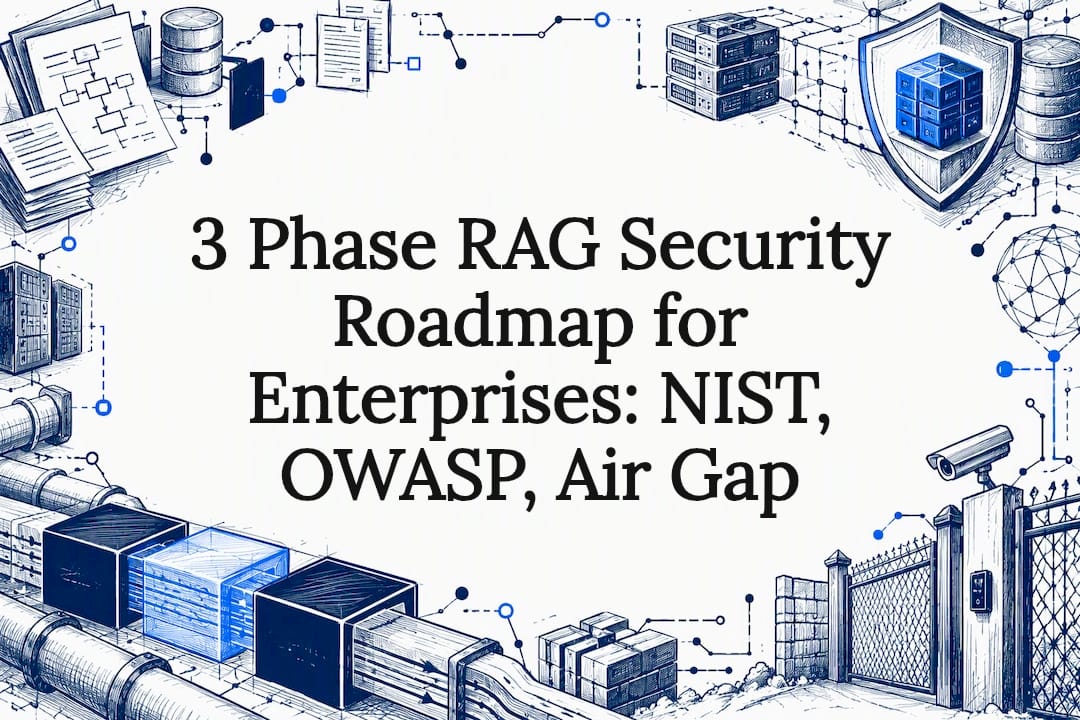
RAG is not safe by default: retrieval pipelines expand the attack surface beyond the model itself, so the required posture is defense in depth, with retrieval time authorization, deterministic input and output screening, and fail closed behavior when any check is uncertain. Two things matter immediately: enforce authorization on every retrieved chunk, not just at the document level, and validate model output before it ever reaches a tool or an action.
TL;DR:
- Enforce authorization at the chunk level for every retrieved document to prevent data leaks and ensure proper access control during retrieval.
- Validate and screen model output before it triggers any external tools or actions to reduce prompt injection and unsafe responses.
- Implement cryptographic hashes and provenance tracking during ingestion to detect tampering and verify the source of each document chunk.
- Use selective encryption, permission-bound access metadata, and rigorous supply chain vetting to contain embedding and index tampering risks.
- Adopt a staged security approach: start with deny-by-default retrieval, then scale with ReBAC checks, index monitoring, and pursue formal risk management frameworks.
Table of Contents
- Why RAG introduces a unique attack surface
- A catalog of RAG attack vectors
- Secure ingestion and provenance controls
- Embedding risks and how to contain them
- Access control patterns: pre-filter, post-filter, and ReBAC
- Prompt hygiene and defenses against context window attacks
- Output validation and safe agent behavior
- Applying NIST RMF to a RAG program
- A prioritized roadmap for hardening RAG
- When sovereignty and air-gapped deployment make sense
- Deploying secure RAG without cloud exposure
- Sources
- FAQ
Why RAG introduces a unique attack surface
A RAG system is a pipeline, not a single model call: documents move through ingest, embed, index, retrieve, generate, and, increasingly, act. Each stage introduces its own trust boundary, and each boundary is a place where an attacker, a misconfigured connector, or a stale permission can push bad data or bad instructions further downstream. This is the core shift security teams need to internalize: risk that used to live entirely inside the model now redistributes across the whole pipeline.
That redistribution is why treating RAG as “just a chatbot with search” undercounts the exposure. A poisoned document ingested weeks ago can sit dormant in a vector index until a retrieval query surfaces it at exactly the wrong moment. A connector with excess permissions can leak data that no prompt ever asked for directly. The OWASP RAG Security Cheat Sheet frames this as a pipeline problem spanning ingestion, embeddings, vector stores, retrieval, and output validation, and the SafeRAG benchmark demonstrates empirically that attacks crafted for one stage often slip past filters designed for another.
The stages worth tracking as distinct security zones:
- Ingest: where documents, files, and connector feeds enter the system, and where poisoning starts.
- Embed: where text becomes vectors, exposing inversion and membership risks.
- Index: where vectors and metadata are stored, and where tampering can persist silently.
- Retrieve: where a query pulls chunks back, the point where authorization must be enforced.
- Generate: where the model composes an answer from retrieved context, the primary injection target.
- Act: where an agent or skill executes based on the generated output, the highest blast radius stage.
A catalog of RAG attack vectors
Security architects need concrete attack shapes to design detections and adversarial tests, not just abstract categories. The following list covers the vectors that show up most often in current research and practitioner guidance.
- Document poisoning and fragmented payloads: attackers split malicious instructions across multiple documents so no single chunk trips a filter. InceptionRAG demonstrates this fragmentation approach, and SafeRAG’s “silver noise” attack class shows a similar bypass pattern against standard retrievers.
- Embedding level attacks: adversarial similarity crafting, embedding inversion, and membership inference let an attacker reconstruct or infer sensitive source content from vector representations alone.
- Prompt injection and inter context conflict: retrieved chunks contain instructions that override the system prompt, a failure mode SafeRAG’s inter context conflict and soft ad tasks were built specifically to test.
- Agent and skill exploitation: over permissive tool manifests let an injected instruction pivot from “answer a question” to “call a tool with elevated credentials,” a risk pattern documented in OWASP’s AST03 guidance on over-privileged skills.
- Index tampering and supply chain compromise: a compromised ingestion connector, a poisoned third party data feed, or direct write access to the vector store can corrupt results without touching the model at all.
- Cache poisoning: shared caches that mix outputs across users or sessions can leak one user’s retrieved context into another user’s response.
Secure ingestion and provenance controls
Ingestion is the cheapest place to stop poisoning, because a document that never enters the index cannot be retrieved. Every document should get a cryptographic hash or signature at ingestion, with the hash and source metadata stored alongside the chunk so any later change to the underlying file is detectable. OWASP’s cheat sheet recommends exactly this pattern: hashing at ingestion paired with per-chunk access metadata and provenance tracking, so every chunk returned at query time carries a verifiable trail back to its source document and its authorized viewers.
Beyond hashing, enterprises need process controls around what gets ingested at all:
- Require an approval workflow and a source allowlist before a new document feed or connector goes live.
- Scan incoming documents for adversarial markers, unusual encoding, or fragmented instruction patterns before indexing.
- Vet every connector’s supply chain and grant it the minimum access needed, never a standing admin credential.
- Log every ingestion event with the actor, source, and hash so an audit can reconstruct exactly what entered the index and when.
Pro Tip: Treat every new data connector as an untrusted third party by default, and require it to pass the same review as a new vendor integration, not a quick internal script.
Embedding risks and how to contain them
Embeddings are not inert numbers: they encode enough structure that an attacker with query access can sometimes run inversion techniques to reconstruct fragments of the original text, or run membership inference to determine whether a specific record was part of the training or indexed corpus. Both risks scale with how much raw, unencrypted embedding data sits exposed to query traffic, and both deserve the same handling discipline as the source documents they represent.
Practical mitigations that fit enterprise environments without breaking retrieval quality:
- Encrypt or selectively mask embeddings for the most sensitive document classes rather than treating the whole index uniformly.
- Choose embedding dimensionality and quantization deliberately: lower precision quantization approaches can reduce the information density available to an inversion attempt while keeping retrieval performant in air-gapped environments.
- Bind access metadata directly to each chunk’s embedding record, not just to the source document, so permission checks travel with the vector.
- Log every embedding access event, and treat any embedding derived from regulated or personal data as personally identifiable information for audit purposes.
Access control patterns: pre-filter, post-filter, and ReBAC
Authorization in RAG has to answer one question for every single chunk: is this specific user allowed to see this specific piece of retrieved content, right now. Two architectural patterns answer that question, and the choice between them depends on corpus size, hit rate, and latency tolerance. Pinecone’s guidance on RAG access control lays out the tradeoff clearly.
- Pre-filtering restricts the vector search itself to only the chunks a user is authorized to see, which keeps latency low and works well when permission boundaries are stable and the corpus is large.
- Post-filtering runs the similarity search first, then strips unauthorized results afterward, which is simpler to implement but wastes compute on chunks the user will never see and can leak result counts or timing signals.
- ReBAC and Zanzibar-like models, implemented through systems such as SpiceDB, attach relationship-based permissions directly to vector chunks and support the low-latency, large-scale checks that high-volume retrieval needs.
For high-assurance environments, the safer default is to verify authorization against the authoritative data source at retrieval time rather than trusting a cached permission snapshot. The AWS Security Blog’s authorization pattern makes this explicit: metadata-only filtering falls short when source permissions change frequently, because a stale cache can grant access that was revoked minutes earlier. Any caching layer used for authorization decisions needs short time to live values and a clear revalidation strategy, not indefinite trust in a snapshot taken at index time.
Prompt hygiene and defenses against context window attacks
The generation stage is where retrieved content most often gets treated as an instruction instead of as data, and that confusion is the root of most prompt injection incidents. Structuring the prompt with explicit delimiters between system instructions, retrieved context, and user input reduces the surface an attacker has to work with, and capping the number and length of chunks injected per query limits how much room a payload has to hide in.
Instruction hierarchy matters as much as formatting: the model needs a consistent signal that retrieved text is untrusted data, never a command, and provenance tags on each chunk help reinforce that distinction throughout generation. OWASP’s prompt injection prevention guidance recommends layering these structural defenses rather than relying on any single check.
- Delimit system prompts, retrieved context, and user input with explicit, consistent markers the model is trained to respect.
- Cap chunk count and length per query to reduce the room available for injected instructions.
- Tag every chunk with provenance metadata so downstream logic can treat retrieved text as data, not command.
- Consider a quarantined or dual LLM pattern, where a separate guardrail model screens retrieved content before it reaches the primary generator.
Pro Tip: A guardrail LLM adds latency and cost, and it inherits many of the same attack classes it is meant to catch, so pair it with deterministic checks rather than treating it as a complete solution.
Output validation and safe agent behavior

Once a response is generated, the last line of defense is checking what it actually says before anything happens because of it. Policy scoring against known bad patterns, enforcing structured output formats instead of free text, and running every response through explicit deny and allow logic catches the cases that upstream filters missed. This matters most when the output triggers a tool call or an agent action, because that is the point where a language mistake becomes a real world consequence.
Per-skill credentialing closes the gap that over-permissive manifests leave open: every tool or skill an agent can invoke should carry its own scoped credential and its own manifest, enforced at runtime rather than declared once and trusted forever. State-changing actions, anything that writes, deletes, or transfers, should require an explicit operator consent step rather than proceeding automatically on model output alone.
- Score outputs against policy rules before allowing a tool invocation to proceed.
- Require structured, schema-validated output formats for any response that feeds an automated action.
- Issue per-skill scoped credentials and enforce manifests at runtime, not just at configuration time.
- Isolate caches per user and session to prevent one person’s retrieved context from leaking into another’s output.
- Fail closed: when a policy check cannot complete or returns an ambiguous result, block the action rather than allow it by default.
Applying NIST RMF to a RAG program
The NIST Risk Management Framework gives RAG programs a structure that governance teams already recognize, and mapping each of its seven steps to RAG specific artifacts turns abstract security posture into something an auditor can actually check. Prepare and Categorize should identify which data sources feed the index and their sensitivity tier. Select and Implement map directly to the controls covered above: authorization patterns, ingestion hashing, and output validation. Assess and Authorize require evidence, not just policy documents, including adversarial test results. Monitor is continuous, not a one-time gate.
Telemetry worth tracking on an ongoing basis:
- Retrieval integrity checks that flag unexpected changes to indexed content or chunk metadata.
- Attack success rate metrics from adversarial tests modeled on SafeRAG’s attack tasks, run against your own retriever and generator.
- Access check latencies, since a slow authorization path often gets bypassed under load pressure.
- Index change audits that tie every modification back to an actor and a timestamp.
Supply chain vetting of connectors and data feeds should feed directly into the authorization package, since an unvetted connector is effectively an unassessed risk sitting inside an otherwise reviewed system.
A prioritized roadmap for hardening RAG
Security teams rarely get to rebuild a RAG pipeline from scratch, so the practical path is staged: fix the highest leverage gaps first, then build toward continuous assurance.
- Quick wins: switch retrieval to deny by default, enforce chunk level access metadata everywhere, add deterministic input and output screening, and isolate caches per user.
- Medium term: integrate a ReBAC system such as SpiceDB for retrieval time checks, stand up index integrity monitoring with alerting, and route any tool invoking output through a quarantined LLM stage.
- Long term: pursue formal RMF authorization for the RAG system, run adversarial red team tests modeled on SafeRAG’s attack classes, and evaluate encrypted or air-gapped deployment for the most sensitive corpora.
| Phase | Primary focus | Example control |
|---|---|---|
| Quick wins | Close obvious gaps | Deny-by-default retrieval, output screening |
| Medium term | Scale enforcement | ReBAC checks, index integrity monitoring |
| Long term | Formal assurance | RMF authorization, SafeRAG-style red teaming |
When sovereignty and air-gapped deployment make sense
Some environments cannot rely on cloud-hosted retrieval no matter how strong the access controls are: regulated data with strict residency rules, intellectual property that cannot risk any external exposure, and audit regimes that demand full control over every log and index. In these cases, an air-gapped deployment removes the exfiltration path entirely rather than mitigating it. The operational tradeoffs are real: update cadence slows down, and latency budgets shift, which is why deployments built on efficient local inference matter more than they would in a cloud setting.
*— John Ezzell, Founder
Deploying secure RAG without cloud exposure
Organizations that need retrieval augmented AI running entirely inside their own infrastructure, with no data ever leaving that boundary, are exactly who Forge builds for. Forge’s sovereign deployment services cover secure local and air-gapped deployment, custom model integration, and ongoing sovereign operations, all validated for auditability rather than bolted on afterward.
If your organization handles regulated, proprietary, or high-consequence data and needs a RAG system that never touches an external network, request a deployment assessment to discuss what a sovereign build looks like for your environment.
Sources
- SafeRAG: RAG security evaluation (ACL Anthology, 2025)
- Retrieval-Augmented Generation (RAG) Security Cheat Sheet — OWASP
- NIST Risk Management Framework (RMF) project page
- Authorizing access to data with RAG implementations — AWS Security Blog
FAQ
Is ChatGPT a RAG system?
ChatGPT is a large language model that can optionally use retrieval features, such as browsing or file upload, but it is not inherently a RAG architecture on its own. RAG specifically refers to a pipeline that retrieves external documents at query time and feeds them into the model’s context before generating a response.
Is RAG still relevant given longer context windows?
RAG remains relevant because longer context windows do not solve freshness, scale, or per-user access control, all of which retrieval handles more efficiently than stuffing entire corpora into a prompt. Enterprises with large, frequently changing, or access-restricted document sets still need retrieval to keep answers current and authorized.
How do I explain RAG in a technical interview?
Describe RAG as a pipeline that retrieves relevant external documents based on a query, then feeds those documents into a language model’s context so it can generate a grounded answer rather than relying only on parametric knowledge. Mention that security minded implementations also enforce authorization at retrieval time and validate output before any downstream action.
What is an example of a RAG system?
A common example is an internal support assistant that retrieves relevant sections from a company’s documentation or knowledge base and uses them to answer employee questions with current, sourced information. Enterprise versions of this pattern add per-document access controls so employees only see retrieved content they are already authorized to view.