LLM red teaming is adversarial testing that finds safety and security failures before deployment. The immediate action for any team starting out: run manual exploratory rounds first, then build automated, repeatable evaluation to catch regressions. This approach lines up with guidance from NIST and OWASP, and it matches what we see across high-consequence, sovereign deployments.
TL;DR:
- Manual exploratory testing is essential for discovering unknown vulnerabilities, as automated tools primarily catch known attack patterns.
- Red teaming should be an ongoing process, with structured phases of scope definition, structured recording, and severity analysis to ensure comprehensive coverage.
- Attack methods like prompt injection, jailbreaks, privacy leaks, poisoning, and agent-in-the-middle attacks must all be systematically tested within a rigorous taxonomy.
- Combining automated attack generation with manual testing and maintaining a regression suite in CI improves resilience against evolving threats.
- Secure, sovereign deployments require in-environment testing, with verifiable evidence, to prevent data leaks and maintain full control over sensitive information.
Table of Contents
- Why red teaming matters for LLM deployments
- The attack taxonomy red teams need to cover
- Choosing the right testing method for your system
- Planning a red-team campaign: before, during, and after
- Metrics that make red-team findings measurable
- Tools and automation: scaling without losing signal
- Turning findings into defenses that hold up
- What changes when red teaming has to stay offline
- FAQ
- Sources
- Work with a team that treats security as the deployment, not an add-on
Why red teaming matters for LLM deployments
Large language models fail in ways that traditional software testing never catches. A model can leak training data, generate convincing misinformation, or take unsafe actions through a connected tool, and none of those failures show up in a unit test. The consequences are not abstract: a customer service bot that discloses another user’s account details, an agent that executes a destructive command because a document told it to, or a chatbot that confidently invents a policy that does not exist.
The attack surface keeps expanding. Retrieval-augmented generation pulls in untrusted documents. Agentic systems chain tool calls together. Memory features persist information across sessions. Multimodal models accept images and audio as input, each one a new channel for hidden instructions. OWASP’s Top 10 for LLM Applications names prompt injection as the leading risk precisely because it travels through all of these channels at once.
HarmBench found that no single attack or defense method is uniformly effective across models, which means a team that tests once and assumes coverage is testing the wrong thing. Red teaming is not a checkbox before launch; it is the mechanism that turns an assumption of safety into evidence of it.
- Data leakage exposes private or proprietary information through extraction or inference attacks.
- Misinformation erodes trust and can create legal or reputational exposure.
- Unsafe agentic actions turn a text failure into a real-world consequence.
- Expanded attack surfaces from RAG, agents, and multimodality multiply the number of entry points attackers can use.
The attack taxonomy red teams need to cover
A useful red-team program organizes its tests around a taxonomy rather than a loose list of tricks. The NIST Trustworthy and Responsible AI report provides an adversarial machine learning taxonomy with lifecycle mitigations, and mapping your test plan to it gives engineering and governance teams a shared vocabulary.
Prompt injection comes in several forms. Direct injection happens when a user types an instruction meant to override the system prompt. Indirect injection hides the instruction inside a document, webpage, or email that the model retrieves later. Multimodal injection embeds instructions in an image’s pixels, a document’s metadata, or an audio waveform, bypassing filters built only for text.
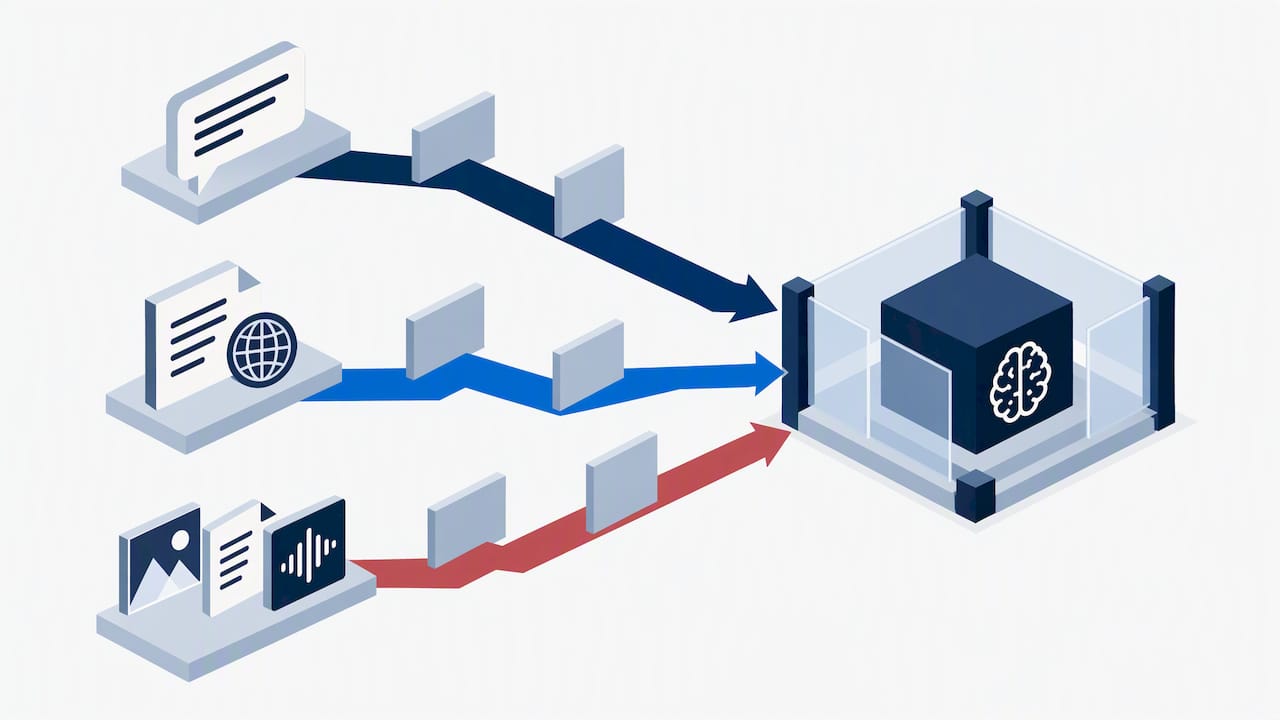
Jailbreaks and refusal suppression attempt to get a model to produce content it was trained to refuse, often through role-play framing, encoding tricks, or multi-step persuasion that gradually erodes the model’s guardrails over a conversation.
Privacy and extraction attacks target the data a model was trained or fine-tuned on. Membership inference tries to determine whether a specific record was in the training set. Embedding leaks reconstruct sensitive information from vector representations stored in a retrieval system.
Poisoning and backdoor triggers plant malicious patterns during training or fine-tuning that activate later under a specific trigger phrase, often invisible during normal evaluation.
Agent-in-the-middle attacks target multi-agent systems specifically. Research on LLM multi-agent communication demonstrates that intercepting and manipulating messages passed between agents can achieve high success rates, because securing each agent individually does nothing to protect the channel they use to coordinate.
- Prompt injection: direct, indirect, and multimodal variants that bypass text-only filters.
- Jailbreaks: role-play, encoding, and multi-turn persuasion that suppress refusals.
- Privacy attacks: membership inference and embedding-based extraction.
- Poisoning: backdoor triggers planted during training or fine-tuning.
- Agent-in-the-middle: interception and manipulation of inter-agent messages.
Choosing the right testing method for your system
No single method finds every failure, so a mature program mixes them deliberately rather than defaulting to whichever tool is easiest to run.
- Manual exploratory testing relies on human creativity and intuition to find edge cases no generator would think to try. A skilled tester notices when a model’s phrasing shifts mid-conversation in a way that signals an exploitable seam, something a script cannot recognize.
- Automated generators and self-play attackers use one LLM to probe another, scaling attack volume far past what a human team could produce manually. This is where you catch regressions and sweep known attack families across every model version.
- Single-turn testing checks whether a single prompt can break a model’s guardrails, useful for fast screening early in development.
- Multi-turn testing often reveals deeper failures, because a model that correctly refuses a direct request may comply after several turns of gradual reframing. A survey of red-teaming methodology notes that practitioners prioritize manual, open-ended rounds before building automated pipelines, since a pipeline can only track harms someone has already discovered.
- Black-box testing treats the model as an opaque API, matching how most third-party deployments are actually consumed and testing what an external attacker could realistically achieve.
- White-box testing gives testers access to weights, logits, or training data, useful for research-grade robustness work but less representative of real attacker conditions in a production API.
Pro Tip: Run your first red-team round manually and without a rubric; the goal is discovering what you didn’t know to test for, not confirming what you already expect.
The trade-off is straightforward: manual testing finds the unknown unknowns, automated testing finds the knowns at scale. A program that skips the manual phase ends up measuring the wrong things very precisely.
Planning a red-team campaign: before, during, and after
Microsoft Foundry’s red-teaming guidance frames the work around a simple structure: decide who will test, what to test, how to run the tests, and how to record the results for later measurement.
Before testing begins, define scope clearly: are you testing the base model, the fine-tuned version, or the full application with its tools and retrieval layer? Build a harm list specific to your deployment, set up logging and test access, and write down the threat model so testers know what an attacker in your context actually wants.
During the campaign, mix open-ended discovery with guided testing against the harm list. Record every attempt in a structured format, a spreadsheet or database works fine, so findings can be compared across rounds. Adaptive red teams who already know your defenses produce more realistic results than teams testing blind, since real attackers will eventually learn your guardrails too.
After testing, triage every finding by severity and exploitability, track remediation to completion, and convert the most important failures into permanent regression tests that run before every release.
- Before: scope, threat model, environment definition, harm list, logging setup.
- During: open-ended discovery, guided testing against the harm list, structured recording.
- After: triage, severity scoring, remediation tracking, regression test conversion.
- Governance: defined roles, incident playbooks, and retained test evidence for audits.
| Phase | Primary output | Owned by |
|---|---|---|
| Before | Threat model and harm list | Security and product |
| During | Structured findings log | Red team |
| After | Remediation tracker and regression suite | Engineering |
| Governance | Retained evidence and incident playbook | Compliance |
Metrics that make red-team findings measurable
A red-team report without numbers is an anecdote. The baseline metric is attack success rate (ASR), the share of attack attempts that successfully elicit the targeted harmful behavior, measured against a fixed, disclosed set of attacker techniques so results are comparable across rounds.
ASR alone is incomplete without severity and coverage scoring. Severity ranks how damaging a successful attack actually is; coverage tracks what fraction of your taxonomy you have tested at all. A model can show a low ASR while still being dangerously exposed in a category nobody tested yet.
Reproducibility matters as much as the score itself. Document the exact prompts, model version, and system configuration used, and rerun the same suite after every change so you can tell whether a new release actually improved anything or whether the attacker set simply moved on.
HarmBench standardizes this kind of evaluation across models and attack methods, and its central finding, that no single defense holds up uniformly, is why adaptive testing matters. Disclosing your defenses to the red team producing adaptive attacks, rather than hiding them, gives a more honest picture than testing against attackers who do not know what they are up against.
- Define ASR against a fixed, disclosed attacker set for comparability.
- Score severity and coverage separately; a low ASR can still hide a blind spot.
- Rerun the same suite after every model or configuration change.
- Use adaptive attackers who know your defenses, not naive ones.
Tools and automation: scaling without losing signal
Automation earns its place once manual testing has mapped the territory, not before. The right question is where each tool fits in the pipeline rather than which one is best overall.
Attack generation is where automated frameworks add the most value, producing large volumes of prompt variations across known categories like injection and jailbreak attempts. DeepTeam and similar open-source frameworks automate this generation step and plug into existing test suites. Evaluation benchmarks like HarmBench standardize scoring so results from different tools and teams can be compared on the same scale, and HarmBench’s own research shows automated methods can also feed adversarial training, not just measurement.
Triage is the one stage automation should not fully own. A model flagging a response as harmful is useful as a first pass, but a human still needs to confirm severity and decide what gets fixed first.
For continuous red teaming, integrate a curated regression suite into CI so every model or prompt change runs against known failure modes before release. Keep the exploratory, human-led track running separately on a slower cadence to catch what the regression suite was never built to find.
- Attack generation: automated frameworks produce volume across known attack categories.
- Evaluation: standardized benchmarks make scores comparable across tools and rounds.
- Triage: keep a human in the loop to confirm severity and prioritize fixes.
- CI integration: run a regression suite on every release; keep manual discovery on a separate track.
Turning findings into defenses that hold up
Red-team findings are only useful once they become controls. OWASP and NIST both recommend defense-in-depth here, because a single safeguard, however well-tuned, tends to fail against an attacker who adapts to it.
Start with input and output mediation: filter and validate what goes into the model and what comes out of it, independent of the model’s own judgment. Harden system prompts against known injection patterns, and sandbox any agentic behavior so a compromised reasoning step cannot execute a real action without a checkpoint.
Adversarial training, where a model is fine-tuned on the attacks that broke it, helps but is not a complete answer. HarmBench’s own research shows that even purpose-built adversarial training methods like R2D2 do not close every gap, which is why layered controls matter more than any single fix.
Infrastructure controls round out the picture: maintain a software and AI bill of materials (SBOM/AIBOM), sign model artifacts so tampering is detectable, enforce least privilege for any tool an agent can call, and monitor production traffic for the same attack patterns your red team already proved work.
Pro Tip: Treat every confirmed red-team finding as a candidate for a permanent monitoring rule, not just a one-time patch.
- Mediate inputs and outputs independently of the model’s own judgment.
- Sandbox agentic actions behind a checkpoint before execution.
- Pair adversarial training with layered controls, not as a standalone fix.
- Maintain an AIBOM, sign model artifacts, and enforce least privilege for tool access.
What changes when red teaming has to stay offline
Air-gapped and sovereign deployments remove the easiest automation shortcut: you cannot send prompts to a hosted evaluation service when nothing is allowed to leave the perimeter. Manual exploratory rounds matter even more here, because the controlled corpora and offline models we work with at Forge AI Deployment do not benefit from the broad attack libraries built around public APIs.
Testing an offline model means building your attack harness inside the same boundary the model runs in, scoring results locally, and verifying that no test artifact, log, or embedding leaves the environment. Governance in this setting demands documented, verifiable evidence: signed test records, erasure proofs, and release gates that a compliance team can audit without ever needing access to the underlying data.
— John Ezzell, Founder
FAQ
When in the development lifecycle should red teaming start?
Red teaming should start as soon as a model or application has a testable interface, well before full production deployment. Early manual rounds catch structural problems that are expensive to fix later, and automated regression testing should run continuously after that.
Can automated tools fully replace manual red teaming?
No. Automated tools scale known attack patterns efficiently, but research on red-teaming methodology shows that unknown harms are typically found by human testers first, then converted into automated checks afterward.
How is testing different for agentic or multimodal systems?
Agentic systems need testing focused on inter-agent communication, since Agent-in-the-Middle attacks show the message channel between agents is a distinct high-impact attack surface. Multimodal systems need injection testing across every input type they accept, including images and audio, not just text.
What is a good first metric for a new red-team program?
Attack success rate against a fixed, disclosed set of attack techniques is the simplest useful starting metric, paired with a severity score so a low rate in one category does not mask a serious gap in another.
Does Forge perform LLM red teaming as part of its deployments?
Our engagements focus on secure, sovereign AI deployment rather than standalone red-teaming services, and operational testing is built into how we deploy and operate systems inside a client’s controlled environment. Details on our solutions describe the deployment and integration work this testing supports.
Sources
- NIST Trustworthy and Responsible AI report (AML taxonomy and mitigations)
- OWASP Top 10 for Large Language Model Applications
- HarmBench: A Large-Scale Benchmark for Automated Red Teaming
- Planning red teaming for large language models (Microsoft Foundry guidance)
Work with a team that treats security as the deployment, not an add-on
Most red-team guidance assumes your test data, your attack logs, and your evaluation traffic can leave your network and hit a cloud API. That assumption breaks the moment you operate in finance, defense, logistics, energy, or manufacturing, where a leaked prompt log is itself an incident.
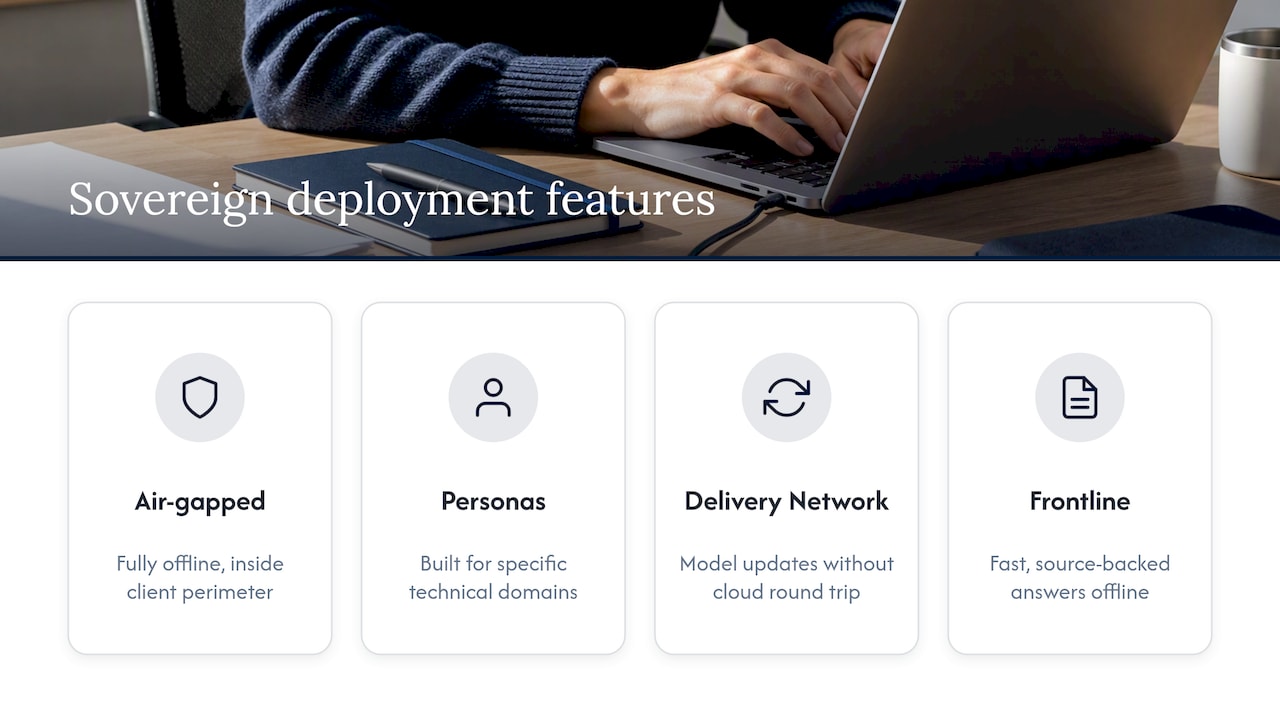
We deploy and operate sovereign AI systems inside infrastructure our clients control, including enterprise data centers, edge sites, and fully air-gapped networks, as an official systems integrator for webAI’s platform. That work leads with private and air-gapped deployment, webAI Personas built for specific technical domains, the Intelligence Delivery Network that keeps models current without a cloud round trip, and webAI Frontline, which gives frontline teams fast, source-backed answers from large technical document libraries, fully offline on a single device.
Our secure local and air-gapped deployment work, custom model integration and optimization, and sovereign MLOps and runtime orchestration are built around the same principle this article argues for: verify before you trust, and keep every piece of that verification inside the boundary you control. Our leadership’s experience in high-consequence and regulated environments shapes how we build release gates and evidence trails for clients who cannot afford a data exfiltration risk at any stage.
If your organization needs AI deployed without sensitive data ever leaving your perimeter, see why security and sovereignty-focused teams choose us on our Why Forge page, or reach out through Forge AI Deployment to scope a deployment.