The right approach to retrieval evaluation blends three layers: classical ranking metrics (Precision@k, Recall@k, MRR, nDCG), a RAG-aware utility metric such as UDCG or eRAG, and a production monitoring layer that catches drift between benchmark runs. Run a lightweight weekly dashboard, a monthly full-suite pass with subcorpus sampling, and targeted LLM-judged evaluations on your riskiest query segments. Classical metrics alone miss distracting documents and misjudge how large language models actually consume retrieved context.
TL;DR:
- Classical retrieval metrics like Precision@k and Recall@k only evaluate relevance, not whether retrieved documents support correct answers in RAG systems.
- Utility-aware metrics such as UDCG and eRAG improve correlation with final answer quality, but they require more computational resources and complex annotations.
- A multi-stage evaluation pipeline including sampling, pooling, LLM judging, and production monitoring ensures comprehensive retrieval performance assessment.
- Offline relevance metrics can diverge from end-to-end accuracy, making it necessary to pair retrieval scores with utility or end-to-end evaluations before deployment.
- Continuous operational signals like index freshness, drift, and abstention rate are essential for monitoring retrieval health in live systems.
Table of Contents
- Core IR metrics: definitions, practical meaning, and RAG limitations
- RAG-aware metrics: UDCG, eRAG, and URAG, and what each one trades off
- Building an evaluation pipeline: sampling, pooling, judging, and scoring
- Production monitoring: operational signals tied to retrieval health
- Choosing metrics and a checklist you can run this week
- End-to-end versus retrieval-only evaluation, and why they can disagree
- Statistical significance testing in retrieval evaluation
- User behavior and interaction metrics in retrieval evaluation
- Error analysis and failure case studies
- Evaluation challenges with large-scale and high-dimensional data
- Practitioner perspective: trade-offs, costs, and research directions
- A secure path to production-grade retrieval operations
- FAQ
- Sources
Core IR metrics: definitions, practical meaning, and RAG limitations
Precision@k measures the fraction of the top k retrieved documents that are actually relevant, typically tracked at Precision@5 for quick dashboards. Recall@k measures how much of the available relevant evidence you captured within the top k, often checked at Recall@10 or Recall@20 when completeness matters more than ranking order. MRR (Mean Reciprocal Rank) rewards getting at least one relevant document near the top, which is useful for single-answer lookup tasks. nDCG (normalized Discounted Cumulative Gain), commonly reported at nDCG@5 or nDCG@10, weighs graded relevance against position, and MAP (Mean Average Precision) summarizes precision across the full ranked list for multi-document retrieval tasks.
Each metric diagnoses a different failure:
- Low Precision@k points to noisy context: retrieval is pulling in off-topic or tangential documents that will clutter the prompt.
- Low Recall@k signals missing evidence: the right document exists in the corpus but never makes the shortlist.
- Low MRR or nDCG indicates a ranking problem: relevant content exists but sits too far down to be trusted or used first.
The limitation specific to RAG is that these metrics assume a human reader scanning results top to bottom, with a positional discount that rewards early placement. LLMs do not consume context that way. They can be pulled off track by a document that is topically relevant but factually distracting, something classical precision never penalizes because it only checks relevance, not whether a document actively misleads the generator.
RAG-aware metrics: UDCG, eRAG, and URAG, and what each one trades off
Classical IR metrics check relevance; they do not check whether a retrieved document actually helps or hurts the model’s final answer. Three recent approaches close that gap, each with a different cost profile.
- UDCG (utility and distraction-aware cumulative gain) scores documents on positive utility and distracting negative effects, then applies an LLM-oriented positional discount instead of a human-reading discount.
- eRAG runs the LLM once per retrieved document, feeding it in isolation, and uses the resulting downstream output quality as that document’s utility label, then aggregates labels across the retrieved set.
- URAG turns open-ended RAG tasks into multiple-choice question answering and applies conformal prediction to quantify the accuracy-versus-set-size trade-off under uncertainty.
Across five datasets and six large language models, UDCG improved correlation with end-to-end RAG accuracy by up to 36% over traditional IR metrics, according to the researchers’ findings. That gap matters because a metric that does not track downstream accuracy will send you optimizing the wrong thing.
The trade-offs are real. eRAG’s document-level labeling requires one LLM call per retrieved document per query, which is expensive at scale, though it still saves substantial compute compared to full end-to-end evaluation. UDCG needs utility and distraction labels, which means either LLM-judge annotation or curated ground truth. URAG’s uncertainty framing found that retrieval noise can amplify confident, wrong answers, and that no single RAG method stayed reliable across every domain tested, so treat any one metric as a lens, not a verdict.
Building an evaluation pipeline: sampling, pooling, judging, and scoring
A practical retrieval evaluation pipeline runs in five stages, and you can build a working version in a sprint rather than a multi-week project.
- Sample your queries. Mix production-sampled queries (real traffic, weighted toward frequency) with human-curated edge cases and a small batch of LLM-generated paraphrases to stress-test robustness to phrasing.
- Pool candidate documents. Run lexical, dense, and late-interaction retrievers in parallel and pool their outputs; diverse retrieval strategies reduce false negatives in your judged set because no single retriever surfaces every relevant document.
- Apply subcorpus sampling. Use reciprocal rank fusion to select a representative slice of the corpus for frequent runs. One benchmark found that retaining roughly a third of a corpus, selected by RRF, preserves the full-corpus ranking between systems while only raising absolute Recall@1000 by 3 to 7 points, which keeps comparative conclusions valid at a fraction of the cost.
- Score with an LLM-as-judge. Fix the judge’s temperature at zero for reproducibility, use a consistent prompt template across runs, and report confidence intervals rather than a single point estimate.
- Compute metrics and compare. Run paired comparisons under identical generation settings so any score difference reflects retrieval, not an unrelated prompt or decoding change.
Spot-check a sample of judge disagreements with a human reviewer before trusting the automated scores at scale.
Pro Tip: Run your LLM-as-judge on last week’s production queries before every release, not just on a static benchmark set, so drift in real traffic shows up before customers notice it.
Layer in shadow evaluation (new retriever runs silently alongside production) and canary releases (small traffic percentage) to validate changes before a full rollout.
Production monitoring: operational signals tied to retrieval health
Benchmarks run periodically; production drifts continuously. A monitoring layer between evaluation cycles catches regressions before a monthly or quarterly sweep would.
- Index freshness flags when newly ingested documents are not yet embedded or indexed, a common cause of recall gaps that benchmarks miss entirely.
- Embedding-similarity drift tracks whether the distribution of query-document similarity scores shifts over time, often a sign the corpus or query mix has changed.
- Empty-result rate counts queries returning nothing above a relevance threshold, a direct signal of coverage gaps.
- Percent-abstain tracks how often the system says it does not know, which rises when retrieval quality drops and the generator correctly refuses to guess.
- p95 latency and reranker timeouts catch performance regressions that would otherwise look like quality problems downstream.
Production guidance recommends segment-level reporting by language, document type, user intent, and content recency, because aggregate metrics routinely hide failures concentrated in one slice. An interactive chat product tolerates less latency than an asynchronous report-generation pipeline, so your service-level objectives should differ: a sub-second p95 for chat, a looser bound where accuracy matters more than speed.
Choosing metrics and a checklist you can run this week
Match your metric mix to the job the retrieval system does. Evidence-finding tasks, where missing a document is costly, call for a recall-first approach. Short-answer policy lookups, where one wrong or distracting result misleads the user, call for precision-first tracking. Any pipeline where the LLM’s final answer is the real product benefits from adding UDCG or eRAG on top of the classical metrics.
- Track Precision@5 and MRR weekly on a lightweight dashboard fed by production queries.
- Run a full-suite evaluation monthly, using subcorpus sampling to control cost.
- Route high-risk query segments (regulatory, financial, safety-adjacent) through combined LLM-judge and human review.
- Reserve UDCG or eRAG runs for releases that change the retriever, reranker, or chunking strategy.
| Cadence | Metric focus | Method |
|---|---|---|
| Weekly | Precision@5, MRR | Lightweight dashboard on production queries |
| Monthly | Full metric suite | Subcorpus sampling via reciprocal rank fusion |
| Per release | UDCG or eRAG | LLM-as-judge with human spot checks |
| Continuous | Index freshness, drift, abstain rate | Operational monitoring |
End-to-end versus retrieval-only evaluation, and why they can disagree
Retrieval-only evaluation scores the ranked list against relevance judgments. End-to-end evaluation scores the generator’s final answer, which depends on retrieval but also on prompt construction, chunking, and the model’s own reasoning. The two can and do diverge: a retriever with excellent Recall@10 can still feed a generator that produces a poor answer because the right document was buried among distracting ones, or because the chunk boundaries split the answer across two passages.
This is the core reason UDCG and eRAG exist. Classical retrieval-only metrics correlate imperfectly with end-to-end quality precisely because they cannot see how the generator uses what it receives. A document that is topically on point but contradicts the correct answer scores well on relevance judgments while actively harming the final output, a gap plain Precision@k cannot detect.
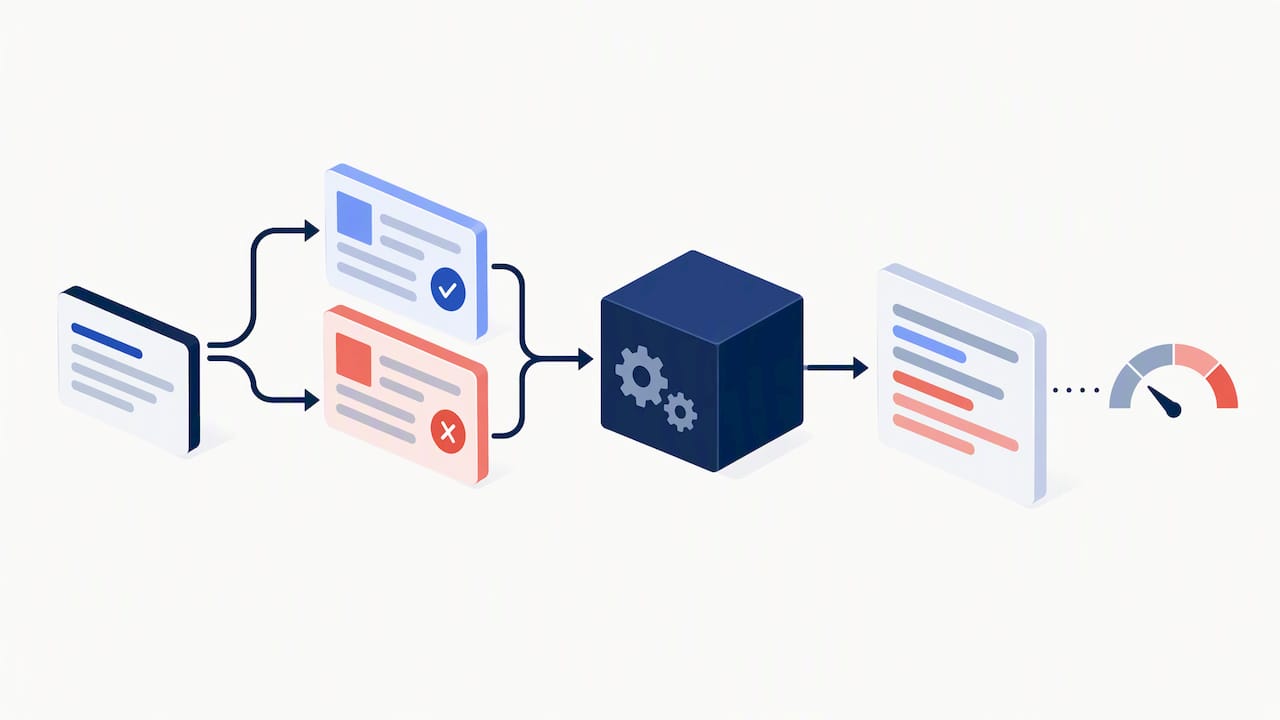
Practically, this means a retrieval-only metric should never be the sole gate for shipping a change. Treat retrieval-only scores as a fast, cheap proxy for day-to-day monitoring, and reserve end-to-end or utility-aware scoring for release decisions and for diagnosing why a retrieval improvement did not translate into a better answer. When the two disagree, investigate chunking, prompt assembly, and context ordering before assuming the retriever itself regressed. Running both in parallel, rather than picking one, is what actually catches the gap: a retrieval metric tells you what came back, and a utility-aware or end-to-end check tells you what the model did with it.
Statistical significance testing in retrieval evaluation
A metric difference between two retrieval systems is not automatically meaningful. Query sets are samples, not populations, and a few outlier queries can swing an aggregate score enough to look like a real improvement when it is noise. Paired significance tests, such as a paired t-test or a bootstrap resampling test over per-query scores, are the standard way to check whether an observed gain in nDCG, MRR, or Recall@k would likely hold on a new query sample.
Bootstrap resampling is particularly useful in retrieval evaluation because per-query metric distributions are rarely normal: a handful of queries often score near zero or near one, skewing the distribution. Resampling the query set with replacement thousands of times and recomputing the metric gives a confidence interval around the observed difference without assuming a particular distribution shape.
Significance testing matters even more once you add subcorpus sampling and LLM-as-judge scoring, because both introduce additional variance on top of query sampling: a judge’s temperature setting, prompt phrasing, or an unlucky subsample can all shift the score. Report a confidence interval or p-value alongside any claimed improvement, and be skeptical of a one-point nDCG gain reported without one. A test set too small to detect anything but a large effect gives a false sense of precision; growing the judged query set is often more valuable than chasing a marginally better metric formula.
User behavior and interaction metrics in retrieval evaluation
Offline metrics judge retrieval against pre-collected relevance labels. User behavior metrics judge it against what people actually do once results reach them, which can reveal problems no offline benchmark captures. Click-through rate on retrieved sources, dwell time on a cited passage, and reformulation rate (how often a user immediately rephrases their query) all signal whether retrieved content is actually satisfying intent.
In a RAG system specifically, the analogous signals are abstention rate, follow-up question rate, and explicit feedback such as thumbs-down on a generated answer. A rising follow-up rate on a topic that used to resolve in one turn often means retrieval quality degraded before any offline metric would catch it, because the judged query set simply has not been refreshed with current traffic patterns.
The limitation of behavioral signals is confounding: a user might reformulate because the answer was wrong, because the interface was confusing, or because they changed their mind about what they wanted. Behavioral metrics are best treated as a trigger for deeper investigation, not a standalone score. Pairing a spike in reformulation rate or abstention with a targeted LLM-judge run on the affected queries turns a noisy signal into an actionable one, and it closes the loop between what users experience and what your benchmark measures.
Error analysis and failure case studies
Aggregate metrics tell you something degraded; they rarely tell you why. Error analysis means pulling the specific queries where a metric scored poorly and reading them, which routinely surfaces patterns an aggregate score hides entirely.
Common RAG retrieval failure patterns worth building a recurring review around:
- Chunking splits: the correct answer spans two adjacent chunks, so neither chunk alone scores as fully relevant.
- Near-duplicate confusion: multiple similar documents outrank the one with the current or correct information, often from stale or versioned content.
- Distracting but relevant documents: a passage about the right topic contradicts or confuses the specific fact the query needs.
- Query-vocabulary mismatch: a user’s phrasing does not overlap with the document’s terminology, a classic lexical-retrieval gap that dense retrieval only partially fixes.
A recurring failure review, even a lightweight one covering the worst-scoring 20 to 30 queries from each monthly evaluation run, consistently surfaces one or two systemic issues worth fixing directly, like a chunking boundary or a stale document that should have been deprecated. This kind of qualitative review is what turns a metric drop into a shippable fix, and it is the step most teams skip when they treat evaluation as a dashboard number rather than a diagnostic tool.
Evaluation challenges with large-scale and high-dimensional data
Evaluating retrieval over a corpus of a few thousand documents is tractable with brute-force relevance judgments. Evaluating retrieval over millions of documents and high-dimensional embeddings introduces cost and sampling problems that change how you have to approach the problem.
Exhaustively judging relevance across a large corpus is not feasible, which is why pooling, the practice of judging only the union of top results returned by several different retrieval systems, remains the standard approach from classical IR evaluation. Pooling assumes that documents never retrieved by any system in the pool are not relevant, an assumption that breaks down as corpus size grows and the number of systems in the pool stays fixed, because more relevant documents sit outside everyone’s top results.
High-dimensional dense embeddings add a second problem: approximate nearest-neighbor search, used at scale for latency reasons, trades a small amount of recall for speed, and that trade-off needs to be evaluated separately from retrieval quality itself. A system can look worse on an offline benchmark purely because its approximate index configuration differs from another system’s, not because its underlying relevance ranking is worse.
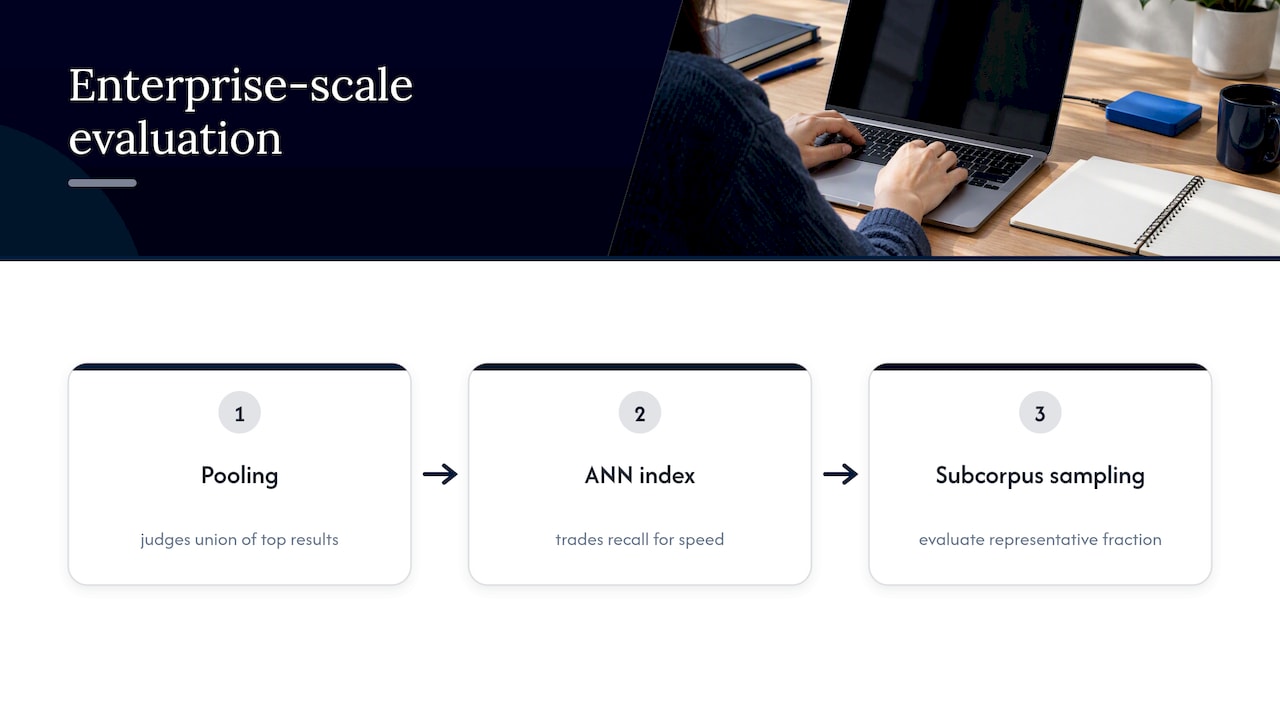
Subcorpus sampling, discussed earlier with reciprocal rank fusion, is the practical answer to the cost side of this problem: evaluating a representative fraction of a large corpus preserves the comparative ranking between systems without requiring exhaustive judgment of every document, which is simply not achievable once a corpus reaches enterprise scale.
Practitioner perspective: trade-offs, costs, and research directions
Here is the honest trade-off: full LLM-judge labeling at scale costs real money, and most teams do not need it on every query, every week. Start with cheap, frequent classical metrics, and reserve utility-aware scoring for releases and risky segments. The mistake I see most often is chasing a single aggregate number instead of checking whether that number actually correlates with downstream task success, which is the entire point of UDCG and eRAG. The open research questions worth watching are better utility annotation methods, sharper uncertainty metrics beyond URAG’s conformal approach, and more reliable, lower-cost ways to scale LLM-judging without a human reviewer checking every disagreement.
— John Ezzell, Founder
A secure path to production-grade retrieval operations
Building and maintaining this kind of evaluation pipeline takes ongoing engineering time, which is exactly where some teams prefer a managed path, especially when the underlying data cannot leave a controlled environment. Forge designs and operates sovereign AI systems inside infrastructure customers control, as an official webAI systems integrator.
- Private and air-gapped deployment enabling retrieval evaluation and monitoring inside a secure perimeter.
- webAI Personas and the Intelligence Delivery Network supporting domain-specific retrieval tuned to document sets.
- webAI Frontline providing source-backed answers from large technical document libraries, fully offline on a single device.
- Sovereign MLOps and ongoing operations support available for teams needing monitoring support.
This is one route among several, not a required one. For teams evaluating what a managed, private deployment looks like in practice, our solutions page outlines the engagement options available.
FAQ
What are the five basic types of evaluation?
Retrieval evaluation generally spans five categories: offline relevance-based metrics (Precision@k, Recall@k, nDCG, MAP), rank-sensitive metrics (MRR), utility-aware and LLM-oriented metrics (UDCG, eRAG), uncertainty and reliability evaluation (URAG’s conformal prediction approach), and production monitoring (drift, latency, abstention rate). Each category answers a different question, from pure ranking quality to how retrieval affects the final generated answer.
How do you measure retrieval quality?
Retrieval quality is measured with ranking metrics like Precision@k, Recall@k, MRR, and nDCG against a judged set of relevant documents, then validated with a RAG-aware utility metric that checks whether retrieved documents actually helped the generator produce a correct answer. UDCG improved correlation with end-to-end accuracy by up to 36% over traditional IR metrics in testing across five datasets and six large language models, which is why utility-aware scoring is increasingly paired with classical metrics rather than replacing them.
What are the different retrieval techniques?
Common retrieval techniques include lexical search (keyword and term-frequency matching), dense retrieval (embedding-based semantic similarity), and late-interaction retrieval (token-level matching between query and document embeddings). Production pipelines often pool results from more than one technique because each catches relevant documents the others miss, which also reduces false negatives during evaluation.
Can you give me an example of evaluation research?
eRAG is a concrete example: it runs the language model once per retrieved document in isolation, uses the resulting answer quality as that document’s utility label, then aggregates labels across the retrieved set. The approach correlates better with end-to-end RAG performance than standard relevance judgments while cutting compute cost compared to full end-to-end evaluation runs.
What is subcorpus sampling and why does it matter for retrieval evaluation?
Subcorpus sampling evaluates systems against a representative fraction of a large corpus instead of the full set, typically selected with reciprocal rank fusion. One benchmark found that retaining roughly a third of the corpus selected by reciprocal rank fusion preserves ranking while raising absolute Recall@1000 by 3 to 7 points, making frequent evaluation affordable at enterprise scale.