LLMOps is the discipline of deploying, monitoring, and governing large language models in production so they stay safe, reproducible, and auditable at scale. For enterprise teams running regulated or high-stakes workloads, the goal is not just uptime. It is proof: evidence that every model behaved as expected, every change was tested, and every output can be traced.
TL;DR:
- Proper LLMOps requires comprehensive versioning and validation of datasets, models, and prompts to ensure traceability and compliance at every lifecycle stage.
- Serving architectures should be selected based on workload patterns, with pipelined multicast serving offering significant tail latency reductions during traffic spikes.
- Implementing strong security controls involves validating all retrieval content, managing prompt changes carefully, and logging intermediate reasoning steps for traceability.
- Monitoring should track language-specific signals like hallucination rates and tool success, with automated incident responses triggered by risk severity thresholds.
- Sovereign deployment solutions help regulated industries meet audit, security, and control requirements by keeping models, data, and testing artifacts within organizational infrastructure.
Table of Contents
- The scope and core components of LLMOps
- How LLMOps differs from MLOps and AgentOps
- Serving and deployment: architecture choices and latency trade-offs
- Data and model lifecycle, TEVV, and governance for regulated deployments
- Security-first operations: OWASP risks and prompt hygiene
- Monitoring, observability, and incident response for production LLMs
- Practical best-practices checklist and a 90-day roadmap
- Forge perspective: sovereign, air-gapped LLMOps for high-stakes use cases
- Case studies or real-world examples illustrating LLMOps in practice
- Integration of LLMOps with existing ML and software engineering workflows
- Tools and platforms commonly used for LLMOps
- Author perspective: operational disciplines mature LLMOps teams adopt
- Forge AI: secure sovereign LLMOps for enterprise deployment
- Sources
- FAQ
The scope and core components of LLMOps
LLMOps covers four connected layers: data, model, distribution, and application. Each layer carries its own operational duties, and a gap in any one of them creates risk downstream. A security-oriented lifecycle model for large language model systems breaks this down into 32 stages across those four layers, with a 12-stage LLMOps pillar sitting at the center of the whole pipeline.
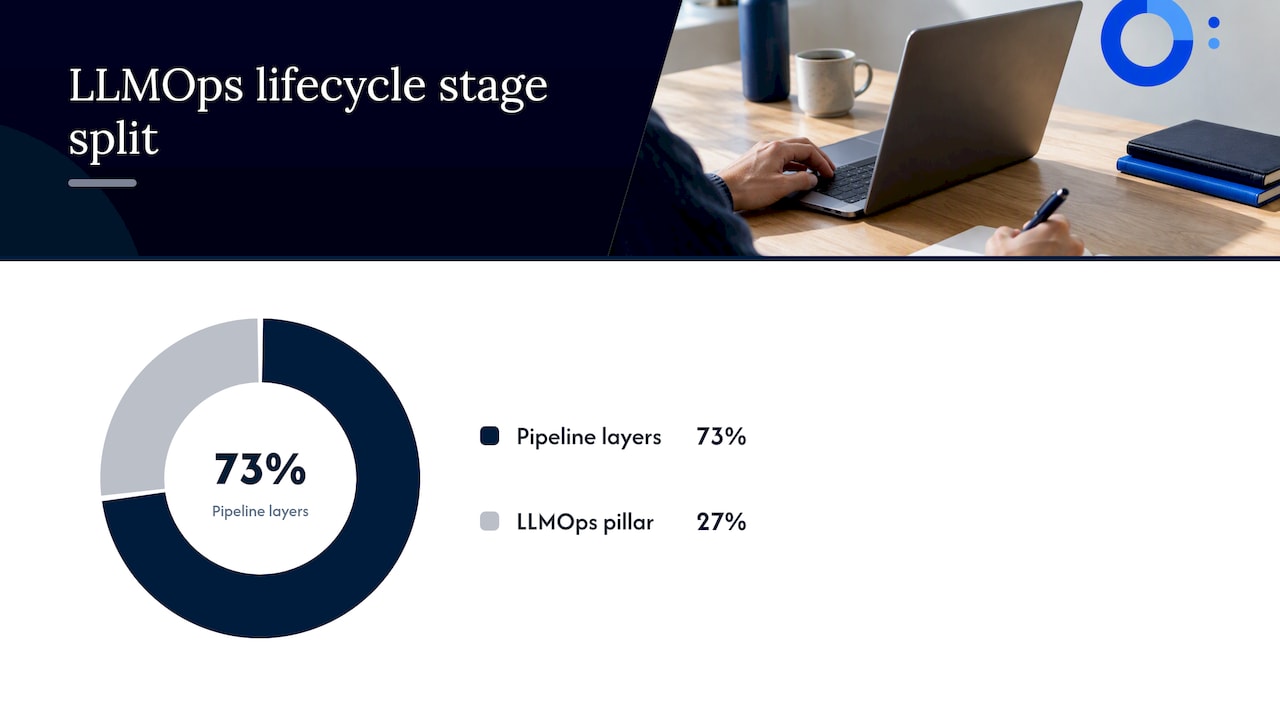
Data-layer work means sourcing, labeling, and validating training and retrieval corpora before anything touches a model. Model-layer work covers fine-tuning, evaluation, and version control. Distribution-layer work handles packaging, serving infrastructure, and rollout mechanics. Application-layer work is where guardrails, user-facing logging, and business logic live.
Within that structure, LLMOps teams typically own:
- Continuous integration and delivery pipelines built for prompts and model artifacts, not just code.
- Dataset and model versioning that ties every deployed artifact back to its training lineage.
- Guardrail configuration, including input filtering, output moderation, and tool-access limits.
- Inference orchestration across serving backends, including routing, batching, and failover.
- Monitoring and alerting tuned to language model behavior, not generic infrastructure metrics.
- Cost control across token usage, GPU allocation, and caching strategy.
The lifecycle paper notes that security evidence tends to concentrate at deployment-facing stages, near release and monitoring. That leaves upstream stages, like data selection and alignment strategy, under-documented unless teams deliberately build audit trails into earlier work. Treat LLMOps as a pillar that cuts across the whole pipeline, not a bolt-on step before launch.
How LLMOps differs from MLOps and AgentOps
Traditional MLOps assumes mostly deterministic models with stable input and output schemas. Large language models break that assumption: the same prompt can produce different outputs, and quality is judged on language, reasoning, and tone rather than a single accuracy score. That changes how teams test, set service levels, and define what counts as a regression.
LLMOps also inherits attack surfaces that classical ML systems rarely faced:
- Prompt injection, where untrusted input manipulates model behavior.
- Supply-chain risk from third-party models, adapters, and plugins.
- Tool-execution risk, where a model with excessive permissions takes unintended actions.
Operationally, this means prompts get treated as versioned code, retrieval content gets validated before it reaches a model, and intermediate reasoning steps get logged for traceability, not just final answers. AgentOps extends these concerns further, since autonomous agents chain multiple LLM calls and tool invocations, multiplying the places where things can go wrong.
Serving and deployment: architecture choices and latency trade-offs
Serving decisions come down to a small set of metrics: time to first token (TTFT), inter-token latency (ITL), end-to-end latency (E2E), throughput, and cost per million tokens. Every architecture choice trades one of these against another, and there is no single correct answer. As one set of serving systems lecture notes puts it, teams need to plot their service-level objectives against a cost-latency Pareto frontier and pick an architecture that fits, rather than copying whatever a competitor uses.
Common patterns include:
- Pinned hot GPU allocation, which minimizes TTFT but keeps expensive hardware reserved even during idle periods.
- Warm host-memory caching, which trades some latency for lower steady-state cost.
- Serverless or disaggregated serving, which scales elastically but can suffer cold-start penalties.
- Pipelined multicast serving, designed for fast scaling under bursty traffic.
Pipelined multicast serving can cut tail TTFT by up to a factor of five and GPU resource use by about 18% to 31% in bursty traces, according to FaaScale’s benchmarks. That kind of gain matters most for workloads with spiky, unpredictable demand rather than steady, predictable load.
Agentic workloads complicate the picture further. A characterization study of agentic serving systems found that non-LLM components, not the model itself, dominated latency in half of the applications tested, and that task-aware serving reduced latency by roughly one-third to two-fifths while state offloading cut memory use by more than fourfold. Sessions in agentic systems can also hold state idle for minutes or hours, so memory management needs its own planning separate from model serving.
The practical move is to run automated benchmarks across backends and quantization settings, collecting TTFT, ITL, and E2E percentiles, then choosing the configuration that sits on your Pareto frontier rather than the one with the best headline number.
Data and model lifecycle, TEVV, and governance for regulated deployments
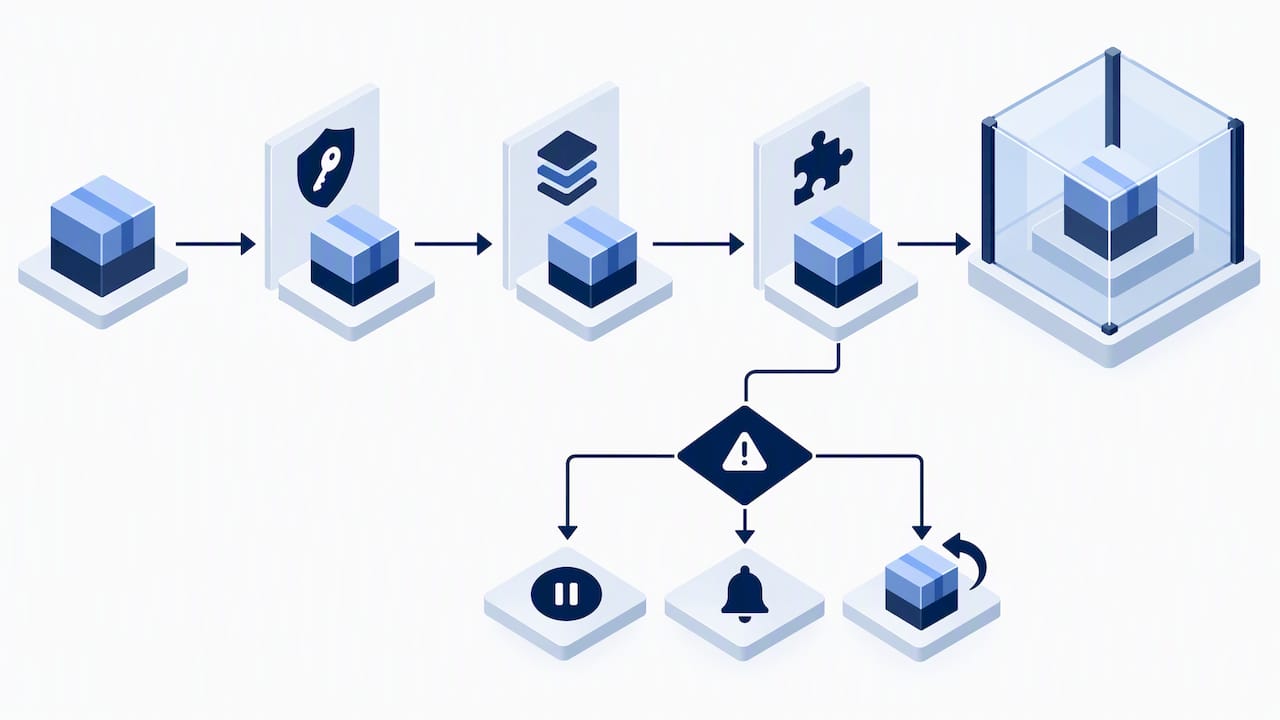
Regulated deployments need more than a working model. They need a bundle of evidence that proves the model was tested, validated, and monitored before and after release. This is where Testing, Evaluation, Verification, and Validation (TEVV) comes in. The 2026 AI Index report on responsible AI recommends that organizations bundle TEVV results with a risk assessment at every release, tying alert thresholds to a risk severity index that can trigger incident playbooks or rollbacks automatically.
A usable TEVV bundle typically includes:
- Documentation of the test datasets used for evaluation.
- The automation scripts that ran those tests.
- Audit logs covering both training and inference behavior.
- Sign-off records tied to each release.
Governance frameworks map onto different lifecycle stages rather than applying uniformly. The lifecycle model paper ties specific governance provisions, drawn from the NIST AI RMF, the EU AI Act, and ISO/IEC 42001, to particular stages across the data, model, distribution, and application layers. That mapping helps teams know which artifact to produce at which point, instead of treating compliance as a single end-of-project checklist.
Supply-chain mitigations matter just as much as testing. Signing model artifacts, pinning model versions in production configs, and vetting any third-party adapters or plugins before they touch live traffic all reduce the chance that an unreviewed component introduces risk. When a risk severity index crosses a defined threshold, that should trigger a specific playbook: pause rollout, notify an owner, or roll back to the last validated version, not an ad hoc scramble.
Security-first operations: OWASP risks and prompt hygiene
The OWASP Top 10 for LLM Applications lists prompt injection and supply-chain vulnerabilities among the highest-priority risks for production systems, alongside data poisoning and excessive agency, where a model is given more permission to act than it needs. These risks come with mitigation controls and verification guidance that map directly to the LLM Security Verification Standard (LLMSVS).
Turning that guidance into daily practice looks like this:
- Validate and sanitize all retrieved content before it reaches the model, treating retrieval as an untrusted input channel.
- Version every prompt like a code change, with tags, history, and a rollback path.
- Separate tool privileges so a model can only call the specific functions its task requires, nothing broader.
- Run regression suites against a golden set of inputs before any prompt change ships.
- Restrict new prompt versions to staging environments until they pass that regression suite.
Recommendations on managing prompts safely in production echo this directly: prompts should never be edited in production without passing tests first, the same discipline applied to application code.
Fuzzing production-facing inputs, maintaining golden regression suites, and gating prompt changes through staging are the three habits that catch most issues before they reach users.
Pro Tip: Run your golden regression suite against every prompt change, no exceptions, even for what looks like a one-word tweak.
Monitoring, observability, and incident response for production LLMs
Generic infrastructure dashboards miss most of what goes wrong with language models. Effective monitoring tracks latency percentiles (TTFT, ITL, E2E) alongside language-specific signals like hallucination rate, tool-call success rate, and retrieval quality.
Service-level objectives should be tied to a risk severity index that automatically triggers a defined incident playbook when thresholds are crossed, rather than relying on someone noticing a dashboard spike. The 2026 AI Index report frames this RSI-linked alerting as a core part of operationalizing LLMs responsibly.
Useful telemetry to instrument includes:
- Latency percentiles at each stage of the request path, not just the total.
- Retrieval quality scores, measuring whether retrieved content actually supports the final answer.
- Tool-call success and failure rates for agentic workflows.
- Intermediate reasoning traces, not only final outputs.
The agentic workload study makes a direct case for instrumenting the full request path, including retrieval and tool execution, since regressions are far easier to debug when you can see where a chain of calls broke down rather than only the final result it produced.
Practical best-practices checklist and a 90-day roadmap
A 90-day plan gives teams a sequence that avoids trying to fix everything at once.
- Weeks 1 to 2: Define service-level objectives for latency, quality, and safety, and agree on what counts as a regression.
- Weeks 3 to 5: Establish a performance baseline and instrument the full request path, including retrieval and tool calls.
- Weeks 6 to 9: Add guardrails and assemble a TEVV bundle for your highest-risk model or use case.
- Weeks 10 to 13: Automate CI/CD for prompts and models, including staged canary rollouts and a tested rollback path.
Alongside that sequence, treat prompts as code with version history, keep datasets and models versioned together so any output can be traced to its source, and require a cross-functional signoff, including a security reviewer, before anything reaches production. Organizations that skip the signoff step tend to discover gaps only after an incident forces the review.
Forge perspective: sovereign, air-gapped LLMOps for high-stakes use cases
For organizations in finance, defense, logistics, energy, or manufacturing, the TEVV and governance work described above is easier to defend when the underlying infrastructure never leaves the client’s control. Forge AI’s sovereign deployment services are built around that constraint: models, data, and the artifacts that document testing and validation all stay inside the client’s own environment.
That matters most when:
- Regulatory requirements demand proof that data never left a controlled boundary.
- Audit trails need to tie directly to infrastructure the organization fully owns.
- Supply-chain controls, like model pinning and adapter vetting, must be enforceable without relying on a third-party cloud.
This approach treats sovereign deployment as the foundation that makes the rest of the LLMOps stack auditable rather than aspirational.
Case studies or real-world examples illustrating LLMOps in practice
The clearest illustrations of LLMOps in practice come from the research on serving systems rather than marketing case studies, since the benchmarks show what actually happens under production-like conditions. The agentic workload characterization study tested ten applications and found non-LLM components, things like database lookups or external API calls, dominated latency in half of them. That is a concrete example of a team optimizing the wrong layer: tuning the model’s inference speed while the real bottleneck sits elsewhere in the pipeline.
Another example comes from bursty-traffic serving. FaaScale’s benchmarks show pipelined multicast cutting tail TTFT by up to 5 times during traffic spikes, which is the kind of workload pattern a customer-support chatbot or a seasonal retail assistant would see. A team running steady, predictable traffic would get far less benefit from that same architecture, which is why benchmarking against your own workload matters more than adopting whatever pattern performed best in someone else’s paper.
These examples point to a consistent lesson: LLMOps decisions that look correct in isolation, like optimizing model inference, can miss the actual constraint governing a system’s performance. Measuring the full request path before choosing an architecture avoids that trap.
Integration of LLMOps with existing ML and software engineering workflows
LLMOps does not replace MLOps or standard software engineering practice. It extends both with controls specific to language model behavior. Existing CI/CD pipelines can handle prompt versioning and model artifact promotion with the addition of a few LLM-specific gates: a regression suite run against golden prompts, a guardrail configuration check, and a TEVV bundle attached to the release.
Version control systems that already track code can track prompts the same way, with tags, history, and pull-request review, so prompt changes go through the same scrutiny as a code change rather than a quiet edit in a dashboard. Feature stores and data pipelines built for traditional ML models extend naturally to cover retrieval corpora, provided teams add validation steps for content that will be fed to a model at inference time.
The main friction point is testing philosophy. Traditional software tests check for exact, deterministic outputs. Language model testing has to account for acceptable variation, which means regression suites need defined tolerance bands and qualitative review alongside automated checks. Teams that bolt LLM workflows onto infrastructure built purely for deterministic software often find their existing test suites report false failures on outputs that are actually fine, or worse, pass outputs that silently drifted in quality.
Tools and platforms commonly used for LLMOps
Most LLMOps stacks combine a handful of categories rather than one all-in-one platform. Benchmarking frameworks, like the SageMaker LLM Inference Optimizer, automate the deploy, load-test, and metric-collection cycle needed to find a Pareto-optimal serving configuration across backends and quantization settings.
Observability tooling needs to capture latency percentiles, retrieval quality, and tool-call outcomes, not just infrastructure health. Version control extends to prompts and datasets, often through the same systems already used for application code, with added tagging for model lineage. Guardrail and moderation layers sit between the application and the model, enforcing the input and output controls described in the OWASP guidance.
For organizations that need the entire stack inside infrastructure they fully control, sovereign deployment platforms bundle serving, orchestration, and monitoring into a single environment rather than stitching together separate cloud services. That trades some flexibility in tool choice for a tighter, more auditable boundary around where models, data, and logs physically live.
Author perspective: operational disciplines mature LLMOps teams adopt
The teams that handle LLMOps well treat prompts as code and run regression tests before any change ships, not after a user reports something strange. They also assign clear ownership: one team accountable for LLM operations, not three teams each assuming someone else is watching. The organizations still getting burned are usually the ones treating observability as optional and distribution security as an afterthought, when both deserve investment before the first production launch, not after an incident.
— John Ezzell, Founder
Forge AI: secure sovereign LLMOps for enterprise deployment
Running LLMOps inside infrastructure you fully control removes an entire category of risk that cloud-based deployments carry by default. Forge AI’s solutions cover secure local and air-gapped deployment, custom model integration and optimization, private AI assistant rollout, sovereign MLOps and runtime orchestration, and ongoing performance tuning, all designed so data, models, and TEVV artifacts never leave your environment.
That setup maps directly to the governance and security work described above: audit logs, model pinning, and signoff records all live where you can defend them. If your organization needs an LLMOps partner built around that constraint, explore Forge AI’s deployment services and start a conversation about your environment.
Sources
- OWASP Top 10 for LLM Applications (GenAI Security Project)
- A security-oriented lifecycle model for large language model systems
- FaaScale: fast, resource-efficient serverless LLM scaling
- 2026 AI Index report — responsible AI / responsible deployment recommendations
FAQ
What does LLMOps stand for?
LLMOps stands for large language model operations, the set of practices for deploying, monitoring, and governing large language models in production. It extends MLOps with controls specific to language model behavior, like prompt versioning and guardrail management.
What are the key differences between LLMOps and AgentOps?
LLMOps covers the operational lifecycle of a single language model in production, including serving, monitoring, and security controls. AgentOps extends those concerns to systems where multiple LLM calls and tool invocations chain together, which multiplies the places where latency, cost, and security risks can appear, as shown in research on agentic serving systems.
What does LLMO mean?
LLMO is sometimes used as shorthand for large language model optimization or operations, though it is not a standardized term. The widely recognized term in the industry is LLMOps, which covers the full operational discipline described throughout this article.
What is MLOps in simple terms?
MLOps is the practice of deploying, monitoring, and maintaining machine learning models in production, covering tasks like versioning, testing, and retraining. LLMOps builds on the same foundation but adds controls for the nondeterministic, language-based outputs that large language models produce.
Why do regulated industries need TEVV for LLM deployments?
TEVV, which stands for Testing, Evaluation, Verification, and Validation, gives regulated organizations the documented evidence auditors expect: test datasets, automation scripts, and audit logs tied to each release. The 2026 AI Index report recommends bundling this evidence with risk assessments so alert thresholds can trigger incident playbooks or rollbacks automatically.