Sovereign MLOps is the practice of building, versioning, evaluating, deploying, monitoring, and updating machine learning models entirely inside infrastructure your organization controls, so that data, models, keys, and logs never depend on an outside party. For large language models it means the same lifecycle discipline, run on your own hardware or in an air-gapped network, with no calls home for licensing, telemetry, or updates. This guide explains what changes compared with ordinary MLOps, what to design first, and how to plan the rollout.
TL;DR
- Sovereign MLOps applies control over data, models, keys, and logs at every stage of the AI lifecycle, not just at the hosting layer.
- LLM operations add new artifacts to manage: prompts, retrieval pipelines, agents, and heavy GPU and storage needs.
- Design for offline-first operation: assume nothing in the control plane can reach a central service.
- Auditability means you can rebuild raw data and every processing step, which requires immutable records and clear key ownership.
- Start with an inventory of use cases, data classes, and regulatory drivers, then phase the build.
Table of Contents
- What sovereign MLOps means in practice
- Hosting location is not the same as control
- How MLOps for LLMs differs from classic MLOps
- The lifecycle, stage by stage
- Designing for audit, residency, and access
- Reliability and security challenges to plan for
- A planning sequence that works
- Our perspective
- Put a sovereign lifecycle in place
- Frequently asked questions
- Sources
What sovereign MLOps means in practice
Standard MLOps is about getting models from experiment to production reliably. Sovereign MLOps adds a constraint: every artifact and every stage stays under your jurisdiction and your technical control. Cloud guidance on this topic describes it as applying sovereign controls consistently across every artifact and stage of the AI lifecycle, so that sensitive data and AI workloads can meet regulatory, legal, and operational requirements.
That covers more than the training data. The list of things to control includes:
- Source data and the features derived from it
- Base models and fine-tuned weights
- Prompts, retrieval indexes, and agent definitions
- Evaluation sets and test results
- Encryption keys and identity systems
- Logs, telemetry, and audit records
If any one of these lives in a service you cannot inspect, restrict, or switch off, the pipeline is not sovereign, no matter where the servers sit.
Why organizations are moving this way
The pressure comes from three directions. The first is regulation and contract: financial institutions, defense contractors, and critical-infrastructure operators often cannot let sensitive material cross a boundary. The second is operational: a 2026 discussion paper from a Canadian industry-government working group says that over-reliance on a few foreign-owned compute and AI capabilities creates geopolitical, operational, and legal exposure. The third is practical: a model that answers from your own technical documents is only useful if you can let it read the documents that matter most, and those are usually the ones that cannot leave.
The point is not that this paper’s country applies to you. The pattern is general: concentrated dependence on outside suppliers becomes a risk you have to engineer around.
Hosting location is not the same as control
A common mistake is treating sovereignty as a data-center address. A sovereign analytics architecture guide makes the distinction plainly: sovereignty is about retaining control of encryption keys and determining data flows, not only where the hardware sits. The same guide describes boundaries enforced through customer-controlled data planes (in a private cloud or on premises), keys you own, and policy engines that apply role-based and attribute-based access control at every layer.
In practice, ask four questions of every component in your pipeline:
- Who holds the keys that protect this data at rest and in transit?
- Can the vendor, or anyone outside our organization, reach this component remotely?
- Does it send telemetry, licensing checks, or update requests outside the perimeter?
- If the connection to the outside world disappears tomorrow, does it keep working?
A “no” to the last question, or a “yes” to any of the others, marks a gap.
How MLOps for LLMs differs from classic MLOps
Teams searching for MLOps for LLMs are usually asking what changes when the model is a large language model rather than a classifier or forecaster. Platform documentation on LLM operations lists several differences:
- LLMOps often starts with an existing model and may fine-tune it, rather than training from scratch.
- The artifacts you promote to production can be prompts, agents, chains, or retrieval-augmented generation (RAG) pipelines, not only model weights.
- LLMs can require GPUs and fast storage.
- Human feedback should inform testing and monitoring, because traditional metrics can be inadequate for judging language output.
Inside a sovereign environment each of those points gets harder. You cannot pull a new base model from a public hub at will, so model intake needs a controlled path. You cannot rent burst GPU capacity from outside, so capacity planning matters more. And you cannot send user feedback or sample outputs to an external labeling service, so evaluation workflows must run in-house.
Six capabilities a dark-site platform needs
One architect’s write-up on designing sovereign AI systems for disconnected sites lists six capabilities designed to run in dark sites: bring your own models, a sovereign vector store, ModelOps (deploy, version, evaluate, monitor, rollback), agent building, AgentOps (telemetry, audit, permissions), and governance and compliance. It is a useful checklist for scoping, even if you implement each piece differently.
The same write-up argues that a sovereign system must be network-aware and offline-first, assuming the control plane cannot reach a central service for licensing, configuration, or telemetry. We agree, and it is the single most useful design rule on this page: if you design for disconnection first, connected operation is the easy case.
The lifecycle, stage by stage
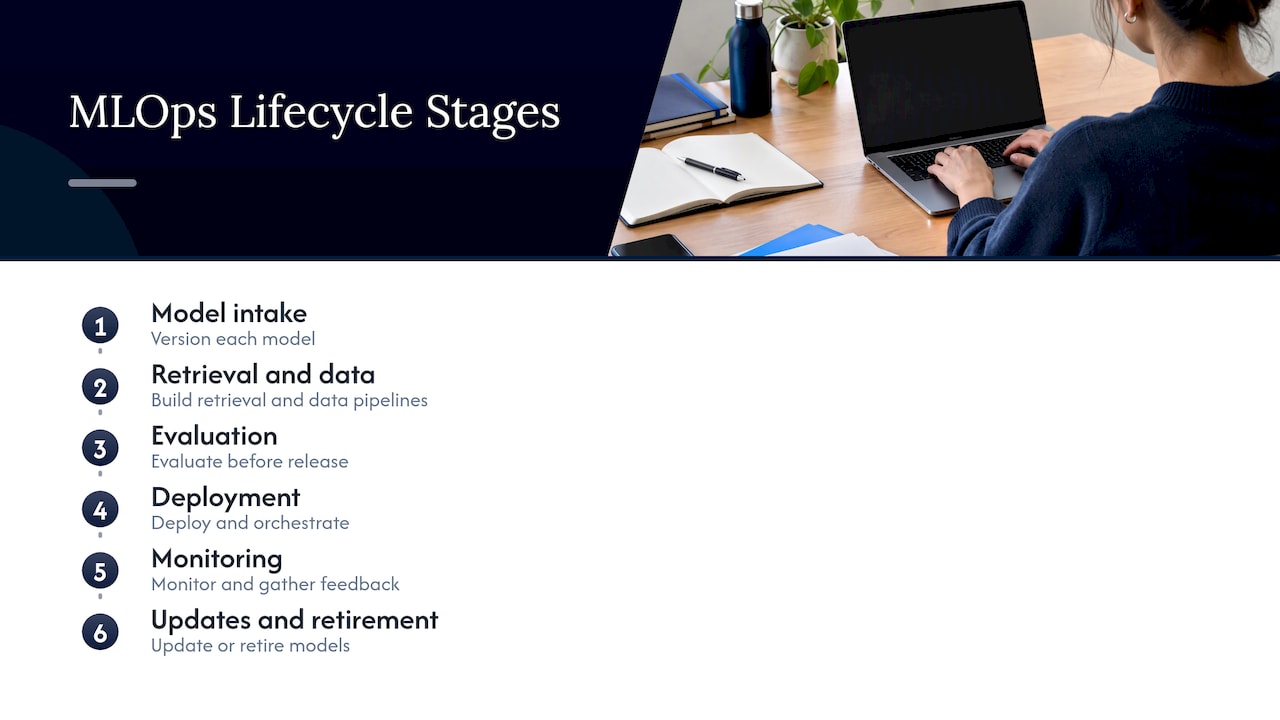
1. Model intake and versioning
Every model that enters the environment should arrive through a defined gate: provenance recorded, files scanned, hashes stored, license checked, and a version identifier assigned. Open-weight models are the usual starting point, since you can host them without an external API. Keep a registry inside the perimeter and treat it as the only source of models for production.
Version more than the weights. A change to a system prompt, a retrieval index, or a chunking rule can change behavior as much as a new checkpoint. Record them together as a release.
2. Retrieval and data pipelines
Most enterprise LLM use cases are retrieval problems: answer from our manuals, procedures, contracts, or case files. A 2025 academic study presents an open-source toolkit for exactly this setting, applying LLMs to sensitive, non-public data in restricted environments with prebuilt pipelines for RAG, document processing, and information extraction across multiple model backends. The takeaway for architects is that these patterns are mature enough to run locally; the hard part is operations, not feasibility.
For a deeper look at how regulated teams phase this work, see our guide to private RAG for regulated teams.
3. Evaluation before release
Because language output is hard to score with a single number, build an evaluation set from your own domain: real questions, expected source passages, known failure cases. Add human review for a sample of outputs and keep reviewer decisions in the audit store. Gate every release on this set, and re-run it whenever a model, prompt, or index changes.
Our 90-day LLMOps roadmap walks through testing, evaluation, verification, and validation as a staged plan for secure sovereign deployment.
4. Deployment and orchestration
Runtime orchestration inside a private environment means scheduling GPU workloads, routing requests, managing model replicas, and rolling back quickly. It should work with no outside registry, no cloud load balancer, and no external identity provider. Plan for blue-green or canary releases using internal infrastructure only, and rehearse rollback before you need it.
5. Monitoring and feedback
Production monitoring watches latency, GPU utilization, error rates, retrieval quality, drift in inputs, and the quality of answers. Every one of those signals must be collected and stored locally. For a practitioner’s view of what to track across the model lifecycle, this guide to model monitoring in MLOps covers the implementation details that carry over to a private stack.
6. Updates and retirement
In an air-gapped site, updates arrive as reviewed packages, carried across a controlled transfer point. Build a repeatable procedure: stage the update, test it against the evaluation set in a mirror environment, approve it, apply it, and keep the previous version ready. Retire models on a schedule so unsupported versions do not linger.
We cover the offline side in more depth in running private AI with no internet.
Designing for audit, residency, and access
Auditors rarely ask whether you use AI. They ask whether you can prove what happened. A practitioner write-up on sovereign data pipelines puts the standard bluntly: if you cannot reconstruct raw data and the sequence of processing steps, you do not have an auditable pipeline. The techniques it describes include mirroring raw data to an immutable store with object locking in compliance mode, capturing system-plane actions, and keeping tamper-evident records signed with keys protected by a hardware security module.
You can apply the same ideas on premises. Write-once storage, signed logs, and separated duties give you records that nobody, including administrators, can quietly edit. If you are drafting the policy side, this checklist of immutable backup policy steps is a good way to confirm that retention and recovery rules hold up.
Access control and keys
- Put identity inside the perimeter, with role-based access as a baseline and attribute-based rules where data classification demands it.
- Build a key hierarchy you own, with clear rotation and recovery procedures.
- Separate the people who deploy models from the people who approve them and the people who read audit logs.
Data residency and processors
If any part of the pipeline touches a third party, map every processor and subprocessor and put a data processing agreement in place before data moves; where rules require it, pin cross-border flows to specific regions. This guidance appears in a privacy compliance reference, which we treat as a checklist prompt rather than legal advice. Fully local deployments shrink this list to near zero, which is one of their main attractions. For your actual legal obligations, talk to your counsel and compliance team.
Reliability and security challenges to plan for
Running your own stack moves responsibility to you. Plan for these areas:
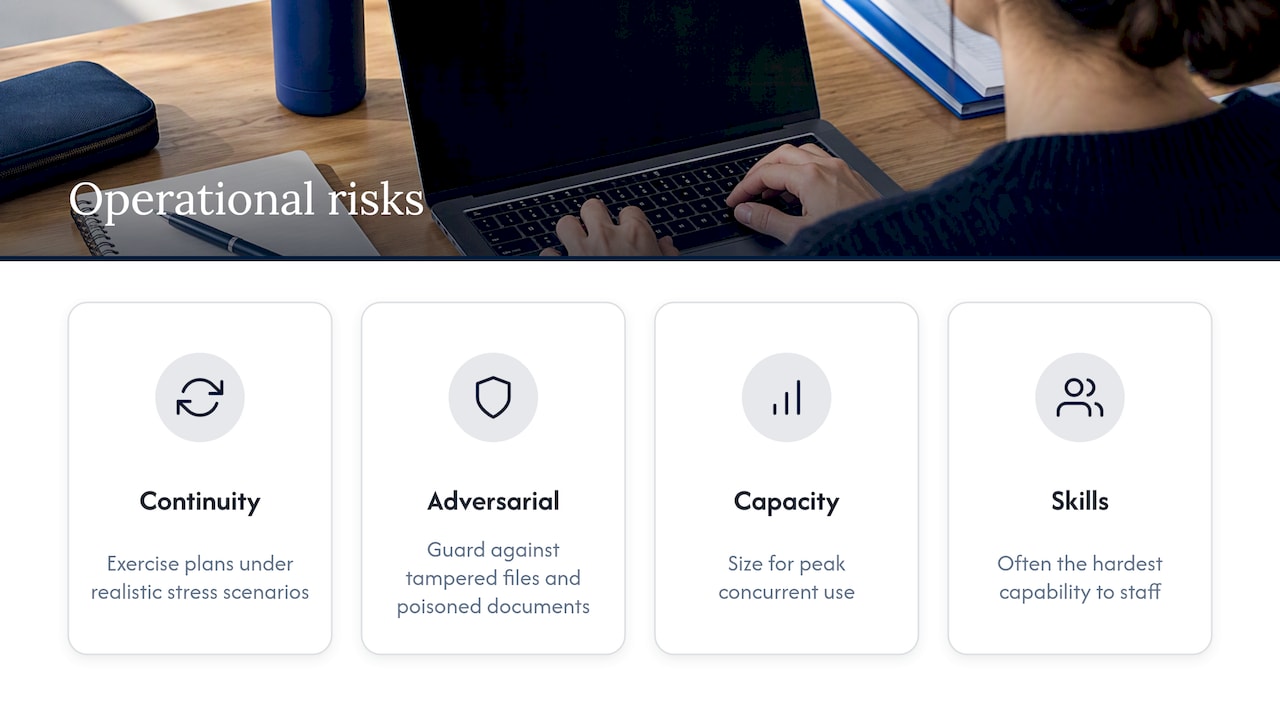
Continuity. The Canadian working group paper says resilience must be engineered through diversified suppliers, failover pathways including domestic edge modes, and continuity plans exercised under realistic stress scenarios. Translate that into runbooks: what happens when a GPU node fails, when a supplier cannot ship hardware, or when a site loses connectivity.
Adversarial risk. Researchers at UNSW Canberra’s IFCyber note that MLOps security risk management must go beyond standard IT policies to account for adversarial machine learning and the continuous updating and training of models. For LLM pipelines, that includes tampered model files, poisoned documents in a retrieval index, and prompt injection through ingested content.
Capacity. GPUs and fast storage are finite when you own them. Size for peak concurrent use, plan headroom for evaluation runs, and decide which workloads yield when capacity runs short.
Skills. Sovereign operations need people who understand infrastructure, security, and model behavior together. Many organizations find this the hardest part to staff, which is why they bring in an integrator for build and early operation.
A planning sequence that works
Cloud sovereignty guidance recommends starting with an inventory of AI use cases, data sources, classification levels, and regulatory drivers, then designing segmented networks, an identity model, a key hierarchy, a logging strategy, and a confidential-compute adoption plan. Here is how we would turn that into phases:
| Phase | Focus | Output |
|---|---|---|
| 1. Assess | Use cases, data classes, regulatory drivers, site constraints | Prioritized use-case list and boundary definition |
| 2. Design | Network segments, identity, keys, logging, hardware sizing | Reference architecture and control mapping |
| 3. Pilot | One use case, one site, full lifecycle including rollback | Working pipeline with evaluation set and audit trail |
| 4. Harden | Failure drills, security testing, update rehearsal | Runbooks and sign-off from security and compliance |
| 5. Scale | More use cases, more sites, shared model registry | Operating model and ongoing support plan |
Pick a first use case that is valuable, bounded, and uses data you already control. Document search over technical manuals is a common choice, because the benefit is easy to measure and the data stays in one place.
Before you go live, run through five agency checks for sovereign AI deployment; they work as a final gate for any regulated team.
Our perspective
Most sovereign AI projects stall for the same reason: the model is the easy part. The hard part is the operating discipline around it, meaning who approves a model, how an update crosses an air gap, where the keys live, and how you prove it all to an auditor.
At Forge AI Deployment, we come at this as operators, not software resellers. Our leadership has spent more than 20 years in high-consequence and Fortune 100 environments, and that shapes how we work: architecture first, then secure deployment, model integration, and ongoing operation, all inside infrastructure you control.
As an official webAI systems integrator, we bring webAI’s local-first platform into production, including its Personas, the Intelligence Delivery Network, and webAI Frontline, which gives frontline teams fast, source-backed answers from large technical document libraries, fully offline on a single device. We design every deployment so that data, models, and domain intelligence remain inside your perimeter, and we validate it for privacy and auditability.
Our advice is to build the lifecycle before you scale the use cases. A small pipeline with versioning, evaluation, rollback, and audit trails in place will carry you further than a large one without them.
John
Put a sovereign lifecycle in place
Forge AI Deployment designs, deploys, and operates private AI systems in enterprise data centers, edge sites, and air-gapped networks. Our work covers secure local and air-gapped deployment, custom model integration and optimization, private AI assistant rollout, sovereign MLOps and runtime orchestration, and performance tuning with ongoing operations.
If you are scoping a first deployment or want a second opinion on an architecture, see our sovereign AI deployment services or read how the webAI partnership underpins our deployments.
Frequently asked questions
What is sovereign MLOps?
It is the set of practices for building, deploying, monitoring, and updating machine learning models where data, models, keys, and logs all stay under your control. Sovereignty applies to every artifact and stage of the lifecycle, not only to where servers are located. For many organizations that means on-premises, edge, or air-gapped infrastructure.
How is MLOps for LLMs different from traditional MLOps?
LLM work often starts from an existing model rather than training one, and the artifacts you release can include prompts, agents, and RAG pipelines. LLMs also tend to need GPUs and fast storage, and human feedback matters for testing because standard metrics can fall short. In a sovereign setup, each of these must run without outside services.
Can LLMs be updated in an air-gapped environment?
Yes, through a controlled procedure. Updates arrive as reviewed packages, are tested against your evaluation set in a mirror environment, approved, applied, and kept reversible with a rollback path. Designing the platform offline-first from the start makes this routine rather than exceptional.
Where should an organization begin?
Start with an inventory of AI use cases, data sources, classification levels, and regulatory drivers. From there, design network segments, identity, key management, and logging, then pilot one bounded use case end to end before scaling.
Sources
- Implementing AI workloads with sovereignty controls
- Sovereign AI Infrastructure Resilience discussion paper (2026)
- Sovereign analytics platform architecture guide
- LLMOps workflows documentation
- Designing a sovereign AI system
- OnPrem.LLM study (2025)
- Sovereign data pipelines and auditability
- Privacy compliance reference
- Securing Machine Learning Operations, UNSW Canberra IFCyber
- Model monitoring in MLOps
- Immutable backup policy steps