On-prem MLOps means running the whole machine learning lifecycle, from data preparation to retraining, on infrastructure your organization owns or directly controls. For banks, defense contractors, manufacturers and logistics operators, the point is simple: data, models and audit evidence never leave your perimeter. The hard part is not the tooling. It is operating the platform reliably once it is live, and that is the work Forge AI Deployment takes on, deploying and operating private, sovereign AI systems inside customer-controlled data centers, edge sites and air-gapped networks.
TL;DR
- On-prem MLOps covers data prep, training, validation, release, deployment, monitoring, retraining and retirement on infrastructure you control, per one 2026 industry guide.
- Control is the payoff: on-premises infrastructure gives direct control over deployment location, model changes and audit evidence, according to Broadcom’s AI workload security guideline.
- The cost is operational responsibility: GPUs, patching, observability, power, cooling and hardware refresh all become yours.
- Start with one production use case, automate the path to production, and keep manual approvals for high-risk models.
- Forge deploys and operates webAI’s local-first platform inside your perimeter, so your team does not carry that load alone.
Table of Contents
- What MLOps means, and what makes it on-prem
- The lifecycle, step by step
- Architecture: seven layers to plan for
- Securing the lifecycle
- What on-prem MLOps costs you
- A rollout path that works
- Where the work lands on your team
- Our perspective
- Bringing the lifecycle in-house with Forge
- FAQ
- Sources
What MLOps means, and what makes it on-prem
MLOps is a set of practices that automate and simplify machine learning workflows and deployments. AWS describes it as unifying ML application development with ML system deployment and operations, with continuous integration, delivery, training and monitoring as the recurring activities.
The on-prem version applies the same lifecycle to infrastructure the organization owns or directly controls. The ONES on-premises guide draws the contrast with a fully managed cloud setup: on your own hardware, you are also responsible for the reliability and governance of the platform underneath the models.
That definition matters for the readers of this article. If your data cannot leave a regulated network, an export-controlled enclave or a factory floor, the question is not whether to run MLOps on premises. It is how to do it without building a second IT department.
The lifecycle, step by step
Every MLOps pipeline follows the same loop, whether it runs in a hyperscaler or in your own racks. Google Cloud’s MLOps architecture documentation lays out eight steps: data extraction, analysis, preparation, model training, evaluation, validation, serving and monitoring. Two gates inside that loop deserve attention:
- Data validation decides whether to retrain or stop the pipeline when it finds schema or value skews.
- Model validation compares the new model with the current production or baseline model before it is promoted.
On premises, each step has a physical and organizational cost that a cloud service would hide. Here is where each one tends to go wrong.
Data preparation and validation
Data stays inside your perimeter, which is the goal. The risk is that datasets sprawl across file shares with no owner. Before anything else, define which data feeds which model and who is accountable for it. ONES advises starting from a production use case with measurable value and clear data ownership.
Training and experiment tracking
Training jobs compete for GPUs, CPUs, memory and storage. Fixed hardware cannot expand as quickly as a cloud resource pool, so ONES recommends planning capacity for peak demand rather than average use, with scheduling and quota policies that prevent both idle hardware and long queues. A schedule that ignores this produces either an expensive empty cluster or a team waiting days for a run.
Registry and release
A candidate model should land in a registry, be annotated, reviewed and approved before release. Google’s practitioner white paper describes this continuous training loop: retraining triggered by new data or detected performance decay produces a registered candidate that goes through approval.
Serving
A model can be served as a REST microservice, embedded on an edge device or run as a batch job. Cisco’s FlexPod design guide shows an on-prem pattern on bare-metal infrastructure where the model is exposed as an inference endpoint over RPC or HTTPS, with CI/CD automation and production monitoring feeding back into the next cycle.
Monitoring and retraining
Monitoring is where on-prem programs most often fall short. The white paper above names model decay, data drift and concept drift, plus efficiency metrics such as latency, throughput and hardware utilization. One private-platform reference makes a sharp point: a platform that watches only admission policy and infrastructure health can pass a site-reliability review while still serving stale or biased predictions for weeks. You need a third surface, model-level observability.
The scale of the gap is industry-wide. A 2026 buyer’s guide, citing a NIST report, notes that post-deployment monitoring remains one of the least mature areas of enterprise AI practice.
Architecture: seven layers to plan for
The ONES guide recommends separating an on-prem MLOps environment into seven layers: data, development, training, registry, serving, operations and governance. It also calls for distinct development, testing and production environments, with production access tightly controlled even when some services are shared.
A table makes the planning questions concrete:
| Layer | Question to settle before building |
|---|---|
| Data | Who owns each dataset, and where does it live? |
| Development | Which notebooks and tools may touch production data? |
| Training | How are GPUs scheduled and capped per team? |
| Registry | Who approves a model for release? |
| Serving | Where do endpoints run: data center, edge or air-gapped site? |
| Operations | Who is on call, and how are patches rolled out? |
| Governance | What evidence will an auditor ask for, and where is it stored? |
At the infrastructure level, expect a Kubernetes-based stack: compute, container management, an AI platform layer, and security and observability. That is the general layering shown in vendor reference architectures for on-prem, hybrid and air-gapped AI platforms. Forge goes deeper on that foundation in its guides to Kubernetes for LLM inference and on-prem LLM orchestration.
Securing the lifecycle
Owning the infrastructure does not make it secure by default. Broadcom’s guideline says on-premises infrastructure gives direct control over deployment location, model changes, audit evidence and behavioral boundaries, yet governed intake, validation, promotion, change, recovery and review are still necessary. The controls below come from published guidance.
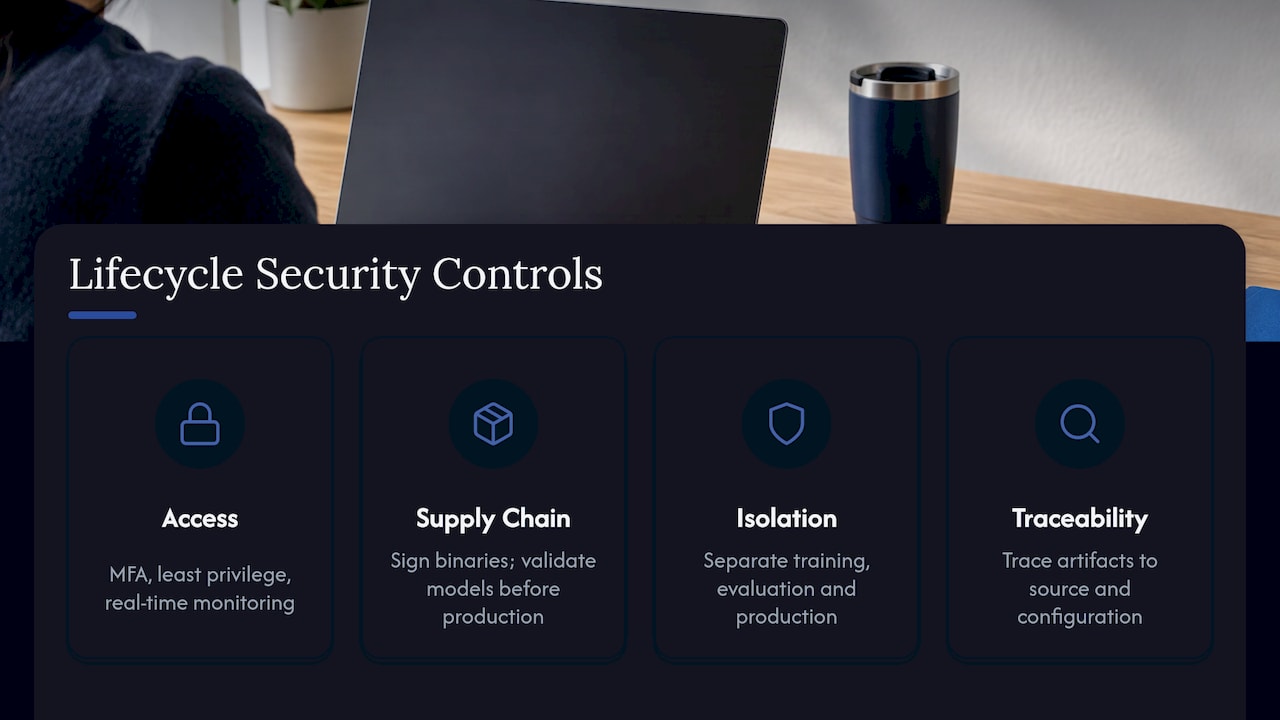
Access and segmentation. Cisco’s Securing AI/ML Ops guide recommends Zero Trust for training environments: verify every user and device, split the environment into isolated zones with role-based policies, apply least privilege to training data, model parameters and compute, and use multi-factor authentication with real-time behavioral monitoring. It also recommends AES-256 encryption at rest and TLS in transit.
Model supply chain. The OWASP Secure AI Model Ops Cheat Sheet directs teams to keep models in access-controlled registries, sign model binaries, encrypt weights and datasets, restrict access to training logs and validate pre-trained models before production. Secrets belong in a secret manager, never hardcoded.
Isolation by trust boundary. The same OWASP sheet recommends separating training, evaluation and production inference, using stronger isolation such as microVMs or dedicated nodes for high-sensitivity models, and scoping serving credentials to a specific model, endpoint and environment.
Traceability. A 2026 academic paper on secure ML operations, the SecMLOps framework, argues that every dataset, feature transformation, training run and model artifact must be traceable to its source and configuration so that investigators can account for what happened after an incident.
For teams building the governance layer, a practical AI governance staging guide helps frame how oversight matures. Financial teams weighing production oversight for models that score transactions can also read about machine learning in fraud detection, where monitoring and access controls carry direct regulatory weight.
What on-prem MLOps costs you
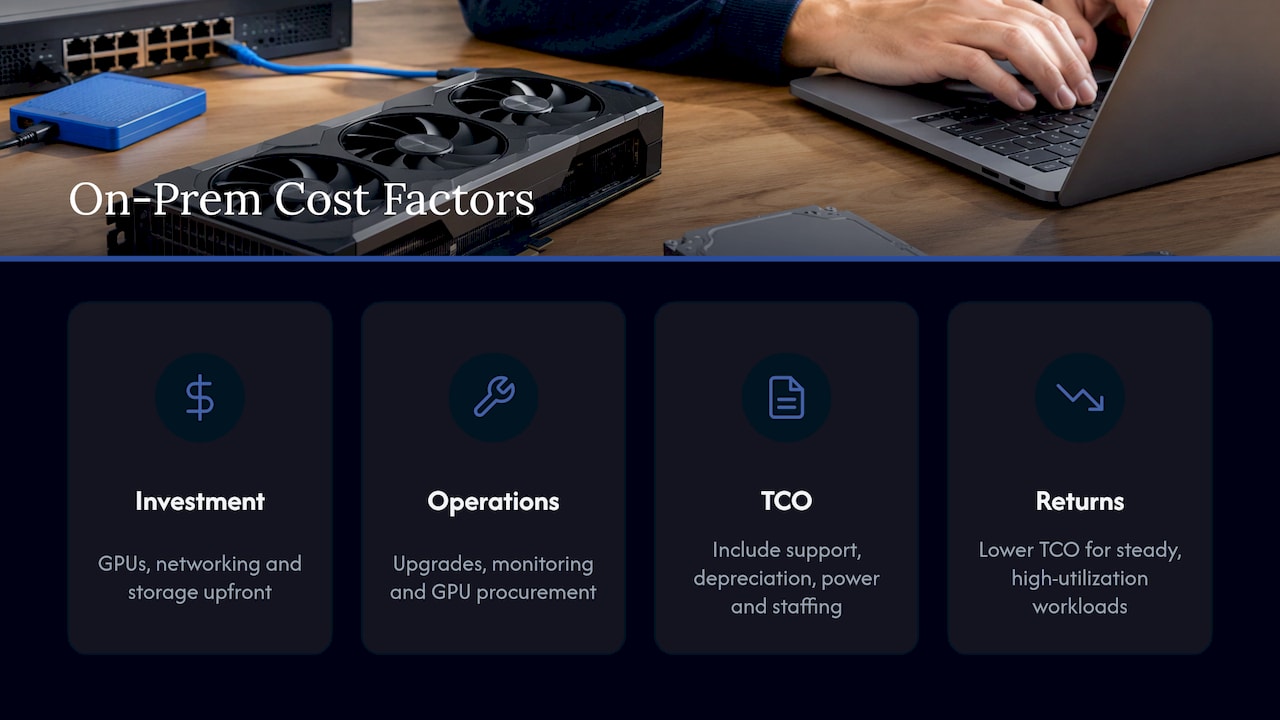
Be honest in planning, and plan for it from day one. According to the LLM Inference Handbook, on-prem demands upfront investment in GPUs, networking and storage, plus responsibility for upgrades, monitoring and GPU procurement, and specialized talent is hard to hire. TechTarget’s June 2026 reporting adds internal MLOps, patching lifecycle, observability, power, cooling and hardware refresh to the list.
The return is control, and for steady workloads, economics. One analysis finds that on-prem capital spending can yield lower total cost of ownership for consistent, long-term, high-utilization workloads, and gives maximum control over hardware, operating system, network and security protocols for strict sovereignty or regulatory needs.
That is why total cost of ownership should be measured honestly. ONES lists the inputs: procurement, support, depreciation, electricity, cooling, staffing, security and compliance. Teams that count only the GPU invoice underestimate the real figure.
Power is part of that math. Data center fuel and backup generation are a real planning item for any site hosting AI hardware, as this overview of data center fuel logistics explains.
A rollout path that works
Google’s guide advises adopting MLOps processes in stages aligned to business priorities and skills maturity, often starting with ML development, model deployment and prediction serving before adding continuous training and monitoring. Combined with ONES’s implementation advice, a sensible sequence looks like this:
- Pick one production use case with measurable value and a named data owner. A document-answering assistant for technical teams is a typical first candidate.
- Stand up the environment layers. Separate development, testing and production from the start, and restrict production access.
- Automate the path to production. Cover data validation, training triggers, evaluation, artifact storage, approval, deployment, rollback and notification, with explicit manual checkpoints for high-risk models.
- Set monitoring baselines for data quality, prediction behavior, latency, resource use and business outcomes.
- Plan and test failure recovery before you need it.
- Measure total cost of ownership against the use case’s value, then add the next workload.
Organizations that want the broader picture of running AI at the perimeter can start with Forge’s guide to on-premise AI deployment, and its piece on sovereign MLOps covers the lifecycle for sovereign environments. Logistics teams will find the sector view in running logistics AI on-prem.
Where the work lands on your team
Seen as a list, the burden is clear: architecture, secure deployment, model integration, orchestration, tuning and day-to-day operation. Most enterprises have strong infrastructure engineers and security staff, but few have people who have run AI lifecycles in disconnected or high-consequence environments.
Forge AI Deployment covers that range. Its services include secure local and air-gapped deployment, custom model integration and optimization, private AI assistant rollout, sovereign MLOps and runtime orchestration, and performance tuning with ongoing sovereign operations. Forge is an official webAI systems integrator, so it brings webAI’s local-first platform into production, including specialized AI Personas, webAI’s Intelligence Delivery Network and webAI Frontline, which gives frontline teams fast, source-backed answers from large technical document libraries, fully offline on a single device.
Our perspective
Most on-prem MLOps projects stall for the same reason: the team treats deployment as the finish line. The model goes live, and then nobody owns the patch cycle, the drift checks, the capacity plan or the evidence an auditor will ask for.
We design deployments so that all data, models and domain intelligence stay inside your infrastructure, validated for privacy and auditability. Our leadership brings more than 20 years in high-consequence and Fortune 100 environments, and we bring that operational discipline to every engagement. We are an integrator, not a software reseller: our work is the architecture, the secure rollout and the running of it afterward.
If your data cannot leave the perimeter, the lifecycle has to live inside it, and someone has to operate it every day. We would rather that be a team that has done it in places where failure is expensive.
John
Bringing the lifecycle in-house with Forge
If you are scoping an on-prem or air-gapped AI program, Forge AI Deployment designs, deploys and operates it inside infrastructure you control, from the first architecture decisions through ongoing operations. See the Forge solutions for the full service list and to start an engagement.
FAQ
What does on-prem MLOps include?
It covers the full ML lifecycle on infrastructure you own or control: data preparation, experiment tracking, training, validation, release, deployment, monitoring, retraining and retirement. The platform underneath, including compute, storage, networking and security, is your responsibility too.
Can MLOps run in an air-gapped environment?
Yes. Platforms can be designed to run with no external connectivity, with models, images and updates brought in through a governed intake process. Forge deploys secure local and air-gapped systems for this purpose.
Is on-prem MLOps harder than cloud MLOps?
It carries more operational responsibility, including patching, GPU capacity, observability, power and cooling. In return you get direct control over where models run and what evidence you keep. Handing deployment and operations to an experienced integrator reduces the load on your own staff.
How should we start?
Pick one production use case with measurable value and a clear data owner. Separate development, testing and production environments, automate the path to production and set monitoring baselines before adding workloads.
Sources
- What is MLOps? AWS
- On-Premises MLOps in 2026: Benefits, Challenges & Tools
- MLOps continuous delivery and automation pipelines, Google Cloud
- Practitioner’s Guide to MLOps, Google
- FlexPod Datacenter with Red Hat OpenShift AI for MLOps, Cisco
- Securing AI Workloads, Broadcom
- Securing AI/ML Ops, Cisco
- Secure AI Model Ops, OWASP Cheat Sheet Series
- SecMLOps framework, arXiv
- AI Model Deployment Platforms: The 2026 Buyer’s Guide
- Private MLOps Platform, KubeDojo
- On-prem LLM deployments, LLM Inference Handbook
- When to run AI on-premises vs. in the cloud, TechTarget
- Cloud vs On-Premise LLM Infrastructure
- Six stages of practical AI governance
- Machine learning fraud detection guide
- Fueling data centers