On-prem logistics AI means the models, the data they read and the answers they produce all live on hardware your organization controls: a data center, a terminal edge site or a fully air-gapped network. For logistics firms that handle sensitive freight contracts, customs records, shipper pricing and defense or pharmaceutical cargo, that is the cleanest way to use AI without sending operational data to a third party. Forge AI Deployment designs, deploys and operates these private systems on webAI’s local-first platform, so the work goes from architecture to production without your data leaving the perimeter.
This guide explains what on-prem means in practice, which logistics workflows suit it, what infrastructure it takes, and how to keep it secure and maintained over time.
TL;DR
- On-prem AI runs models on infrastructure you own or control, so shipment, contract and customer data are processed without leaving your environment.
- The strongest logistics uses combine structured queries, document retrieval and live operational data, not a standalone chatbot.
- Plan for GPU compute, local storage, a local model registry and a patch process that works with no internet access.
- Sovereignty does not equal safety: you still need governance, access control and audit logs.
- Forge deploys and operates webAI’s platform, including Personas, the Intelligence Delivery Network and Frontline, inside your infrastructure.
Table of Contents
- What on-prem AI means for a logistics operation
- Which logistics workflows run well on-premises
- What infrastructure on-prem logistics AI needs
- Running logistics AI offline and keeping it current
- Security, governance and audit
- A practical path from pilot to production
- Where Forge fits
- Our perspective
- FAQ
- Sources
What on-prem AI means for a logistics operation
On-premises AI is AI that runs on servers your organization owns and operates, rather than on a public cloud service you rent by the request. The model weights sit in your racks. Prompts, documents and outputs travel across your own network. Nothing is sent to an outside API.
In a logistics context, that difference matters because of what the data contains:
- Negotiated carrier and customer rates
- Bills of lading, customs declarations and commercial invoices
- Shipment locations and schedules for high-value or regulated cargo
- Warehouse, yard and terminal operating data
- Call, email and chat records with customers and drivers
With a cloud AI tool, each of those becomes data in someone else’s system, under someone else’s retention and access rules. With an on-prem deployment, you set the rules. There are three common patterns:
| Pattern | Where it runs | Typical logistics fit |
|---|---|---|
| Data center | Your own or a colocated enterprise facility | Network-wide planning, contract analysis, document intelligence |
| Edge site | A warehouse, port terminal, cross-dock or yard | Low-latency vision, gate and dock workflows, local assistants |
| Air-gapped | A network with no external connection | Defense logistics, classified or export-controlled cargo, secure facilities |
Most organizations end up with a mix: a core deployment in a data center and lighter footprints at sites where connectivity is unreliable or policy forbids it.
Which logistics workflows run well on-premises
The workflows that gain most are the ones where the data is sensitive and the answer has to be tied to a source.
Freight contracts and rate intelligence
Contracts hold your commercial position. A local contract-intelligence approach lets models read sensitive freight agreements inside the organization and feed results into freight-audit systems, transportation management (TMS) rate engines or carrier scorecards. The value is not a summary of a PDF. It is a clause, a rate or an accessorial charge surfaced inside the systems your team already uses.
Port, terminal and yard operations
The clearest public example is the Tanger Med agentic AI platform project, which describes an on-premises platform where data and models stay under port ownership. It supports natural-language SQL, vector search over documents and regulations, multi-step reasoning, real-time freight-unit tracking and anomaly detection. The lesson for any operator: an on-prem AI layer becomes useful when it combines structured queries, document retrieval, agentic reasoning and live data, rather than sitting beside your systems as an isolated chatbot.
Technical documentation for frontline teams
Maintenance crews, dock supervisors and equipment technicians work from large libraries of manuals, procedures and diagrams, often in places with poor signal. webAI Frontline is built for this: cited answers from large technical libraries, fully offline, on a single device. Forge deploys it for organizations that want source-backed answers at the point of work without routing manuals or questions through a cloud service.
Operations assistants and Personas
A private assistant that knows your lanes, SOPs, customer commitments and exception rules can draft customer updates, triage exceptions and answer planners’ questions. webAI Personas are specialized assistants built around a domain, which Forge deploys so the domain knowledge stays inside your environment.
What infrastructure on-prem logistics AI needs
You do not need a hyperscale cluster to start, but you do need to plan four layers.
Compute
Inference and customization run on GPU servers. At the high end, NVIDIA’s DGX H200 datasheet lists 1,128 GB of GPU memory and 32 petaFLOPS of FP8 performance, and describes the system as available for on-premises deployment for large generative AI and language workloads. Many logistics use cases need far less. The right size depends on model choice, concurrent users and whether you are serving documents, voice or vision. Sizing is a design decision, not a purchase order.
Storage and network
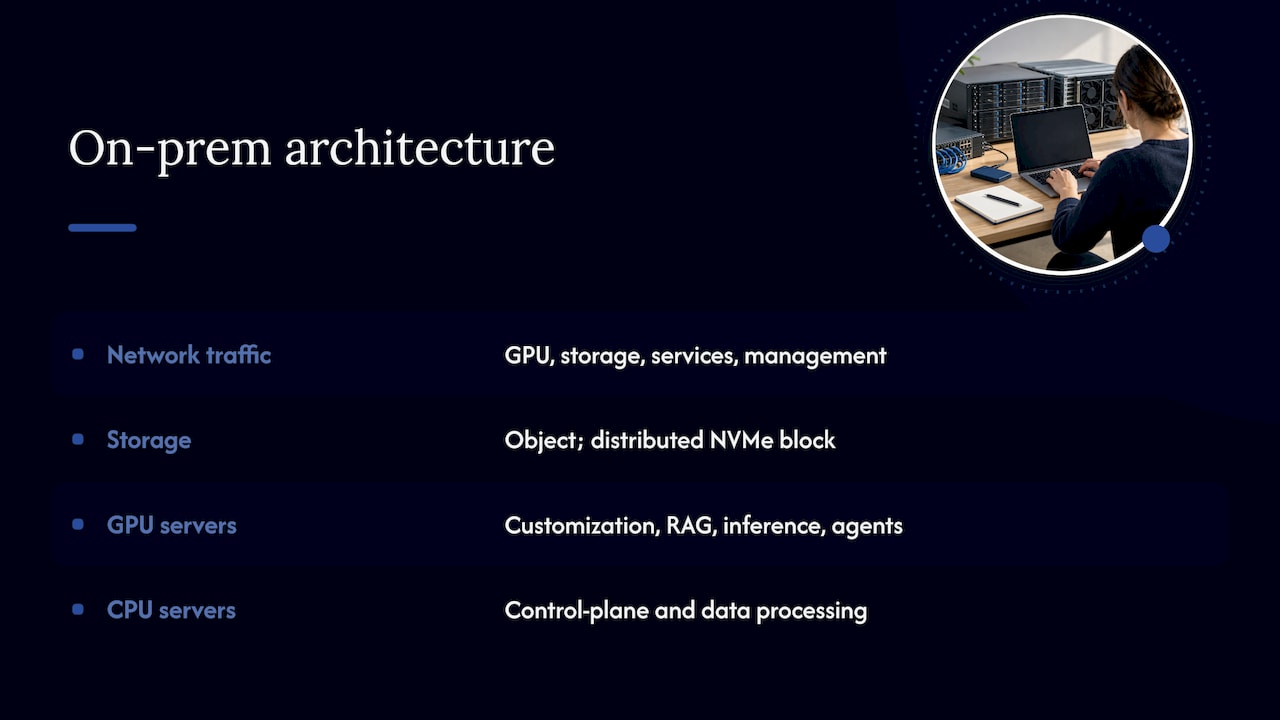
Dell’s September 2026 supply-chain reference architecture shows the pattern: separate GPU, storage, services and management traffic across a leaf-spine network, with object storage and distributed NVMe block storage, GPU servers for customization, retrieval-augmented generation (RAG, where the model looks up your documents before answering), inference and agents, and CPU servers for control-plane and data-processing work. The point for planners is that the data path, not just the GPU, decides how fast answers arrive.
Models and registry
On-prem does not mean building a model from scratch. It means choosing models that fit your hardware and task, then hosting them locally. Forge handles model integration and optimization so the model matches your workload and your hardware, and runs where you can see it.
Integration
A system that cannot reach your TMS, warehouse management system, ERP or document stores will not change daily work. Plan the connectors and the permissions model at the start, because the AI should only retrieve what the asking user is allowed to see.
Running logistics AI offline and keeping it current
Fully disconnected operation is realistic, but only if it is designed in. NVIDIA’s documentation for its NIM Operator states that LLM serving can run in an air-gapped system without internet, NGC Registry or Hugging Face Hub access, using a proxy or mirrored local model registries. The Kubernetes AIkit project makes a related point: air-gapped inference needs model content and dependencies baked into images or mirrored in local registries, and runner images that download models at startup are not air-gapped by default.
That translates into a maintenance routine you should define before go-live:
- Mirror what you need. Keep models, container images and packages in a local registry.
- Stage updates outside, then transfer in. New model versions and security patches are scanned and approved on a staging network, then moved across under change control.
- Pin versions. Record exactly which model and software versions run at each site.
- Verify files. One local-AI implementation guide recommends hashing and pinning model files, and notes a matching hash proves the file is the one you expect, not that it is safe. Pair it with scanning and review.
- Roll back cleanly. Keep the previous version ready at each site.
Our guide to offline AI inference walks through how this works and when it is the right choice.
Security, governance and audit
Keeping data in house removes a large category of risk, mainly third-party exposure. It does not remove the need for governance. NIST’s risk-management perspective is that sovereignty is not the same as safety or compliance: organizations still need to govern, map, measure and manage model and system risks.
For a logistics deployment, that means a short list of controls:
- Access control. Tie retrieval to user roles, so a regional dispatcher cannot pull a key account’s contract terms.
- Logging. Record prompts, retrieved sources and outputs so decisions can be reviewed.
- Isolation. Segment the AI environment from the wider network, with policy enforcement between zones.
- Ownership. Name who approves model changes and who reviews incidents.
Oversight is a management task as much as a technical one. A three-phase approach to generative AI data governance is a useful frame for assigning responsibility and review before systems reach production. For a deeper treatment of model approval, monitoring and documentation, see our practical guide to AI model governance.
A practical path from pilot to production
An on-prem program tends to succeed when it starts narrow and is built to scale.
- Pick one workflow with a measurable cost. Contract lookup, exception triage or technician document search are good starting points because answers can be checked against a source.
- Map the data. List where the relevant documents and records live, who owns them and who may see them.
- Decide the environment. Data center, edge or air-gapped, based on your policy and connectivity at the site.
- Size the infrastructure to the workflow. Start from users, document volume and response-time needs.
- Deploy with the operating model. Patching, monitoring, access reviews and model updates need an owner from day one.
- Expand by reuse. Once the platform, registry and governance exist, a second workflow is far cheaper than the first.
Our practical guide to on-premise AI deployment covers the enterprise-wide version of this path.
Where Forge fits
Forge AI Deployment is an official webAI systems integrator. We bring webAI’s local-first platform into production inside infrastructure you control, covering architecture, secure deployment, model integration and ongoing operation. That includes private and air-gapped deployment, webAI Personas, the Intelligence Delivery Network and webAI Frontline for fully offline, source-backed answers from large technical document libraries.
Our leadership brings more than 20 years of experience in high-consequence and Fortune 100 environments. Forge designs deployments so that all data, models and domain intelligence remain inside your infrastructure.
If you are scoping an on-prem logistics AI system, the Forge solutions page outlines secure local and air-gapped deployment, custom model integration and optimization, private AI assistant rollout, sovereign MLOps and runtime orchestration, and performance tuning with ongoing operations. Engagements are scoped to your environment; no prices are published.
Our perspective
Logistics is a trust business. Your customers hand you their cargo, their schedules and their rates, and an AI project should not quietly turn that trust into a data-sharing arrangement with someone else.
We think the best logistics AI is the kind you can point to on a floor plan. The models are in your racks, the documents are in your stores, and the people who answer for the system sit in your organization. That is what private and air-gapped deployment gives you, and it is the reason we build the way we do.
The second lesson from our work in high-consequence environments is that deployment is the start. A system that cannot be patched offline, audited or handed to a technician with no signal is a demo. So we treat operation as part of the engagement: architecture, secure deployment, model integration and the routine that keeps it running.
Start with a workflow where an answer must be tied to a source, such as a manual, a contract or a regulation. Prove it inside your perimeter, then reuse the same foundation for the next one.
John
FAQ
What does AI on-prem mean?
It means AI models run on hardware your organization owns or controls, such as a data center, edge site or air-gapped network, instead of on a rented cloud service. Prompts, documents and outputs stay inside your environment. You decide who can access the system and how it is updated.
How is AI being used in logistics?
Common uses include contract and document analysis, natural-language queries over operational data, shipment tracking and anomaly detection, and assistants for planners and frontline technicians. The Tanger Med project shows several of these combined in one on-premises port platform. Sensitive-data workflows are the natural fit for on-prem.
Can logistics AI run without an internet connection?
Yes, if the deployment is designed for it. Models, software dependencies and container images must be mirrored in local registries rather than downloaded at startup. Forge deploys webAI Frontline to give frontline teams fully offline, source-backed answers on a single device.
Does on-prem AI make a logistics operation compliant?
Not by itself. Keeping data inside your perimeter reduces third-party exposure, but you still need access control, logging and a governance process. Your compliance, legal or security officer should confirm which rules apply to your cargo and customers.
Sources
- Tanger Med Agentic AI Platform project
- Local AI Is Changing How Freight Contracts Get Managed
- NVIDIA DGX H200 datasheet
- Sovereign AI for the Supply Chain, Dell
- Air-Gapped Environments, NVIDIA NIM Operator
- AIkit README
- NIST AI RMF Implementation Guide for Local AI (2026)
- NIST AI risk management response
- webAI Frontline
- Generative AI Data Governance: 3 Phases for Execs