A multi-tenant LLM system lets several tenants, such as customers, business units or subsidiaries, use one shared model platform while each keeps its own data, settings and access rules. The hard part is not serving many users. It is proving that one tenant’s prompts, documents, cached results and logs can never surface in another tenant’s answers. This guide covers the isolation models, the controls that matter in RAG pipelines, and how to decide how much to share.
TL;DR
- Multi-tenant LLM means shared platform capabilities (gateway, models, governance) with per-tenant data, configuration and usage tracking.
- Isolation runs on a spectrum: dedicated stacks (strongest isolation, highest cost), shared pools (efficient, but only as safe as your code), and hybrids.
- In RAG, the whole data path is an authorization boundary: ingestion, embeddings, vector search, reranking, prompt assembly, caches and logs. Prompt instructions are not security controls.
- Shared GPUs, KV caches and model weights add leakage risks that ordinary SaaS isolation does not cover.
- When data sovereignty or air-gapped operation is required, a private deployment inside your own infrastructure often replaces the question of how to share safely.
Table of Contents
- What a multi-tenant LLM system is
- Isolation models: silo, pool and bridge
- Multi-tenant RAG: where tenants actually leak
- Risks specific to shared LLM infrastructure
- Governance, auditing and cost per tenant
- How to validate isolation before you ship
- Our perspective: share less than you think
- When a private deployment is the better answer
- Work with Forge on a sovereign deployment
- FAQ
- Sources
What a multi-tenant LLM system is
In software, multitenancy means one application instance serves many customers while keeping their data and configuration logically separate. Applied to generative AI, AWS describes the pattern as multiple tenants using a common AI gateway and shared platform capabilities, with each tenant keeping its own application stack and requirements. The platform centralizes governance, guardrails, usage auditing and cost tracking per tenant.
The opposite is a single-tenant deployment: one organization, one stack, one set of models and indexes. Nothing is shared, so there is no neighbor to leak to. You pay for that with duplicated infrastructure and more operational work.
Who are “tenants” in practice? Three common cases:
- A SaaS vendor serving external customers through an AI feature.
- A large enterprise serving internal business units, each with different data classifications (for example, trading, legal and HR).
- A holding group serving subsidiaries in different jurisdictions with different residency rules.
The internal cases are easy to underestimate. A legal team’s matter files and an engineering team’s source code should not meet in one retrieval index just because they share an employer.
Isolation models: silo, pool and bridge
Most designs fall somewhere on one spectrum. The commonly used vocabulary is silo (a dedicated stack per tenant), pool (shared infrastructure, with isolation depending on correct code) and bridge (a mix of both). Silo costs more and isolates best; pool is more efficient but leans on every query path being right.
Cloud architecture guidance shows the same trade-off for hosted models. Microsoft’s Azure guidance notes that dedicated model instances give high data and performance isolation but require managing more resources, while shared instances are easiest to implement, give the least isolation and can cause noisy-neighbor latency. It also states that a shared resource does not enforce access control between model deployments by itself: your application must enforce which tenant may call which deployment.
| Model | Isolation | Cost and effort | Typical fit |
|---|---|---|---|
| Silo (dedicated stack per tenant) | Strongest | Highest; more resources to run | Regulated tenants, customer-supplied models, contractual guarantees |
| Pool (shared everything) | Depends on code and filters | Lowest per tenant | Low-risk, trusted workloads |
| Bridge (shared logic, dedicated data) | Strong where it counts | Moderate | Most enterprise RAG |
A useful principle from inference-platform design: match the tenancy model to how far you trust the workload. One platform guide advises reserving shared serving tiers for trusted, provider-owned models and avoiding them for customer-supplied workloads. Do not pick one model for the whole product. Place each tenant on the spectrum according to risk and contractual commitments.
Multi-tenant RAG: where tenants actually leak
Retrieval-augmented generation is where most multi-tenant LLM incidents will happen, because the model itself holds no tenant data. The documents sit in a vector store, and the retriever decides what the model sees.
The most common RAG pattern for shared platforms is simple to state: tenants share the application logic, orchestration and possibly the generator model, while each gets a dedicated vector index. That is the bridge model above, and it removes the single biggest failure, a similarity search that forgets to filter by tenant.
If you pool the index instead, tenant scope has to be a mandatory filter applied before the search, not a post-processing step. Even then, it is one forgotten parameter away from a leak. That is why the stronger pattern is to derive tenant scope from an authenticated identity, never from anything the user types.
A recent engineering write-up on RAG security argues that the entire data path is an authorization boundary: ingestion, embedding, vector storage, reranking, prompt assembly and logs. Its practical checklist is worth adopting:
- Resolve the tenant from the authenticated principal (a session or token), not from request parameters.
- Enforce authorization in every retrieval branch, including keyword search, hybrid search and any fallback, before anything reaches the model.
- Scope caches and logs by tenant.
- Validate retrieved candidates before prompt assembly.
Another architecture reference describes the same idea as sending each query with a principal ID and evaluating policies against the returned chunks’ metadata, logging each decision. The log of why a chunk was allowed is what lets an auditor reconstruct an answer later.
The per-tenant settings matter too. Different tenants want different models, system prompts, retrieval depth and guardrails. Store those as tenant configuration in the platform, versioned and access-controlled, rather than baking them into shared prompts.
Prompts are not a security boundary
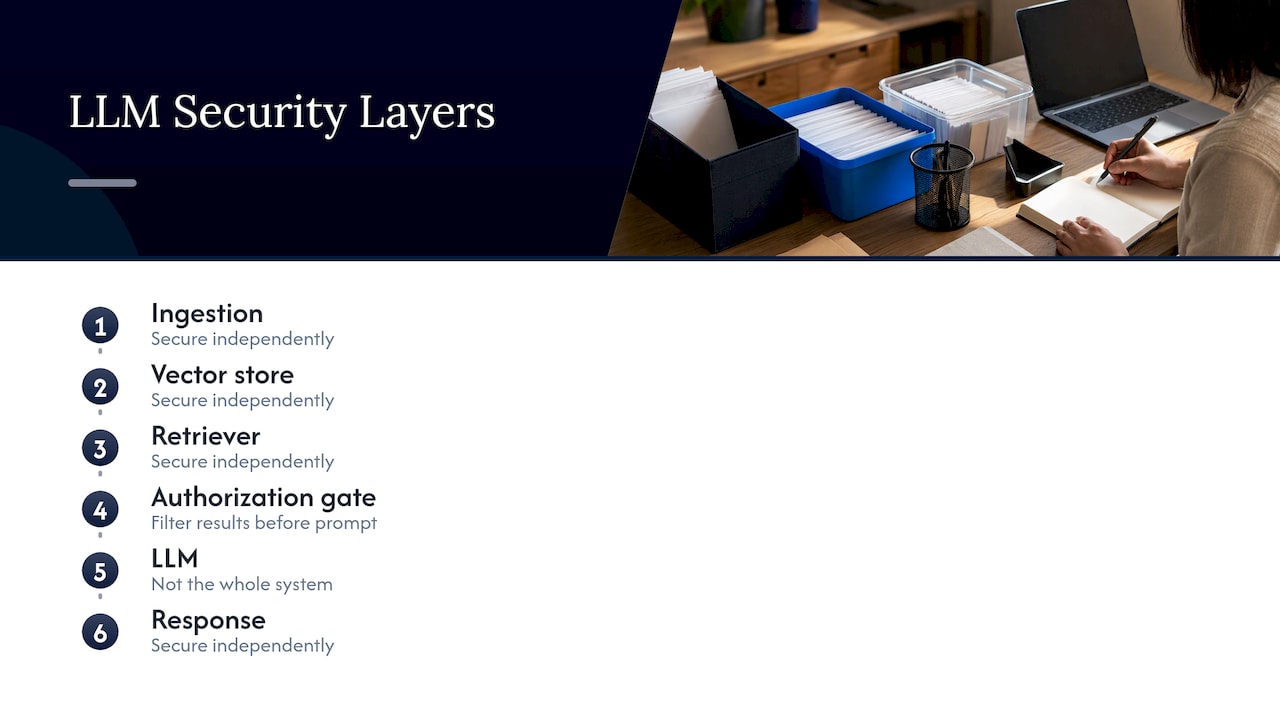
Telling the model “only answer from this customer’s documents” is not isolation. If a chunk from another tenant reaches the context window, the model can repeat it. Authorization must happen before retrieval results enter the prompt. Security teams should also treat each layer separately: one practitioner guide names the ingestion, vector store, retriever, LLM and response layers as places to secure independently, and calls treating the LLM as the whole system a common mistake.
Risks specific to shared LLM infrastructure
Traditional SaaS isolation, such as row-level security and per-tenant schemas, is necessary but not enough for LLMs. A 2026 academic paper on multi-tenant LLM integration identifies shared inference infrastructure, GPU compute, KV caches and model weights as potential cross-tenant leakage channels.
That gives you a checklist beyond the vector store:
- KV and prompt caches. Reused attention state or cached responses must be keyed by tenant, or disabled across tenants. We cover this in detail in our guide to LLM caching strategies that prevent tenant data leaks.
- Fine-tuned weights and adapters. If you tune on one tenant’s data, those weights are that tenant’s data. Do not serve them to anyone else.
- Logs and traces. Prompts and retrieved chunks written to a shared log are a copy of tenant data with weaker access control.
- Embeddings. Embeddings can be inverted to recover meaning, so they inherit the classification of the source text.
- Noisy neighbors. A heavy tenant can degrade latency for others. Quotas, rate limits and provisioning tiers are the operational answer.
AWS’s Generative AI Lens lists the kind of tenant-level controls a shared platform needs: virtual-key authentication, rate limits, provisioning tiers, usage quotas and secure storage of credentials and routing configuration. These are the price of sharing.
Governance, auditing and cost per tenant
A shared gateway is also the natural place to centralize policy. Per-tenant usage metering, guardrails, model allow-lists and audit trails all attach there. For financial services teams that must show regulators who used which model and why, AI agent governance for finance is a useful companion topic, since agent inventories and audit-ready evidence build directly on gateway-level records.
AWS lists the requirements a multi-tenant generative AI architecture must meet beyond model access: tenant and data isolation, access management, responsible-AI governance and cost control. For model-level policy, see our practical guide to AI model governance.
How to validate isolation before you ship
Design review is not proof. Validate with tests that try to break the boundary:
- Canary documents. Seed each tenant with unique marker strings, then run automated queries as other tenants that try to surface them. Run this in CI so a change to retrieval code cannot silently remove a filter.
- Cache probing. Send the same prompt as two tenants and confirm no response, embedding or KV state is shared.
- Log review. Search shared logs and traces for another tenant’s markers.
- Authorization fuzzing. Alter tenant identifiers in requests, tokens and metadata and confirm every branch rejects them.
- Load tests with mixed tenants. Confirm that one tenant’s burst does not break another’s latency commitments.
Our own deployment practice includes canary-style detection of leakage paths, described in enterprise AI data leakage: six paths and how to detect them. For the broader pipeline, the three-phase RAG security roadmap maps controls to NIST and OWASP guidance.
Our perspective: share less than you think
The multi-tenant conversation usually starts from cost: how do we serve more tenants on fewer GPUs? In the high-consequence environments our leadership has worked in for more than 20 years, the question runs the other way: what is the least we can safely share?
We see three honest answers.
Share orchestration, not data. Common code, a common gateway and common governance are cheap to share and valuable to standardize. Data, indexes, adapters, caches and logs should be partitioned by default, with sharing as a deliberate exception.
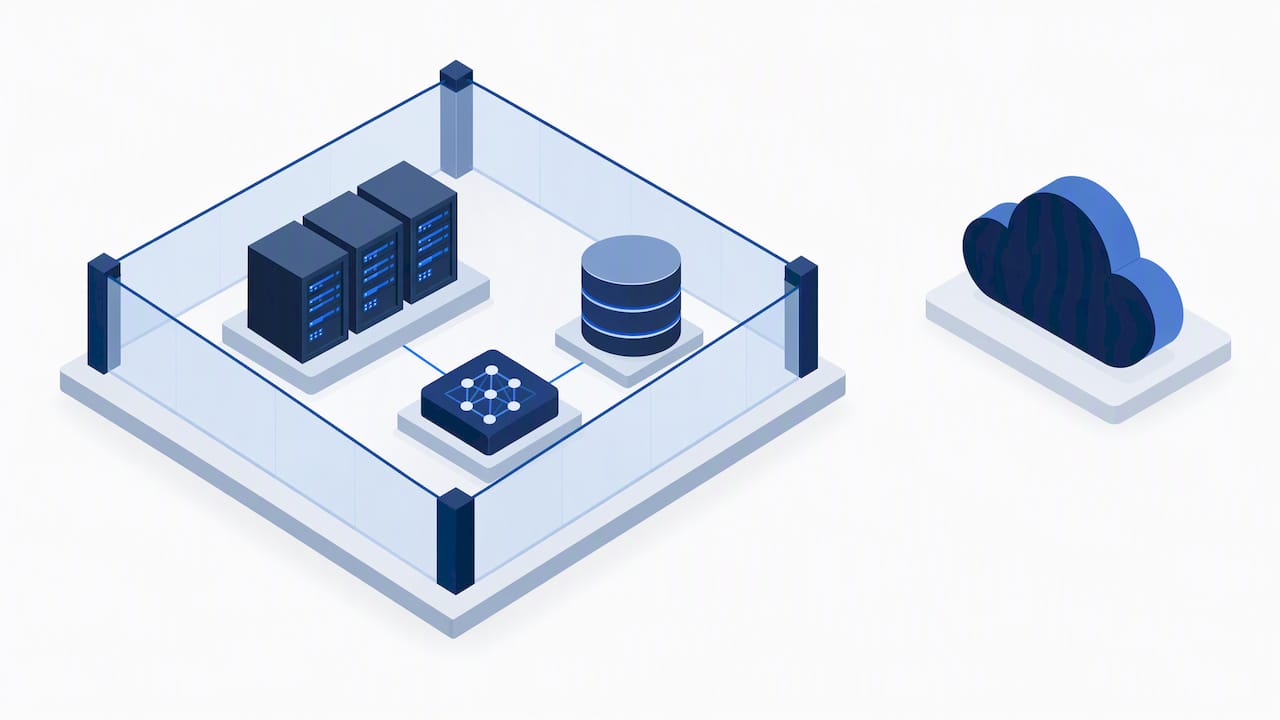
Treat sovereignty as a tenancy requirement. If a business unit, subsidiary or customer must keep data inside a boundary you control, a pooled cloud service cannot satisfy it however clean the filters are. The tenant boundary becomes a physical or network boundary: its own environment, in your data center, at the edge or air-gapped.
Operations decide security. Most leaks come from drift: a new retrieval path, a cache turned on for speed, a debug log left running. Isolation is something you keep testing and operating, not something you design once.
That is why Forge AI Deployment designs, deploys and operates private AI systems inside infrastructure our customers control. As an official webAI systems integrator, we bring webAI’s local-first platform into production, including its Personas and Intelligence Delivery Network. For many of our customers the right “multi-tenant” design is several isolated deployments managed consistently, rather than one pool shared with filters.
— John Ezzell, Founder
When a private deployment is the better answer
Shared multi-tenancy makes sense when tenants are low-risk, the data is not regulated, and you can afford the engineering to prove isolation. A private or air-gapped deployment makes more sense when:
- Data must not leave a defined perimeter for legal, contractual or classification reasons.
- The environment has no reliable internet, such as plants, vessels, field sites or secure networks. Our guide to disconnected operations AI covers that case.
- Customer-supplied or fine-tuned models are involved, so shared serving tiers are inappropriate.
- Auditors want a short, provable story: the data never left the building.
Sovereign deployments still serve many groups. You can give each unit its own Persona, document library and access policy on infrastructure you control. Our on-premise AI deployment guide walks through the planning, and our post on runtime policy for NIST-aligned private LLMs covers enforcement. Capacity planning matters as well: see LLM performance tuning with joules per token for how to size shared hardware honestly.
Work with Forge on a sovereign deployment
If you need several teams or entities to use AI without any data leaving your perimeter, Forge AI Deployment can architect, deploy and operate it. Our work covers secure local and air-gapped deployment, model integration, private assistant rollout, sovereign MLOps and ongoing operations. That includes webAI Frontline, which gives frontline teams fast, source-backed answers from large technical document libraries, fully offline on a single device. You can read more about the platform behind our deployments.
Engagements are scoped to your environment, and we do not publish fixed prices.
FAQ
What is the difference between multi-tenant and single-tenant LLM deployments?
In a multi-tenant deployment, several tenants share a platform (gateway, orchestration, sometimes models and GPUs) while their data and settings stay logically separate. In a single-tenant deployment, one organization gets its own dedicated stack. Single-tenant isolates more strongly but costs more to run.
How do I keep tenants’ documents separate in multi-tenant RAG?
The strongest common approach is a dedicated vector index per tenant, with tenant identity derived from an authenticated session rather than user input. If you share an index, apply the tenant filter as a mandatory pre-filter on every retrieval path. Then test with canary documents so a missing filter is caught before release.
Is a prompt instruction enough to stop one tenant seeing another’s data?
No. Once another tenant’s text enters the context window, the model can repeat it. Authorization has to happen before retrieval results are assembled into the prompt, and caches and logs must be scoped by tenant too.
Does a shared cloud model endpoint isolate my tenants?
Not by itself. Microsoft’s Azure guidance states that a shared resource does not enforce access control between model deployments, so your application must decide which tenant can use which deployment. Shared capacity can also cause noisy-neighbor latency.
When should I avoid multi-tenancy altogether?
Avoid pooling when data is regulated or classified, when the network is air-gapped, or when customer-supplied models are involved. In those cases, separate private deployments under common management are usually easier to defend to an auditor.
Sources
- Build a multi-tenant generative AI environment for your enterprise on AWS
- Multitenancy and Azure OpenAI, Azure Architecture Center
- Building an inference platform
- How to Secure Multi-Tenant RAG and Prevent Data Leaks
- Gateco Architecture: How RAG Retrieval Security Works
- Securing RAG Pipelines: Prompt Injection and Access Controls
- Security Challenges of LLM Integration in Multi-Tenant SaaS
- Multi-tenant generative AI platform scenario, Generative AI Lens
- AI Agent Governance for Finance: Four Functions, Evidence by Design