Choose the tokenizer that fits your languages, your domain text and your model’s architecture, then prove the choice on your own data before you commit. Research on training runs shows the choice can move both downstream quality and compute cost, and common shortcuts such as vocabulary size or a single efficiency score do not settle it. If you are adapting an existing model, the decision is mostly about compatibility. If you are training or continuing to pretrain, it is a real design decision.
This guide covers how the main algorithms relate, which criteria matter, how to benchmark candidates on sensitive text without sending it anywhere, and what to check for local and air-gapped deployments. It is written for teams at Forge AI Deployment’s kind of customer: organizations running AI inside infrastructure they control.
TL;DR
- A tokenizer turns text into integer IDs the model can read. Its choice affects quality, sequence length and cost, and the effect grows for non-English and specialized text.
- BPE and Unigram are algorithms. SentencePiece is a library that implements them, so “SentencePiece vs BPE” is not a like-for-like contest.
- Assess languages, domain vocabulary, task, model architecture, memory, latency and license. Do not rely on one metric.
- Benchmark candidates on your own representative data, including token-length distributions and downstream task results.
- If you use a pretrained model, keep its original tokenizer unless you are prepared to retrain embeddings.
Table of Contents
- What a tokenizer actually decides
- BPE, Unigram and SentencePiece: how they relate
- Criteria that should drive the decision
- Vocabulary size and token efficiency
- Compression helps, but it is not the whole story
- How to benchmark tokenizers on your own data
- Constraints for local and air-gapped deployments
- Perspective: why we treat the tokenizer as part of the deployment
- Put it into production without data leaving your perimeter
- Common mistakes to avoid
- FAQ
- Sources
What a tokenizer actually decides
A language model never sees raw text. The tokenizer splits text into pieces and maps each piece to an integer ID, and the model uses those IDs to look up rows in its embedding table. Everything downstream, from the length of a prompt to the cost of a training run, is counted in tokens.
That makes the tokenizer more than preprocessing. A study from Fraunhofer IAIS and the Lamarr Institute found that tokenizer choice can significantly affect downstream performance and training costs. In one example, for German documents, costs rose by up to 68% when comparing a multilingual 50k-vocabulary tokenizer with an English-only 100k one. The same tokenizer can be efficient on one language and wasteful on another.
For an enterprise, three practical consequences follow:
- Context budget. A tokenizer that splits your part numbers, legal clauses or log lines into many fragments uses more of the context window for the same document.
- Throughput and cost. More tokens per document means more compute per request, which shows up in latency and hardware sizing. Our guide to tokens per second for LLMs explains how to measure that.
- Quality on your text. If important terms are shattered into meaningless fragments, the model has a harder job learning or retrieving them.
BPE, Unigram and SentencePiece: how they relate
The query “SentencePiece vs BPE” comes up often, and the short answer is that it mixes two levels. Byte pair encoding (BPE) and Unigram are tokenization algorithms. SentencePiece is a library that implements them. The Fraunhofer and Lamarr study makes this distinction explicit and, in its experiments, found the SentencePiece implementation of BPE outperformed another popular library’s BPE on average. So the implementation can matter as well as the algorithm.
Here is how to think about each piece:
| Item | What it is | Practical note |
|---|---|---|
| BPE | Algorithm that builds a vocabulary by repeatedly merging the most frequent adjacent pairs | Widely used, deterministic merges, simple to reason about |
| Unigram | Algorithm that starts with a large candidate vocabulary and prunes it by likelihood | Can produce several candidate segmentations, which some teams use for regularization |
| SentencePiece | Library supporting BPE and Unigram | Works directly on raw text, so no separate pre-tokenization step is needed |
The SentencePiece paper describes whitespace mapped to a special character (U+2581) and reversible, lossless tokenization without pre-tokenization. Reversibility matters in regulated environments: you can reconstruct the exact input from the token IDs, which helps with audit trails and debugging.
So the real question is rarely “which name wins.” It is which algorithm, trained on which data, at which vocabulary size, in which implementation, matches your languages and constraints.
Criteria that should drive the decision
A 2026 paper on tokenizer design argues that tokenizers are core design choices, not defaults. Its guidance says to assess intended purpose, target languages and dialects, required capabilities, and model constraints such as architecture, memory and latency. Turned into a checklist:
- Languages and scripts. List every language and dialect your users write in, including mixed-language documents. Multilingual tokenizers pay for coverage: those trained on the five most frequent European languages needed up to three times the vocabulary size of English tokenizers.
- Domain text. Engineering manuals, financial filings, maintenance logs, chemical names and code all have their own vocabulary. Check how your most important terms are split.
- Task type. Generation, classification, extraction and retrieval stress tokenization differently. Exact identifiers and numbers matter more in some workloads than others.
- Model compatibility. The tokenizer and the embedding table are a matched pair. The same guidance asks teams to confirm compatibility with the model’s architecture and embeddings.
- Deployment limits. Larger vocabularies grow the embedding and output layers, which affects memory and latency on the hardware you actually own.
- License. Confirm that the tokenizer and its vocabulary files can be used and redistributed the way your deployment requires.
The same paper summarizes what a good tokenizer looks like: linguistically faithful, aligned with the domains and languages in use, ready for latency and memory limits, and compatible with the model. Treat those four as your scoring rubric.
Vocabulary size and token efficiency
Teams often assume a bigger vocabulary is better because it produces fewer tokens per document. Fewer tokens means shorter sequences, which sounds like a free win. The evidence is less tidy.
In the Fraunhofer and Lamarr experiments, larger vocabularies added training cost, and lower fertility (fewer tokens per word) did not offset that added cost. Fertility describes how many tokens a word is split into on average. The same study also warns that fertility and parity, a measure of how evenly languages are treated, are not consistently predictive of downstream performance, so they are questionable proxies on their own.
So vocabulary size is a trade-off with three parts:
- Sequence length. A bigger vocabulary generally shortens sequences, which saves attention compute and context.
- Parameter and memory footprint. Embedding and output matrices scale with vocabulary size. For memory planning, see our guide to sizing GPU memory for LLMs.
- Rare-token learning. Tokens that appear rarely get fewer training updates, so oversized vocabularies can leave some entries poorly learned.
If you are serving an existing model, you cannot change this trade-off without retraining. You can, however, estimate its cost: tokenize a sample of your real documents and measure tokens per document, because that number drives your capacity plan.
Compression helps, but it is not the whole story
Compression ability, meaning how few tokens a tokenizer needs for a given text, is the most popular selection metric. The research is split in an instructive way.
One 2024 study reports a correlation between a tokenizer’s compression ability and the downstream success of pretrained models, and suggests that building better-compressing tokenizers is a worthwhile and relatively cost-effective investment. Another 2024 paper finds no clear linear relationship between compression and downstream accuracy, with some results suggesting an inverted U-shaped curve: more compression helps up to a point, then hurts.
The workable reading is that compression is a useful screening signal and a poor final judge. Use it to eliminate clearly inefficient candidates, then decide with task results. A 2025 ACL paper adds a further signal for multilingual models: deviation from a Zipfian power-law distribution in token counts was a highly informative predictor of performance.
How to benchmark tokenizers on your own data
Public benchmarks will not tell you how a tokenizer treats your contracts, telemetry or technical manuals. For sensitive text, you also should not ship samples to an outside service to find out. Tokenizer evaluation is cheap to run locally, since it needs no GPU for the intrinsic checks.
The 2026 design guidance recommends diagnostics such as vocabulary overlap and token-length distributions, anomaly audits, and assessment of intrinsic and downstream performance across varied datasets. Here is a process built on that:
- Assemble a representative sample. Pull documents from each language, department and document type you will serve. Include the ugly ones: scanned-then-OCR’d text, tables, part numbers, code and mixed languages. Keep the sample inside your environment.
- Define candidates. These are usually the tokenizer shipped with each candidate model, plus any custom one you might train.
- Run intrinsic checks. Measure tokens per document, tokens per word by language, the distribution of token lengths, and how your top 200 domain terms are split. Frameworks such as Qtok look at language coverage, token completeness and token distribution across languages and linguistic categories.
- Look for anomalies. Hunt for byte-level fallbacks on common characters, unused vocabulary entries, odd tokens left over from web scraping, and inconsistent handling of whitespace or Unicode normalization.
- Run downstream tasks. Test the candidates on the tasks that matter: extraction accuracy, retrieval quality, answer correctness on your question set. Intrinsic scores only screen candidates, as the compression research above shows.
- Record the result. Responsible tokenization calls for auditable workflows, including anomaly detection and vocabulary stability checks. Store the sample definition, the tool versions and the scores so a reviewer can reproduce the decision.
A useful side benefit: if you later evaluate retrieval, the same discipline applies to embedding models. Our piece on offline embedding models covers that side.
Constraints for local and air-gapped deployments
Selecting a tokenizer for a system that never touches the public internet adds a few practical checks.
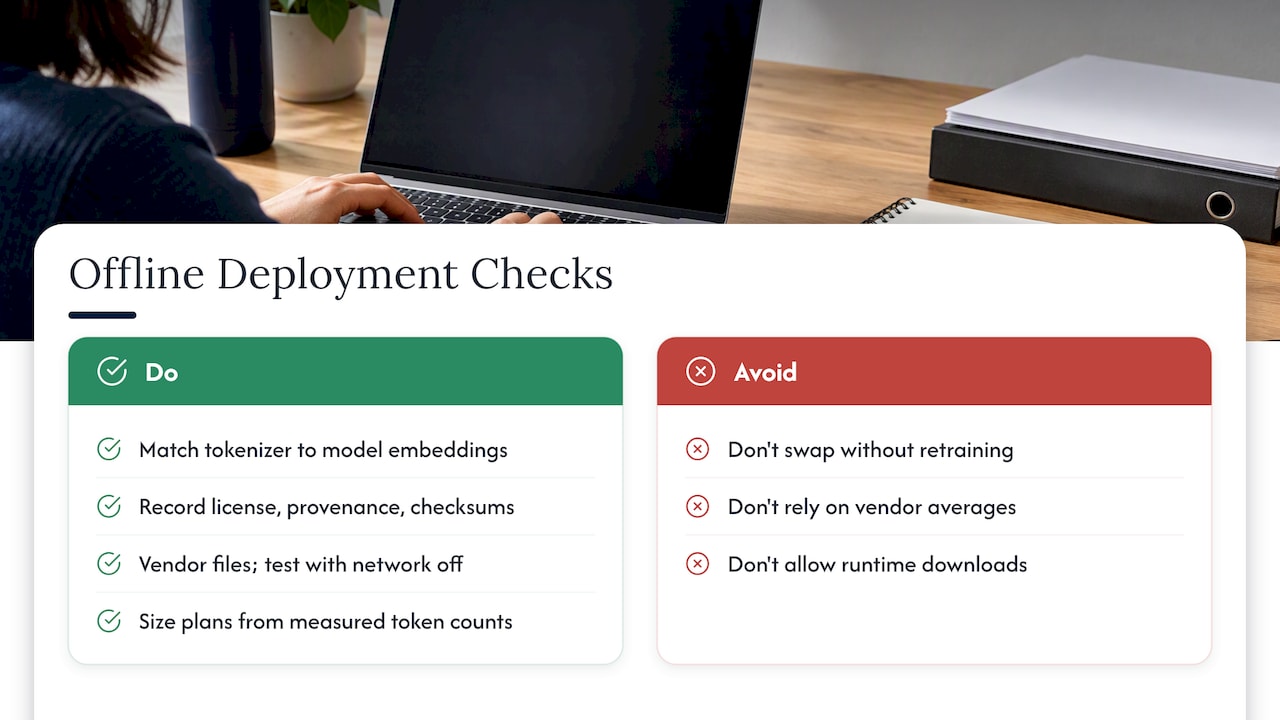
Keep the pair together. A tokenizer must match the model’s embeddings. Swapping it on a pretrained model without retraining means the IDs point at the wrong rows. If your text is poorly served by the shipped tokenizer, the realistic options are to pick a different base model or to plan an adaptation project with proper retraining and evaluation.
Check the license and provenance. The 2026 guidance lists the tokenizer’s license among the things to verify, alongside fit and compatibility. In an air-gapped environment, also record where the files came from and their checksums, since you cannot fetch them again later.
Remove runtime downloads. Some tokenizer loaders reach for remote files by default. Vendor everything into your internal artifact store and test loading with the network disabled.
Plan for unknown characters. Models handle out-of-vocabulary text differently. Byte fallback, which represents unseen characters as raw bytes, is one approach: the SentencePiece paper notes that a model such as GPT-SW3 uses byte fallback with character coverage of 0.9999. Test how your candidate behaves on rare symbols, accented names and special characters in your own data.
Size for the real token counts. Throughput, caching and memory plans should use the token counts you measured, not vendor averages. Our guides on LLM caching strategies and multilingual private AI go deeper on those operational sides.
Freeze the version. A tokenizer change silently changes every token count and every cached prefix. Pin versions and treat upgrades as a tested release.
Perspective: why we treat the tokenizer as part of the deployment
In our work, the tokenizer is one of the first things we look at in a sovereign deployment, and one of the last things teams think to question. It sets the real token count of your documents, and that count drives sizing, latency and the cost of every request your users make.
Our approach comes from more than 20 years in high-consequence and Fortune 100 environments: measure on the customer’s own data, inside the customer’s own perimeter, and write down the result so it can be audited. A tokenizer review that requires uploading sensitive samples to someone else’s cloud defeats its own purpose. Done locally, it is a few days of disciplined work that prevents months of surprises.
As an official webAI systems integrator, Forge AI Deployment brings webAI’s local-first platform into production, so tokenizer, model, runtime and operations are planned together instead of in separate silos. That is how we keep context budgets honest, memory plans accurate and offline deployments reproducible.
John
Put it into production without data leaving your perimeter
If you are choosing a model and tokenizer for a regulated or air-gapped environment, Forge designs, deploys and operates private AI systems inside infrastructure you control. That includes private and air-gapped deployment, webAI Personas, webAI’s Intelligence Delivery Network, and webAI Frontline, which gives frontline teams fast, source-backed answers from large technical document libraries, fully offline on a single device.
To scope an engagement covering model integration, tokenizer evaluation on your own documents and ongoing operation, see our sovereign AI solutions or learn about the webAI platform behind our deployments.
Common mistakes to avoid
- Picking by vocabulary size alone. As shown above, bigger is not automatically cheaper or better.
- Trusting one metric. Fertility, parity and compression each tell part of the story, and none reliably predicts downstream results by itself.
- Testing only on English. If your users write in other languages, the cost and quality gap shows up there first.
- Ignoring numbers and identifiers. Serial numbers, dates and amounts are often where tokenization quirks hurt extraction accuracy most.
- Changing the tokenizer without retraining. It breaks the link to the embeddings.
- Skipping documentation. Without a record, nobody can explain later why this tokenizer was chosen.
FAQ
Is SentencePiece better than BPE?
The comparison mixes categories. BPE is an algorithm, and SentencePiece is a library that can run BPE or Unigram. In one study, the SentencePiece implementation of BPE outperformed another widely used BPE implementation on average, so implementation details can matter. Decide based on tests with your own data.
Does tokenizer choice really affect model quality?
Yes, it can. Research on training runs found significant effects on downstream performance and training cost, especially across languages. The size of the effect depends on your languages, domain and model, which is why you should measure rather than assume.
Can I swap the tokenizer on a pretrained model?
Not safely without retraining. The tokenizer’s IDs map to rows in the model’s embedding table, so a different tokenizer produces mismatched inputs. If the shipped tokenizer handles your text poorly, evaluate a different base model or plan a properly tested adaptation.
What should I measure first when comparing tokenizers?
Start with tokens per document and tokens per word on a representative sample, plus how your key domain terms are split. Then check token-length distributions and anomalies. Finish with downstream task results, because intrinsic numbers alone do not predict accuracy.
Do I need a custom tokenizer for private AI?
Often not. For most deployments of existing models, the shipped tokenizer is the right one because it matches the embeddings. A custom tokenizer makes sense mainly when you train or continue pretraining on specialized text, and it should win a benchmark on your data first.
Sources
- Tokenizer Choice For LLM Training: Negligible or Crucial?
- Stop Taking Tokenizers for Granted: They Are Core Design Decisions
- SentencePiece paper (arXiv 2304.14780)
- Unpacking Tokenization: Evaluating Text Compression and its Correlation with Model Performance
- Tokenization Is More Than Compression
- Beyond Text Compression: Evaluating Tokenizers Across Scales
- Qtok: A Comprehensive Framework for Evaluating Multilingual Tokenizer Quality