An AI SBOM, also called an AI-BOM or ML-BOM, is a machine-readable ingredients list for models and their data. It gives security, compliance, and engineering teams the provenance and component detail they need to manage AI supply-chain risk. The G7 and CISA guidance, the CycloneDX and SPDX formats, and our own work at Forge AI Deployment all point the same way: transparency first, then vulnerability management and audit.
TL;DR:
- CISA’s general SBOM elements still apply; add model cards, dataset provenance and licensing, weight hashes, and signature status for high consequence systems.
- Choose CycloneDX when your pipeline already uses it, or SPDX when licensing and legal records lead; maintain one canonical schema across the organization.
- Generate documents on every release, fine tune, and dependency change, then enforce schema validation and a completeness threshold in the model publishing workflow.
- Verify weight hashes and signatures when models load, and link model, dataset, and deployment records to trace affected systems after a disclosed flaw.
- For air gapped deployments, keep SBOMs inside the customer perimeter and gate promotion on validation, since the inventory itself can expose sensitive details.
Table of Contents
- What does an AI SBOM contain beyond a standard SBOM?
- Which format should you emit: CycloneDX or SPDX?
- How do you automate AI SBOM generation and scoring?
- How do security and compliance teams use an AI SBOM?
- What is a practical checklist for producing and consuming AI SBOMs?
- How far can validation go: load-time checks and knowledge graphs?
- Why SBOMs are only as good as the perimeter around them
- How Forge helps you put AI SBOMs to work
- FAQ
- Sources
What does an AI SBOM contain beyond a standard SBOM?
CISA’s public guidance describes the Software Bill of Materials for AI as supplemental to the general SBOM minimum elements. The 2026 minimum elements document says those baseline elements apply to AI systems, and that AI may need additional fields such as model cards and dataset references. Think in clusters rather than a flat component list.
- SBOM metadata: who produced the document, when, with which tool, and for which system.
- System-level information (SLP): the AI system as a whole, including its intended use and the infrastructure it runs on.
- Component list: libraries, inference engines, and the model itself, each with a version and supplier.
- Dataset declarations: training, fine-tuning, and evaluation data, with provenance and licensing notes.
- Validation records: hashes, signing status, and results of integrity checks.
For the model, expect an identity and version, model card elements, a repository reference, tokenizer and configuration files, and weights with hashes and signing status. The general SBOM elements stay in force. The AI-specific fields are what we recommend adding for any high-consequence use case, such as decision support in regulated or defense settings.
Which format should you emit: CycloneDX or SPDX?
Pick a schema-compliant format, because automation, diffing, and vulnerability correlation all depend on it. Free-text documents do not scale.
- CycloneDX: the authoritative ML-BOM guide treats models as components and encodes model cards, repositories, release notes, and dataset references through component and composition objects. It is the natural choice when your pipeline already speaks CycloneDX.
- SPDX AI profile: SPDX 3.0 implementations extend conventional SBOM practice to algorithms, dataset documentation, training methods, and licensing. Choose it when license and legal documentation drive your program.
A practical mapping works the same in both. Declare the model as a component, with its configuration fields attached. Record datasets inline when they are small and owned, or as separate component references when they are shared across models. Whatever you choose, keep one canonical format per organization so tooling stays simple.
How do you automate AI SBOM generation and scoring?
Manual construction fails quickly. Practitioners report that legacy SBOM tools struggle with dynamic, opaque model artifacts, which is why the OWASP AIBOM Generator exists. It produces CycloneDX output and a completeness score that exposes gaps in model transparency, and the OWASP AIBOM Generator resource page adds support for Hugging Face-hosted models, visualization, and improvement recommendations.
- Run generation on every release, every fine-tune, and every dependency change, not once a quarter.
- Treat the completeness score as a gate signal, and fail builds that fall below your threshold.
- Export only schema-compliant documents so downstream tools can ingest them without custom parsing.
Pro Tip: Wire generation into the same CI job that publishes the model artifact, so an SBOM can never lag behind the weights it describes.
How do security and compliance teams use an AI SBOM?
An SBOM is a transparency mechanism, and the BSI food-for-thought paper notes it becomes effective once it feeds broader risk management, such as vulnerability management systems or the NIST AI Risk Management Framework. Our guide to operationalizing NIST AI risk management covers that integration in more depth.
- Vulnerability triage: correlate components against advisories, then see which deployed models inherit the exposure.
- Supply-chain risk assessment: review model suppliers, dataset sources, and license terms before approval.
- Audit evidence: hand auditors a dated, versioned record of what ran in production.
- Incident forensics: trace a poisoned dataset or tampered weight to every model and deployment it touched.
- Runtime checks: verify weight hashes and signatures when a model is integrated or loaded, and refuse to serve on mismatch.
Teams in smaller organizations can pair this with a short AI risk assessment to decide which models deserve the deepest SBOM coverage first.
What is a practical checklist for producing and consuming AI SBOMs?
- Declare every model as a component, with its model card and dataset references attached.
- Include weight hashes and signature status, and record fine-tune lineage back to the base model.
- Generate on release and on every fine-tune or dependency update.
- Gate deployment on validation: schema check, completeness threshold, and hash verification.
- Store SBOMs in a versioned, access-controlled repository that auditors can query.
- Link each SBOM identifier to deployment records and incident tickets, so a single query answers “where did this model run?”
- Assign an owner for each handoff: ML engineering produces, security validates, compliance retains.
Pro Tip: Start with your highest-consequence model, reach a passing completeness score, and only then roll the process out to the rest of the portfolio.
How far can validation go: load-time checks and knowledge graphs?
Practitioner guidance recommends load-time verification: matching weight hashes, verifying signatures, scanning for unsafe deserialization, and capturing signed attestations for fine-tune lineage and dataset snapshots. This closes the gap between what the SBOM says and what actually loads into memory.
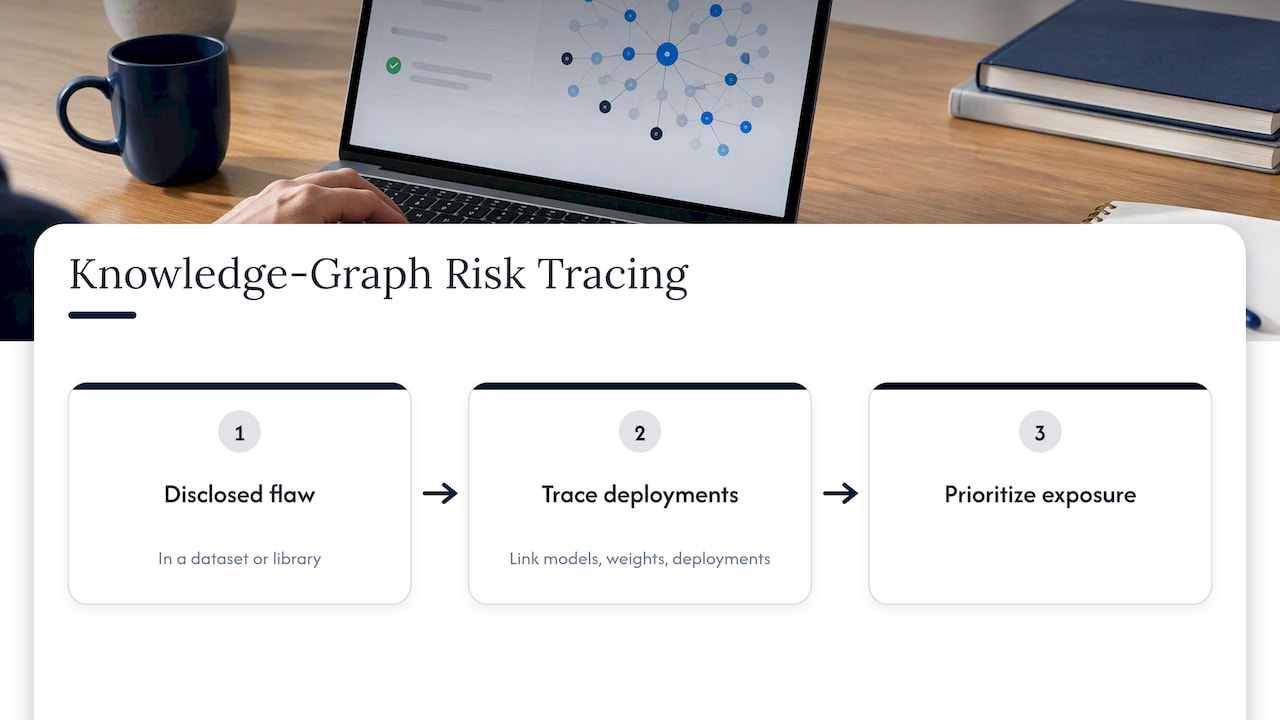
Beyond verification, model your artifacts as a knowledge graph. Link models, datasets, weights, and deployments as nodes, so one disclosed flaw in a dataset or library can be traced to every affected deployment and prioritized by exposure. NIST material on illuminating AI usage in software supply chains lists the components worth graphing, including inference providers, prompt and data processors, and models, and names prompt injection, model poisoning, and licensing issues as risks to trace.
Why SBOMs are only as good as the perimeter around them
Most AI SBOM advice assumes a connected pipeline. We work where that is not true: private and air-gapped deployments, where an SBOM that leaks is itself a risk. We keep SBOMs inside the customer perimeter, run attestation checks before a model is promoted, gate deployment on validation, and retain audit artifacts where the customer controls them. Our view is that an SBOM nobody enforces is paperwork, so the enforcement matters as much as the document. If you want to know how ready your environment is, an architecture review is the fastest way to find out.
— John Ezzell, Founder
How Forge helps you put AI SBOMs to work
We deploy and operate webAI’s platform as an official webAI systems integrator, so SBOM-driven governance fits into the environment you already control. Our solutions include secure local and air-gapped deployment, custom model integration and optimization, and sovereign MLOps and runtime orchestration, all aligned with webAI Personas, the Intelligence Delivery Network, and webAI Frontline for fully offline, source-backed answers.
Request an architecture review through Forge AI Deployment.
FAQ
What is an AI SBOM?
An AI SBOM is a machine-readable inventory of an AI system’s components, models, and data. It extends the standard SBOM with model cards, dataset references, and weight provenance so teams can manage AI-specific supply-chain risk.
What should be included in an AI SBOM?
Start with the general SBOM minimum elements, then add model identity and version, model card, repository reference, tokenizer and configuration files, weights with hashes and signature status, and dataset references. CISA’s guidance treats these AI fields as supplemental to the baseline.
Which format is best for an AI SBOM?
CycloneDX with ML-BOM support and the SPDX 3.0 AI profile are the two schema-compliant options. Choose the one your pipeline and tooling already ingest, and keep one canonical format.
How often should an AI SBOM be regenerated?
Regenerate on every release, fine-tune, and dependency change. Automating this in CI keeps the document in step with the weights it describes.