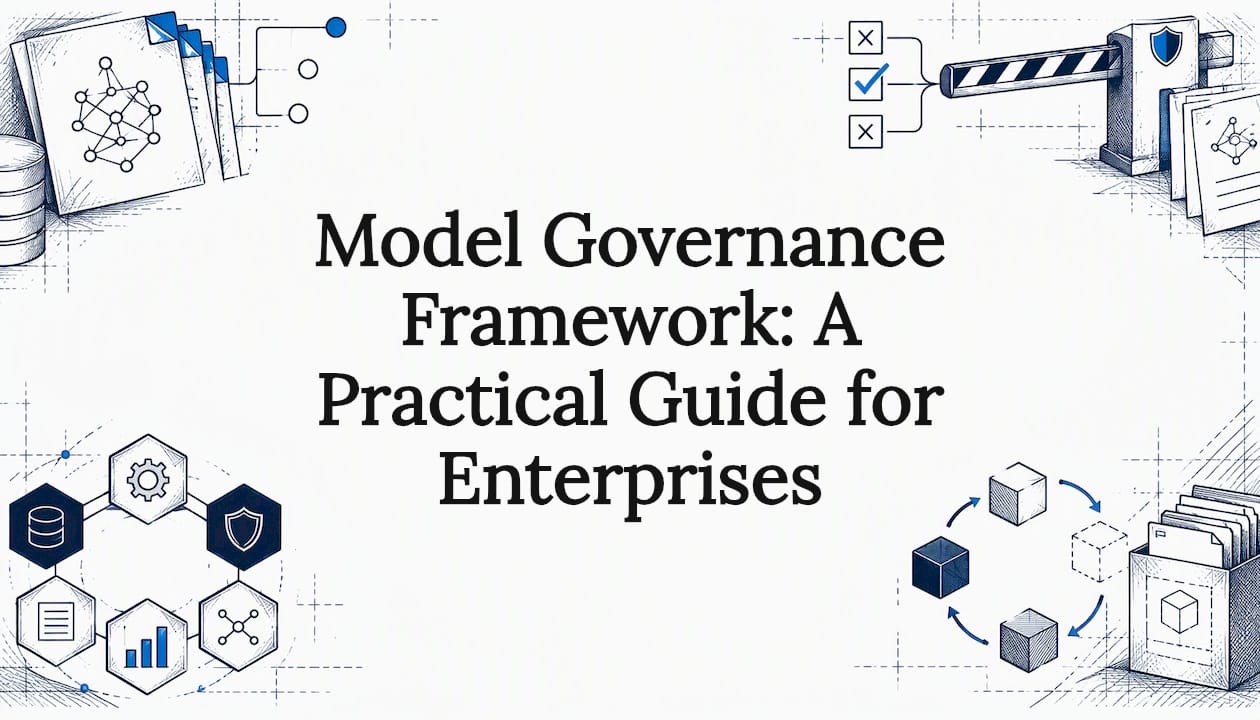
A model governance framework is the set of policies, roles and controls that decides who may build, approve, deploy, monitor and retire every model your organization runs. IBM describes model governance as the end-to-end process of establishing, implementing and maintaining controls around the use of models, from documentation and version control to back-testing and monitoring. This guide shows what a working framework contains, how to roll it out in order, and what changes when your models run inside infrastructure you control, such as a private data center or an air-gapped network.
TL;DR
- A framework is only real if every model has a named owner, an approved use case and a lifecycle record an auditor can read without help.
- Six components carry most of the weight: governance structure, model inventory, documentation, independent validation, continuous monitoring, and change control with retirement.
- Scale rigor to risk. A tiering system keeps low-impact models light and puts the heavy validation where customer impact and complexity are highest.
- Governance has to reach the runtime. In on-premise and air-gapped deployments, controls must live in the deployment path, not in a binder.
- Start with an inventory and a tier list. You can do both in weeks, and everything else hangs on them.
Table of Contents
- What a model governance framework actually covers
- The six components that do the work
- Tier your models before you tier your effort
- How to implement model governance in eight steps
- Governance in private and air-gapped environments
- Our perspective: governance is an operating discipline
- Regulatory pressure to plan for
- Common failure points
- Staffing the framework
- Where Forge fits
- FAQ
- Sources
What a model governance framework actually covers
People use several terms for overlapping things, so it helps to separate them.
- Model governance manages individual models across their life: design, validation, deployment, monitoring, retirement.
- Model risk management is the older banking term for the same discipline, centered on the risk that a wrong or misused model causes harm.
- AI governance is the wider program: ethics, legal exposure, data use, vendors and people. Model governance is its operating core.
- Data governance covers the quality, lineage and access rules for the data that feeds models. The two programs depend on each other.
The BIS Financial Stability Institute notes that model risk management guidelines share common elements: governance and oversight, development and documentation, validation and implementation, and monitoring and maintenance. That four-part skeleton is a safe base whatever industry you work in.
One shift matters more than any definition. Governance is moving from a yearly compliance exercise to a continuous one. EC-Council’s open AI governance framework argues for embedding controls directly in the deployment workflow so compliance is evidenced at every step instead of reconstructed before an audit.
The six components that do the work
1. Governance structure and accountability
Name the bodies and the people. At minimum you need an executive sponsor, a model risk or AI risk committee with authority to block a release, and a named owner for each model. The NIST AI Risk Management Framework puts it first under its Govern function: policies, processes and practices for mapping, measuring and managing AI risk must be in place, transparent and implemented effectively.
Many organizations adopt the “three lines of defense” structure. Financial regulators describe it as separating management and control responsibilities so that AI teams, risk managers and oversight committees hold distinct roles. The team that builds a model should never be the only team that approves it.
2. A complete model inventory
You cannot govern what you cannot list. The inventory records, for each model: owner, purpose, approved use case, data sources, version, deployment location, risk tier, validation date and next review date. Include vendor models and fine-tuned open-weight models. Include the assistant a business unit quietly turned on last quarter.
A useful test: pick any production model at random and ask who owns it, what it is approved to do, and when it was last validated. If answering takes more than a few minutes, the inventory is not finished.
3. Standardized documentation
Every model needs a record of its theory, assumptions, limitations, training data and intended use. Keep it in a fixed template so reviewers compare like with like. Documentation also protects you from staff turnover: the reasoning behind a model should not leave when its builder does.
4. Independent validation
Validation is a challenge function. In the United States, the Federal Reserve and OCC’s SR 11-7 guidance from April 2011 is the foundational supervisory guidance for model risk management in banking, and it applies to vendor and third-party models too. Even outside banking, the principle travels well: people who did not build the model should test its assumptions, back-test its performance and document where it fails.
For models that are hard to explain, practitioners cited by the BIS advise independent validation teams able to challenge the model’s theory, assumptions and limitations. That includes large language models, where “validation” means curated evaluation sets, red-teaming and source-grounding checks rather than a single accuracy figure.
5. Continuous monitoring
A model that passed validation in March can be wrong by September because the data moved. Monitor for drift, bias and performance degradation, set thresholds that trigger a review, and decide in advance who gets paged. For assistants that answer from documents, add checks on whether answers cite their sources and whether retrieval still covers the current document set.
6. Change control and retirement
Retraining, prompt changes, a new base model, a new data source: each is a change that needs approval proportional to its risk. Retirement belongs here too. Retired models should be removed from service, their access revoked and their records kept for the retention period your regulators require.
Tier your models before you tier your effort
Treating every model the same way either buries the team in paperwork or leaves the risky ones under-reviewed. The BIS paper advises planning a risk-based tiering system where validation rigor and monitoring intensity scale with a model’s materiality, potential customer impact and complexity.
A simple three-tier scheme works for most enterprises:
| Tier | Typical model | Validation | Monitoring | Approval |
|---|---|---|---|---|
| 1, high | Credit decisions, safety-relevant maintenance guidance, anything touching regulated outcomes | Full independent validation before release, annual revalidation | Continuous, automated alerts | Risk committee |
| 2, medium | Internal assistants that inform human decisions, forecasting for planning | Independent review of documentation and test results | Scheduled reports plus drift alerts | Model owner and risk lead |
| 3, low | Productivity helpers on non-sensitive data | Owner self-attestation against a checklist | Periodic sampling | Model owner |
The numbers and cadences are yours to set. What matters is that the rules are written down, applied consistently and revisited when a model’s use changes. A tier 3 tool that starts feeding customer decisions is a tier 1 model by Monday.
How to implement model governance in eight steps
- Appoint accountable people. One executive sponsor, one governance lead, one owner per model.
- Build the inventory. Survey every business unit, scan infrastructure for running models, and add vendor models.
- Set the tiering rules. Define materiality criteria and what each tier requires.
- Write the standards. Documentation template, validation procedure, monitoring thresholds, change approval rules.
- Map to an external framework. The NIST AI RMF is a common reference in the US. ISO/IEC 42001 specifies requirements for an AI management system that you can improve continuously, and organizations that need certification evidence often start there.
- Pilot on two or three models. Pick one tier 1 and one tier 2 model. Find the friction before you scale.
- Automate evidence. Log approvals, evaluation runs, versions and access automatically, so the audit trail is a by-product of working.
- Review and improve. Run the framework against incidents and near misses every quarter.
If you want a deeper walkthrough of the NIST route, we cover it in six steps to operationalize NIST AI risk management.
Governance in private and air-gapped environments
Most published frameworks assume a cloud provider will supply logging, monitoring and identity. When models run inside your own data center, at an edge site, or on a network with no outside connection, you supply those yourself, and the framework has to be built around that.
Three adjustments matter.
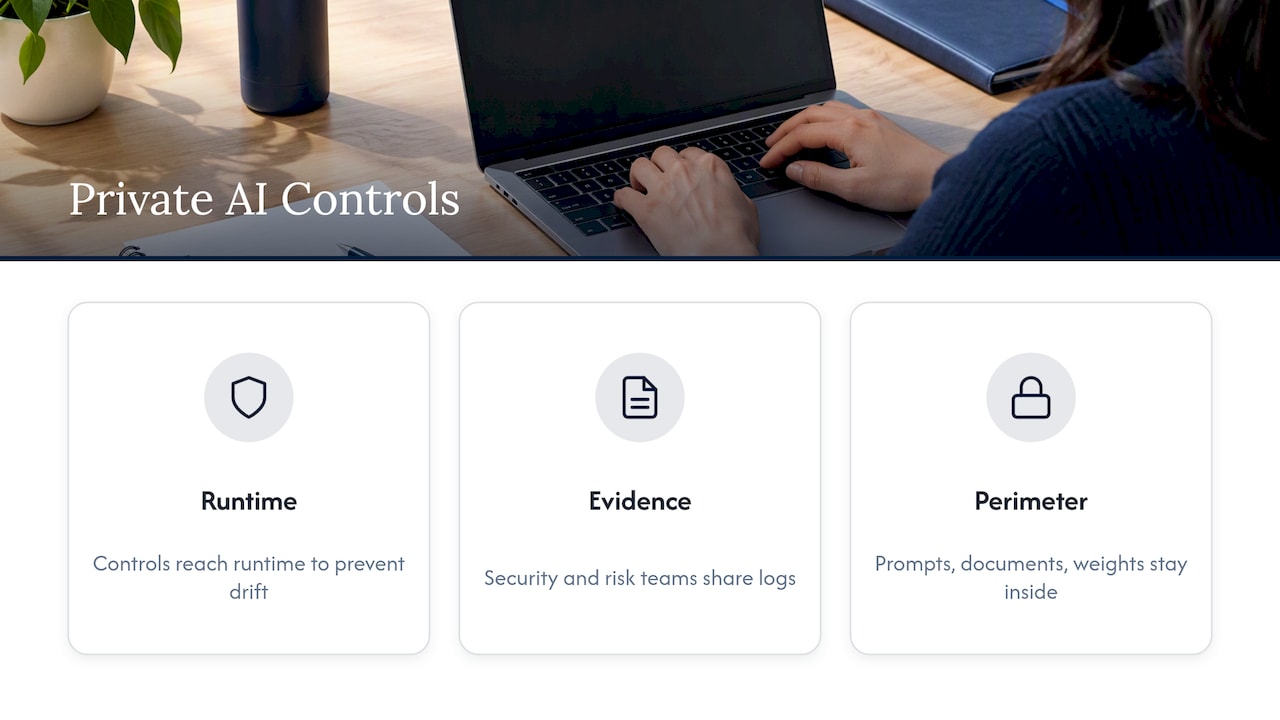
Controls must extend into the runtime. EC-Council’s guidance on high-security deployments is that governance controls need to reach the runtime environment so the system stays within its defined envelope, preventing drift and unauthorized modification outside standard CI/CD pipelines. In an air-gapped site, nobody can pull a fresh model from the internet, which is an advantage: every artifact that enters is a deliberate, recorded event. See how we think about verifying artifacts before sovereign AI runs.
Security and governance share one evidence base. A common pitfall is running them as separate programs with separate records. Mature organizations use one integrated control set so the security team and the model risk team look at the same logs. That also reduces audit prep. Our piece on SOC 2 evidence for air-gapped AI shows what that evidence looks like in practice.
Data sovereignty becomes a governance control. ISO/IEC 42001 practitioners stress that an AI management system should sit inside the broader risk strategy, and that organizations whose governance ignores operational resilience often struggle with data sovereignty and security when AI must run in strictly controlled infrastructure. If prompts, documents and model weights never leave your perimeter, a whole class of third-party risk disappears from the register. We map the leakage routes that remain in six enterprise data leakage paths.
Our perspective: governance is an operating discipline
We deploy and operate private AI systems for organizations that cannot let data leave their perimeter, and our leadership has more than 20 years in high-consequence and Fortune 100 environments. The same lesson repeats: the frameworks that fail are written as policy and handed to engineers afterward.
We treat each model like a capital asset. It has an owner, an approved use, and a lifecycle record from day one. When a team treats a model as disposable code, governance debt builds quietly, and nobody re-validates when the data shifts or the business question changes. IBM’s guidance makes the same point about treating models as operating assets.
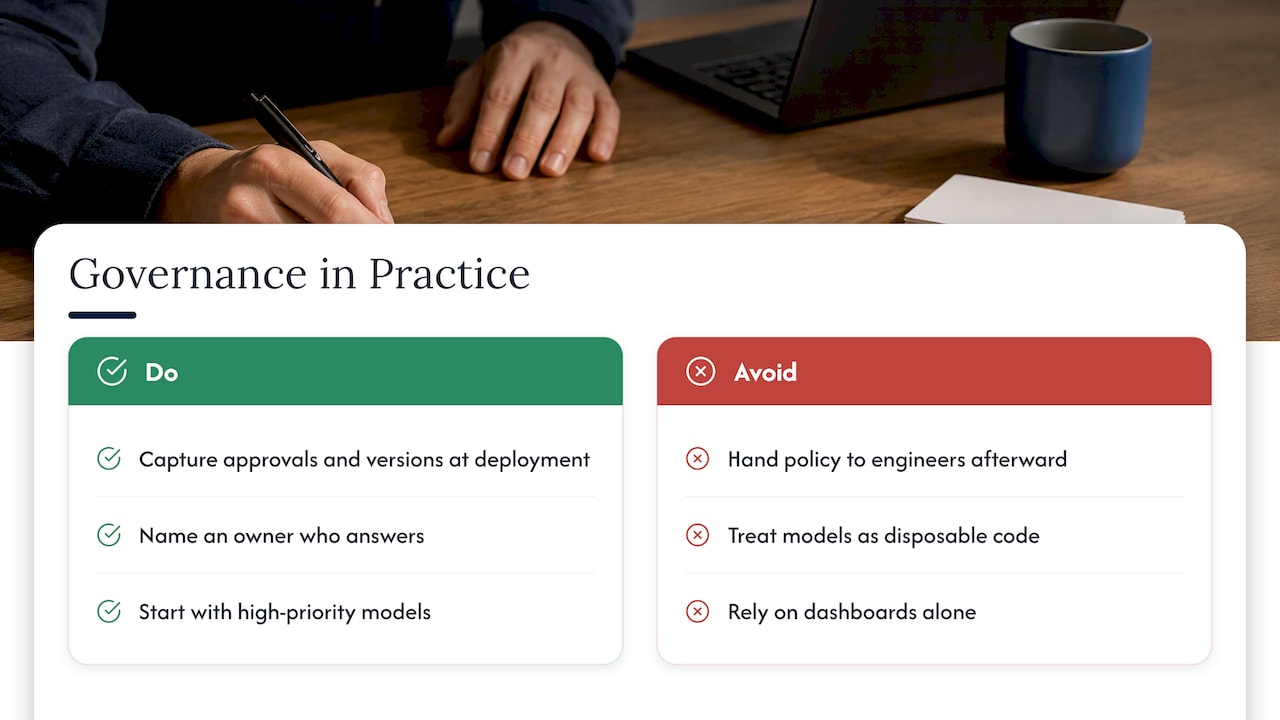
We also push controls into the deployment itself. When a platform runs on a single device offline, or across an enterprise cluster, the approvals, versions and evaluation results should be captured where the model runs. That is how a team proves, at any moment, that nothing left the building and nothing changed without sign-off. Our methodology favors operational discipline over tooling: the best dashboard cannot replace a named owner who answers the phone.
If you remember one thing, make it this: start small, pick the models that matter most, and make their records excellent before you widen the net.
— John Ezzell, Founder
Regulatory pressure to plan for
The rules differ by country, so attribute each requirement to its source rather than assuming one global standard.
- United States banking: SR 11-7 sets expectations for development, validation, governance and controls, and extends to vendor models.
- European Union: the EU AI Act requires high-risk systems to follow conformity assessments, with documentation of design and development, a risk management system and clear instructions for use, as laid out in the Commission’s implementation guidance. If your organization sells into the EU, see our role-based EU AI Act roadmap.
- Financial supervisors globally: the BIS has observed that boards and senior management stay ultimately accountable for AI use cases in their institutions, including in core business activities.
If you operate in a regulated sector, ask your compliance counsel or model risk officer which of these applies to each business line before you finalize your standards. A framework that satisfies one regime can still fall short of another.
Common failure points
- Inventory drift. The list was complete in January. Tie inventory updates to deployment approvals so a model cannot go live unrecorded.
- Validation by the builder. Independence is the point. If the team is too small for a separate group, use a peer from another unit or an outside reviewer.
- Static annual reviews. Drift does not wait for the review calendar. Use automated thresholds and event-driven triggers.
- Orphaned models. Staff move on. Every owner field needs a role as well as a name, and a handover step in your offboarding process.
- Governance split from security. Two programs mean two sets of evidence and two sets of gaps.
- One-size-fits-all rigor. Overbuilding for low-risk tools drives teams to bypass the process. Tiering protects the framework as much as it protects the business.
Staffing the framework
Governance needs people with mixed skills: engineers who can instrument a runtime, validators who can challenge a model, and risk staff who can read both. Smaller teams often cannot cover all three internally. If you are hiring developers in Australia or New Zealand, a flat-fee software developer recruitment service is one way to add engineering capacity without a percentage-of-salary fee. Whatever route you take, write the governance role descriptions before you open the search so candidates know the work includes evidence and sign-off, not only building.
Where Forge fits
Forge AI Deployment designs, deploys and operates private, sovereign AI systems inside infrastructure you control, including enterprise data centers, edge sites and air-gapped networks. As an official webAI systems integrator, we bring webAI’s local-first platform into production: private and air-gapped deployment, specialized AI Personas, the Intelligence Delivery Network, and webAI Frontline, which gives teams fast, source-backed answers from large technical document libraries, fully offline on a single device.
For governance, that means we help you design deployments where data, models and domain intelligence stay inside your environment, with the ownership, approval and audit records described above built into how the system is run. Review our deployment and operations services or start from our home page if you want to scope an engagement. Engagements are priced individually, and no prices are published.
FAQ
What are the main parts of a model governance framework?
Most frameworks include governance structure and ownership, a model inventory, standardized documentation, independent validation, continuous monitoring, and change control with retirement. Risk tiering ties them together by deciding how much rigor each model gets. The exact weighting depends on your sector and regulators.
How is model governance different from AI governance?
AI governance is the broader program covering ethics, legal exposure, data use, vendors and culture. Model governance is the operational layer that manages individual models across their lifecycle. Most organizations need both, with model governance supplying the evidence that the wider program relies on.
Which standards should I map my framework to?
In the US, the NIST AI Risk Management Framework is a common starting point, and banks work to SR 11-7. ISO/IEC 42001 provides a certifiable management system standard, and the EU AI Act applies if you place high-risk systems on the EU market. Choose the ones your regulators and customers actually ask about.
Can model governance work in an air-gapped environment?
Yes, and the closed boundary can make it easier to enforce. Every model, update and dataset enters through a controlled, recorded path. The work is in supplying your own logging, monitoring and evaluation tooling, and in extending controls into the runtime so the system stays within its approved envelope.
Where should we start?
Build the inventory and assign an owner and a risk tier to every model. That gives you the map for everything else, and it usually exposes models nobody knew were running.
Sources
- What Is Model Governance? | IBM
- Govern | NIST AI RMF Playbook
- AI Governance Framework (ADG) | EC-Council
- Managing explanations: how regulators can address AI explainability | BIS
- Regulating AI in the financial sector | BIS
- ISO/IEC 42001 | ISO
- EU AI Act implementation guidance | European Commission
- Model Risk Management: Validation, Governance & SR 11-7