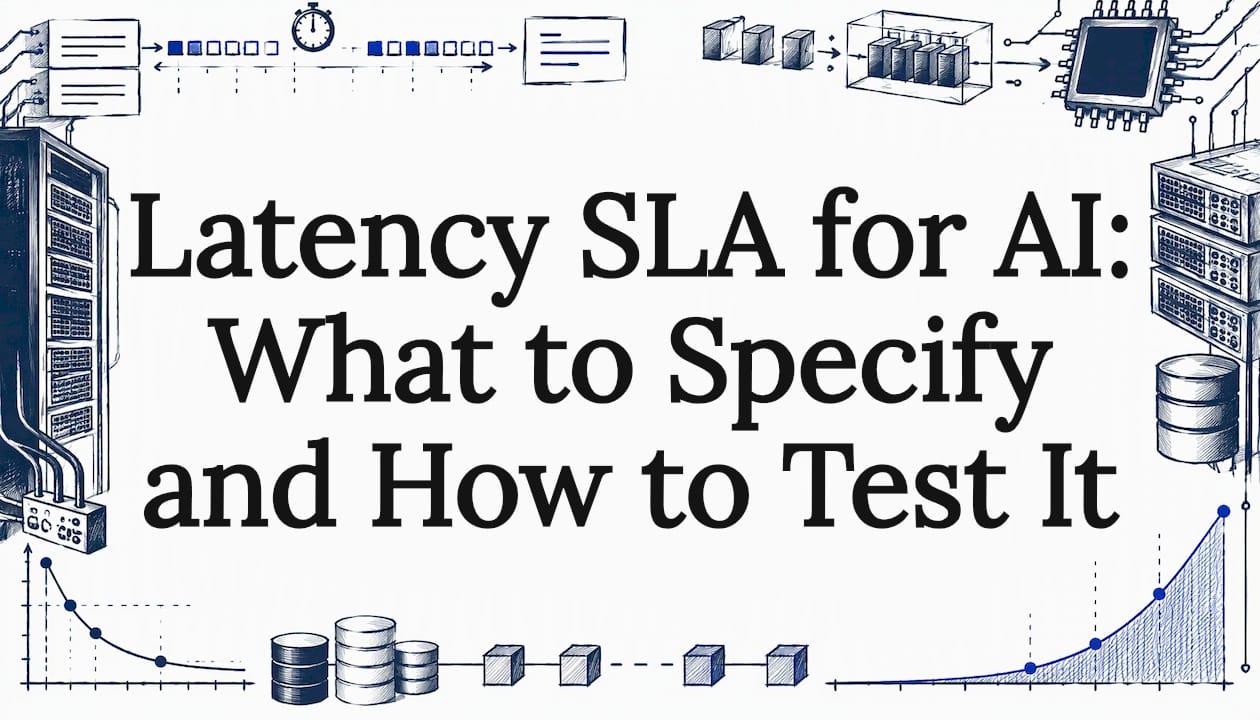
An AI latency SLA is a written commitment that a model will respond within a defined time, measured a defined way, for a defined share of requests, with a stated consequence when it does not. Most failures come from the “defined” parts being left vague. When the system runs inside infrastructure you control, you can set the targets yourself and measure them where your users sit. That is the case Forge AI Deployment builds for: private, air-gapped and on-premises AI that your own team can hold to a number.
This guide covers what to put in the agreement, which measures matter, how to test them, and how the answer changes when the AI runs inside your perimeter instead of a shared cloud.
TL;DR
- A useful AI latency SLA names the metric, the percentile, the threshold and the measurement window. Anything less is a hope, not a commitment.
- Time to first token, time per output token and end-to-end time are three different things. Specify the ones your users feel.
- Tail percentiles (p95, p99) decide whether users trust the system. Averages hide the slow requests.
- Some published cloud latency SLAs set a floor on token rate, not a promise about response time. Check whether your promised user experience fits inside it.
- On private infrastructure you own the measurement and the capacity plan, so the SLA becomes an internal engineering target backed by an operations partner.
Table of Contents
- What an AI latency SLA actually promises
- The measures to specify
- Floor versus promise: reading a published SLA
- Where you measure changes the number
- How private and air-gapped deployments change the SLA
- Setting targets by workload
- How to test before you sign off
- Clauses every AI latency SLA needs
- What we think about latency commitments
- Putting a latency target into production
- FAQ
- Sources
What an AI latency SLA actually promises
Three terms get mixed up, and the difference matters when something goes wrong.
- SLI (service level indicator): a measured number, such as the p95 time to first token last Tuesday.
- SLO (service level objective): a target for that number. The IETF’s terminology draft for LLM serving describes an SLO as a quantitative threshold and gives examples such as p99 time to first token under 500 ms or an error rate below 0.1%.
- SLA (service level agreement): the SLO plus the agreement around it: who is covered, over what window, measured where, and what happens on a miss.
The same IETF draft says an SLO definition has to include the metric, the percentile, the threshold and the measurement window. If one of those four is missing, two people can read the same sentence and disagree about whether it was met.
For an AI system, “latency” also needs a definition of the finish line. The draft defines end-to-end latency as the time from the client starting a request to receiving the complete response, covering network transmission, queuing, the model’s prefill step, token-by-token decoding, output filtering and the return trip. For streaming answers it runs until the final token. Whether you count to the first word or the last one changes the number by seconds.
The measures to specify
A chat assistant and a document summarizer wait on different things, so one number rarely covers both. These are the measures most enterprise agreements need.
| Measure | What it captures | Where it matters |
|---|---|---|
| Time to first token (TTFT) | Wait from sending the request until the first usable output appears | Interactive assistants, search, frontline Q&A |
| Time per output token (TPOT) | Pace of the text once it starts | Long answers, reports, code generation |
| End-to-end latency | Full time to a complete, accepted result, including retrieval, tools and retries | Workflows, batch jobs, agents |
| Error and timeout rate | Share of requests that fail or never finish | Every use case |
| SLO attainment | Fraction of requests or periods that met all declared targets | Reporting and remedies |
The IETF draft’s SLO attainment definition is worth borrowing directly: it is the fraction of requests or time periods meeting all declared objectives, and anything below 1.0 means violations occurred.
There is a useful rule of thumb connecting the first three. Total response time for N output tokens is roughly TTFT plus (N minus 1) times TPOT, according to the LLM Inference Illustrated chapter on measurement. Time to first token dominates short answers, and per-token pace dominates long ones. The same chapter puts a comfortable reading pace for interactive use at about 50 to 100 ms per token, or 10 to 20 tokens per second. Treat that as a design guide rather than a standard, and set your own target against your own users.
Why percentiles, not averages
A median (p50) tells you what a typical request feels like. A p99 tells you what one request in a hundred feels like, and in a system serving thousands of requests an hour, that is a lot of unhappy people. Specify both. The gap between them is also diagnostic: a wide spread usually points to queueing, model routing, cold starts or GPU contention.
The IETF methodology draft uses this gap as a saturation signal. It treats a system as saturated when queues grow continuously, when completions fall below 90% of arrivals, or when p99 latency climbs above 10 times p50 at a lower load. You can use the same ratio as an early warning in production.
Floor versus promise: reading a published SLA
Published cloud AI SLAs show how easy it is to promise something that does not match user expectations. Redress Compliance’s analysis of a major cloud provider’s AI SLA reports that the latency commitment for provisioned deployments is a 99% target on token generation rate, measured as p50 per five-minute period, with a floor of 25 tokens per second for one of the listed models. It applies to provisioned deployments only.
That is a floor on speed, not a response-time promise. At 25 tokens per second, a 600-token answer takes 24 seconds to reach its last token, and the provider is still within its SLA. If your product team told users to expect an answer in two seconds, the gap has to be closed by design: shorter outputs, streaming so the first words appear quickly, or a faster model.
The lesson applies to any agreement, including internal ones. Write down the user promise first, then check that the metric in the SLA can actually fail when the promise is broken.
Where you measure changes the number
A latency figure without a measurement point is nearly meaningless. The IETF terminology draft requires a statement of whether measurement is client-side or server-side, because client-side numbers include the network round trip and server-side ones do not. The LLM Inference Illustrated chapter adds that the TTFT a user experiences can exceed the engine’s internal prefill time, because tokens may be buffered for network batching or word-boundary decoding.
The practical consequence: the model’s GPU time is only part of what the user waits for. Authentication, document retrieval, queueing and output filtering all sit in the path. An SLA that covers only the inference engine can be met every day while users complain.
A workable agreement states:
- The start event (user submits the request, or the gateway receives it).
- The stop event (first usable token, or the accepted, completed result).
- The clock source and where the probe runs.
- Which components are in scope: retrieval, tools, retries, validation.
How private and air-gapped deployments change the SLA
When the AI runs on infrastructure you control, the SLA stops being a contract with a distant provider and becomes a commitment between your business owners, your infrastructure team and whoever operates the system.
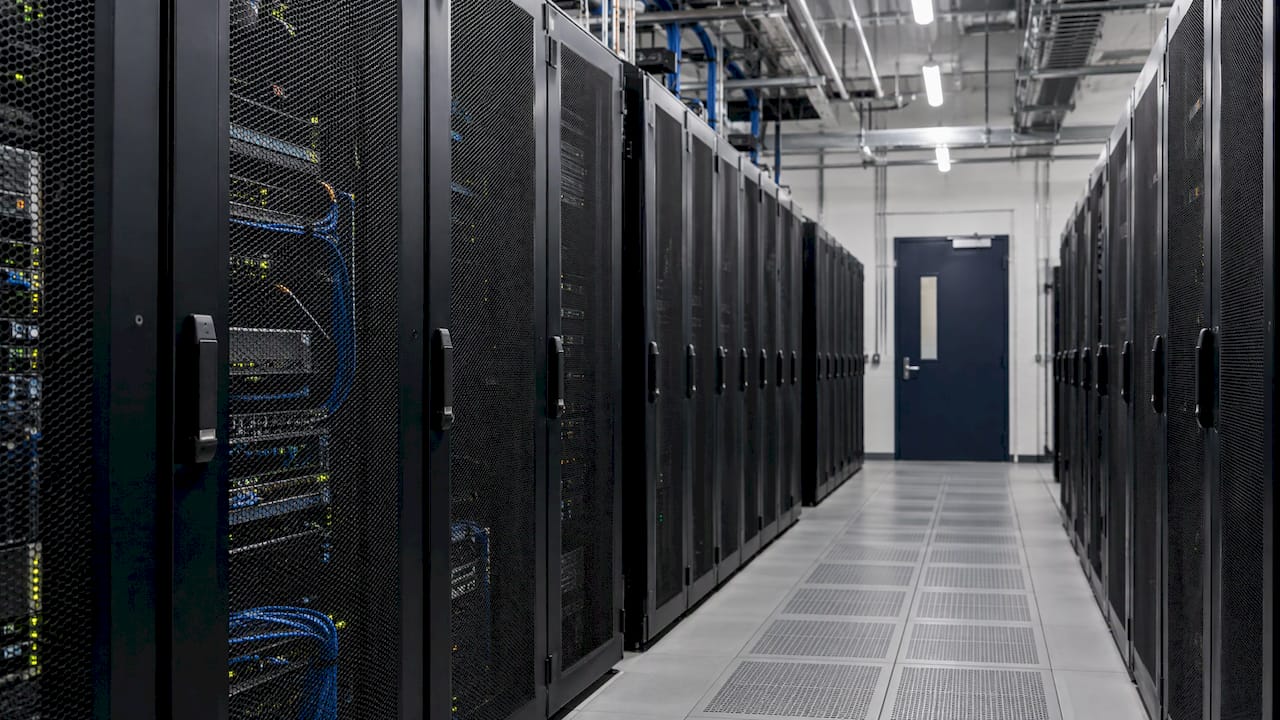
The OMG Cloud Working Group’s guide to cloud service agreements notes that agreements for private on-site clouds resemble traditional enterprise IT SLAs. Because data center resources may be shared by more internal users, availability and response-time objectives have to be met through ongoing measurement and tracking. For privately hosted but outsourced environments, it points to dedicated single-customer resources and to specifying perimeter and link security, with service criticality justifying the added cost.
In practice, that moves the SLA conversation to different terms:
- Capacity, not metering. There is no per-request price to argue over. The questions are how many concurrent users the hardware supports at your p95 target and what headroom exists at peak. Our capacity planning guide for LLM inference walks through sizing.
- Shared internal demand. Other teams on the same GPUs can push your tail latency up. Define priority and quotas in the SLA.
- Lifecycle commitments. Hardware refresh, support response and model version changes belong in the agreement alongside latency.
- Resilience. A latency target means little if a failure takes the system down for hours. Recovery objectives should sit next to latency objectives, which is covered in our piece on backup and disaster recovery for private AI.
- Network effects removed. In an air-gapped or fully offline setup there is no public internet in the path, so internet variability drops out of your numbers. For more on that, see how offline AI inference works.
For regulated teams such as banks, defense contractors and manufacturers, this is a real advantage: the measurement lives inside your perimeter, so your auditors can inspect it without any data leaving. For the monitoring layer itself, bring-your-own-LLM infrastructure monitoring is one way teams track operational signals across their stack.
Setting targets by workload
Do not copy a number from a vendor. Work backward from the person waiting.
- Frontline lookup (technician asking a question about a maintenance manual): the first words should appear quickly, so set a tight p95 TTFT and a modest TPOT. The answer should be short and cite its source passage.
- Analyst assistant (summarizing a long filing): users accept a longer wait if the system shows progress. Set a p95 end-to-end target and require streaming.
- Batch processing (overnight document classification): latency per request matters less than throughput and completion by a deadline. Define a completion window, not a per-token pace.
- Agent workflows: several model calls and tool calls stack. Allocate a time budget across each stage and measure the total on accepted jobs.
The IETF methodology draft is useful here because it defines standard test workloads with different shapes: short synthetic requests, skewed lengths, multi-turn conversations with shared system prompts, code completion with a shared repository prefix, and long-context inputs of 8,192 to 32,768 tokens. Your documents are probably closer to the last one, which is far slower than a chat benchmark suggests.
How to test before you sign off
A target is only credible after you have tried to break it. This routine follows the IETF benchmarking methodology draft and procurement guidance.
- Write the workload down. Use your real prompt lengths, output lengths and shared system prompts. The draft requires full workload specification and deterministic random seeds so a test can be repeated.
- Run long enough. The draft specifies throughput tests of at least 60 seconds, with 300 seconds recommended, so short bursts do not flatter the system.
- Find the ceiling. Raise load until the system saturates, using binary search for maximum throughput. Then set your production target comfortably below that point.
- Use several load shapes. The AI Inference Provider RFP and Procurement Guide calls for ramp, step, spike and soak profiles, including 2x headroom over your critical peak.
- Classify failures. Count timeouts, rate-limit rejections, stream interruptions, malformed responses and tool failures separately, since each has a different fix.
- Measure the business view. Track the user-journey time on accepted jobs, not only the model API. The same guide argues for keeping both the contractual availability figure and a user-journey indicator, because meeting one does not prove the other.
- Test failure for real. Inject a real fault rather than discussing it in a meeting.
The guide also recommends recalculating the SLA from proof-of-concept telemetry before signing, so that the figures in the contract are ones you have seen the system hit.
Clauses every AI latency SLA needs
A metric schedule works best as a table with one row per obligation. For each row, define:
- Metric name and percentile, for example p95 TTFT.
- Threshold, in milliseconds or tokens per second.
- Measurement method and source of truth: logs, synthetic probes, or a shared dashboard.
- Measurement period: calendar month or rolling quarter.
- Start and stop events for the clock.
- Exclusions: scheduled maintenance in narrow, pre-announced windows only.
- Breach threshold and the remedy: credits, escalation or required corrective action.
The procurement guide lists warning signs worth scanning for: only server errors count as downtime, idle intervals count as available, rate-limit rejections and capacity errors are excluded, and credits are the only remedy. It also notes that credits rarely compensate for lost business, so chronic-failure termination and transition support deserve negotiation. Ask for a worked example using a month that contains failures, maintenance and zero-traffic periods, so both sides calculate the same result.
Two more clauses are easy to forget. First, pin the latency target to a specific model version, so a model retirement cannot quietly reset the service level downward. Redress Compliance’s contract wording recommends exactly that, along with minimum notice before a pinned version is retired. Second, make sure the evidence is exported during an incident: platform metrics may be retained for only a limited time by default, and 93 days is the figure reported for one major cloud’s monitoring service.
What we think about latency commitments
Most latency arguments we see in enterprise AI come down to ownership. When the model, the hardware and the data all sit inside your perimeter, nobody can tell you the slow response was someone else’s network. That is uncomfortable at first and valuable afterward.
Our view is that a private deployment deserves a stricter SLA than a shared service, not a looser one. You control capacity, so you can set a p95 target, plan headroom against it and measure it from the user’s desk. We build deployments with that in mind: private and air-gapped by design, with webAI Personas, the Intelligence Delivery Network and webAI Frontline, which gives teams fast, source-backed answers from large technical document libraries, fully offline on a single device.
We deploy and operate webAI’s platform as an official webAI systems integrator. Our leadership has more than 20 years in high-consequence and Fortune 100 environments, and that shapes how we treat latency: as an operating discipline with measurement, tuning and review, not a number on a slide.
Write the user promise first, pick the percentile that protects it, and make sure someone is accountable for hitting it every month.
John
Putting a latency target into production
Forge AI Deployment designs, deploys and operates private AI systems inside infrastructure you control, including enterprise data centers, edge sites and air-gapped networks. The scope covers secure local deployment, model integration and optimization, private AI assistant rollout, sovereign MLOps and runtime orchestration, and performance tuning with ongoing operations. That means the team that sizes the system is also the one that tunes it against your latency targets over time. See the Forge AI Deployment solutions to scope an engagement, and read about the webAI platform behind our deployments.
FAQ
What is an SLA in latency?
It is an agreement that response time will stay within a stated limit for a stated share of requests over a stated period. For AI, it should name the metric (such as time to first token), the percentile, the threshold, the window and where it is measured. It also states what happens when the target is missed.
What does latency mean in AI?
It is the time between a request and a response. For language models, it splits into the wait for the first token, the pace of the remaining tokens, and the total time to a complete answer. Network, queueing, retrieval and filtering delays add to the model’s own compute time.
Which percentile should an AI SLA use?
Use at least p50 and p95, and add p99 where slow outliers hurt, such as in operations or safety-related lookups. The median shows typical experience, while the tail shows how often users wait too long. A p99 above 10 times the p50 at moderate load is a sign the system is approaching saturation.
Do private deployments need a latency SLA?
Yes. Without a provider contract, the SLA becomes the agreement between business owners, infrastructure teams and the operator. It should cover latency targets, capacity headroom, priority between internal teams, recovery objectives and who reviews the measurements each month.
Sources
- Benchmarking Terminology for Large Language Model Serving (IETF draft)
- Benchmarking Methodology for Large Language Model Serving (IETF draft)
- LLM Inference Illustrated: Measuring LLM Inference
- Practical Guide to Cloud Service Agreements, Version 3.0 (OMG Cloud Working Group)
- The Azure OpenAI SLA and support plans (Redress Compliance)
- AI Inference Provider RFP and Procurement Guide