An AI backup and disaster recovery plan has to restore the whole AI capability, not just the servers it runs on. That means data, models, pipelines, configuration, retrieval indexes and the people-run processes around them, all returning to a known good state, inside infrastructure you control. For organizations that keep AI on premises, at the edge or on air-gapped networks, the plan also has to work without a cloud service to lean on. At Forge AI Deployment, we design, deploy and operate private AI inside customer infrastructure, so recovery is part of the design from day one, not an afterthought.
TL;DR
- Back up the full AI stack: data and labels, model weights and registry entries, pipelines, container images, configuration, secrets handling, logs and runbooks.
- Set recovery time (RTO) and recovery point (RPO) objectives per AI workload through a business impact analysis, not one number for everything.
- Keep at least one copy offline or immutable, encrypted, and inside your sovereignty boundary, because ransomware goes after reachable backups first.
- Test restores on a schedule and document the results; an untested backup is an assumption.
- Regulators are starting to name AI-specific recovery steps, such as rolling back fine-tuned models and cleaning retrieval sources.
Table of Contents
- Why AI systems need more than a server backup
- What to back up: the AI asset map
- Setting RTO and RPO for AI workloads
- Designing recovery for private, edge and air-gapped AI
- Protecting AI backups from ransomware and unauthorized access
- Testing and documenting restores
- Where Forge fits
- Our perspective
- FAQ
- Sources
Why AI systems need more than a server backup
A traditional backup plan asks: can we get the machine and its files back? An AI system is a combination of data, models, pipelines, configurations, infrastructure and human processes. The PMI CPMAI methodology frames backup and disaster recovery for AI as making sure you can restore that whole capability.
The reason is asymmetry. Code can be rewritten. Historical data, labeled datasets and time-specific snapshots usually cannot be recreated, and without backups a disaster can force expensive retraining or make it impossible if the original data is gone. The same guidance points to the compute investment in training as a further cost you do not want to repeat.
For regulated organizations there is a third reason: reproducibility and auditability. If a model made a decision last quarter, a regulator may ask you to show which version made it and what it was trained on. A recovery that brings back “a” model but not “the” model fails that test.
What to back up: the AI asset map
The most common failure in AI recovery is a scope that stops at the data. The PMI CPMAI guidance groups the assets worth protecting into six families, and it works well as a checklist:
| Asset family | What it includes |
|---|---|
| Data | Raw and cleansed data, feature stores, labeled data, training, validation and test splits, per-version snapshots |
| Model | Trained weights, registry entries, hyperparameters, model cards, evaluation results |
| Code and pipeline | Training and inference code, orchestration and pipeline definitions |
| Environment | Container images, dependency manifests, configuration files, secrets, hardware specifications |
| Operational | Monitoring baselines, drift thresholds, logs, prediction histories, runbooks |
| Knowledge | Documentation, decision logs, governance approvals |
Two details deserve emphasis. First, DataStorage reports that training scripts, hyperparameter configurations, container images and orchestration definitions are often left out of backup planning, which makes exact reproduction difficult even when the code itself is preserved. Second, components cannot be protected in isolation. The AI North Star control on AI system backup says to back up the artifacts and state needed to restore AI-supported services to an approved condition, and to verify dependencies rather than treating each component alone.
For private deployments, add the items that exist only because you run the stack yourself: infrastructure-as-code state, approved configuration templates and deployment parameters, certificate records and rollover plans, and model checkpoints marked as approved versions and rollback targets. Singapore’s GovTech operations guidance lists exactly these in its backup scope for AI operations.
A practical test of your inventory: for each production AI service, could a new engineer rebuild it from your backups alone, on clean hardware, without calling the person who built it? If not, something is missing. ETSI TS 104 223, the baseline standard for securing AI, expects a comprehensive asset inventory with version control for AI-specific assets, so the inventory is a compliance artifact as well as an engineering one.
Don’t forget retrieval sources and embeddings
Many enterprise assistants answer from document libraries through retrieval-augmented generation (RAG), where the model looks up passages in your own documents before it responds. The document store, the index and the embeddings are all part of the system’s state. Back them up with the same version discipline as model weights, so you can roll back to the index that matched an approved set of documents.
Setting RTO and RPO for AI workloads
Two terms drive every recovery design. The recovery time objective (RTO) is the maximum time an AI service can be unavailable. The recovery point objective (RPO) is the maximum acceptable data loss, measured in time, for example no more than one hour of changes.
These are business decisions, not storage settings. The PMI CPMAI guidance says to identify critical AI solutions through a business impact analysis and set the targets with business stakeholders. Its example: a real-time fraud model may need an RTO of minutes, while a monthly forecasting model may tolerate days.
The OWASP GenAI Incident Response Guide adds a useful nuance. RPO applies more to data integrity than to models, since a model artifact is a fixed file you can restore from a versioned copy, while datasets, feedback logs and indexes keep changing. It also tracks containment time and eradication time alongside RTO and RPO, which reminds you that recovery starts after the threat is out, not before.
A worked example
Take a manufacturer with two AI services on its plant network: a quality-inspection model reading line cameras, and a technician assistant answering questions from maintenance manuals.
- Inspection model. A stopped line costs money by the minute, so the business sets an RTO of under an hour. The model changes rarely, so the weights and container images need versioned copies and a warm standby on local hardware. The RPO matters little for the model but a lot for the inspection logs, which feed quality audits.
- Technician assistant. Technicians can fall back to paper manuals for a day, so an RTO of one business day is acceptable. The manual library updates weekly, so a weekly RPO on the index is enough.
Same company, same platform, two different recovery tiers. Spending to the stricter objective everywhere wastes budget, and spending to the looser one everywhere puts the line at risk.
Designing recovery for private, edge and air-gapped AI
Cloud-based recovery assumes a second region you can fail over to. Sovereign deployments rarely have that option, so the architecture has to be built from what sits inside your boundary.
Tier your sites. A primary data center, a secondary site you also control, and edge locations each need a defined role. Decide which workloads fail over, which are rebuilt from backup, and which fall back to manual procedure. Our guide to running private AI with no internet covers the operating model for sites that never connect outward.
Plan for AI-specific attacks. Both the UK Code of Practice for the Cyber Security of AI and ETSI TS 104 223 say system operators should tailor disaster recovery plans to attacks aimed at AI systems, and ETSI adds that a known good state must be restorable. The Bank of England’s November 2026 effective-practices publication on AI cyber risk names the changes to plan for: a greater likelihood of zero-day attacks, faster impact and propagation, simultaneous impact on multiple assets, and AI agents gaining unauthorized access to recovery environments. It lists manual fallbacks and immutable backups as recovery options for important business services.
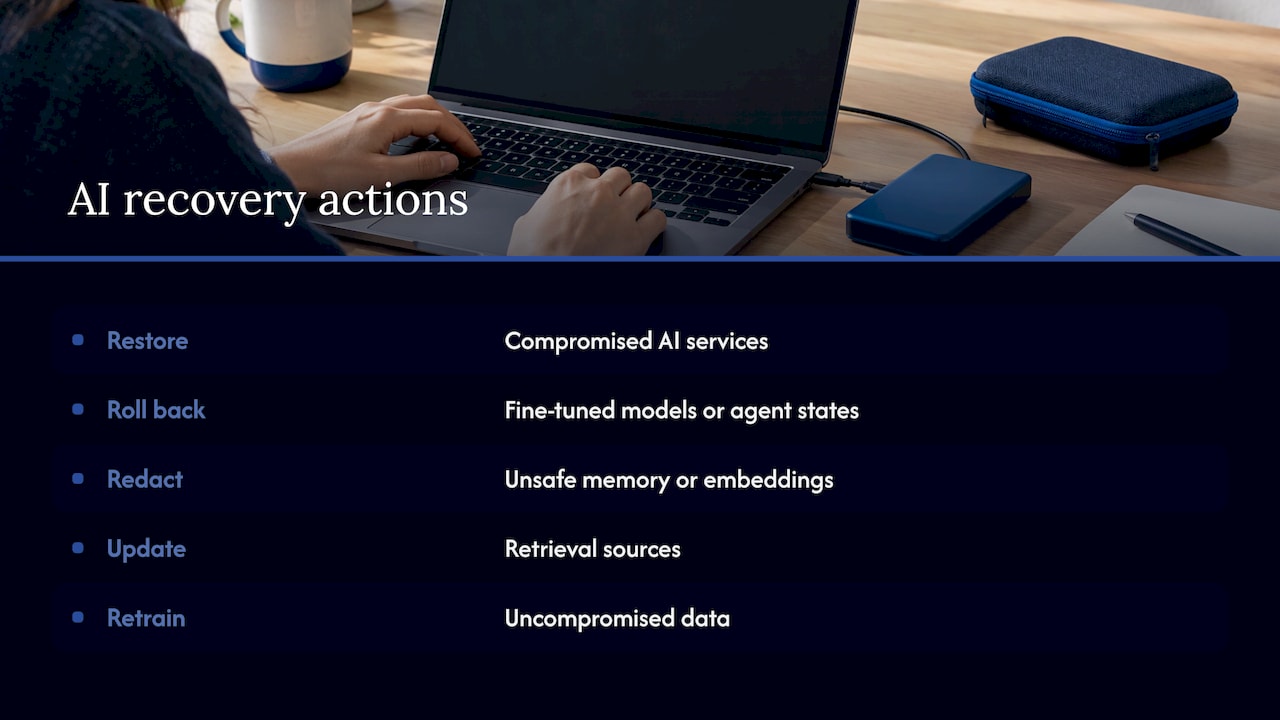
Write AI-specific recovery steps. The same publication says recovery in an AI context may include restoring compromised AI services, rolling back fine-tuned models or agent states, redacting unsafe memory or embeddings, updating retrieval sources, and retraining with uncompromised data. Each of these needs a runbook and a named owner before an incident, because none of them appears in a standard server-restore playbook.
Keep recovery tooling inside the perimeter. An air-gapped network that depends on an external service to restore is not air-gapped. Registries, signing keys, package mirrors and model artifacts should be available locally. Recovery environments also need access controls as strict as production, since the Bank of England specifically flags agents reaching them. For a broader look at how recovery work can be exposed to AI-era cyber risk, see this overview of data security during recovery.
Protecting AI backups from ransomware and unauthorized access
Backups are a target. The CISA #StopRansomware Guide recommends offline, encrypted backups of critical data, with regular tests of their availability and integrity in a disaster recovery scenario. Its reasoning is that many ransomware variants look for accessible backups and delete or encrypt them. CISA also advises keeping infrastructure-as-code template files backed up offline so resources can be redeployed quickly, which maps directly to the environment assets above.
For AI systems, apply that in layers:
- One copy you cannot reach from production. Offline media, or an immutable store with write-once retention, held in a separate administrative domain.
- Encryption with keys you hold. Keep keys in your own key management, separate from the backup system, so a stolen copy is unreadable and sovereignty requirements stay satisfied.
- Integrity checks on models and indexes. Store hashes or signatures for every approved model version and index snapshot, and verify them before restoring. A restore of a poisoned artifact brings the problem back.
- Least privilege on backup operations. Separate the people and service accounts that can delete or alter backups from those who run the AI platform.
- Sovereignty by default. Keep every copy, including archives and offsite media, in jurisdictions and facilities your rules allow. Backups of training data and logs often contain personal data, so apply the same controls described in our guide on PII handling in AI.
Logs deserve special care. Audit trails are what let you prove what happened after an incident, so they belong in the immutable tier. Our article on audit logging for AI covers what to record and how to protect it, and energy-sector teams can read AI security threats and safeguards for energy.
Testing and documenting restores
A plan that has never been exercised is a draft. Australia’s AI Technical Standard, Statement 33 requires agencies to define disaster recovery, backup and restore, and monitoring plans, to test business continuity plans for relevance, and to review objectives, success criteria, failure indicators and procedures regularly. CISA likewise calls for regular testing of backup procedures. Neither sets one universal frequency, so tie yours to how often the system changes and how critical it is.
A workable cadence:
- After every significant change: verify that new model versions, indexes and configurations are captured and restorable.
- Regularly, per tier: restore a full critical service into an isolated environment and time it against the RTO. Check the data against the RPO.
- Annually or after major architecture changes: run a full scenario exercise, including a compromised-model case with rollback and retraining decisions.
Document each test: what was restored, how long it took, what failed, who fixed it, and what changed afterward. Those records serve auditors, and they show whether your stated RTO is real.
If you want help structuring an AI-specific risk review before you set these objectives, this AI risk mitigation guide walks through the planning side.
Where Forge fits
Backup and recovery for private AI is hard because it crosses disciplines: infrastructure, model operations, security and compliance. Forge AI Deployment designs, deploys and operates private, sovereign AI inside infrastructure our customers control, including enterprise data centers, edge sites and air-gapped networks. As an official webAI systems integrator, we bring webAI’s local-first platform into production, including AI Personas, the Intelligence Delivery Network and webAI Frontline, which gives frontline teams fast, source-backed answers from large technical document libraries, fully offline on a single device.
Our engagements cover architecture, secure deployment, model integration, sovereign MLOps and runtime orchestration, performance tuning and ongoing sovereign operations. Because the same team designs and runs the environment, the asset map, the recovery objectives and the restore tests are shaped around how your system is actually built. See the secure local and air-gapped deployment and operations services to start a conversation about your environment.
Our perspective
Most AI recovery plans we would want to improve share one habit: they protect the data and assume the rest will come back. In a sovereign deployment, the rest is where the value lives, the tuned model, the retrieval index, the Persona configuration, the runtime and the way they fit together.
Our view is that recovery belongs in the architecture. When a deployment is designed so that all data, models and domain intelligence remain inside your infrastructure, backup and restore can stay inside it too, with no external dependency to break when the network is cut or an incident forces isolation.
That is why we pair deployment with ongoing operations. Our leadership brings more than 20 years in high-consequence and Fortune 100 environments, and the discipline from those settings is simple: define what must come back and how fast, write down the steps, and rehearse them until they are routine.
John
FAQ
What is the purpose of backup and recovery for enterprise AI?
It lets you restore a working, approved AI capability after a failure, attack or disaster. That covers data, models, pipelines, configuration and processes, which protects business decisions, reproducibility for regulators, and the compute already invested in training.
How is AI disaster recovery different from standard DR?
Standard DR restores servers and files. AI DR also has to restore model versions, retrieval indexes, embeddings and agent state to a known good condition. Recovery may include rolling back a fine-tuned model or retraining on uncompromised data, as the Bank of England describes.
How do I set RTO and RPO for an AI workload?
Run a business impact analysis, then agree the maximum tolerable downtime and data loss with the business owners of each workload. A real-time fraud model may need minutes, while a monthly forecast can tolerate days. Apply RPO mainly to changing data, since model files are fixed versions.
Can an air-gapped AI system have disaster recovery?
Yes. It requires secondary capacity and backups held inside your own boundary, local copies of every registry, key and artifact needed to rebuild, and tested runbooks for restoring without outside connectivity.
Sources
- Backup and Disaster Recovery for AI Solutions (PMI CPMAI)
- Backup and Disaster Recovery for AI Systems (DataStorage)
- CF01-S11: AI System Backup (The AI North Star)
- Operations, Monitoring, Backup, and Recovery (GovTech GTO)
- ETSI TS 104 223, Securing Artificial Intelligence
- OWASP GenAI Incident Response Guide
- Code of Practice for the Cyber Security of AI (GOV.UK)
- Bank of England: Effective practices, cyber risk and resilience management relating to AI
- CISA #StopRansomware Guide
- AI Technical Standard, Statement 33 (digital.gov.au)
- Data Security During Recovery
- AI Risk Mitigation: A Practical Guide