Audit logging for AI means keeping a structured, attributable record of every AI interaction, detailed enough that you can later reconstruct who asked, which model and configuration answered, what data informed the answer, and what happened next. For organizations that handle regulated or classified data, the log is only half the problem. The other half is where it lives: an audit trail full of prompts, document references and user identities is itself sensitive, so the best place for it is inside infrastructure you control. Forge AI Deployment designs, deploys and operates private AI systems inside customer-controlled environments, including air-gapped networks, and that is the lens for this guide.
TL;DR
- An AI audit trail is evidence, not diagnostics: it must reconstruct the requester, model, configuration, data and outcome of each event.
- Log references, hashes and redaction markers for prompts and retrieved content, not raw sensitive text, and keep detail in a separate encrypted store.
- Protect the audit store with append-only or write-once controls, hash chaining, synchronized clocks and least-privilege access, separate from the production application.
- Treat AI agents as their own actors, with their own identity and a recorded chain of authorization back to a human or policy.
- Run the whole logging pipeline inside your perimeter so audit data never leaves the environment the AI protects.
Table of Contents
- What AI audit logging is, and how it differs from application logs
- What to record for every AI event
- Treat AI agents as separate actors
- Make the log tamper-evident
- Why the audit trail belongs inside your perimeter
- Retention and operating practice
- Using audit logs in an incident review
- Regulation: where the EU AI Act fits
- Putting private AI and audit logging together
- Our perspective
- FAQ
- Sources
What AI audit logging is, and how it differs from application logs
An AI audit trail is a structured, chronological record built to reconstruct what happened. According to one practitioner definition, it establishes who or what initiated an action, which model and policy applied, what data informed it, and what outcome or action followed. The point is evidence. A reviewer, an internal auditor or a regulator should be able to open the record months later and understand the event without asking the engineer who built the system.
Ordinary application logs serve another purpose. They exist mainly for debugging. They capture individual requests and infrastructure errors, and they are often sampled, truncated or rotated to save space. An audit event is meant to be complete, protected against tampering, linked to other events in the same run, and kept on a deliberate retention schedule. That last difference matters most in practice: if your log pipeline drops events under load or rotates them after a few days, it is a diagnostic tool, not an audit trail.
Two layers are worth separating:
- Model-level logging captures inputs and outputs for each call to a model.
- Agent-level logging captures those plus the decisions made, the tools and systems touched, and the downstream effects across a long-running task.
Most enterprise assistants that read documents, call internal APIs or trigger workflows need the second layer. If you are also building performance and quality tracing, what to trace in LLM observability overlaps with audit logging, though audit adds the requirements of completeness, integrity and retention. Our own guide to LLM observability on-prem covers keeping those traces inside your perimeter.
What to record for every AI event
A workable schema starts with the questions an investigator will ask. Practitioner guidance converges on a common set: unique event and correlation IDs, timestamps with timezone, and the identity, role and originating system of the actor, plus model and prompt or configuration versions, input and output references, decision results and downstream actions. The table below turns that into a field list you can adapt.
| Field group | What to capture | Why an auditor wants it |
|---|---|---|
| Identity | User ID, role, originating system, and a separate agent identity where an agent acts | Attribution: who or what did this |
| Time and linkage | Timestamp with timezone, event ID, correlation ID tying all steps of one run | Reconstruct the sequence |
| Model context | Model name and version, prompt template version, policy or guardrail version, parameters | Reproduce the conditions of the answer |
| Input and output | Hash, length and redaction markers for prompts and completions, with a pointer to the protected detail | Prove what was asked and returned without copying sensitive text |
| Retrieval | Corpus ID, filter digest, IDs of the documents returned, access-control decision ID | Show which source material informed the answer and that permissions were enforced |
| Outcome and action | Result, approval or override, tool calls made, systems changed | Connect the answer to its real-world effect |
| Operations | Latency, token counts, errors, cost where available | Spot anomalies and capacity issues |
The AI standards reference for enterprise audit logging suggests recording prompts and completions as hashes, lengths and redaction markers, and for retrieval recording corpus IDs, filter digests and hit IDs instead of full chunk text by default. That is a sound default for a regulated enterprise, because it lets you prove what happened while keeping the audit index free of the content itself.
What to keep out of the log
Credentials, API keys, session cookies and secrets should never land in an audit record. Where a prompt or tool call contains sensitive data, store a hash, a redacted summary, a tokenized value or a reference instead. Masking personal data before it reaches the model also shrinks what the log can ever contain; our guide to PII redaction for LLMs walks through that step.
Treat AI agents as separate actors
The hardest audit question in agentic systems is attribution. If an assistant reads a contract, drafts a message and updates a record, who did it? Logging only the user who started the task hides the agent’s own choices. The agent should be recorded as a distinct actor, with the human principal, the delegation, and the authorization that allowed each step all linked in the record.
In practice, that means each agent action carries:
- The human or policy that authorized the task.
- The agent’s own identity and version.
- Each tool call, with the system it touched and the permission used.
- Any human approval, review or override that occurred along the way.
- The resulting change, written as a reference to the affected record.
If your agents operate across business workflows or inside a productivity suite, you also need an inventory: which agents exist, who created them, what they connect to and what they can do. Auditing AI agents in Microsoft 365 is one example of that discipline, where every agent is tied to an owner so that accountability never goes missing.
Make the log tamper-evident
A log that an administrator can quietly edit is not evidence. Guidance for enterprise AI logging recommends append-only or write-once-read-many (WORM) storage, signed batches or hash chaining, synchronized clocks, encryption, least-privilege access, and a clear separation between the production application database and the audit repository.
In plain terms:
- Append-only or WORM storage means records can be added but not changed or deleted during their retention period.
- Hash chaining means each record includes a fingerprint of the one before it, so altering an old entry breaks every entry after it.
- Synchronized clocks keep timestamps comparable across servers, which matters when you rebuild a timeline.
- Separation means the people and systems that run the AI cannot rewrite its audit history.
A useful local-design example comes from OpenAdapt’s on-premises deployment documentation. It keeps a hash-chained, append-only audit index free of personal health and identity data, while detailed run records stay on a separate encrypted volume. The same documentation notes a real limit: a local administrator could recompute a hash chain, so stronger operating-system append-only controls or a write-once network store are needed where administrators are within the threat model. Build that into your design from the start rather than discovering it in an assessment.
The principle underneath is a trust boundary. Keep sensitive detail encrypted and local. Let the central index carry traceability metadata only: IDs, hashes, timestamps and references. Auditors get the chain of events, and the underlying content stays under tight access rules.
Why the audit trail belongs inside your perimeter
The audit store for an AI system holds a map of your most sensitive work: who asked about which program, which documents were retrieved, what was approved. Sending that to an external logging or analytics service recreates the exposure you adopted private AI to avoid. For financial institutions, defense and aerospace contractors, logistics operators and manufacturers with proprietary process data, the cleaner design is a single boundary: model, data, retrieval and audit trail all inside infrastructure you control.
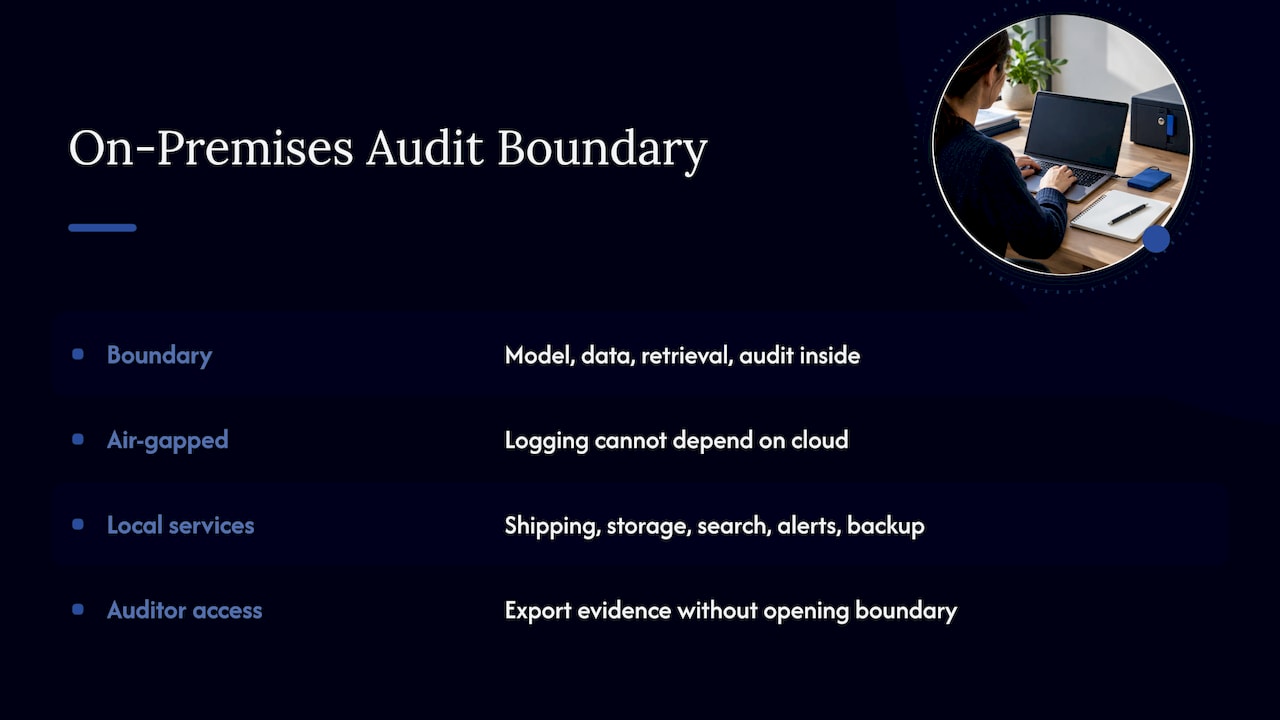
That is the approach Forge takes. Forge AI Deployment is an official webAI systems integrator, bringing webAI’s local-first platform into production in enterprise data centers, edge sites and air-gapped networks, and our deployments are designed so that data, models and domain intelligence remain inside the customer’s infrastructure. In an air-gapped network, that also means the logging pipeline cannot depend on a cloud endpoint. Log shipping, storage, search, alerting and backup all have to run locally, and your operations team needs a way to export evidence for an auditor without opening the boundary. Our practical guide to on-premise AI deployment covers the wider architecture these decisions sit in.
Retention and operating practice
How long to keep audit logs depends on your sector, your contracts and the law that applies to you, so set the schedule with your compliance team and counsel and write it down. Some principles hold everywhere:
- Never sample audit events. Sampling is acceptable for debugging, not for evidence.
- Store sensitive content separately from the audit index, with its own access and retention rules.
- Do not keep personal information longer than you need it. Retention and privacy duties pull in opposite directions, which is another reason to log references rather than raw content.
- Test the pipeline end to end. Generate representative events, confirm they arrive and are searchable, and reconcile source counts against what was stored.
Run that test after every model, prompt or infrastructure change. A silent gap discovered during an audit is far more expensive than a failing test discovered on a Tuesday.
Using audit logs in an incident review
When something goes wrong, the log is your starting point. A disciplined review follows a pattern described in cross-team incident review guidance: use stable run or event identifiers and timestamps to locate the records, build a chronological timeline, and correlate it with service and operational evidence.
The same guidance makes a point worth repeating: an audit trail is evidence to check, not a complete account and not proof of causation. Keep recorded facts apart from interpretations, mark gaps and timestamp conflicts, and have the relevant teams validate the events before you document conclusions and follow-up actions. This is why completeness matters so much. A trail with holes forces reviewers to guess.
Can AI help analyze the logs?
Yes, with oversight. A 2026 research preprint on log analysis in AI systems describes using AI scanners to explore large log collections and surface patterns, but frames the process as semi-automated. Validate scanner output against human-labeled samples, and do not treat model-generated classifications as ground truth. If you use an AI model to review your audit logs, run it inside the same boundary, because the logs contain the sensitive material you are protecting.
Regulation: where the EU AI Act fits
Logging is moving from good practice to legal requirement in some jurisdictions. For high-risk systems under the EU AI Act, Article 12 requires technical capability for automatic recording of events over the lifetime of the system, to support traceability, risk identification and post-market and operational monitoring. For certain biometric identification systems, it spells out specifics such as the period of each use, the reference database checked, the input data that led to a match, and the identification of the people who verified the results.
This is a European rule and applies to systems within its scope, with its own phasing, so check the official text for your situation. In the United States, requirements typically come through sector regulators, contracts and security frameworks rather than one AI logging statute. Either way, an architecture that records events completely, protects them from tampering and keeps them under your control is a sound base. Our overview of generative AI in regulated industries covers how those obligations shape deployment choices.
Putting private AI and audit logging together
We deploy and operate webAI’s local-first platform inside customer infrastructure, including webAI Personas, the Intelligence Delivery Network and webAI Frontline, which gives frontline teams fast, source-backed answers from large technical document libraries, fully offline on a single device. Source-backed answers are a natural fit for audit thinking: each answer points to the documents behind it, which gives a reviewer something concrete to check.
If you are planning secure local or air-gapped deployment, private assistant rollout, or sovereign operations where audit evidence has to stay in your hands, see our solutions or start at Forge AI Deployment.
Our perspective
Most teams treat audit logging as something to bolt on after the assistant works. We think that order is backwards. The decisions that make an AI trail trustworthy, where the logs live, who can touch them, what is stored by reference, are architecture decisions, and they are cheapest on day one.
Our background is high-consequence and Fortune 100 environments, where “can you prove it?” is asked as often as “does it work?” That is why we design deployments so that data, models and the evidence about them all stay inside the customer’s boundary, and why we run them with operational discipline instead of handing over software and leaving.
For regulated and high-security organizations, a private deployment is also the simplest audit story: one perimeter, one set of access controls, one place an auditor needs to look. As an official webAI systems integrator, we bring that platform into production and keep it running, so the audit trail is part of the operating routine, not a project that stalls.
John
FAQ
What is audit logging for AI?
It is a tamper-resistant, structured record of AI activity that lets you reconstruct who made a request, which model and configuration handled it, what data was used and what action resulted. It is built as evidence for reviewers and auditors, which is why it must be complete and protected, unlike debugging logs.
What should an LLM audit log contain?
At minimum: event and correlation IDs, timestamps, user and agent identity, model and prompt versions, input and output references, retrieval source IDs, the outcome and any downstream action. Store hashes and references instead of raw sensitive text, and never record credentials or secrets.
Can audit logs work in an air-gapped environment?
Yes, provided the whole pipeline is local: collection, storage, search, alerting and backup. Use append-only or write-once storage and hash chaining, and plan how evidence is exported to auditors without crossing the boundary.
Can AI be used to analyze audit logs?
Yes, as a semi-automated aid. Validate its findings against human-reviewed samples and keep a person in the loop, since model-generated classifications are not ground truth. Run the analysis inside your perimeter so the logs stay protected.
Sources
- What Is an AI Audit Trail? Logging, Monitoring, and Compliance
- Why AI agent audit logs are different from application logs
- ISO/IEC 42001: AI system recording of event logs
- Enterprise AI Audit Logging
- Deploy on-prem, OpenAdapt Docs
- AI Audit Logging and Retention for SOC 2
- How to Use an AI Agent Audit Trail in a Cross-Team Incident Review
- Seven simple steps for log analysis in AI systems
- Article 12: Record-Keeping, EU Artificial Intelligence Act
- LLM Observability: What to Trace, Measure and Score
- AI agent security for Microsoft 365