Generative AI can be used in regulated industries, but only if the deployment answers three questions in advance. Where does the data go? Who is accountable for each output? Can you prove both to an auditor? Banks, defense contractors, manufacturers and logistics operators that answer those questions first move faster, because security and compliance reviews stop being a late-stage blocker. This guide covers where generative AI helps, which rules apply, what to put in place before launch, and when private or air-gapped deployment is the right architecture.
TL;DR
- The strongest early use cases are reading, searching and summarizing dense regulatory and technical documents, with a human accountable for the result.
- There is no single AI law in the US. Federal guidance, agency enforcement and state laws overlap, and the EU AI Act can reach US companies too.
- Before launch, inventory every tool, log prompts and outputs, name an owner for each risk and define where human review is required.
- When data cannot leave your perimeter, private, on-premises, edge or air-gapped deployment removes the largest exposure by design.
- Treat governance as a living program, not a one-time policy document.
Table of Contents
- Where generative AI earns its place in regulated work
- The rules: what applies to a US enterprise
- What to settle before you deploy
- A simple readiness checklist
- When private, edge or air-gapped deployment fits
- Perspective
- How Forge can help
- FAQ
- Sources
Where generative AI earns its place in regulated work
Regulated work is document-heavy: rules, policies, procedures, maintenance manuals, filings, audit evidence. Generative AI is good at searching, summarizing and drafting across that material, which is why compliance and risk teams were early adopters.
The IMF’s August 2025 technical note on compliance risk describes four generalized use cases in which generative AI can augment risk analysts: assistant, consultant, collaborator and autonomous agent. It singles out natural language research, analysis and analytics as the capabilities with transformational potential.
For financial institutions, a June 2026 Bretton Woods Committee brief says generative AI can support regulatory horizon scanning, obligation extraction and control mapping. It can also help draft and maintain policies, disclosures, regulatory filings, exam responses and evidence binders.
Outside finance, the same pattern applies:
- Aerospace and defense: technicians and engineers need a precise answer from thousands of pages of technical documentation, often on a device with no network connection.
- Manufacturing: line and maintenance staff need procedures and troubleshooting steps at the point of work, without sending plant data to an outside service.
- Logistics: teams handling sensitive shipment, customs and customer data need to query internal records without exposing them.
- Financial services: analysts need source-backed summaries of policies, contracts and regulatory text.
Notice what these have in common. The model is not the product. The product is a trusted answer, tied to a source, delivered inside a boundary you control.
The rules: what applies to a US enterprise
The first thing to accept is that no single statute governs generative AI in the United States. A November 2026 Slaughter and May review describes a US approach built mainly on voluntary standards and industry self-policing at the federal level. Jones Day adds that federal frameworks are often nonbinding guidance issued agency by agency.
In practice, your obligations come from several layers:
- Sector regulators. Your existing banking, healthcare, defense or critical-infrastructure rules still apply when a model touches the regulated process. If you handle patient data, see our guide to HIPAA AI compliance for privacy officers.
- Federal standards. NIST’s July 2024 Generative AI Profile names data privacy, confabulation, information integrity and information security among the risks unique to or exacerbated by generative AI. It offers actions to govern, map, measure and manage them.
- State law. Morgan Lewis notes that state-level legislation and agency enforcement continue to drive compliance risk while federal policy evolves toward a national framework.
- Foreign law, if you operate abroad. The EU AI Act entered into force on 1 August 2024. Per the European Commission’s implementation guidance, prohibited practices have applied since 2 February 2025, obligations for general-purpose AI models since 2 August 2025, and the Act generally applies from 2 August 2026. Article 6(1) obligations follow on 2 August 2027.
The EU Act is risk-tiered, so a document search assistant and a system that makes decisions about people sit in very different places. Have counsel classify each use case against the jurisdictions where you operate.
Tracking all this is itself a use case. Our readers who want a view on how regulatory delays and shifts affect purchasing decisions can read this analysis of AI regulation impact.
What to settle before you deploy
Most failed pilots in regulated companies do not fail on model quality. They stall when someone asks a question nobody can answer: which data does it see, who approved it, what happens when it is wrong.
Inventory every tool
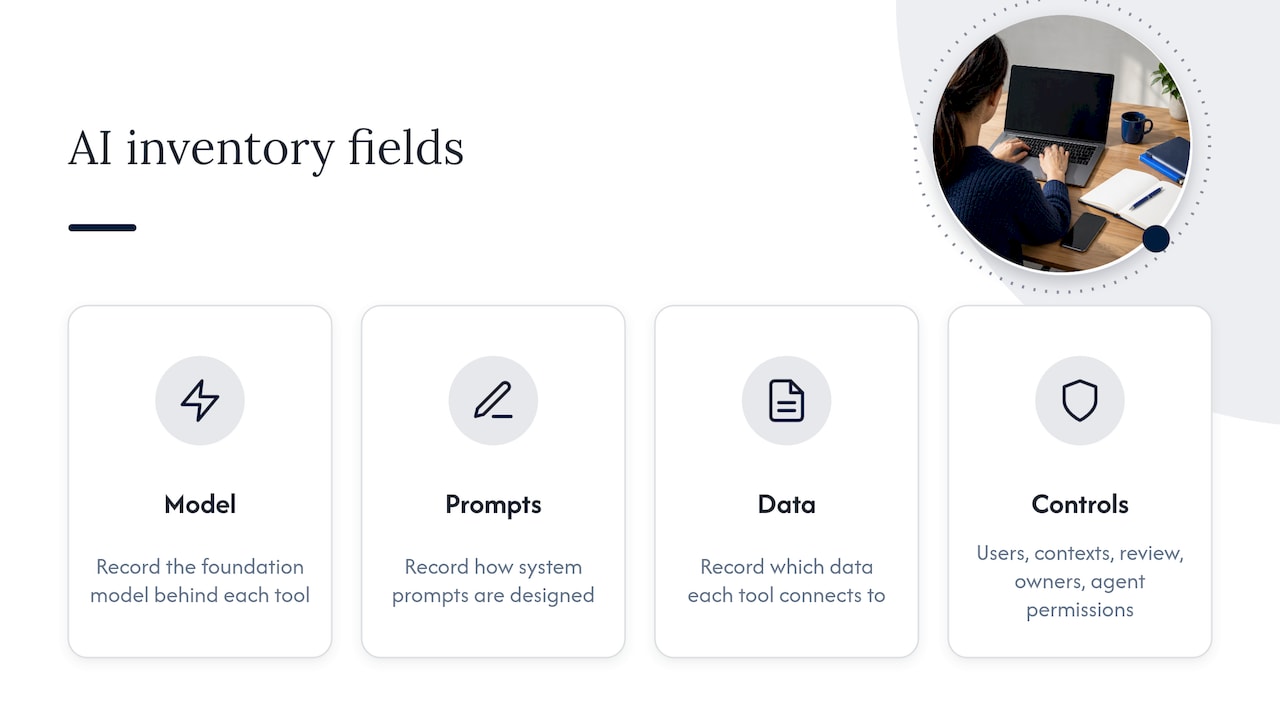
MIT CISR researchers recommend that leaders inventory every generative AI tool in use. For each, record the foundation model behind it, how system prompts are designed, which data it connects to, who may use it, which use contexts are authorized, where human review is required and who is accountable. For agents, add the permissions granted.
Log prompts, outputs and interventions
The same MIT CISR work argues that even if a foundation model is a black box, the risk space cannot be. That means audit trails that log prompts, outputs and human interventions at each step. If a regulator asks how an answer was produced six months ago, the log is your evidence.
Define human accountability
The IMF note makes human accountability a core principle. Analysts using AI stay accountable for decisions the AI influences or determines. They must be able to explain which procedures were applied and why they are defensible. Write this into the workflow: who reviews, what they check, and what they sign.
Do the privacy work
Under EU rules, the European Data Protection Supervisor’s October 2025 guidance expects institutions to define purpose and legal basis, run a generative AI risk assessment, and perform a Data Protection Impact Assessment where processing is likely to be high risk. It also calls for data minimization and retention controls and thorough vendor due diligence. US teams operating in Europe will recognize the pattern, and it is a sensible template even where it is not binding.
The UK Government’s Generative AI Framework adds a point worth adopting widely: understand where tool-provided data is processed, and use content filtering and validation checks so responses are accurate and do not leak data.
Plan for agents separately
Agents that connect to email, CRM, ticketing, procurement and code repositories raise a different problem. Squire Patton Boggs describes delegation without clear accountability and recommends defining permissible uses, human-in-the-loop requirements, logging, testing and responsibility for errors. If you start with assistants that answer questions from approved documents, you get value quickly and keep the permission surface small.
A simple readiness checklist
| Question | What a good answer looks like |
|---|---|
| Where does data go? | Prompts, documents and outputs stay inside infrastructure you control |
| Which model, which version? | Documented and change-controlled |
| Who can use it, for what? | Named roles and authorized use cases |
| How is an answer verified? | Source citations a reviewer can open |
| What is logged? | Prompts, outputs, human edits and approvals |
| Who owns the risk? | A named accountable person per use case |
| Who reviews the program? | A recurring governance review, not a one-time sign-off |
For a deeper treatment of the governance side, see our practical guide to AI model governance.
When private, edge or air-gapped deployment fits
A public cloud AI service is a reasonable choice for some work. But when the data is classified, export-controlled, covered by contractual restrictions, or simply too valuable to leave the building, the cleanest control is architectural: keep the models, the data and the logs inside your own perimeter.
That is where private deployment comes in, in three common forms:
- Private data center or on-premises: models run on hardware you own or control, connected to internal systems only.
- Edge: models run at a plant, depot, branch or field site, close to the people and data, with local processing.
- Air-gapped: the system has no connection to outside networks at all, which suits the most sensitive environments.
The benefit for compliance is simple to explain to an auditor: if data never leaves, a whole category of transfer, vendor-access and third-party-processing questions shrinks. The UK framework’s guidance to know where data is processed becomes a one-line answer.
The planning questions are practical ones. Who will update models and documents in a disconnected environment? How will you monitor performance and manage the runtime? Which hardware fits the site? How are answers traced back to source documents? These are operations questions, and they are solvable when someone owns them from the start. They are also the reason a private deployment is best treated as a managed service line, not a one-off install.
Perspective
We built Forge AI Deployment around one observation: in regulated organizations, the question is rarely whether the model is smart enough. It is whether the organization can stand behind the answer.
That is why we start with the perimeter. When the data, the models and the logs all sit in infrastructure you control, most of the hard compliance conversations become shorter. Security teams can verify instead of trust. Auditors can see the trail. Business teams can use the system on real documents instead of sanitized samples.
As an official webAI systems integrator, we bring webAI’s local-first platform into production: private and air-gapped deployment, specialized AI Personas, the Intelligence Delivery Network, and webAI Frontline, which gives frontline teams fast, source-backed answers from large technical document libraries, fully offline on a single device. The technology is webAI’s. The architecture, secure deployment, model integration and ongoing operation are what we do.
Our leadership has spent more than 20 years in high-consequence and Fortune 100 environments, and we bring that operational discipline to every engagement. Our design goal is zero data exfiltration, validated for privacy and auditability. We think regulated industries should not have to choose between using AI and keeping control of their data.
John
How Forge can help
Forge AI Deployment designs, deploys and operates private AI systems inside infrastructure you control, including enterprise data centers, edge sites and air-gapped networks. Our engagements cover secure local and air-gapped deployment, custom model integration, private AI assistant rollout, sovereign MLOps and orchestration, and performance tuning with ongoing operations.
If you have a regulated use case in mind, start with the Forge solutions page to see how an engagement is structured, or learn how the webAI platform behind Forge deployments fits together. You can also explore our blog on private AI deployment for more detailed guides.
FAQ
Can regulated companies use generative AI at all?
Yes. Regulation rarely bans the technology. It governs how data is handled, who is accountable and what evidence exists. Organizations that inventory their tools, log activity, keep humans accountable and control where data is processed can deploy it in banking, defense, manufacturing and logistics.
Is there a US federal law for generative AI?
Not a single one. Professional reviews describe a mix of voluntary federal standards such as NIST’s framework, agency guidance and enforcement, and a growing set of state laws. Your sector rules still apply, so ask counsel to map them to each use case.
Does the EU AI Act apply to a US company?
It can. The Act has broad extraterritorial reach, so it may affect companies outside the EU that place AI systems on the EU market or whose outputs are used there. Obligations are tiered by risk, so classify each use case with counsel.
What is the difference between private and air-gapped AI?
Private AI runs in infrastructure you control, such as your data center or an edge site, and may still connect to your internal networks. Air-gapped AI has no connection to outside networks at all. Air-gapped suits the most sensitive environments, and both keep data inside your perimeter.
What should we log for audit purposes?
Log prompts, outputs and every human intervention at each step, plus the model version and the data sources connected. MIT CISR researchers recommend this kind of audit trail so you can reconstruct how an answer was produced later.
Sources
- IMF technical note on generative AI for compliance risk
- Bretton Woods Committee brief on generative AI and risk management
- Slaughter and May, Key AI themes
- Jones Day, Rising Global Regulation for Artificial Intelligence
- NIST Generative AI Profile (AI 600-1)
- Morgan Lewis, The New Rules of AI
- European Commission, Implementation Guidance for the EU AI Act
- MIT CISR, Mapping the Generative AI Risk Space
- EDPS generative AI orientations
- UK Government Generative AI Framework
- Squire Patton Boggs, What GCs should consider for US AI deployment in 2026
- AI Regulation Impact analysis