AI security in the energy sector means three jobs at once: defending against attackers who use AI, using AI to defend, and hardening the AI that helps run your systems. The most reliable way to cut the exposure of that third job is to keep models, data and inference inside infrastructure you control, with the same discipline you apply to the plant floor. At Forge AI Deployment, we design, deploy and operate private and air-gapped AI systems for that purpose, using webAI’s local-first platform as an official webAI systems integrator.
This guide is for security, operations and IT leaders at utilities, energy producers and the industrial firms around them. It covers what the threats are, what government and industry bodies recommend, and how to turn that guidance into an architecture.
TL;DR
- The U.S. Department of Energy groups AI risk for critical energy infrastructure into four categories: unintentional AI failures, adversarial attacks on AI, hostile uses of AI, and compromise of the AI software supply chain.
- Data tampering, model theft, prompt injection and data extraction are the attack methods that matter most when AI touches sensitive energy data.
- Current guidance (CISA’s December 2025 OT principles, DHS’s 2024 guidelines) asks for governance, testing, segregated environments, vendor accountability and human oversight.
- Keeping data, models and inference inside your own perimeter, including fully offline, removes whole classes of exposure before controls are even applied.
Table of Contents
- What AI security covers in energy
- The threats, in plain terms
- What AI can do for defense
- A safeguard framework that maps to the guidance
- Where the AI runs matters as much as what it does
- How we approach it
- Putting it into practice
- Perspective
- Talk to us about a private deployment
- FAQ
- Sources
What AI security covers in energy
The U.S. Department of Energy describes the field as defending energy infrastructure against AI-enabled attacks, using AI to strengthen energy security, and hardening the AI used to operate, control or defend U.S. energy systems. Those are separate problems with separate owners, and mixing them up is the first mistake many programs make.
The applications are already broad. A 2026 peer-reviewed study of AI-enabled energy management lists demand forecasting, automated demand response, grid-stability management and distributed-energy-resource optimization, fed by smart-meter, sensor, market and user-behavior data. Add maintenance copilots, document search over engineering manuals and field-support assistants, and you have a large amount of operational knowledge flowing into models.
Every one of those flows is a place where data can leak, be altered, or be used to mislead an operator.
The threats, in plain terms
The four risk categories
The DOE’s April 2024 summary of AI risk to critical energy infrastructure names four broad categories:
- Unintentional AI failures. The model is wrong, drifts, or behaves badly in conditions it was not built for.
- Adversarial attacks against AI. Someone manipulates the model, its data or its inputs.
- Hostile uses of AI. Attackers use AI to scale phishing, reconnaissance or malware.
- Software supply chain compromise. The model, library or vendor component you installed is itself the entry point.
Attacks on the model and its data
Two attack types deserve attention from any organization that customizes AI on its own operational data.
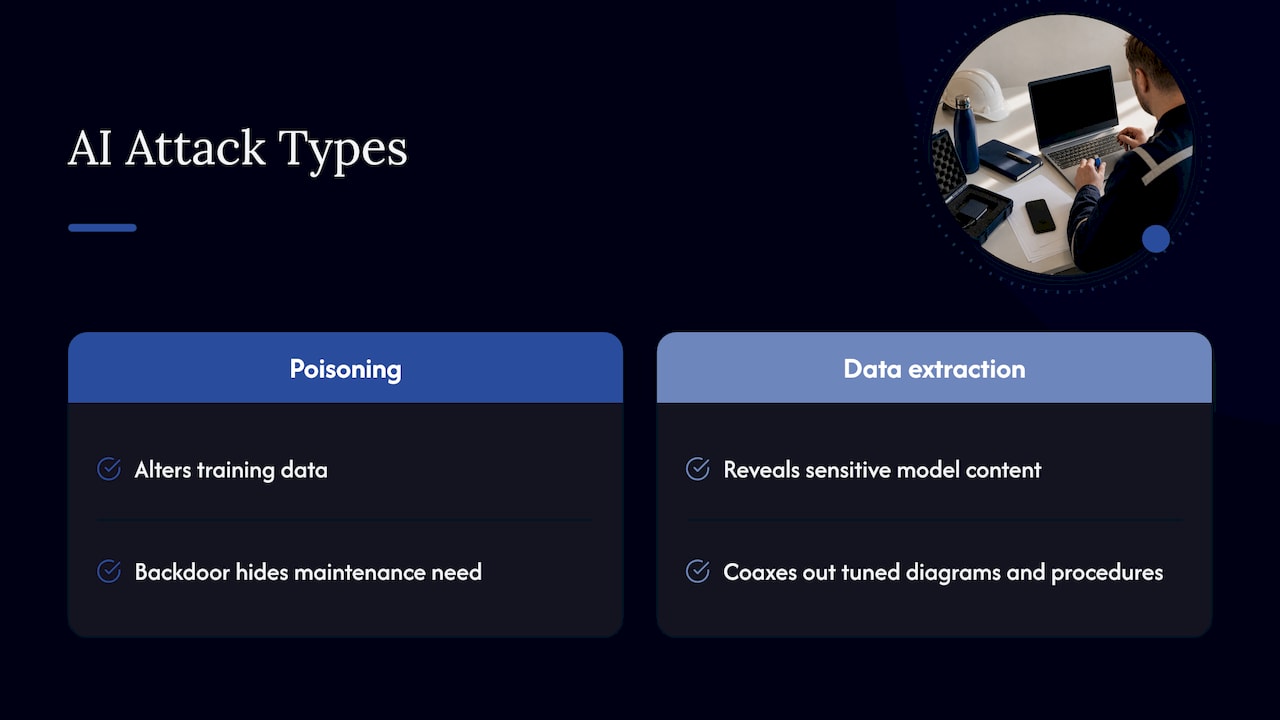
Poisoning. The DOE’s risk assessment describes attackers altering training data so a model learns the wrong behavior. Its example is a backdoor that makes an equipment-maintenance model never declare maintenance necessary when it sees a specific image. A model like that passes every ordinary test and fails exactly when the attacker wants.
Data extraction. The same DOE document warns that extraction attacks can reveal sensitive information embedded in AI tools customized for energy infrastructure. If a model has been tuned on network diagrams, SCADA procedures or incident reports, that content can be coaxed back out.
EPRI, the electric power research institute, adds data tampering, model stealing, adversarial examples, deepfakes and synthetic phishing to the list, and notes that risk depends on data sensitivity, model complexity and the level of human supervision.
Risks specific to language models
Generative AI adds its own failure modes. A 2026 peer-reviewed review of language-model risks in power systems identifies hallucination, prompt injection and retrieval jailbreaks, unsafe agentic tool use, privacy leakage, compliance gaps and weak auditability. For a field technician asking an assistant about a procedure, a confident wrong answer is a safety problem, not a usability one.
Operational technology raises the stakes
The multinational guidance led by CISA, the U.S. cybersecurity agency, and published December 3, 2025, warns that AI in operational technology (OT, the systems that physically run equipment) can introduce model drift and safety-process bypass risks that threaten availability and reliability. In an office, a bad model output costs time. In a substation, it can cost uptime.
Why the sector is exposed
The International Energy Agency points to electrification, digital connectivity, legacy IT, automation, cloud computing and third-party vendors with insecure systems as factors behind the sector’s cyber exposure. It also reports that malicious actors have used generative AI for reconnaissance, deeper network access, malicious scripting and evasion. Attackers are already using the technology you are evaluating.
What AI can do for defense
The same IEA report identifies real-time threat detection, automated incident response and stronger phishing defenses as defensive uses. The DOE’s 2026 priorities for AI in cyber defense include threat hunting, OT and industrial-control-system visibility, anomaly detection and incident-response decision support, along with resilience that lets systems operate through a compromise.
EPRI’s 2025 report on its utility cybersecurity initiative describes AI that can analyze large volumes of OT network data, use behavioral heuristics to spot potential malware, and help analysts reduce false positives. Britain’s regulator Ofgem makes a similar point in its May 2026 guidance: AI can help detect intruders through subtle changes in system performance.
The common thread is that AI is a force multiplier for both sides. What decides the outcome is how well your own AI is controlled.
A safeguard framework that maps to the guidance
The published guidance converges on a short list. Here is how it reads when you turn it into work.
1. Know what AI you run, and where
Ofgem’s position is that AI cyber hygiene starts with knowing what AI is used, where, why and by whom. Build an inventory that includes the quiet cases: staff pasting engineering text into public chat tools, a vendor feature switched on by default, a pilot that never got shut down. Anything you cannot list, you cannot defend.
2. Assess the use case before the tool
CISA’s guidance sets four principles: understand AI, assess its proposed use in OT, establish governance and assurance, and embed safety and security practices. Start from the business case. Does this task need a model at all, what data does it touch, and what happens if it is wrong?
Ofgem asks that risks be identified and prioritized in proportion to likelihood, impact and materiality of harm to consumers, the energy system or market integrity. A document assistant for maintenance manuals and a model that recommends switching actions do not deserve the same controls.
3. Define vendor roles and manage the supply chain
DHS’s April 2024 critical-infrastructure guidelines recommend secure-by-design practices across the AI lifecycle and documented vendor responsibilities, along with policies for retaining and disposing of critical data. Write down who patches the model runtime, who holds the weights, who can see prompts and logs, and who responds at 2 a.m.
The supply chain point is hardest to satisfy when inference runs in someone else’s environment, because the dependencies you cannot inspect are the ones you inherit.
4. Test continuously, in a segregated environment
DHS recommends continuous testing for errors and vulnerabilities, including cybersecurity and compliance flaws, and dedicated segregated networks for testing, research and development. The 2026 power-systems review adds physics-grounded validation, cryptographically signed model provenance and continuous red-teaming, meaning you check outputs against how the physical system actually behaves and you can prove which model version is running. Specialist firms offer independent AI security testing for prompt injection and model abuse, which fits naturally into this stage.
5. Keep humans in charge of high-impact decisions
The same review recommends retaining human operator authority over high-impact decisions. The DOE notes that defenses against adversarial attacks on AI remain too immature to guarantee security against sophisticated attacks, while data curation, access controls and human supervision can mitigate risk. Design for that: failsafes, manual fallbacks and incident-response plans that cover the AI system itself.
6. Align to recognized frameworks
DHS maps its recommendations to the NIST AI Risk Management Framework functions of Govern, Map, Measure and Manage. Ofgem lists ISO/IEC 23894, ISO/IEC 27001, ISO/IEC 42001 and the NIST framework among the approaches it reviews. Pick one as your backbone so audits and board reporting use the same vocabulary.
Where the AI runs matters as much as what it does
Most of the guidance above is about control: of data, of models, of vendors, of change. Architecture decides how much of that control you actually have.
Consider what each threat needs. Data extraction needs a model that holds sensitive content and an interface an attacker can reach. Supply chain compromise needs components you did not vet. Privacy leakage needs your prompts and documents to leave the building. Each becomes smaller when the model, its data and its inference sit inside infrastructure you own: an enterprise data center, an edge site, or a network with no outside connection at all.
That is the logic of private, sovereign AI. It does not replace governance, testing or human oversight. It gives those controls a boundary to work inside.
A practical test for any energy AI project:
| Question | What a controlled answer looks like |
|---|---|
| Where do prompts, documents and outputs go? | They stay inside your perimeter and logs are yours |
| Who holds the model weights and customizations? | Your organization, in your environment |
| What happens if the network is cut? | The system keeps working offline where operations require it |
| Can you prove which model version is running? | Versioned, signed and auditable |
| Who operates and patches it? | A named party with documented responsibilities |
If an answer is “it depends on the vendor’s cloud,” the control sits outside your perimeter.
How we approach it
Forge AI Deployment designs, deploys and operates private AI systems inside infrastructure our customers control, including enterprise data centers, edge sites and air-gapped networks. We bring webAI’s local-first platform into production as an official webAI systems integrator, covering architecture, secure deployment, model integration and ongoing operation. The technology is webAI’s; the integration and operation discipline is ours.
For energy teams, the pieces that matter most are these:
- Private and air-gapped deployment. All data, models and domain intelligence remain inside your infrastructure, validated for privacy and auditability.
- webAI Personas. Specialized AI Personas built for a defined domain, so an assistant is scoped to the job rather than a general-purpose chatbot.
- webAI’s Intelligence Delivery Network. The webAI capability for delivering intelligence across your own environment.
- webAI Frontline. Fast, source-backed answers from large technical document libraries, fully offline on a single device, which suits field crews working from long manuals at sites with poor or no connectivity.
Source-backed answers connect directly to the auditability problem the research flags. When an assistant shows which document an answer came from, a technician can check it, which supports the human-oversight principle in the CISA guidance.
Our leadership brings more than 20 years of experience in high-consequence and Fortune 100 environments, and our approach is built on operational discipline, not software resale. We are paid for engagements: deployment, integration and ongoing operations.
Putting it into practice
A sensible sequence for an energy organization starting now:
- Inventory every AI tool and pilot in use, sanctioned or not.
- Classify the data each one touches. Operational procedures, network diagrams and asset data are your most sensitive inputs.
- Choose the boundary. Decide which workloads must run entirely inside your perimeter or offline, and which carry little enough risk to run elsewhere.
- Define roles for every vendor and internal team: who deploys, who patches, who monitors, who responds.
- Test in a segregated environment before anything reaches production, then keep testing.
- Keep operators in the loop for decisions with safety or reliability consequences.
- Review on a schedule, since the threat picture and the guidance both keep moving.
For related reading on how the same controls work in other sectors, see our guide to generative AI in regulated industries.
Perspective
Energy is an unusual sector for AI because the cost of being wrong is physical and the information worth protecting is operational. Procedures, network layouts and asset histories are exactly what an adversary wants, and exactly what makes an assistant useful.
We have spent our careers in high-consequence environments, and the lesson that carries over is simple: decide the boundary first, then add the intelligence. When the data, the models and the inference all live inside infrastructure you control, the guidance from DOE, CISA and DHS becomes something you can actually enforce, not just document.
That is why we build private and air-gapped deployments on webAI’s platform and stay on to operate them. A system that keeps working offline, answers from your own documents and shows its sources gives your people something to verify, and gives your auditors something to inspect.
John
Talk to us about a private deployment
If you are weighing how to bring AI into energy operations without sending sensitive data outside your perimeter, Forge AI Deployment can scope secure local and air-gapped deployment, custom model integration, private assistant rollout, sovereign MLOps and ongoing operations as one engagement. See the solutions we deliver or start from forgeprivate.ai.
FAQ
What is the biggest AI security risk for energy companies?
There is no single one, which is why the DOE sorts risk into four categories: AI failures, attacks on AI, hostile use of AI and software supply chain compromise. For organizations that customize models on operational data, poisoning and data extraction are especially relevant, because they target the content that makes the model valuable.
Can AI be used safely in operational technology?
Yes, when it is introduced with governance and safeguards. CISA’s December 2025 guidance asks operators to assess the use case, manage data and vendor roles, test, and embed oversight, safety, failsafes and incident response. Keep operators in control of high-impact decisions.
Which frameworks should an energy company follow for AI risk?
The NIST AI Risk Management Framework is the one DHS uses for critical-infrastructure recommendations, and Ofgem also reviews ISO/IEC 23894, 27001 and 42001. Choose one as the backbone, then map CISA’s OT principles onto it.
Why run AI inside our own infrastructure?
Because prompts, documents, model weights and logs then stay under your access controls, and the system can keep working with no outside connection. That shrinks the exposure to leakage and third-party dependencies that the IEA and DOE describe, and it gives your testing and audit work a clear boundary.
Sources
- DOE CESER: Artificial Intelligence for Operationally Resilient Technologies and Systems
- Security by design in artificial intelligence-enabled energy management systems
- DOE Delivers Initial Risk Assessment on Artificial Intelligence for Critical Energy Infrastructure
- DOE CESER AI Report Summary, April 2024
- EPRI: Artificial Intelligence and Generative AI in the Energy Sector
- Security Risks and Mitigation Strategies for Large Language Models in Power Systems
- CISA and partners: Principles for the Secure Integration of AI in Operational Technology
- IEA: AI and energy security
- EPRI Journal: A New Approach to Utility Cybersecurity
- Ofgem: Ethical AI use in the energy sector
- DHS: Safety and Security Guidelines for Critical Infrastructure Owners and Operators
- AI Security Testing