Key management for an LLM system means controlling every credential the system touches: provider API keys, vector database passwords, tool tokens and the internal identities that let services call the model. The strongest design removes most of those secrets from the picture. When models, data and tools all run inside infrastructure you control, there are far fewer outside keys to leak, and the ones that remain sit behind your own identity and audit layer. That is the approach Forge AI Deployment builds when it deploys private and air-gapped AI inside customer environments.
TL;DR
- Never place a key in a prompt, system prompt, code, logs or client application. Keep it in a secret manager and let a trusted service attach it to requests.
- Give each application and environment its own scoped key with an owner, an expiry and a budget. One shared key makes audits and revocation painful.
- Rotate with an overlap window, revoke fast on suspected exposure, and audit every secret request.
- In an air-gapped deployment, the goal is fewer secrets: load model assets locally, verify licenses offline and block all outbound traffic by default.
- Treat key management as one layer. Access control, audit logging and observability must sit alongside it.
Table of Contents
- Why LLM keys need more care than ordinary API keys
- Store keys in a secret manager, never in code
- Scope keys per application, environment and tenant
- Put a gateway between callers and provider credentials
- Rotate, revoke and audit on a schedule you can prove
- Key management in private and air-gapped deployments
- A practical checklist for your security review
- How Forge AI Deployment approaches it
- Our perspective
- FAQ
- Sources
Why LLM keys need more care than ordinary API keys
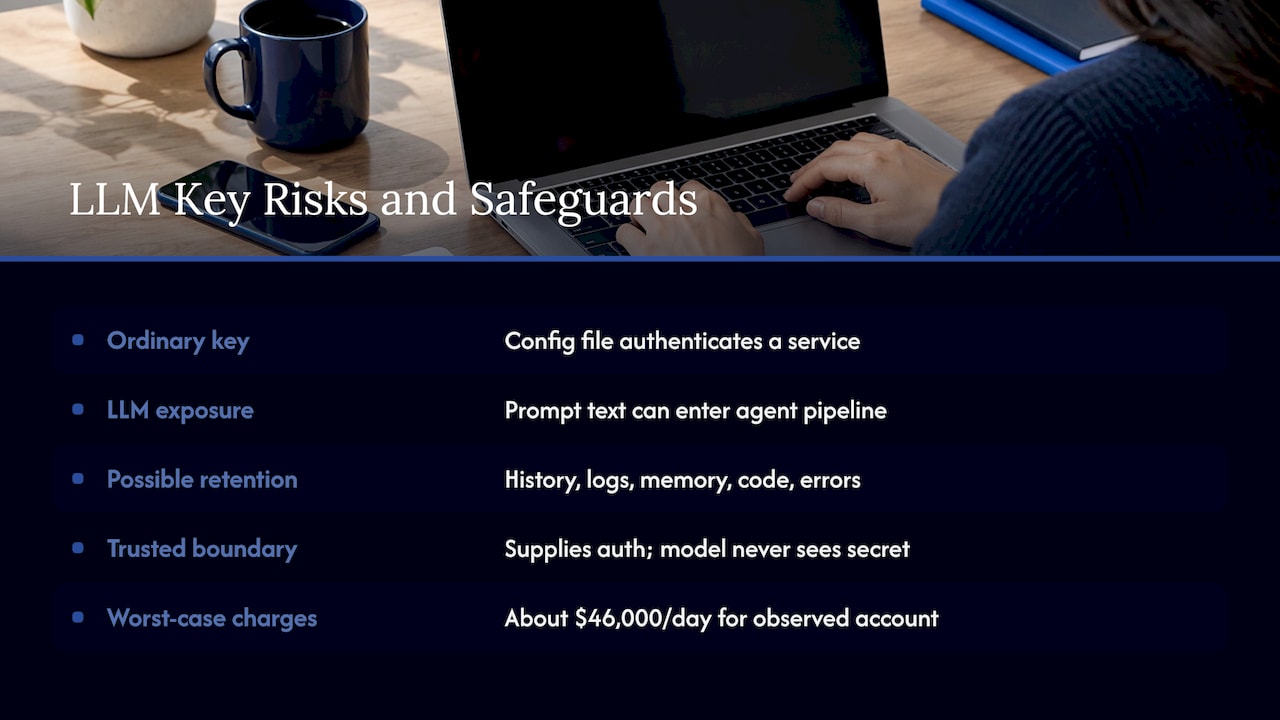
A normal application key sits in a config file and authenticates a service. An LLM key has a second risk: the model reads text, and text travels. A threat analysis on credential exposure in LLM agents explains that a key pasted into a prompt, or embedded in a system prompt or tool configuration, can enter the agent’s data pipeline. From there it can be retained in conversation history, logs, memory stores, generated code and error payloads. The authors add that prompt injection and excessive agency can turn that passive disclosure into unauthorized action.
Their design conclusion is simple. The model should name only a connector, such as “the document store”, and a trusted request boundary outside the model should supply the authentication. The model never sees the secret.
There is a financial risk too. A stolen cloud model credential can be used to run someone else’s workloads on your bill, a practice called LLMjacking. One gateway vendor’s guide, citing Sysdig’s 2024 research, reports a worst-case estimate of about $46,000 a day in model charges for the account Sysdig observed. For a regulated enterprise, the larger cost is usually attribution: if you cannot say which application made which request, an audit goes badly.
Store keys in a secret manager, never in code
Every major guide agrees on the baseline. OpenAI’s documentation on API keys and service accounts says a service-account key’s full value is shown only once at creation. It should go into a secret manager and be provided to the workload on the server, and kept out of browser code, mobile apps, source control, logs and customer-facing responses.
For a concrete pattern, AWS’s guidance on API keys for security-sensitive workloads recommends:
- One secret per API key, stored as structured JSON (key, key ID, endpoint, provider).
- Customer-managed encryption keys for regulated workloads.
- Tags for team, environment and compliance scope.
- Read permission limited to the secrets each application actually needs.
The pattern carries over to any vault, including HashiCorp Vault in an on-premises data center. For the order of preference, the LLM4S security guide ranks a platform-mounted file that is re-read on rotation first, a secret-store provider second and a plain environment variable third. It also redacts secrets from anything the application logs.
A useful standard to borrow is Yandex Cloud’s AI security standard. It asks that each secret record an owner, version, purpose, permitted consumers, delivery method, revision period and revocation procedure. It also forbids storing values in source code, build history, images, datasets, system prompts or logs. Even if you never adopt the standard, that list makes a good inventory template.
Scope keys per application, environment and tenant
A single organization-wide key is the most common failure. Aptible’s key management guide for HIPAA-regulated AI names four problems with a flat key: attribution failure, a large blast radius, delayed rotation because every system must change at once, and governance gaps. Its answer is a scoped key per application, environment and use case, each with its own model allowlist and budget.
A workable scoping record looks like this:
| Attribute | What it controls |
|---|---|
| Owner | A named team or service that answers for the key |
| Environment | Dev, staging or production, never shared |
| Model allowlist | Which models the key may call |
| Budget and rate tier | The spend and request ceiling |
| Source network | Where requests may originate |
| Expiry | When the key stops working unless renewed |
The gateway guide from nhimg.org turns this into measurable targets: every virtual key carries an owner, expiry, budget and model allowlist, over 95% of spend is attributed to a named application or agent, and the time to revoke a caller’s key is measured in minutes. It also advises short-lived federated identity over static provider keys wherever supported, and keeping key-management admin interfaces off the internet behind SSO and MFA.
If several business units or customers share one platform, scoping becomes a tenancy question. Our piece on multi-tenant LLM architecture covers isolation in more depth.
Put a gateway between callers and provider credentials
The cleanest pattern is brokered credentials. A paper on governing enterprise AI traffic describes a policy-driven gateway in which clients present only internal credentials, such as personal access tokens, application credentials or platform-minted JWTs, and never vendor keys. The gateway fetches upstream secrets at runtime from a managed store using its own identity. Secrets never appear in code or static configuration, and request logging redacts credentials.
The same paper notes that platform-minted tokens are verified offline against a key set, with lifetimes capped to the identity token’s expiry, and that every decision, including rejections, is audited by reason code. Its design rule is to fail closed: an invalid configuration stops the service from starting rather than serving incorrectly.
This matters for the model too. Putting permission checks before the model, instead of trusting it to refuse, is the subject of our guide to LLM access control.
Rotate, revoke and audit on a schedule you can prove
OWASP’s Secrets Management Cheat Sheet frames the lifecycle as creation, rotation, revocation and expiration. It recommends regular rotation, immediate revocation when a secret is no longer needed or may be compromised, and defined expiry where possible. It also calls for auditing secret requests, approvals, expirations, reuse attempts and authentication errors, all with accurate timestamps.
A zero-downtime rotation sequence
- Create the new key with restrictions equal to or narrower than the old one.
- Store it as a new version in the secret manager.
- Shift traffic to the new version, keeping the previous one as a fallback during the overlap.
- Revoke the old key at the source.
- Confirm the old key is rejected with a controlled test, and record the evidence.
This follows the sequence in Flatkey’s key management checklist, which also suggests tracking one metric during incidents: how long a suspected credential stays usable after credible evidence of exposure. OpenAI’s production best practices add that administrators can enforce a maximum key lifetime and set expiry on every project key.
When a key leaks
The gateway guide cited earlier proposes a response by time horizon. Within minutes, turn the key off, revoke the provider key and check what lived beside it. Within hours, pull that key’s requests, read the audit logs and compare spend. Within days, tighten the key with an IP allowlist, a lifetime cap and narrower model access. Leaked keys should rotate with no overlap window.
Also delete keys that ever left a laptop. Google Cloud’s guidance on team API keys points out that a bearer key does not expire on its own and is not tied to a person or machine, so a copied key stays live until someone deletes it. It recommends short-lived service-account identities instead.
What you log matters as much as how you rotate. Our guide to audit logging for AI covers what to record and how to protect those records.
Key management in private and air-gapped deployments
Most advice above assumes a cloud provider on the other end. Inside a private or air-gapped deployment, the best key strategy is to need fewer keys.
NVIDIA’s air-gap deployment documentation shows the model. Model assets are downloaded with credentials on a connected machine. The container then runs on the isolated machine with no outbound network access and with the registry and model-hub tokens deliberately unset, loading everything from local storage. The credentials that fetch assets never enter the secure zone.
The rest of an offline stack follows the same logic:
- Offline license checks. Signed license tokens can be validated locally at startup with a customer-held public key, with no network round trip, as Algenta’s air-gapped documentation describes.
- Fail-closed egress. Deny every outbound request unless it is explicitly allowlisted.
- Local identity and vault. A self-hosted identity provider, scoped virtual keys that resolve to specific models and budgets, raw credentials held in an internal vault, and signed audit logs of key creation, as outlined in a write-up on air-gapped LLM stacks. That article also points to the NSA, CISA and FBI April 2024 joint guidance on validating AI artifacts with cryptographic signatures and checksums.
Two related disciplines complete the picture. Signed, versioned artifacts let you roll back safely, which we cover in LLM model versioning. Telemetry that stays inside your boundary, so traces never carry secrets or data outward, is covered in on-premises LLM observability.
A practical checklist for your security review
- Inventory every credential the LLM stack uses: model, vector store, tools, internal service identities.
- Confirm none sits in prompts, code, images, datasets or logs.
- Confirm each has an owner, scope, expiry and a tested revocation path.
- Route model traffic through one gateway so applications hold internal identities only.
- Prefer short-lived federated tokens over static keys.
- Run a rotation drill and measure time to revoke.
- Keep admin and key-management interfaces off the internet.
- In air-gapped zones, verify that nothing needs a credential to reach outside.
Vault mediation alone is not enough. The threat analysis above is explicit that least privilege, deterministic authorization, human approval, telemetry redaction and rotation each remain independently required.
How Forge AI Deployment approaches it
Forge AI Deployment designs, deploys and operates private AI systems inside infrastructure its customers control: enterprise data centers, edge sites and air-gapped networks. As an official webAI systems integrator, Forge brings webAI’s local-first platform into production, including webAI Personas, the Intelligence Delivery Network and webAI Frontline, which gives frontline teams fast, source-backed answers from large technical document libraries, fully offline on a single device. Architecture, secure deployment, model integration and ongoing operation are part of the engagement.
For key management, that means the design question is settled early: data, models and domain intelligence remain inside your perimeter, so credentials have no reason to travel outside it. Our secure local and air-gapped deployment, private AI assistant rollout and sovereign MLOps and runtime orchestration services are described on the solutions page. If you are planning a deployment and want key handling designed in from day one, that is the place to start.
Our perspective
Most key leaks we would worry about in enterprise AI are architecture problems, not discipline problems. If a model can read a secret, someone will eventually get it to repeat it. If a platform depends on outside services, someone must hold keys to reach them.
Our view is that the safest credential is the one a system never needs. Inside an environment you control, with models running locally and traffic denied by default, the number of secrets drops sharply, and each remaining one can have an owner, a scope and an audit trail.
Our leadership has more than 20 years in high-consequence and Fortune 100 environments, and that background shapes how we work: operational discipline first. We design deployments so that all data, models and domain intelligence stay inside your infrastructure, validated for privacy and auditability, and we operate them afterward so the discipline does not erode.
John
FAQ
What is key management for an LLM?
It is the practice of creating, storing, delivering, scoping, rotating, revoking and auditing every credential an LLM application uses. That includes provider API keys, database passwords, tool tokens and internal service identities. The aim is that no secret ever reaches the model, a log or client code.
How often should LLM API keys be rotated?
OWASP recommends regular rotation and defined expiry where possible, plus immediate revocation on suspected compromise. Set the interval by the sensitivity of the workload and your compliance requirements. Rotation is far easier when each application has its own key and at least two keys can be active during the overlap.
Do air-gapped LLM deployments still need key management?
Yes, but with fewer secrets. You still need internal service identities, vault-held credentials for databases and tools, signed license or artifact verification and audit logs. What disappears is dependence on outside provider keys, since model assets load from local storage.
Why not put the API key in the system prompt?
Anything in a prompt enters the data pipeline and can be retained in history, logs, memory and error output. Prompt injection can then coax it out or use it. Let a trusted service outside the model attach credentials instead.
Sources
- API Secrets Should Never Become Tokens in the LLM’s Context (arXiv)
- Governing Enterprise AI Traffic at Scale (arXiv)
- API keys and service accounts (OpenAI)
- Production best practices (OpenAI)
- Manage API keys for security-sensitive workloads (AWS)
- LLM application security (LLM4S)
- Security standard for AI systems (Yandex Cloud)
- API key management and scope isolation for LLM usage (Aptible)
- AI gateway keys: environments, limits, rotation, off switch (INFRO)
- AI Gateway and LLM Gateway Guide (nhimg.org)
- Secrets Management Cheat Sheet (OWASP)
- API Key Management Best Practices for AI Products (Flatkey)
- How to fix your team’s API keys (Google Cloud Blog)
- Air-Gap Deployment (NVIDIA NIM)
- Run air-gapped (Algenta)
- How to Deploy an LLM Stack in an Air-Gapped Environment (Maxim)