For a bank, on-premises AI means the models, the prompts, the documents they read and the logs they produce all live inside infrastructure the bank controls: its own data center, a private edge site or a fully air-gapped network. Nothing is sent to a shared AI service. That makes the system easier to audit, easier to explain to examiners and easier to keep inside data-residency obligations. Forge AI Deployment designs, deploys and operates private AI systems of this kind, as an official webAI systems integrator, inside the customer’s own environment.
This guide is for bank technology, security, risk and compliance leaders who already know why they are asking the question. It covers where on-prem AI fits, what US supervisors expect, what to plan for in infrastructure and staffing, and how a rollout runs.
TL;DR
- On-prem AI keeps customer data, models and logs inside the bank’s perimeter, which simplifies audit trails, data residency and third-party risk.
- The best first workloads are the ones that touch sensitive data all day: fraud investigation, compliance document search, internal knowledge assistants and branch or operations support.
- US model risk guidance (SR 11-7) and state rules such as New York’s cybersecurity regulation apply to AI like any other model or system. Plan validation, access control and logging from day one.
- Success depends less on buying GPUs than on integration, runtime operations and measuring a clear KPI per use case.
- Forge deploys and runs webAI’s local-first platform, including Personas, the Intelligence Delivery Network and webAI Frontline, inside your infrastructure.
Table of Contents
- What on-premises AI means for a bank
- Where banks put on-prem AI to work
- What US supervisors expect
- Controls to design in from day one
- Infrastructure, staffing and cost: what to plan for
- A rollout path that holds up in review
- Our perspective
- Plan your bank’s private AI deployment
- FAQ
- Sources
What on-premises AI means for a bank
Three deployment patterns come up in every bank’s planning.
| Pattern | Where models run | Where customer data goes | Typical fit |
|---|---|---|---|
| Public cloud AI | Provider’s shared infrastructure | Leaves the bank’s environment | Low-sensitivity analytics, experimentation |
| Hybrid | Split by workload | Sensitive data stays local, the rest may move | Training bursts in cloud, inference on site |
| On-premises or air-gapped | Bank-controlled servers, edge devices or isolated networks | Never leaves the bank’s perimeter | Regulated data, mission-critical and offline operations |
Most banks end up with a mix. A Swiss Bankers Association paper on generative AI in banking (April 2025) frames the cloud-versus-on-premises choice as a set of trade-offs across cost, security, scalability and compliance. It names data residency and sovereignty under data protection law as one of the planning factors.
The practical rule that follows: the closer a workload sits to customer records, regulated systems or operations that cannot stop, the stronger the case for keeping it on premises. If you want the wider enterprise picture, our practical guide to on-premise AI deployment goes through the same decision for any large organization.
What “air-gapped” adds
An air-gapped network has no connection to the public internet. For a bank, that is the right design for the most sensitive environments: trading support, internal audit, special-investigation units and some operations centers. It changes how models are updated, how logs are exported and how people get answers. Our explainer on offline AI inference describes how inference works when nothing can call out.
Where banks put on-prem AI to work
Start where data sensitivity and daily volume meet. Four workloads recur.
Fraud investigation and transaction monitoring
Fraud analysts work with account histories, device data and case notes, exactly the data a bank least wants to send outside. Scoring a transaction as it happens also needs fast responses, which is easier when the model and the data sit together. Industry coverage describes on-premises fraud platforms aimed at faster investigations, such as the Mashreq announcement of an on-premise fraud investigation platform, which targets 70% faster investigations. Treat any such figure as a vendor target, not a benchmark for your own bank.
Compliance and policy document search
Compliance officers, auditors and operations staff spend hours in policy manuals, procedures, regulatory texts and prior case files. An assistant that answers in plain language and cites the exact passage cuts that search time. Because the questions reveal what the bank is investigating, many banks prefer the whole system to stay inside the perimeter.
This is the problem webAI Frontline addresses: fast, source-backed answers from large technical document libraries, fully offline on a single device. Forge deploys it for organizations that need answers in places with no connectivity or no tolerance for outside calls.
Internal assistants for employees
Relationship managers, lenders and back-office teams want a private assistant that knows internal policy, product terms and procedures. Deployed on premises, it can read internal repositories without copying them to a third party. Our guide to five questions before a private AI chatbot covers scoping, access and governance for this use case.
Domain-specific Personas
A general model is rarely the right fit for credit policy, AML or treasury operations. webAI Personas are specialized AI assistants tuned to a domain. Forge integrates them with your repositories and permissions so that each team gets an assistant limited to what that team may see.
What US supervisors expect
There is no single US “on-prem AI rule”. Existing obligations apply to AI systems, and they shape the design.
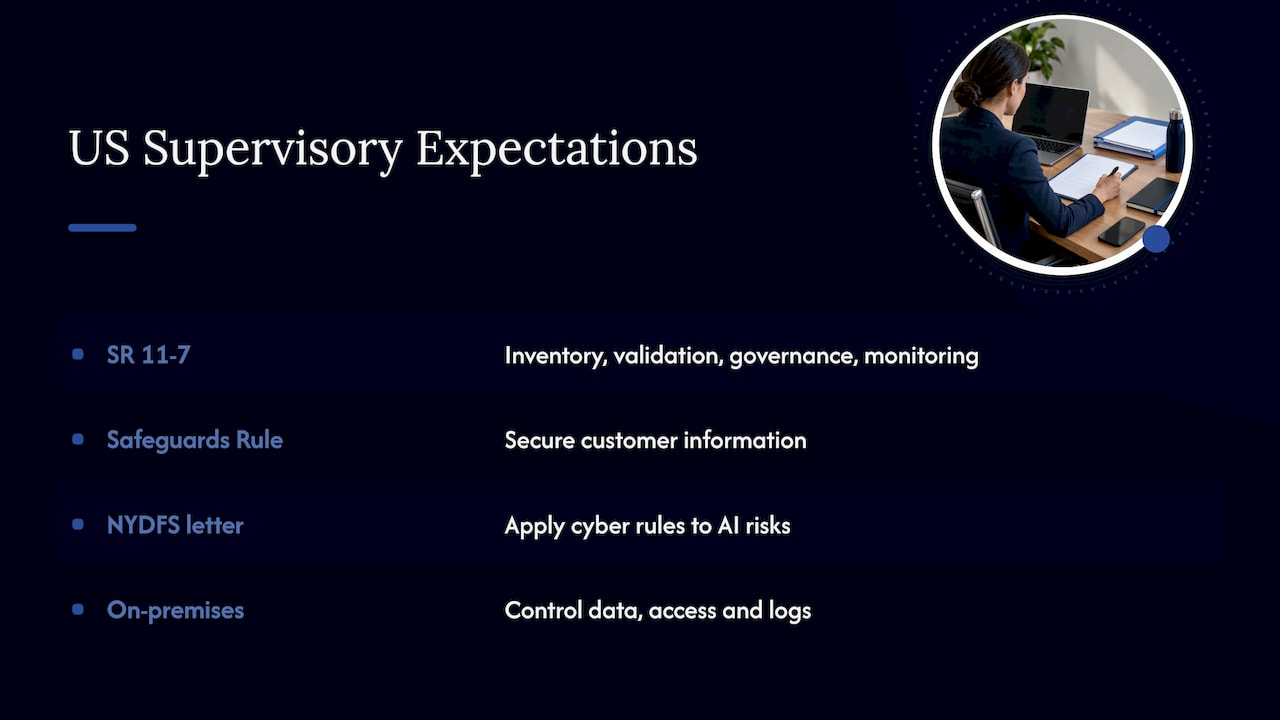
Model risk management. The Federal Reserve and the OCC issued SR 11-7, Guidance on Model Risk Management, in April 2011. It sets out expectations for model development, validation, governance and internal audit, and it asks that board members make sure model risk stays within tolerance. Banks generally treat AI models, including generative ones, as models under this framework. In practice that means an inventory, documented purpose and limits, independent validation and ongoing monitoring.
Safeguarding customer information. The Gramm-Leach-Bliley Act’s Safeguards Rule, administered by the FTC for non-bank financial institutions under its jurisdiction, requires measures to keep customer information secure. Banks supervised by the federal banking agencies follow the interagency equivalent. An AI system that reads customer records is within scope.
State cybersecurity rules. On October 16, 2024, the New York Department of Financial Services issued an industry letter on cybersecurity risks arising from artificial intelligence. It explains how covered entities should apply the existing cybersecurity regulation to AI-related risks, including third-party service providers. Banks with New York exposure should read it alongside their own program.
Outside the US, the picture differs by country. Japan’s Financial Services Agency published an AI Discussion Paper in March 2025, and Switzerland’s banking association has issued the paper cited above. If your bank operates across borders, map each jurisdiction’s requirements separately. Rules and supervisory expectations change often, so confirm the current text with your regulator and counsel before you finalize a design.
On-premises deployment helps with several of these expectations directly. The bank knows where data sits, controls who can reach it and can produce logs without asking a vendor. It also shortens the third-party chain examiners ask about.
Controls to design in from day one
Whether or not a regulation names them, these controls decide whether an AI system passes internal review.
- Data boundaries. Define which data classes the system may read, and enforce them through the same entitlements that govern the source systems. An assistant should never answer from a document the asking employee could not open.
- Auditability. Log prompts, retrieved sources, model versions and outputs in a store the bank owns. Source-backed answers help reviewers verify what the assistant relied on.
- Model governance. Record each model’s purpose, version, validation status and approved users. This is the SR 11-7 inventory in practice.
- Security against AI-specific attacks. The Swiss Bankers Association paper lists data breaches, adversarial attacks, prompt injection and data poisoning among the cyber risks to plan for. Test for them before go-live and again after every model change.
- Resilience. Decide what happens when a node fails or a site loses power. Edge and single-device deployments need a defined fallback.
- Update path. In an isolated network, new model versions arrive through a controlled transfer process with review, not an automatic download.
Infrastructure, staffing and cost: what to plan for
The Swiss Bankers Association’s list of planning factors is a useful checklist: hardware cost for training, storage and networking; low-latency, scalable performance for real-time processing; cybersecurity; data management and legacy-system integration; and data residency. Four points deserve emphasis.
Utilization decides the economics
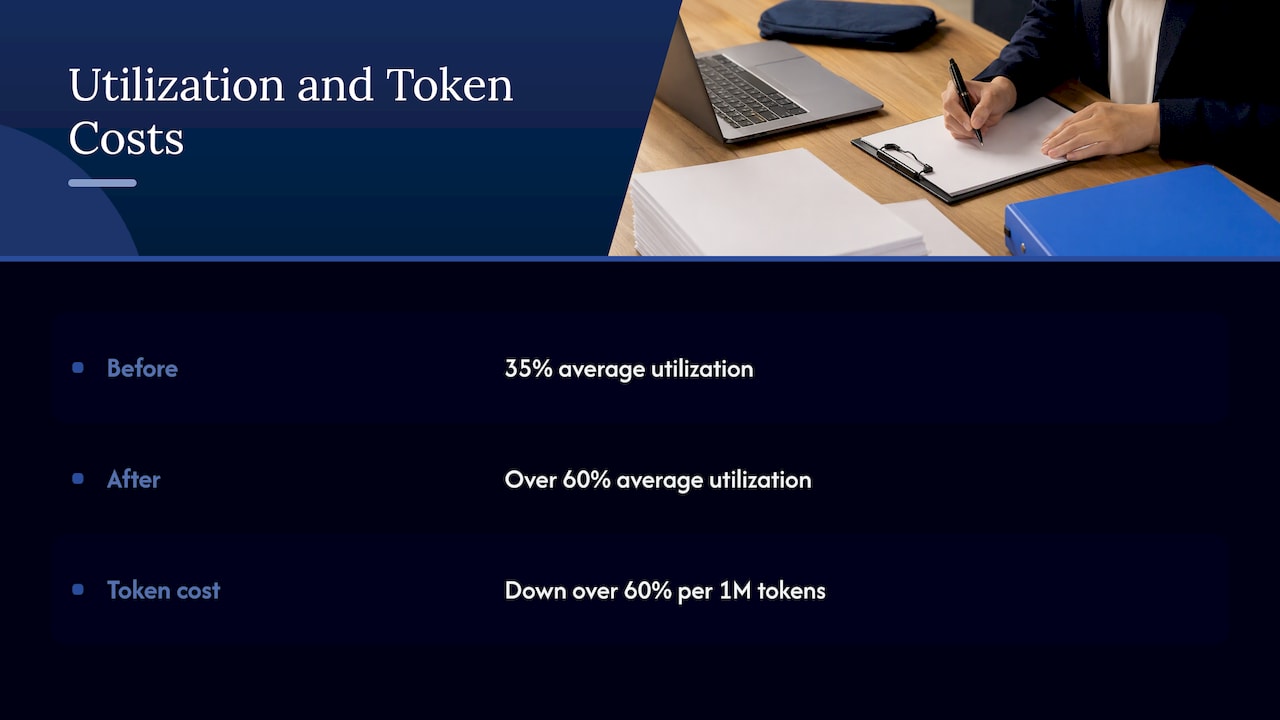
Accelerators are expensive, and idle ones are the main cost risk. China Merchants Bank’s CNCF end-user case study, reported in September 2026, describes a unified Kubernetes control plane sharing nearly 10,000 heterogeneous accelerator cards between training and inference. The bank reports average utilization rising from 35% to over 60%, and the cost of processing 1 million tokens falling by more than 60% under comparable conditions. The lesson is not the scale. It is that scheduling, orchestration and runtime tuning determine what each GPU hour is worth.
That is operational work, and it is why sovereign MLOps and runtime orchestration sit alongside deployment in Forge’s services.
Integration is the hard part
Banks with legacy core systems rarely struggle to find a model. They struggle to connect it to document stores, identity systems, ticketing and case management without opening new data paths. Scope integration first, and let the model choice follow.
Staffing
An on-prem system needs people who can run inference infrastructure, patch it, monitor it and support users. Many banks prefer to have an experienced integrator deploy and then operate the system, so internal teams focus on use cases and validation. Forge’s engagements cover architecture, secure deployment, model integration and ongoing operation.
Measuring return
Japan’s FSA paper reports that financial institutions find it hard to show return on AI investment, partly because AI systems can become obsolete quickly and because usage-based pricing of external generative AI makes costs hard to estimate. The agency recommends KPIs tailored to user and usage characteristics, with regular monitoring. A private deployment turns usage-priced spend into a capacity you plan for, which makes the cost side easier to model. Define the KPI before you build: minutes saved per investigation, documents resolved per hour, first-answer accuracy.
A rollout path that holds up in review
The sequence below is how we would structure a bank engagement.
- Pick one high-value, bounded use case. Choose a team with a measurable workflow and a sponsor in risk or compliance.
- Classify the data. Decide which repositories the system may read, under which entitlements, and whether the environment must be air-gapped.
- Design the architecture. Choose hardware, network zones, identity integration and logging. Decide where inference runs: data center, branch edge or single device.
- Deploy and integrate. Install the platform, connect the document sources and configure Personas for the domain.
- Validate. Run the model through your model risk process: testing, documentation, independent review and sign-off.
- Pilot with real users. Measure against the KPI you set in step one.
- Operate and tune. Monitor performance, manage model updates through your change process and tune the runtime for throughput.
- Expand. Add the next use case on the same foundation.
Our guide to generative AI in regulated industries covers the governance side of these steps in more detail.
Our perspective
Banks do not need to choose between using AI and keeping control of their data. The question we hear most is how to get an assistant that is useful on day one without creating a new data path out of the bank.
Our answer is to design for the perimeter first. Forge AI Deployment deploys webAI’s local-first platform inside infrastructure the customer controls, and our deployments are designed so that data, models and domain intelligence stay inside it, validated for privacy and auditability.
We also believe operations matter as much as installation. Our leadership brings more than 20 years of experience in high-consequence and Fortune 100 environments, and we apply that discipline to the unglamorous parts: orchestration, tuning, updates and support. A private system that is not run well will not earn the trust of risk teams or of the staff who use it.
Start small, pick the workflow where source-backed answers save real time, and build the foundation once.
John
Plan your bank’s private AI deployment
Forge AI Deployment designs, deploys and operates private AI systems inside your data center, edge sites or air-gapped networks. Services include secure local and air-gapped deployment, custom model integration and optimization, private AI assistant rollout, sovereign MLOps and runtime orchestration, and performance tuning with ongoing operations. The platform behind it is webAI’s, which you can read about on our webAI partnership page.
If you have a first use case in mind, see the Forge solutions to scope a deployment inside your own environment.
FAQ
What does on-prem AI mean in banking?
It means AI models run on servers or devices the bank controls, such as its own data center, an edge site or an air-gapped network. Customer data, prompts and logs do not go to an outside provider. The bank manages access, auditing and updates itself or through an integrator working inside its environment.
What do banks use on-premises AI for?
Common uses are fraud investigation, compliance and policy document search, internal assistants for staff and operations support. These workloads touch sensitive records and benefit from answers that cite their sources. The best first project is a bounded workflow with a measurable KPI.
Do US bank regulators allow AI on premises or in the cloud?
US supervisors do not ban either approach. They expect banks to manage AI under existing frameworks, including model risk guidance in SR 11-7, customer-information safeguards and state cybersecurity rules. Confirm current requirements with your primary regulator and counsel.
Can an on-prem AI system work with no internet connection?
Yes. An air-gapped design runs inference locally with no outside calls. webAI Frontline, which Forge deploys, gives teams source-backed answers from large technical document libraries fully offline on a single device. Model updates move in through a controlled transfer process.
How should a bank measure the return on on-prem AI?
Set a KPI per use case before deployment, such as time per investigation or documents resolved per hour. Japan’s FSA recommends KPIs matched to user and usage characteristics with regular monitoring. Track utilization and operating cost alongside it.
Sources
- Swiss Bankers Association, Generative AI in Banking (April 2025)
- Federal Reserve, SR 11-7 Guidance on Model Risk Management
- FTC, Safeguards Rule
- Paul Hastings, NYDFS Issues AI Industry Letter
- Japan FSA, AI Discussion Paper (March 2025)
- China Merchants Bank CNCF case study (PR Newswire Asia)
- Mashreq fraud investigation platform announcement (Crowdfund Insider)