Any AI system that receives or can reach cardholder data is in scope for PCI DSS, the Payment Card Industry Data Security Standard. The organization that handles the card data stays accountable, whichever model or vendor sits in the middle. The cleanest way to keep that scope small and auditable is to run AI inside infrastructure you control, so card data never travels to a third party. That is the kind of deployment Forge AI Deployment designs and operates, using webAI’s local-first platform.
This guide is for security, compliance and platform leaders at banks, processors, logistics firms, manufacturers and other enterprises that touch payment data. It covers what the PCI Security Standards Council (PCI SSC) has said about AI, how to decide whether a system is in scope, which controls matter, and what changes when AI runs on-premises or air-gapped.
TL;DR
- PCI DSS v4.0.1 has no AI-specific requirements. The existing requirements apply, and the PCI SSC’s AI guidance explains how to read them.
- If an AI system receives, stores or can reach account data, it is in scope. Encrypting or tokenizing the data does not remove it from scope if the system can reach the means to decrypt or detokenize.
- Hosted AI makes the provider a third-party service provider under Requirement 12.8. Private deployment removes that hosting relationship.
- Enforce limits outside the model: identity and access management, network isolation, DLP on egress, human approval for actions involving cleartext card data.
- Forge AI Deployment deploys and operates webAI’s platform inside your own data center, edge site or air-gapped network.
Table of Contents
- What PCI DSS actually says about AI
- Who is accountable when AI touches card data
- When an AI system comes into scope
- How AI changes the risk picture
- Controls that hold up in an assessment
- Shadow AI is a scope problem too
- PCI data versus PII
- Can AI tools help with PCI compliance?
- Why private deployment shrinks the problem
- A scoping example
- What Forge AI Deployment does
- Our perspective
- FAQ
- Sources
What PCI DSS actually says about AI
The standard itself is silent on AI. PCI DSS v4.0.1 is the current version and contains no AI-specific requirements; the Council has layered guidance on top. If you want a plain overview of how payment compliance obligations work in general, this payment processing compliance guide is a reasonable starting point.
The guidance arrived in three steps:
- Assessment guidelines. The Council published guidelines on using AI in PCI assessments in 2025, as described in its 2025 Annual Report.
- AI Principles. In September 2025 the Council published AI Principles for payment environments. Their core point: using AI does not remove or bypass the need to meet any applicable PCI SSC standard.
- Information supplement. In September 2026 the Council announced Security Considerations for AI Systems. It is guidance, not mandatory requirements, and where the two differ, the PCI standards take precedence.
That last point matters for how you write policy. The supplement is not a checklist an assessor can fail you against by itself. But the people who wrote it are senior assessors, and you should expect Qualified Security Assessors (QSAs) to use it as their reference when they ask how your AI systems were scoped and controlled.
Who is accountable when AI touches card data
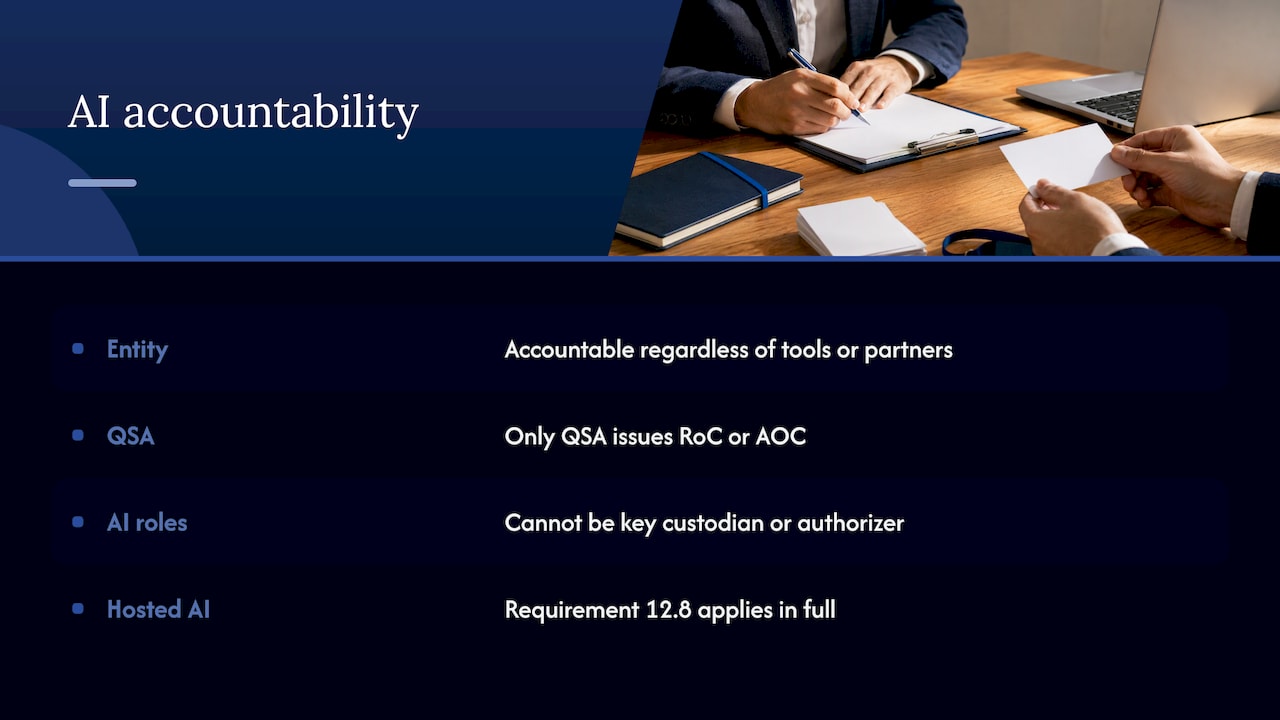
The entity that stores, processes or transmits cardholder data stays accountable for compliance, regardless of the tools or partners it uses. Responsibility for scoping decisions, controls and risk stays with you. Only a QSA can issue a Report on Compliance or Attestation of Compliance. No AI tool, and no vendor’s marketing, substitutes for that.
The PCI SSC also states that AI systems cannot accept or take on responsibility. Roles such as key custodian or management-level authorizer are not suitable for AI, and the whole software creation and deployment pipeline should not be fully automated. A person must stay in the loop.
There is a second accountability layer: vendors. When a third party hosts an AI system that can reach sensitive data, that provider is a third-party service provider and Requirement 12.8 applies in full. That includes AI features built into other products, such as chat widgets. You need written agreements, due diligence, a record of which PCI requirements the provider covers, and monitoring of their compliance status.
When an AI system comes into scope
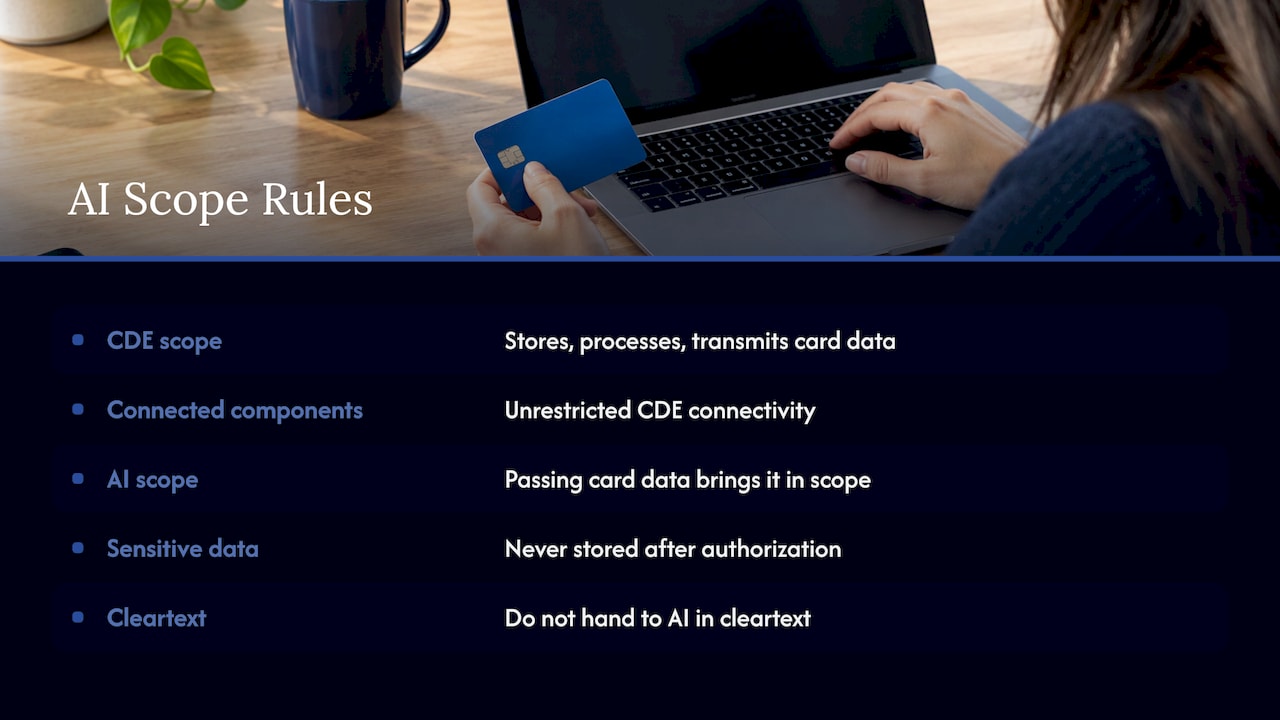
PCI DSS scope is built around the cardholder data environment (CDE): the system components, people and processes that store, process or transmit cardholder data or sensitive authentication data, plus components with unrestricted connectivity to them. Sensitive authentication data means things like the card verification code, which may never be stored after authorization.
The PCI SSC’s supplement applies that logic to AI. Passing cardholder data to an AI system is not prohibited, but it brings that system into scope, and that may affect your ability to meet requirements such as account-data storage security. The supplement’s framing is blunt: an AI system does not remember, it stores. Anything you may not store in cleartext should not be handed to AI in cleartext.
The scoping questions to ask
Work through these for every AI system, including pilots:
- Does it receive account data? Prompts, uploaded documents, call transcripts and retrieved records all count. A prompt sent to an AI tool is a transmission under Requirement 4, and a retained prompt is stored data under Requirement 3, as Securisea explains.
- Can it reach account data indirectly? Through connected applications, databases, plugins or tools. Map the full payment workflow, not only the AI application. As Datatel notes, a separation that looks sound limits scope only if an assessment verifies the specific implementation.
- Does it hold only tokens or encrypted data? List every system and identity it can reach. If any of them can detokenize or decrypt, treat the AI system as having cleartext access. Per the same Datatel summary of the supplement, an AI system can be out of scope when it is sufficiently isolated from anything that could expose the underlying data, and stays in scope if it can reach decryption or detokenization.
- What about training and retrieval data? Training sets and AI-created data stores belong in the inventory. The PCI SSC advises sanitizing training data of items such as access tokens, credentials, unsecured account data and cryptographic keys before use.
- Which isolation controls protect the boundary? Even when the AI system is out of scope, the controls that isolate it are in scope.
If you need help mapping workflows before you buy anything, a readiness assessment that maps workflows first is a useful discipline: you cannot scope a system until you know which workflows touch card data.
How AI changes the risk picture
Generative AI and autonomous agents break an assumption built into older controls. Traditional PCI DSS controls were designed around human access and predictable workflows. A model reads instructions and data in the same channel, so it can be steered by content it was only meant to read.
The supplement names a combination to avoid in a single system, the so-called lethal trifecta: access to sensitive data, exposure to untrusted content, and the ability to communicate externally. Guidance summarized by jazz.security cites the UK NCSC’s view that current large language models do not enforce a security boundary between instructions and data, and OWASP’s ranking of prompt injection first in its LLM Top 10. The same source recounts a September 2025 prompt-injection demonstration against a CRM agent, where instructions planted in a web form made the agent send records to an outside domain. If work needs all three capabilities, split it across agents that each hold only one or two.
The agentic commerce material from the PCI SSC adds two practical rules: agentic systems should not handle raw PANs, and detokenization should stay out of the agent’s reach. Infrastructure that stores long-lived card credentials becomes a CDE component.
Controls that hold up in an assessment
The supplement’s recommendations, as summarized by jazz.security, translate into a short control set:
| Control | What it means in practice |
|---|---|
| Least agency, enforced outside the model | Restrict what an agent can do with IAM, brokered access and network controls. A system prompt saying “never read the payments table” can be overridden. |
| No sensitive authentication data | Never give it to an AI system, even encrypted (Requirement 3.3.1). |
| Human approval | Require explicit approval for any action involving cleartext card data. Do not run such an agent in a monitored-autonomy model. |
| Independent DLP on AI egress | Inspect what leaves the AI environment with a tool the model cannot influence. |
| Masked or tokenized logs | Keep card data out of prompts logged for debugging and analytics. |
| Inventory | List AI systems and their data stores under Requirement 12. |
| Incident response | Add AI failure scenarios to your Requirement 12.10 plan: prompt injection, model poisoning, out-of-scope actions, shadow AI. |
Two cautions from practitioners are worth building into process. First, reviewers trust AI output too much: someone who approves fifty correct suggestions will likely miss the fifty-first, so sample, rotate reviewers and use second-person checks on high-impact actions. Second, keep a record of every AI action touching the CDE. Our guide to audit logging for AI covers what to record and how to protect the logs themselves, which matters because logs can become card data stores.
Shadow AI is a scope problem too
The quickest way for card data to reach an AI system is an employee pasting it into a consumer tool. The supplement describes staff use of public AI tools as a common route for uncontrolled disclosure and says policy alone will not contain it. There is no vendor agreement, no log and often no record. The practical answer is to give staff a sanctioned assistant that works as well as the public one, inside your perimeter, with DLP on the way out. People stop pasting into outside tools when the approved option is fast and useful.
PCI data versus PII
PII, personally identifiable information, is any data that can identify an individual. PCI data is the narrower set tied to payment cards: card numbers, cardholder names, expiration dates and security codes. PCI data is effectively a subset of PII with its own standard and stricter handling.
For AI, the distinction means two review tracks. A model that summarizes customer emails may need PII controls under privacy law and not PCI DSS, until a customer types a card number into the message. Then PCI applies to the whole pipeline. Build detection for card numbers into intake, and handle the broader category with the practices in our guide to PII handling in AI.
Can AI tools help with PCI compliance?
Yes, for monitoring, evidence gathering, report drafting and tracking remediation. They cannot certify anything. Only a QSA issues the Report on Compliance or Attestation of Compliance, and the PCI SSC’s assessment guidelines expect assessors to keep confidentiality, avoid bias and review generated content before relying on it. Treat AI as an assistant to your compliance team, subject to the same scoping rules as any other system. If the assistant reads your evidence, and your evidence contains account data, it is in scope.
Why private deployment shrinks the problem
Most of the hard questions above come from data crossing a boundary: to a hosted model, to a provider’s logs, to a plugin with outbound access. Running the system inside infrastructure you control changes the questions.
- No hosted third party. If no outside provider runs part of the system that can reach sensitive data, Requirement 12.8 has no AI hosting vendor to manage.
- A boundary you can draw. Models, data stores and logs sit on networks you own, so you can document isolation, egress rules and identity limits for your assessor.
- No exposure to untrusted content or external communication by default. An air-gapped network removes two legs of the lethal trifecta by design.
Private does not mean out of scope. If the system can reach cleartext card data, it is in the CDE and every applicable requirement applies. The advantage is that you choose the boundary and can prove it. Banks weighing this will find the architecture and rules covered in our piece on on-prem AI for banking.
A scoping example
A payments operations team wants an assistant that answers analysts’ questions about chargeback disputes from a library of case files.
- Inventory. The case files include scanned forms with full card numbers. The assistant would index them, so the index is a card data store.
- Reduce. Mask or tokenize card numbers before indexing and exclude security codes entirely. The assistant now holds tokens.
- Check reach. The retrieval service can call the detokenization API for analysts. If the assistant’s identity can call it, the assistant has cleartext access and is in scope. Remove that permission at the network and IAM layer, not in the prompt.
- Isolate. Run the model and index in a segment with no internet egress. Document the segmentation rules, since they are in scope for assessment.
- Approve. Any action that needs a real card number goes to a human with approval, logged.
- Record. Add the system and its data stores to the Requirement 12 inventory and the AI failure scenarios to the incident plan.
The result is an assistant that is useful, bounded and explainable to a QSA.
What Forge AI Deployment does
Forge AI Deployment designs, deploys and operates private AI systems inside infrastructure its customers control, including enterprise data centers, edge sites and air-gapped networks. As an official webAI systems integrator, Forge brings webAI’s local-first platform into production: architecture, secure deployment, model integration and ongoing operation. That includes specialized AI Personas, webAI’s Intelligence Delivery Network, and webAI Frontline, which gives frontline teams fast, source-backed answers from large technical document libraries, fully offline on a single device.
Our design goal is that data, models and domain intelligence stay inside your infrastructure, validated for privacy and auditability. For a payments team, that gives your QSA a boundary to review and gives you one less hosted provider to manage. See our solutions for secure local and air-gapped deployment, private AI assistant rollout, sovereign MLOps and ongoing operations.
To see how the platform underneath fits together, read about the webAI partnership.
Our perspective
Compliance teams ask us the wrong question first. They ask whether a given model is PCI compliant. Models are not certified. Systems are scoped, and the scope follows the data and the paths to it.
We build from that. Before we talk about model choice, we ask where the data lives, which identities can reach it and what leaves the environment. Then we design the deployment so those answers are short and provable: models, data and logs inside your perimeter, limits enforced by the network and identity layers rather than by instructions to the model.
Our leadership has more than 20 years in high-consequence and Fortune 100 environments, and that shapes the method: operational discipline first, software second. We deploy and operate webAI’s platform for you, and we stay on to run it, because a boundary that is documented on day one but drifts by month six does not pass an assessment.
If your first AI project touches payment data, start with the smallest system that does the job and keep card data out of it where you can. Where you cannot, put it in a private environment you control and make every access explainable.
John
FAQ
Does PCI DSS have AI requirements?
No. PCI DSS v4.0.1 contains no AI-specific requirements. The PCI SSC has published AI Principles and an information supplement on AI system security, both guidance that applies the existing requirements to AI. Where the guidance and the standard differ, the standard prevails.
Is an AI system in scope if it only sees tokenized data?
Not automatically either way. Tokenized or encrypted data does not remove a system from scope if the system can reach decryption or detokenization capabilities. An AI system sufficiently isolated from those paths may be out of scope, but the isolation controls themselves are assessed.
Can employees use public AI tools with card data?
Pass card data to an AI system only when you have accepted that the system is in scope and have the controls to match. For public tools that is rarely practical, and a hosted tool that handles card data becomes a third-party service provider under Requirement 12.8. Give staff a sanctioned internal assistant and monitor egress with DLP.
Can AI certify our PCI compliance?
No. Only a QSA issues the Report on Compliance or Attestation of Compliance. AI can help with monitoring and evidence, and it falls under the same scoping rules as any other system it uses.
Sources
- AI Principles: Securing the Use of AI in Payment Environments (PCI SSC)
- Just Published: Security Considerations for AI Systems (PCI SSC)
- Information Supplement: Security Considerations for AI Systems (PCI SSC)
- PCI SSC 2025 Annual Report
- Agentic Commerce and PCI DSS (PCI SSC presentation)
- PCI Compliance and AI: Managing New Compliance Risks (Securisea)
- What is the cardholder data environment (jazz.security)
- Can support agents use AI with customer data (jazz.security)
- Conversational AI, Credit Card Data and PCI DSS (Datatel)
- PCI DSS AI Guidance: What It Means for Your CDE (Accorp)
- PII vs PCI: Key Differences and Best Practices (GDPR Local)