Air-gapped DevOps is software delivery, covering source control, builds, testing, release and operations, inside a network that has no automated path to the outside. Everything the pipeline needs must already live inside the boundary, and everything new must cross it through one controlled, verified door. The hard part is not the isolation. It is keeping builds, patches and now AI workloads moving without weakening it. At Forge AI Deployment, we design, deploy and operate private systems inside infrastructure our customers control, including air-gapped networks, so the same discipline applies to the AI systems that now run next to your pipelines.
TL;DR
- An air gap means no automated connection between systems. Data crosses only under human control, so your pipeline must be designed around deliberate, verified transfers.
- The reliable pattern has three zones: a connected zone that collects, a staging zone that scans and signs, and an enclave that only receives a verified bundle.
- Pin every dependency, mirror everything locally, and make each release carry its own signatures, SBOM and test evidence.
- Kubernetes works offline, but defaults such as
imagePullPolicy: Alwaysand thelatesttag break it. - Private AI belongs in the same pipeline: models, runtimes and updates follow the same transfer-and-verify path as code.
Table of Contents
- What air-gapped means for a delivery pipeline
- The three-zone architecture
- Building CI/CD without internet access
- Moving artifacts across the gap
- Kubernetes inside the gap
- Security risks and how to address them
- Bringing private AI into the pipeline
- Where Forge fits
- Our perspective
- FAQ
- Sources
What air-gapped means for a delivery pipeline
NIST’s glossary defines an air gap as an interface between two systems that are not physically connected, where any logical connection is not automated and data crosses only manually, under human control. That definition drives every design decision below.
In practice, teams run into three variations:
- Physical air gap: no cables and no wireless links. It is the most secure form and the least flexible, and updating or restoring systems takes real effort.
- Operational air gap: procedures and human actions allow a connection only when necessary, as Ericsson describes.
- One-way flow: a data diode lets data move in a single direction only.
For a bank, a defense contractor, a logistics operator with sensitive shipment data or a plant floor that cannot depend on the cloud, the reason is the same: nothing sensitive should be reachable from outside, and nothing inside should phone home.
The three-zone architecture
DevOps assumes the internet: package managers, public registries, hosted CI, vulnerability feeds. Take that away and the architecture has to supply each of those functions inside the boundary. Practitioner guidance converges on three zones.
- Connected zone. Systems that can reach the outside collect candidate content: base images, Helm charts, OS updates, open-source packages.
- Staging (verification) zone. Content is scanned for vulnerabilities, described in an SBOM (a software bill of materials, the inventory of every component in a build), signed, and packaged into one bundle with a checksum manifest. Dominik Heinrich’s practitioner guide describes exactly this split.
- Enclave. The isolated environment receives only the signed bundle, re-verifies it, and serves it from its own registry and Git. Nothing inside reaches out.
The AIRGAPNET secure CI/CD guide adds the point many teams miss: physical isolation limits reachability, but only signatures, immutable identifiers and policy preserve trust. It recommends naming an owner for every transition and defining explicit entry and closure criteria for each connection window, so a transfer is a release event and not an informal file copy.
Building CI/CD without internet access
The same guide gives a clear sequence for the pipeline itself. Here is how it plays out step by step, and where it usually goes wrong.
1. Pin everything to immutable identifiers
Source revisions, dependencies and base images should be referenced by commit hash, content hash or image digest, never by a moving tag. A lockfile that records exact versions and hashes lets a build fail cleanly when something is missing instead of quietly pulling the wrong thing. This is where most first attempts fail: one unpinned dependency means a build that works in the connected zone and breaks inside.
2. Mirror what the build needs
Compilers, base images, build tools and package repositories all need internal copies, populated at a single controlled ingress point. That typically means a container registry, a package proxy for each language ecosystem you use, and internal Git hosting. The gap in the plan is usually the long tail: a Helm chart that references a public registry, or an init script that downloads a package at startup.
3. Run builds on controlled workers
Use build workers with a known toolchain and no outbound access. With self-managed GitLab, for example, SPK and Associates advise registering internal runners that only pull jobs from the internal system, and checking and verifying every import through the controlled transfer path.
4. Package a release, not a pile of files
A release should bundle binaries, images, manifests, signatures, SBOMs, test results and rollback content as one versioned unit. Verify it in the staging zone, move it across, and have enclave-side services independently verify and promote it. Keep the registries, repositories, deployment controller, policy engine and required secrets inside the enclave.
5. Keep a cadence
Without real-time connectivity, updates arrive in batches. Plan a regular rhythm for refreshing mirrors, remediating vulnerabilities and validating upgrades in a connected staging environment before they enter the gap. Portainer’s reference architecture suggests resyncing a mirror registry monthly at minimum for security patches, and immediately when a critical vulnerability is disclosed.
Moving artifacts across the gap
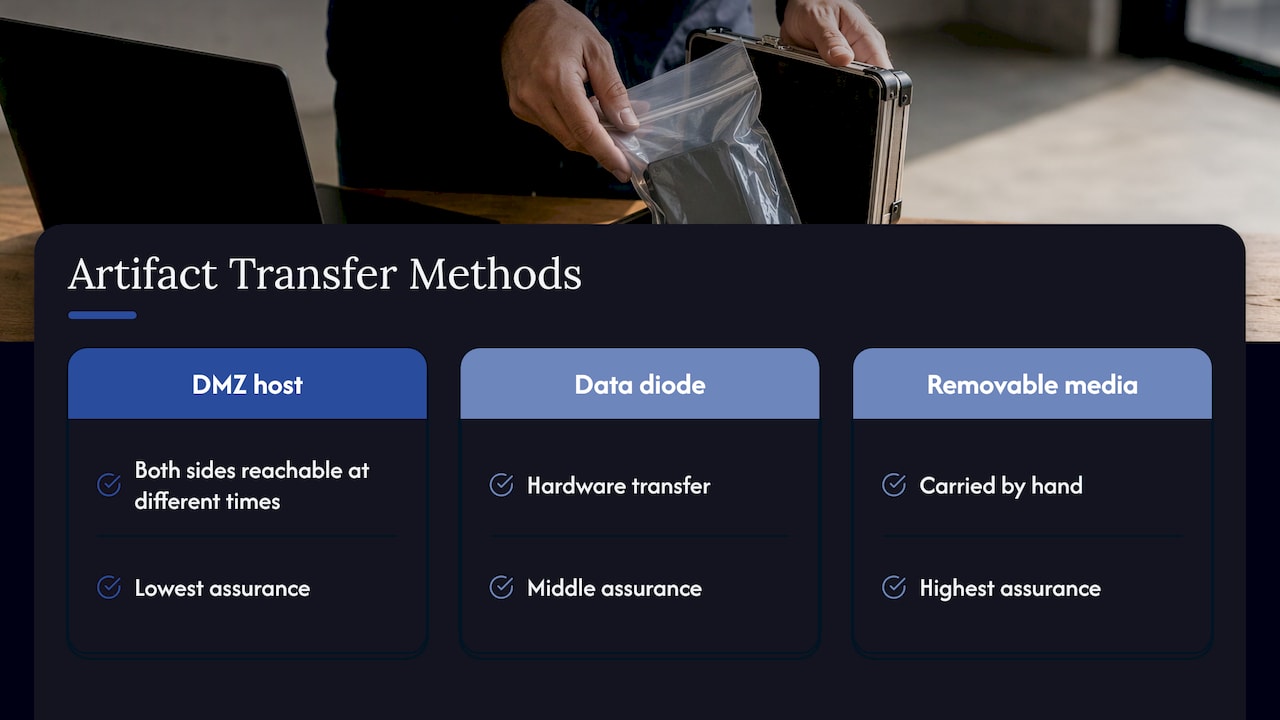
The transfer is the most scrutinized moment in air-gapped DevOps. Three mechanisms are in common use, in rising order of assurance according to Anil Jaiswal’s write-up: a DMZ transfer host that both sides can reach at different times, a hardware data diode, and removable media carried by hand.
Whatever the transport, the design principle is the same: make the bundle self-verifying. Sign it with a key whose public half the receiving side already holds, and run the same verification whether the bundle arrives by diode, DMZ hop or USB drive. Offline-capable signing modes matter here, because flows that depend on a public transparency log cannot run inside the gap. Size matters too: a very large bundle turns a diode transfer into hours, so deduplicate layers and split bundles where you can.
A widely cited pattern from JFrog’s reference architecture puts one artifact repository in the DMZ to download and validate artifacts and their transitive dependencies, exports approved content on encrypted physical media to a second repository with no external network, and runs vulnerability scanning on both sides. A formal dependency request-and-approval process sits in front of it, and can be automated where that still helps developers.
For Kubernetes workloads, Distr’s air-gapped documentation describes bundling the Helm chart, container images, dependencies and SBOMs into one archive that deploys offline with no vendor access at install time.
Transfers also need a release discipline of their own. A software release checklist with rollback gates is a useful model for deciding what must pass before a verified build is promoted across the boundary and how you back out if it misbehaves.
Kubernetes inside the gap
Yes, Kubernetes is widely used in DevOps, and it runs well air-gapped. The benefits are concrete: no runtime dependency on external registries, control over approved images, an audit trail for artifacts, data sovereignty and immutable deployments. The cost is operational: ITCS Luxembourg describes a standing seed-transfer-push cycle, in which every image change is downloaded on a connected machine, carried to the air-gapped bastion host and pushed to the registry.
The pitfalls are mostly defaults that assume connectivity. Antithesis’s Kubernetes guidance lists the usual suspects:
imagePullPolicy: Alwaysforces a registry fetch and fails offline.- The mutable
latesttag triggers those pulls and producesErrImagePull. - Init containers that call
curlorwget, Helm charts that reference public registries, and bootstrap scripts that install packages online all break. - The fix is to reference images by immutable digest and keep every workload free of internet dependencies.
It is far easier to design these constraints in from day one than to retrofit them. For the inference side of this, see our guide to Kubernetes for LLM inference in a private deployment.
Security risks and how to address them
Isolation is not the same as safety. The AIRGAPNET guide puts it plainly: a disconnected pipeline can still faithfully deliver compromised code. The risks that follow are worth planning for:
- Hard-to-trace dependencies and informal approvals. Occasional file copies become unwritten policy. Replace them with a documented approval path and named owners.
- Assurance decay. Vulnerability data and mirrored dependencies age. Monitor data age, lead time, exceptions and rollback success.
- Weak signing hygiene. Separate signing authority from developer access, and define how keys are revoked.
- Unrehearsed failures. Exercise the scenarios in advance: a malicious dependency, an expired certificate, an unavailable scanner, a failed transfer, a compromised runner and an urgent release.
The OpenSSF tech talk recap names the underlying friction: dependencies that need mirroring, policies that assume constant connectivity, patching that needs new scrutiny, and observability gaps because remote telemetry is absent. Security teams want to patch fast, yet the gap slows every update. A Naval Postgraduate School study on submarine networks shows one answer: continuously monitored immutable images, signatures verified on both sides of the gap before installation, and observability built into the reference design.
Bringing private AI into the pipeline
Once a pipeline is air-gapped, the next request is usually AI: a code assistant, a document assistant for engineers, a model that analyzes logs. Those workloads should follow the same rules as everything else. Models, runtimes and updates arrive as signed, versioned bundles, are verified in staging, and run on local infrastructure with no outbound calls.
That is the work we do at Forge. As an official webAI systems integrator, Forge AI Deployment brings webAI’s local-first platform into production: architecture, secure deployment, model integration and ongoing operation, including specialized AI Personas and the Intelligence Delivery Network. For teams that need answers from large technical document libraries, webAI Frontline gives frontline teams fast, source-backed answers fully offline on a single device. If developer productivity is the goal, our guide to deploying an on-prem code assistant securely walks through it.
Where Forge fits
Air-gapped DevOps is an operating discipline as much as an architecture. Mirrors need curating, bundles need signing, cadences need keeping, and the AI systems beside them need the same care. Forge AI Deployment covers secure local and air-gapped deployment, custom model integration and optimization, private AI assistant rollout, sovereign MLOps and runtime orchestration, and performance tuning with ongoing sovereign operations. Our deployments are designed so that all data, models and domain intelligence remain inside your infrastructure, validated for privacy and auditability.
If you are planning a private AI system for an air-gapped or locally controlled environment, review our solutions and book an engagement with our team.

Our perspective
Most air-gapped programs we see discussed start with the network diagram and stop there. We think the better starting point is the operating routine: who approves what enters, who signs it, how often it moves, and how you roll it back.
That is why we treat AI the same way as any other workload. A model is an artifact. It should be versioned, verified and promoted through the same door as your code, then run entirely inside infrastructure you control.
Our leadership brings more than 20 years of experience in high-consequence and Fortune 100 environments, and our method is operational discipline, not software resale. We deploy and operate webAI’s platform as an official systems integrator, so your teams get private AI that stays inside the perimeter without taking on the day-to-day work of running it.
John
FAQ
What does air-gapped mean in computing?
It means a system or network has no automated connection to other networks. Under NIST’s definition, any logical connection is not automated, so data crosses only manually under human control. The purpose is to keep sensitive systems unreachable from outside.
Can you do CI/CD without internet access?
Yes. Mirror dependencies, images and tools locally, pin everything to immutable identifiers, and build on controlled workers. Package each release with its signatures, SBOMs and test results, then verify it in a staging zone and again inside the enclave before promotion.
How do you update an air-gapped environment safely?
Use a signed, self-verifying bundle and a controlled transfer: a DMZ host, a one-way data diode or removable media. Each import is checked on arrival, and mirrors are refreshed on a regular cadence, with critical vulnerabilities handled immediately.
Is Kubernetes a good fit for air-gapped DevOps?
Yes, provided workloads are built for it. Reference images by digest, avoid the latest tag and imagePullPolicy: Always, and remove any startup step that downloads from the internet. You gain approved-image control, audit trails and immutable deployments.
Can AI workloads run in an air-gapped DevOps environment?
Yes. Models and runtimes are staged inside the boundary like any other artifact and run on local infrastructure. Forge AI Deployment designs and operates these private AI systems for organizations that need data to stay within their perimeter.
Sources
- Air gap, NIST CSRC glossary
- Why air gap strategies are essential for your network security, Ericsson
- Air-gapped systems: running critical software with no connection, Dominik Heinrich
- Secure CI/CD for Air-Gapped and Disconnected Environments, AIRGAPNET
- Building Secure CI/CD Pipelines with GitLab in Air-Gapped Networks, SPK and Associates
- Container Registries, Portainer Enterprise Reference Architecture
- Shipping Software Updates Into an Air-Gapped Environment, Anil Jaiswal
- No Network Access, JFrog Platform Reference Architecture
- Air-Gapped Deployments, Distr
- Air-gapped Kubernetes with NKP, ITCS Luxembourg
- Kubernetes best practices, Antithesis Docs
- Tech Talk Recap: Simplifying DevSecOps in Air-Gapped Environments with Zarf, OpenSSF
- Zarf air-gap transfer for submarine networks, Naval Postgraduate School