
Private AI for manufacturing means running AI models inside infrastructure you control, whether that is a plant data center, an edge site on the factory floor or a fully air-gapped network, so process data, designs and operating knowledge never leave your perimeter. For manufacturers with sensitive intellectual property, regulated supply chains or unreliable connectivity, it is the practical way to get AI value without depending on a public cloud. Forge AI Deployment designs, deploys and operates these systems on webAI’s local-first platform, as an official webAI systems integrator.
TL;DR
- Private AI keeps models, prompts, documents and outputs inside your own data center, edge hardware or air-gapped network, not on a shared public service.
- The strongest early uses are visual inspection, root-cause analysis and fast answers from large technical document libraries.
- Security work centers on access control, encryption and traceability, and these have to extend to the OT (operational technology) side of the plant.
- Assess infrastructure, model fit and OT/IT integration before you buy hardware, then judge a pilot on measurable plant outcomes.
- Forge AI Deployment handles architecture, secure deployment, model integration and ongoing operation, so your team does not build the stack alone.
Table of Contents
- What private AI means on a factory floor
- Why manufacturers choose private AI
- Where private AI pays off in manufacturing
- Securing a private AI system
- What to assess before you deploy
- How to judge a pilot
- What a deployment with Forge looks like
- Perspective: private AI is an operations problem
- Plan your private AI deployment
- FAQ
- Sources
What private AI means on a factory floor
Most people meet AI through a public service: you type a question into a web page, and it is processed on someone else’s servers. That is convenient, and it is the wrong model for a plant that holds proprietary process parameters, part geometries, supplier terms and quality records.
Private AI reverses the arrangement. The model comes to your data instead of your data going to the model. It runs on hardware you own or control, behind your firewall, with access governed by your identity systems. Three deployment patterns cover most manufacturers:
- On-premises data center. A central GPU cluster or server room serves several plants and business units.
- Edge. Compact hardware sits next to the line, the cell or the maintenance bench, so answers arrive in real time and do not depend on a WAN link.
- Air-gapped. The system has no connection to the internet or to outside networks at all. This is the pattern for defense programs, controlled technical data and highly sensitive process IP.
The term “sovereign” describes the same idea from a governance angle: you decide where data lives, who can reach it and what the system is allowed to do, and you can prove it to an auditor.
How it differs from public cloud AI
| Question | Public cloud AI | Private AI |
|---|---|---|
| Where does data go? | To a provider’s servers | Stays in your infrastructure |
| Who controls the model and its updates? | The provider | You, with your integrator |
| Works offline or air-gapped? | No | Yes, by design |
| Latency on the line | Depends on the network | Local, set by your hardware |
| Audit trail | Limited to what the provider exposes | Yours to define and keep |
The point is control. When a plant manager asks “where did that drawing go?”, the answer with private AI is “nowhere, it never left the building.”
Why manufacturers choose private AI
Three pressures push manufacturers in this direction.
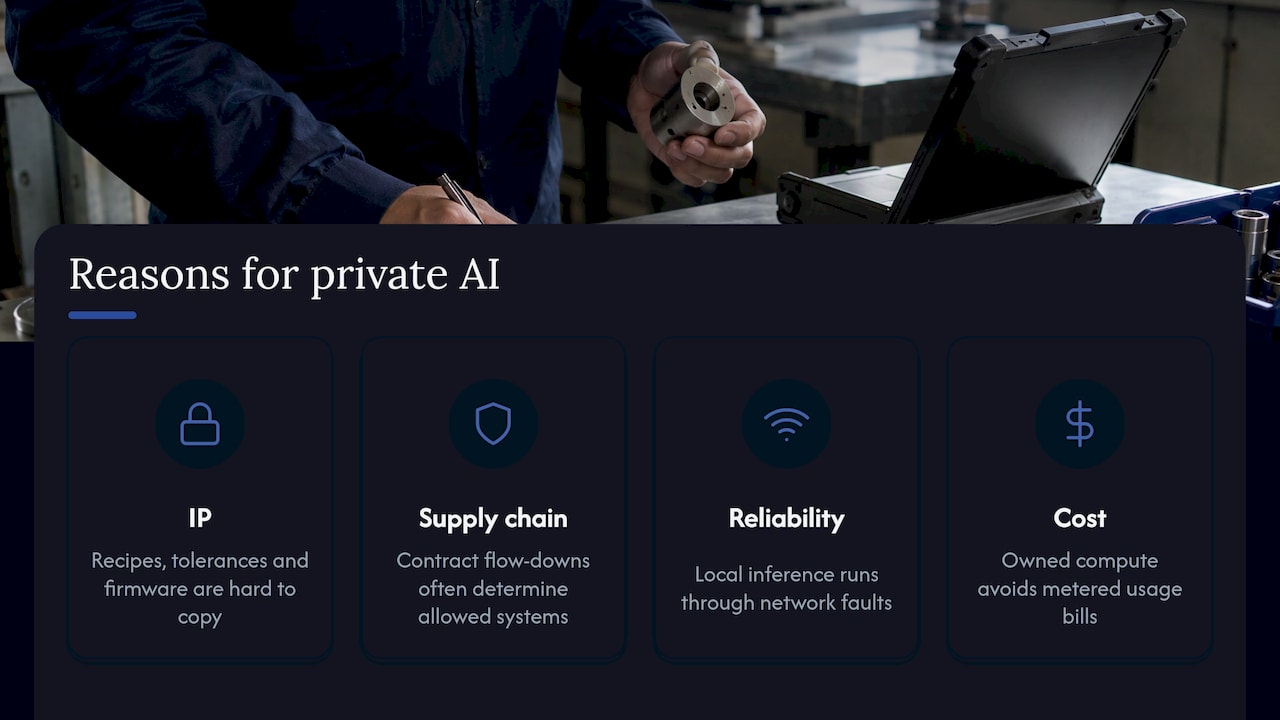
Intellectual property. Recipes, tolerances, tooling designs, firmware and process tuning are what competitors cannot copy. Sending them to an outside service, even one with strong contract terms, widens the number of places they exist and the number of parties who could be compromised.
Regulated and defense supply chains. Aerospace and defense suppliers handle technical data that comes with handling rules, and many of their customers expect it to stay on controlled systems. Contract flow-downs from prime contractors often decide what is allowed. If your plant sits in such a chain, a system that never connects outside is far simpler to defend than a cloud service with an exception process.
Operational reliability. A plant cannot stop because a vendor has an outage or a link to the internet drops. Local inference keeps assistants and inspection tools running through network faults, and it suits remote sites, shipyards, mines and plants with restricted connectivity.
There is also a plain cost argument for steady, high-volume workloads such as continuous image inspection: the compute you run every shift is hardware you own, not a metered usage bill that grows with the line.
Where private AI pays off in manufacturing
Start with tasks that are repetitive, document-heavy or visual. They are where results are easiest to measure.
Visual inspection and defect classification
A peer-reviewed study of a multi-agent visual inspection system reported 91.3% defect detection accuracy and 88.7% classification accuracy on the NEU-DET steel surface defect dataset. Across three industrial datasets it averaged 90.9% and 88.1%. The same work reports that inspection cycle time fell by 38%, from 108.3 seconds for human experts to 67.2 seconds, and that its root-cause inferences matched domain experts 79.2% of the time, against 44.7% for a rule-based baseline.
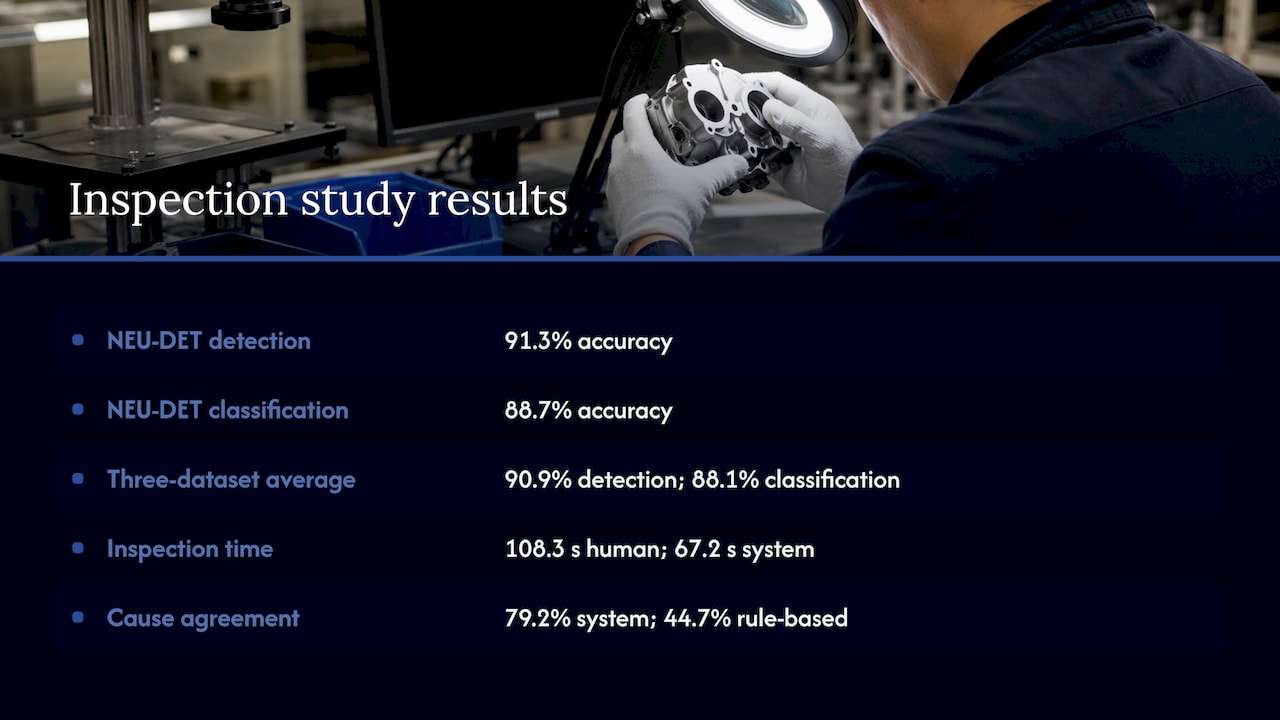
Those are research results on specific datasets, not a promise for your line. They do show what the category can do, and they point to the workflow worth piloting: detect, classify, then suggest a likely cause for an engineer to confirm. Inspection images often show unreleased parts, which is one more reason to process them locally.
Answers from technical document libraries
A typical plant holds decades of work instructions, maintenance manuals, equipment documentation, engineering change orders, standards and quality procedures. Technicians lose time hunting through them, and the answer they need is often in a PDF nobody remembers.
This is the job webAI Frontline does. It gives frontline teams fast, source-backed answers from large technical document libraries, fully offline on a single device. “Source-backed” matters on a floor: a technician can see which document and section an answer came from before acting on it. “Fully offline” means it works in a shielded area, on a remote site or on an air-gapped network.
Specialized assistants for specific roles
A general chatbot knows little about your plant. webAI Personas are specialized AI assistants shaped around a domain and a role, for example a quality engineer, a maintenance planner or a supply chain analyst. Running them privately means they can be grounded in your internal records without those records leaving your control.
Distributed workloads
Multi-plant manufacturers need models and updates to reach many sites in a controlled way. webAI’s Intelligence Delivery Network is the layer for delivering intelligence across an organization’s own infrastructure, which Forge integrates and operates for customers.
Securing a private AI system
Private does not automatically mean secure. A local system that anyone on the network can query is a new leak path. A peer-reviewed meta-framework published in PMC in February 2024 (Alonso et al.) found that the most important security and privacy requirements for AI in manufacturing concern unauthorized access and improper privilege management, information loss or system compromise, and the inability to detect and analyze incidents. The measures it points to are identity management and access control, data encryption and secure communication, and traceability of actions and data transactions.
Translated for a plant:
- Least-privilege access. A line operator, a quality engineer and a contractor should each see only the documents and data their role requires. The assistant must respect those same permissions, so it never answers from a document the user could not open directly.
- Encryption in storage and in transit. This includes the links between edge devices and any central cluster, not just the data center.
- Traceability. Log who asked what, which sources were used and which model version answered. When something goes wrong, you need to reconstruct it.
- Incident detection. Feed AI system logs into the monitoring your security team already runs.
- Handling of personal data. Work records, badge data and HR-adjacent documents can contain personal information. Our guide on PII handling in AI covers how to keep it contained.
Our own approach is to design deployments so that all data, models and domain intelligence remain inside the customer’s infrastructure, validated for privacy and auditability.
What to assess before you deploy
Skipping this stage is how pilots stall. Work through four areas.
Infrastructure
Inventory what you have: GPU capacity, storage, network segmentation, power and cooling at the edge sites, and rack space. Decide which workloads need a central cluster and which need a single device at the point of use. A document assistant for technicians may run on one device. Continuous multi-camera inspection will need more. Our on-premise AI deployment guide walks through sizing and rollout decisions for enterprises.
Models
Match the model to the task and the hardware, not to a leaderboard. Ask what the model must do (read documents, classify images, answer in a fixed format), how fast it must respond, and how it will be updated when you cannot pull updates from the internet. Domain tuning on your own documents often matters more than raw model size. Custom model integration and optimization is a core part of what we deliver.
OT and IT integration
This is where factories differ from offices. Your IT network and your OT network, the one that runs PLCs, SCADA and machines, usually sit in separate zones for good reason. Decide early which data the AI may read, in which direction it flows and what it is never allowed to write back. Map the data sources: MES, ERP, historians, quality systems, document repositories and camera feeds. Agree who owns the system after go-live, because the plant, IT and security teams all have a stake.
Operations
A private system needs someone to patch it, monitor it, update models and tune performance for years. Plan for this before launch, not after. It is the least glamorous item on the list and the one that decides whether the system is still useful in year three.
How to judge a pilot
Keep the pilot narrow: one plant, one workflow, one measurable outcome. Then define success before you start.
- Task accuracy. For inspection, defect detection and classification rates against your own labeled samples. For documents, whether answers are correct and whether the cited source supports them.
- Time saved. Inspection cycle time, time to find a procedure, time to resolve a maintenance question, measured against today’s baseline.
- Fit with the floor. Do operators use it without a workaround? Does it run within your latency needs on your actual hardware?
- Security posture. Does access follow your roles, and does the log show the full trail?
- Operability. Can your team keep it running, and what does a model update look like in your environment?
Set a go or no-go threshold for each in advance. A pilot that is judged afterwards on impressions tends to be extended forever.
What a deployment with Forge looks like
Forge AI Deployment is a systems integrator, not a software reseller. Our engagements cover:
- Secure local and air-gapped deployment
- Custom model integration and optimization
- Private AI assistant rollout
- Sovereign MLOps and runtime orchestration
- Performance tuning and ongoing sovereign operations
We bring webAI’s local-first platform into production: architecture, secure deployment, model integration and ongoing operation. Forge’s leadership has more than 20 years of experience in high-consequence and Fortune 100 environments, and we apply that operational discipline to plant networks where downtime and data exposure carry real cost. The webAI partnership page explains the platform behind our deployments, and for regulated settings the guide to generative AI in regulated industries is a good companion.
Perspective: private AI is an operations problem
Manufacturers often start by asking which model to use. We start by asking where the data lives and who has to keep the system running.
The model is the easy part. The hard parts are the segmented network, the permissions that mirror your org chart, the audit trail, the update path with no internet and the person who gets the call when the line is waiting on an answer. That is why we treat deployment and operation as one job.
Our deployments are designed so that data, models and domain intelligence stay inside your infrastructure. Pair that with webAI Personas for role-specific assistants, the Intelligence Delivery Network for reaching multiple sites, and webAI Frontline for source-backed answers offline on a single device, and a plant gets useful AI without opening a door it has spent years closing.
Start with one workflow where the value is easy to see. Get it running properly. Then extend.
John
Plan your private AI deployment
If your plant needs AI that works on-premises, at the edge or fully air-gapped, Forge AI Deployment can scope the architecture, deploy it and operate it with your team. See the Solutions page for the full list of services, or start at forgeprivate.ai to book an engagement conversation.
FAQ
Is private AI the same as running a chatbot on my own server?
Not quite. A model on a server is only one piece. Private AI also covers access control, encryption, logging, model updates, integration with your document and plant systems, and ongoing operation. Those pieces decide whether it is safe and useful in production.
Can private AI work in an air-gapped plant?
Yes. Air-gapped deployment is one of the core patterns. The system runs entirely on your own hardware with no outside connection, and updates are brought in through your controlled process. webAI Frontline, for example, delivers source-backed answers from large technical document libraries fully offline on a single device.
What should we automate first?
Choose a repetitive, measurable workflow such as visual inspection or finding answers in technical documentation. Research on multi-agent inspection has reported a 38% reduction in inspection cycle time against human experts on specific datasets, which shows why inspection is a common starting point. Your own baseline is what you should measure against.
Who needs to be involved on our side?
Plan for plant operations, IT, OT and security from the start. Operations defines the workflow and success measures, IT and OT define what the system may touch and security defines access and logging. Forge works with these teams on architecture, deployment and operation.
Sources
- Agent Collaboration for Manufacturing (multi-agent visual inspection study)
- Interoperable software platforms for introducing artificial intelligence in manufacturing (PMC, 2024)