
Sovereign AI is the capacity to develop, deploy, and govern artificial intelligence using infrastructure, data, and talent you fully control rather than borrowing someone else’s cloud and hoping for the best. It goes well past storing data in the right country. Pursue it when your workloads carry real legal, security, or competitive exposure, and treat it as a spectrum of control rather than an all-or-nothing project. Most organizations that succeed at this land somewhere in the middle, a posture analysts call managed interdependence.
TL;DR:
- Achieving true sovereignty requires control over infrastructure, data, model ownership, legal jurisdiction, and provenance, not just data location.
- Most organizations adopt a hybrid or regional approach, focusing on critical dependencies instead of full independence to manage costs and complexity effectively.
- Practical sovereignty techniques include confidential computing, air-gapped deployment, and immutable audit logs, which ensure control without sacrificing performance.
- Controlling access, encryption keys, and audit trails is essential for operational sovereignty, while poorly defined exit strategies can lead to vendor lock-in.
- Building sovereignty is expensive, involving higher costs, talent scarcity, and energy overhead, so incremental, targeted controls are typically more feasible than full self-sufficiency.
Table of Contents
- What Is Sovereign AI, Really?
- Why Organizations Actually Pursue Sovereign AI
- The Sovereignty Spectrum: Picking a Model That Fits
- How Governments Are Actually Building Sovereign AI
- Building Sovereign AI: Technical Choices That Actually Deliver Control
- Governance and the Liability Firewall
- A Pragmatic Roadmap for Getting There
- What Sovereign AI Actually Costs You
- How Forge AI Deployment Puts Sovereign AI Into Practice
- The Real Trade-Off Nobody Wants to Admit
- Ready to Move From Policy to Deployment?
- Sources
- FAQ
What Is Sovereign AI, Really?
People conflate sovereign AI with data sovereignty constantly, and it costs them. Data sovereignty just means your data sits on servers inside a given jurisdiction. Sovereign AI is bigger: it’s the ability to independently develop, deploy, and govern AI systems using your own infrastructure, data, and workforce, as McKinsey defines it. A server physically located in your country, running on infrastructure owned by a foreign company, can still be reachable under laws like the US CLOUD Act. That’s the trap CIO’s practitioner guidance warns about directly: residency without operational control is a false sense of security.
Real sovereign AI strategy spans five distinct dimensions, and skipping any one of them leaves a gap an auditor or adversary will eventually find:
- Territorial: where the physical infrastructure and data actually live.
- Operational: who can update, monitor, audit, or shut down the system, independent of a vendor’s cooperation.
- Technological and IP: whether you own the model weights, training pipeline, and underlying intellectual property, or you’re leasing access to someone else’s.
- Legal: which country’s courts and regulators have jurisdiction over the system and its outputs.
- Model provenance: whether you can trace training data, fine-tuning steps, and version history back to a verifiable source.
Each dimension answers a different question a regulator, board member, or hostile actor might eventually ask you. Territorial control answers “where is this data physically.” Operational control answers “who can turn this off.” Provenance answers “can you prove what this model was trained on.” A defense contractor might need airtight legal and operational control but tolerate a foreign chip supplier. A hospital network might prioritize provenance and IP control above almost everything else because a model producing biased diagnostic outputs is a liability nightmare that starts with untraceable training data.
Why Organizations Actually Pursue Sovereign AI
Three forces drive most sovereign AI decisions, and they rarely show up in the same order for every organization.
The first is liability. When a deployed model makes a bad call, that is a wrong prescription, a discriminatory loan denial, a compliance breach, regulators and courts increasingly hold the deployer responsible, not the model vendor. Retaining operational control and full audit trails functions as what analysts describe as a liability firewall, giving you the evidence to show what the system did and why. McKinsey’s insight on this is worth internalizing: sovereignty isn’t just a security posture, it’s a legal defense strategy.
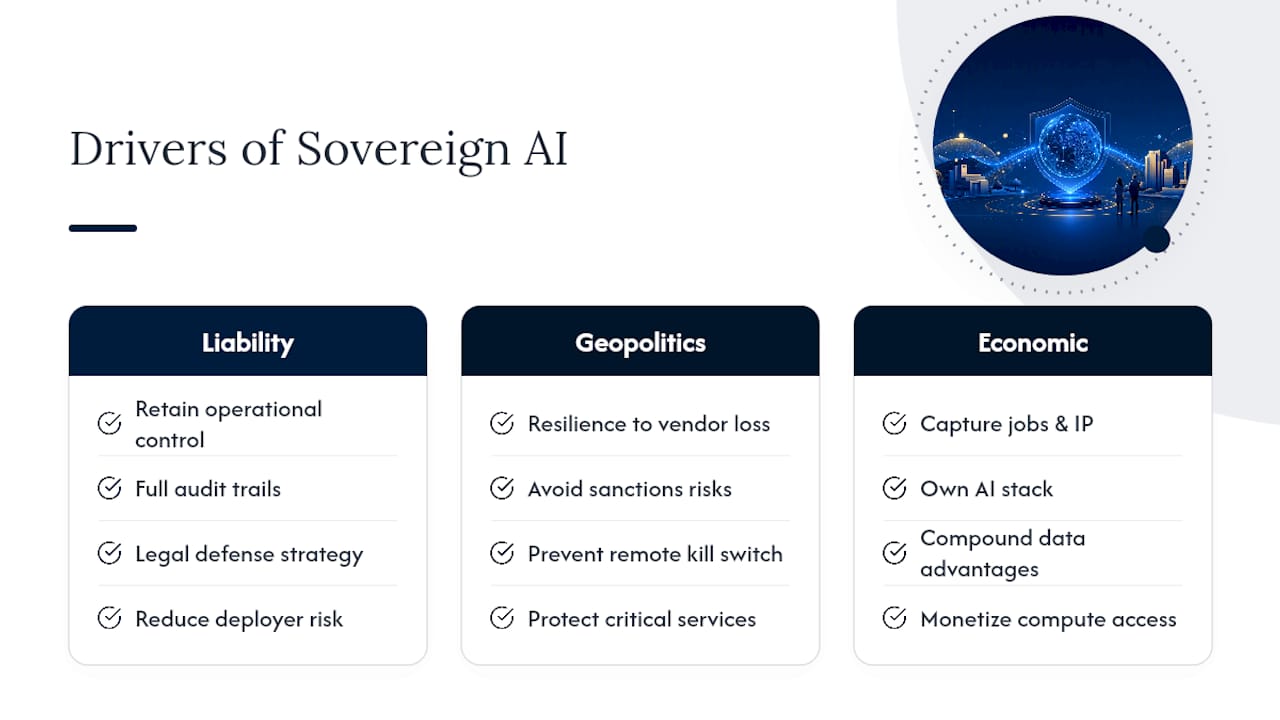
The second is geopolitical resilience. Organizations in finance, defense, and critical infrastructure worry about a foreign vendor losing access, facing sanctions, or getting compelled to disable service during a dispute. A kill switch you don’t control is a kill switch someone else can pull.
The third is economic value capture. Nations and large enterprises alike want the jobs, IP, and compounding data advantages that come from owning the AI stack instead of renting it forever.
By the numbers: the UK government launched a Sovereign AI Fund that pairs capital investment with subsidized compute access for domestic AI startups, one of several national programs treating compute availability as a strategic asset rather than a commodity.
Sectors that show up first on this list: defense, finance, healthcare, energy, and logistics. All five combine strict regulation with catastrophic downside if a model leaks proprietary data or makes an unauditable decision.
The Sovereignty Spectrum: Picking a Model That Fits
Nobody needs to build a domestic chip industry to get meaningful sovereignty. Four practical models cover almost every real-world case, and picking the wrong one wastes money without buying you the control you actually need.
- Full sovereignty: every layer, from silicon to model training to deployment, sits inside infrastructure you own and control. This is expensive and slow to stand up, and it fits national governments or the most heavily regulated defense and intelligence workloads. Almost no enterprise needs this tier in full.
- Hybrid sovereignty: sensitive workloads run on-premises or air-gapped, while lower-risk tasks use public cloud or third-party models. This is where most enterprises land, because it matches control to actual risk instead of applying one policy to everything.
- Regional sovereignty: infrastructure and governance stay within a defined bloc or region (the EU, for instance) rather than a single country, trading some autonomy for shared scale and cost.
- Sectoral sovereignty: an entire industry, banking or healthcare, for example, builds shared standards and sometimes shared infrastructure to meet regulatory requirements collectively rather than each firm reinventing controls alone.
Carnegie Endowment’s analysis frames this correctly: sovereignty works best as a spectrum of managed interdependence, where you control the dependencies that matter most and partner out the rest, rather than a binary choice between total control and total outsourcing.
How Governments Are Actually Building Sovereign AI
National programs give the clearest evidence of what works and what doesn’t, because governments have to justify every dollar spent. Several patterns repeat across countries pursuing this at scale in 2026:
- Sovereign funding vehicles that pair capital with compute access, following the model set by the UK’s Sovereign AI Fund.
- Public investment in domestic infrastructure, local datasets, and homegrown technical talent, so models get trained and tuned for local languages, regulations, and citizens rather than adapted from a foreign default, a pattern NVIDIA has documented across multiple national strategies.
- Procurement rules that favor vendors meeting specific operational or data-residency criteria, using government buying power as a policy lever instead of new regulation.
The recurring pitfall: nations that chase full self-sufficiency across every layer, chips, models, cloud, talent, at once tend to burn budget without shipping usable systems. The programs that show results pick two or three critical dependencies and lock those down first.
Building Sovereign AI: Technical Choices That Actually Deliver Control
The infrastructure decision comes down to four real options: fully on-premises, colocation in a controlled data center, a sovereign cloud region operated under local jurisdiction, or a distributed cloud architecture with strict data-residency guarantees. Each trades cost and agility against how much direct control you retain.
Beneath that infrastructure choice sit the technical primitives that make sovereignty enforceable rather than theoretical:
- Confidential computing and trusted execution environments (TEEs) keep data encrypted even while it’s being processed, not just at rest or in transit.
- Air-gapped deployment physically isolates systems from external networks, the standard for the highest-sensitivity defense and intelligence workloads.
- Customer-managed encryption keys mean the infrastructure provider literally cannot decrypt your data without your cooperation.
- Immutable audit logs and model provenance tracking let you reconstruct exactly what a model was trained on and what it did at any point in time.
IBM’s taxonomy of AI sovereignty puts confidential computing at the center of practical implementation, and for good reason: it lets an organization keep a model performant without ever exposing raw data to a third party, even during active inference. Techniques like Entropy-Weighted Quantization, used in some private deployments, push this further by compressing models to run efficiently on local hardware without a round trip to the cloud, which removes one of the biggest practical objections to going sovereign: that it means sacrificing performance for control.
Pro Tip: Before you evaluate any vendor’s sovereignty claims, ask them one direct question: can you produce an immutable log of every training data source and every inference request for the past 90 days, on demand, without their engineering team’s help? If the answer requires a support ticket, you don’t have operational sovereignty yet.
Governance and the Liability Firewall
Sovereignty only holds up under legal and regulatory scrutiny if the governance behind it is airtight. That means identity and access management tight enough to know exactly who touched a model and when, logging that can’t be quietly edited after the fact, and explainability tooling that can answer a regulator’s questions about a specific decision.
Four questions separate organizations with real operational sovereignty from those with a false sense of it:
- Who has physical and administrative access to the systems, and is that list current?
- Who holds the encryption keys, and can the infrastructure provider access data without you?
- Who can disable or roll back the system in an emergency, and how fast?
- Can you reconstruct, after the fact, exactly what data trained the model and what it output on a given date?
By the numbers: Stanford HAI’s analysis urges policymakers and enterprises to specify which layer of the AI stack they actually need to control, security, economic, or cultural, rather than pursuing undirected full autonomy that nobody can afford or maintain.
Red-team testing and a documented incident-response plan round out the checklist. Regulators increasingly want to see that you tested for failure before it happened, not just that you reacted well afterward.
A Pragmatic Roadmap for Getting There
Start by segmenting workloads, not by buying infrastructure. McKinsey’s guidance here is blunt: only your highest-value or most regulated workloads need to move into sovereign infrastructure. Everything else can keep running on public models while you build capacity.
A workable rollout looks like this:
- Inventory workloads by sensitivity and regulatory exposure, then rank them, not every use case deserves the same investment.
- Run a pilot on one genuinely sensitive workload with clear success metrics defined before you start, not after.
- Set a scale decision point in advance: what result triggers expansion, and what result triggers a rethink.
- Vet partners on operational transparency, not marketing claims. Ask what happens if you want to leave.
- Define your exit route on day one. Portable model formats, exportable audit logs, and no proprietary lock-in on your own data are non-negotiable terms, not nice-to-haves.
Skipping that last step is the single most common mistake. Organizations that never define an exit plan often discover, two years in, that “sovereign” deployment actually just moved the lock-in problem instead of solving it.
What Sovereign AI Actually Costs You
Sovereignty isn’t free, and pretending otherwise sets up unrealistic budget conversations. The honest list of trade-offs:
- Higher upfront capital and ongoing operating costs versus renting cloud AI by the token.
- Real energy and sustainability overhead if you’re running your own compute infrastructure.
- Talent scarcity: skilled MLOps and security engineers capable of running sovereign infrastructure are in short supply and expensive to retain.
- Continued dependence on a small number of GPU manufacturers regardless of how sovereign your software stack is, a constraint even national programs haven’t solved.
Pooling compute with trusted partners or selecting a hybrid model instead of full sovereignty mitigates most of this without abandoning the core goal.
How Forge Puts Sovereign AI Into Practice
An experienced private AI specialist emphasizes operational discipline over software resale in its deployment approach, shaped by extensive work in high-security, high-consequence environments. Its work centers on a few concrete capabilities:
- Air-gapped deployments that keep data, models, and domain intelligence entirely inside client infrastructure.
- Entropy-Weighted Quantization, which keeps models efficient on local hardware without any cloud dependence.
- Sovereign MLOps and runtime orchestration built through its webAI partnership, the platform underpinning Forge deployments.
- Ongoing performance tuning and operations support after the initial rollout, not just a one-time install.
This approach is suitable for organizations in highly regulated and critical sectors that require sovereign AI deployments, particularly when undertaking pilots, procurement decisions, or compliance-driven AI infrastructure rebuilds.
The Real Trade-Off Nobody Wants to Admit
Here’s what the conventional advice on sovereign AI gets wrong: it treats sovereignty as a purity test, an all-or-nothing declaration of independence from the cloud. That framing wastes budget and delays deployment on workloads that don’t need it. The actual research supports a more useful position: sovereignty is a set of specific, answerable questions, who can access this, who can shut it off, who holds the keys, applied to the specific workloads where the answer genuinely matters.
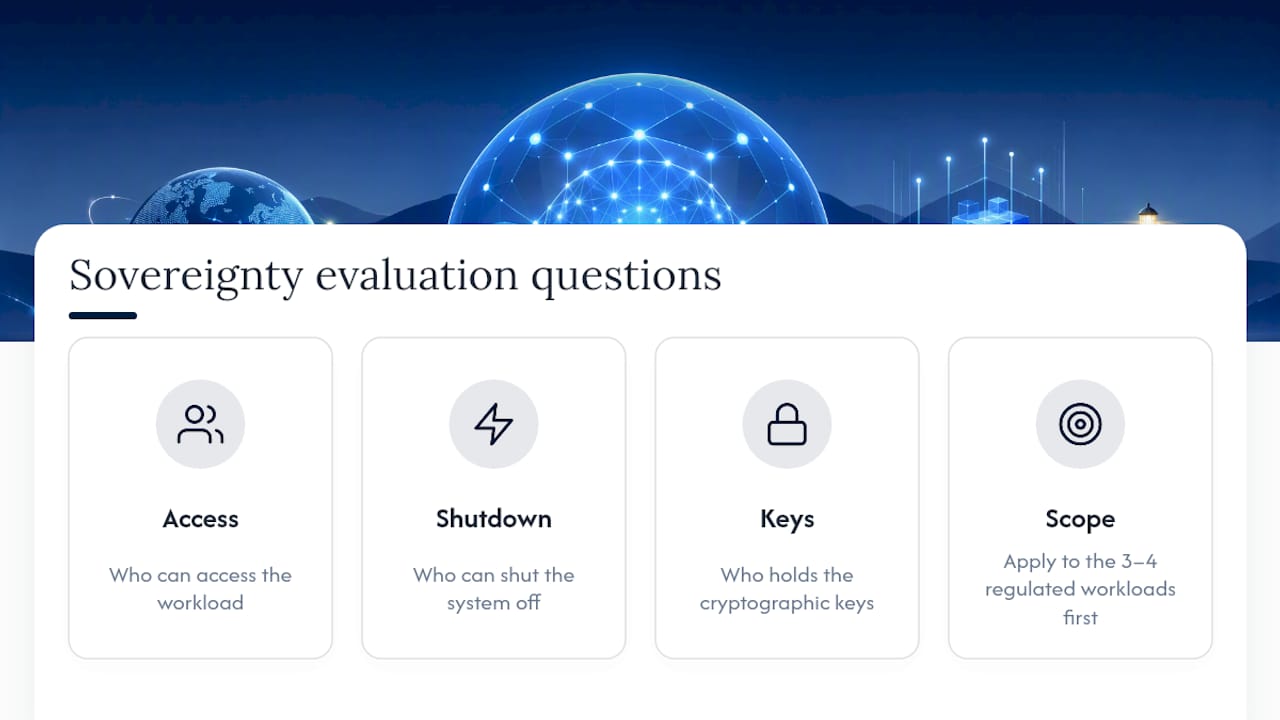
Where most organizations go wrong isn’t underinvesting in sovereignty. It’s misallocating it, spending months building an air-gapped fortress for a marketing chatbot while their actual regulated, high-liability workload still runs on a vendor’s default cloud terms. Segment first. Figure out which three or four workloads would actually hurt you if a foreign vendor lost access or a court subpoenaed the wrong server. Build sovereignty there first, and let the rest wait.
What Forge’s air-gapped deployment work and Entropy-Weighted Quantization approach demonstrate is that this doesn’t have to mean sacrificing model performance to get operational control. That trade-off used to be real. It’s shrinking fast, and the organizations still assuming they must choose between capability and control are the ones falling behind.
— John Ezzell, Founder
Ready to Move From Policy to Deployment?
If you’ve made it this far, you already know the gap between understanding sovereign AI and actually operating it. Forge closes that gap by handling the entire deployment inside your own infrastructure, not a shared tenant, not a vendor’s cloud with a sovereignty label attached to it.
Its services cover the full lifecycle: secure local and air-gapped deployment, custom model integration and optimization, private AI assistant rollout, sovereign MLOps and runtime orchestration, and ongoing performance tuning once the system is live. Pricing for each engagement is available on request, since scope varies by workload and infrastructure. If you’re heading into a pilot, a procurement cycle, or a compliance deadline that’s forcing the sovereignty question onto your roadmap, this is the moment to reach out. Review the full breakdown on the Forge solutions page and start the conversation about what a sovereign deployment would actually look like inside your own environment.
Sources
- What is sovereign AI? | McKinsey
- AI sovereignty’s definitional dilemma | Stanford HAI
- Early lessons in the pursuit of sovereign AI | Carnegie Endowment
- What is sovereign AI? Strategic control of your AI future | CIO
FAQ
What Is Sovereign AI?
Sovereign AI is an organization’s or nation’s ability to independently develop, deploy, and govern AI systems using its own infrastructure, data, and talent, spanning territorial, operational, technological, and legal control, as McKinsey defines it. It goes beyond data residency: physical location alone doesn’t guarantee you can audit, update, or disable a system independently.
What Does McKinsey Say About Sovereign AI?
McKinsey frames sovereign AI around four core dimensions, territorial, operational, technological and IP, and legal, and positions it as a liability firewall that gives organizations auditable control when a deployed model causes harm. Its explainer also recommends segmenting workloads by sensitivity rather than applying sovereignty everywhere at once.
Who Controls Sovereign AI?
Control belongs to whoever holds operational authority: the entity that manages access, holds encryption keys, can audit training data, and can shut the system down without a vendor’s cooperation. A server sitting in the right country under a foreign-owned provider can still be legally reachable, which is why CIO’s guidance treats operational control as the real test, not physical location. Forge’s air-gapped model is built around keeping that control entirely inside the client’s own environment.
Which Countries Have Sovereign AI Programs?
The UK operates a Sovereign AI Fund that pairs capital investment with compute access for domestic startups, and multiple other nations are building domestic infrastructure, local datasets, and homegrown AI talent, a pattern NVIDIA has tracked across several national strategies. Most of these programs pursue a spectrum of control rather than complete self-sufficiency across every layer of the AI stack.
How Much Does Forge’s Sovereign AI Deployment Cost?
Forge prices each engagement based on scope, infrastructure, and workload complexity, so current rates aren’t published as a flat number. Details and next steps are available through the Forge solutions page.