Choose RAG when facts change weekly and answers need traceable sources; choose fine-tuning when you need consistent tone, format, or behavior on a knowledge base that barely moves. Most mature deployments end up running both. Check your update frequency, latency budget, and labeled-data supply before committing to either one.
TL;DR:
- RAG is ideal for applications with weekly or more frequent knowledge updates and needs source citation for factual answers.
- Fine-tuning provides consistent tone, formatting, and behavior but requires retraining, which can be costly and may cause performance drift over time.
- Hybrid setups, combining fine-tuning for style and retrieval for current facts, often deliver the best results in enterprise environments.
- Deployment constraints like security or sovereignty might limit retrieval frequency, making structured fine-tuning or hybrid models more suitable.
- Key performance indicators include retrieval recall, hallucination rate, and indexing lag, which should guide decision-making over vendor claims alone.
Table of Contents
- RAG vs Fine Tuning: How Retrieval-Augmented Generation Actually Works
- RAG vs Fine Tuning: What Fine-Tuning Changes Under the Hood
- RAG vs Fine-Tuning: The Trade-Offs That Actually Move the Needle
- When to Choose RAG, Fine-Tuning, or a Hybrid Setup
- Building and Running Either System Without It Falling Apart
- Hybrid Patterns: Running RAG and Fine-Tuning Together
- Why Secure Deployment Changes the RAG vs Fine-Tuning Calculus
- Get a Secure Path to RAG, Fine-Tuning, or Hybrid Deployment
- Sources
- FAQ
RAG vs Fine Tuning: How Retrieval-Augmented Generation Actually Works
Retrieval-augmented generation pulls relevant text from an external knowledge base at the moment a query arrives, then feeds that text into the model’s prompt alongside the question. This is what lets RAG systems answer with facts the model was never trained on, and cite exactly where each answer came from, a mechanism first formalized in the 2020 RAG paper from Meta AI researchers.
The pipeline has a handful of moving parts, and each one is a place where things break:
- Chunking: documents get split into passages, usually by sentence, paragraph, or a sliding window, and bad splits create half-formed context.
- Embedding: each chunk becomes a vector; the embedding model’s quality sets a ceiling on everything downstream.
- Vector database: stores embeddings and runs approximate nearest neighbor (ANN) search to find candidates fast.
- Retriever and reranker: the first pass grabs plausible matches, a reranker narrows them to the best few before they hit the prompt.
The most common failure isn’t the language model. It’s retrieval returning the wrong chunk, or an index that hasn’t been refreshed since last quarter.
RAG vs Fine Tuning: What Fine-Tuning Changes Under the Hood
Fine-tuning takes a pretrained model and continues training it on labeled examples specific to your task, baking domain behavior directly into the weights instead of pulling it in at query time. That’s the core mechanical difference in any rag vs fine-tuning comparison: RAG hands the model new information at inference; fine-tuning changes what the model already knows.
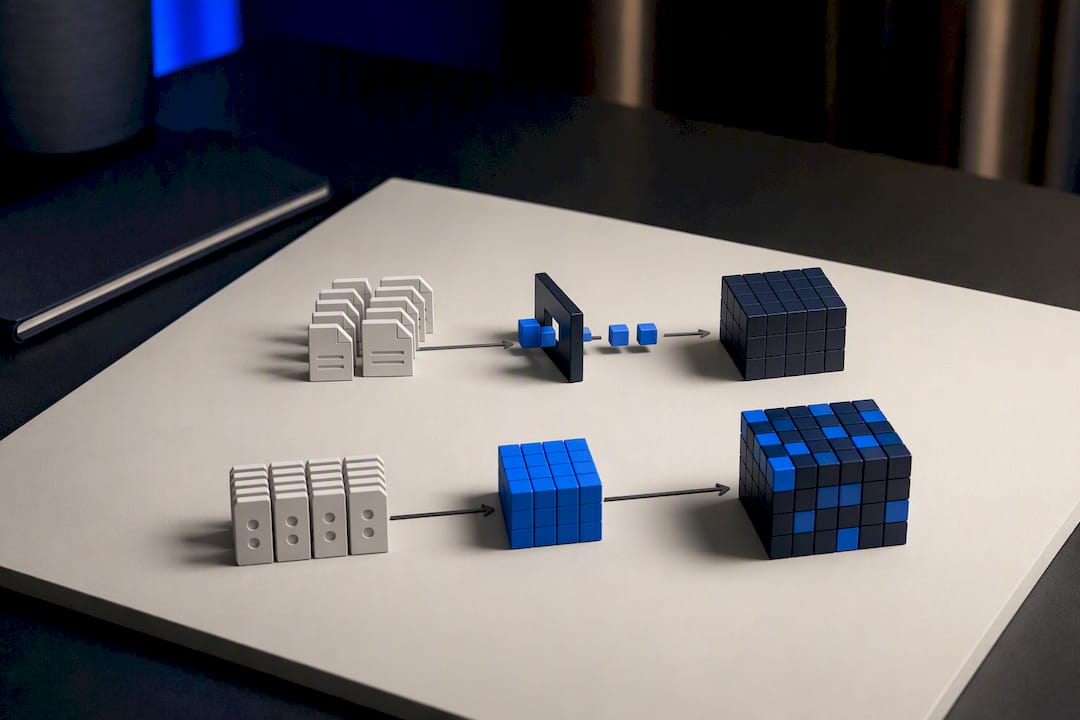
Full supervised fine-tuning updates every parameter and is expensive at scale. Parameter-efficient fine-tuning (PEFT) methods, LoRA chief among them, freeze most of the model and train small adapter layers instead, cutting compute cost sharply while recovering most of the performance gain. Some teams add a reinforcement-learning-from-human-feedback (RLHF) pass on top to shape tone and refusals.
A few things to plan around before you commit:
- Dataset size scales inversely with base model capability. A smaller model may need tens of thousands of examples; a strong foundation model can shift meaningfully with a few thousand well-curated pairs.
- Every fact baked into weights has a shelf life. Retraining cadence becomes a recurring line item, not a one-time cost.
- Aggressive fine-tuning can cause behavior drift, where the model gets better at your task but worse at things it used to handle fine.
RAG vs Fine-Tuning: The Trade-Offs That Actually Move the Needle
The retrieval-augmented-generation-vs-fine-tuning decision comes down to six dimensions, and most teams only think seriously about two of them before they build.
Update frequency and data currency. RAG can index a new document in minutes; fine-tuning demands a full retraining cycle and degrades toward staleness the longer you wait between cycles, according to AWS’s prescriptive guidance on the two approaches. If your knowledge base changes weekly, RAG wins by default.
Control over output style. Fine-tuning is better at enforcing a consistent voice, structure, or refusal pattern across thousands of requests, because that behavior lives in the weights rather than depending on what gets retrieved. RAG can hallucinate around gaps in retrieval; fine-tuning can hallucinate confidently in a consistent style, which is arguably worse.
Operational cost. Fine-tuning concentrates cost up front in training runs. RAG spreads cost across ongoing indexing, vector storage, and per-query retrieval calls.
Latency and infrastructure. RAG adds a retrieval hop, embedding calls, and reranking before generation even starts, meaning more moving parts and more places for latency to creep in.
Traceability. RAG can cite the exact source document behind an answer. Fine-tuned models can’t point back to where a fact came from, since it’s been absorbed into parameters.
Team skills. RAG leans on data engineering and search infrastructure; fine-tuning leans on ML training expertise and GPU scheduling.
Here’s the ranking that matters most for regulated industries:
- Traceability and compliance
- Data currency
- Control and consistency
- Operational cost
- Latency
- Team skillset availability
Pro Tip: Before choosing, run both a retrieval-quality baseline and a small fine-tune ablation on the same 50 test questions. Whichever one produces fewer factual errors on your actual domain data should shape your default, not whichever one sounds better in a vendor pitch.
Hybrid setups, fine-tuning for behavior and RAG for facts, routinely beat either approach alone once an enterprise has both a stable domain voice to maintain and a knowledge base that keeps moving.
When to Choose RAG, Fine-Tuning, or a Hybrid Setup
A few thresholds cut through most of the deliberation:
- If documentation changes faster than weekly and answers must cite sources, start with RAG. Full stop.
- If queries need deterministic formatting or behavior at high volume, and you can absorb a retraining cadence, evaluate fine-tuning or PEFT.
- If you need both a stable voice and live facts, plan for hybrid from day one instead of bolting one onto the other later.
Before locking in, run a pilot. Measure baseline retrieval precision and hallucination rate on RAG. Separately, run a small fine-tune ablation, 5,000 to 10,000 examples or a PEFT adapter, on the same test set, then compare hallucination and consistency scores side by side.
Build a cost model before you decide, not after. Account for embedding refresh cycles, vector database operations, and per-inference token costs against fine-tuning amortized over your expected request volume and retraining frequency. Teams that skip this step tend to discover the “cheaper” option was cheaper only in the first quarter.
Building and Running Either System Without It Falling Apart
Index design decides most of your retrieval quality before a single query runs. Sentence-level chunks preserve precision but lose context; paragraph-level chunks do the opposite; sliding windows split the difference at the cost of some duplication. Tag chunks with metadata (source, date, section) so retrieval can filter, not just rank.
A few nonnegotiables for either path:
- Version your embedding model explicitly, since swapping it without reindexing silently corrupts retrieval quality.
- Test recall@k and mean reciprocal rank (MRR) against a labeled query set before shipping, not after users start complaining.
- Place your reranker deliberately. It adds latency, so measure whether the accuracy gain justifies the extra hop.
- For fine-tuning, keep a clean validation set separate from training data and log PEFT hyperparameters (rank, learning rate, epochs) for every run.
- Track hallucination rate as false factual claims per 1,000 responses, plus indexing lag and embedding drift over time as your core reliability signals.
Track retrieval recall@k, MRR, hallucination rate, and indexing lag as your primary service-level indicators; these four numbers catch most production regressions before users do. On the distillation side, effectiveness depends heavily on task complexity and data quality, not just on model size, so don’t assume a smaller distilled model automatically saves money once you account for the extra evaluation work.
Hybrid Patterns: Running RAG and Fine-Tuning Together
The pattern that keeps showing up in mature deployments: fine-tune for behavior and format, use RAG for facts that need to stay current. A legal assistant fine-tuned to always structure answers as issue, rule, application, conclusion, but pulling live case law through retrieval, gets both consistency and currency without asking one technique to do the other’s job.
Coordination is where hybrid setups get tricky, not the individual pieces:
- Decide explicitly whether retrieved context overrides fine-tuned instincts when the two disagree, and write that rule down.
- Version fine-tuned models and index snapshots together so you can roll back a bad deploy cleanly.
- Watch for conflict cases: a model fine-tuned on outdated policy that contradicts a freshly retrieved document is a real failure mode, not an edge case.
Knowledge workers and legal or compliance assistants tend to be where hybrid wins most visibly, since both structured output and up-to-the-minute source material matter at once.
Why Secure Deployment Changes the RAG vs Fine-Tuning Calculus
Air-gapped and sovereign environments change this calculus more than most vendors admit. Retrieval cadence gets constrained when there’s no live connection to refresh an index, which pushes some teams toward scheduled retraining instead of continuous RAG updates. Forge AI Deployment builds both paths inside client infrastructure, so the choice stays technical rather than a workaround for data exfiltration risk. If sovereignty or security is your primary constraint, that’s worth an assessment before you pick an architecture.
Get a Secure Path to RAG, Fine-Tuning, or Hybrid Deployment
Some vendors offer solutions to deploy AI architectures entirely inside your own infrastructure, with no data ever touching a third-party cloud.
If you’ve read this far, you already know RAG and fine-tuning both come with real operational weight, indexing pipelines, retraining cycles, GPU scheduling, monitoring. Forge’s solutions cover secure local and air-gapped deployment, custom model integration and optimization, and sovereign MLOps and runtime orchestration, so your team isn’t building retrieval infrastructure and training pipelines from scratch while also trying to keep sensitive data locked down. The work draws on two decades of experience in high-security environments, and Forge’s accessibility conformance report is public for teams that need to verify that before procurement. If security or sovereignty is a factor in your architecture decision, get in touch about a deployment assessment.
Sources
- Comparing Retrieval Augmented Generation and fine-tuning (AWS Prescriptive Guidance)
- LLMs: Fine-tuning, distillation, and prompt engineering (Google Developers)
- RAG vs Fine Tuning: Enterprise Decisions for AI Models and AI Systems (Databricks)
- LLM distillation explained: Applications, implementation & more (DataCamp)
FAQ
What Makes a Fine-Tune Count as RAG?
It doesn’t. RAG and fine-tuning are separate mechanisms: RAG retrieves external documents at query time, while fine-tuning changes model weights during training. A system only counts as RAG if it retrieves and injects context into the prompt at inference, regardless of whether the underlying model has also been fine-tuned.
Is There Something Better Than RAG?
Nothing beats RAG outright for source traceability and fast-changing facts, but it isn’t better than fine-tuning for consistent tone or format at high volume. A hybrid setup that combines both usually outperforms either one running alone in enterprise use.
Is Fine-Tuning Still Relevant Now That RAG Exists?
Yes. Fine-tuning remains the better tool when you need deterministic behavior, a specific voice, or structured output at scale, none of which RAG controls well on its own. PEFT methods like LoRA have also made fine-tuning cheaper and more accessible than full retraining ever was.
How Does Distillation Differ From Quantization?
Distillation trains a smaller model to mimic a larger one’s outputs, transferring behavior rather than just compressing weights. Quantization instead reduces the numerical precision of an existing model’s weights to shrink size and speed inference, without training a new model at all. Forge uses Entropy-Weighted Quantization specifically to keep models efficient in air-gapped deployments without a cloud dependency.
Does Forge Support Both RAG and Fine-Tuning?
Yes. Forge’s solutions cover custom model integration and optimization alongside sovereign MLOps and runtime orchestration, supporting RAG, fine-tuning, or hybrid architectures inside a client’s own infrastructure. Pricing is available on request through the solutions page.