You can’t prevent every LLM jailbreak with one filter, one prompt or one model setting. You can make jailbreaks hard, noisy and low-impact by layering controls around the model: input and output checks, a clear instruction hierarchy, narrow permissions, rate limits, red teaming and monitoring. This guide walks through each layer, explains how a jailbreak differs from prompt injection, and covers what changes when the model runs inside your own infrastructure.
TL;DR
- A jailbreak tries to make a model ignore its own safety rules. Prompt injection tries to override an application’s instructions with untrusted input. You defend against both, with overlapping controls.
- Research indicates a perfect jailbreak classifier is not achievable, so the goal is to raise attacker cost and shrink the damage a successful jailbreak can do.
- The strongest programs combine input and output classifiers, rate limits, scoped tool access, identity-aware retrieval, red teaming and monitoring.
- Private and air-gapped deployments remove external exposure and data egress, but the model can still be jailbroken, so the same layers apply inside the perimeter.
Table of Contents
- What a jailbreak attack is, and how it differs from prompt injection
- Why one safeguard never closes the door
- The layers of a jailbreak defense
- How to test whether your defenses hold
- What to monitor after launch
- Private and air-gapped deployments: what changes and what doesn’t
- A practical checklist
- Our perspective
- Deploying jailbreak-resistant AI inside your perimeter
- FAQ
- Sources
What a jailbreak attack is, and how it differs from prompt injection
A jailbreak is an attempt to bypass an LLM’s safety mechanisms so that it produces restricted content or takes actions it was trained to refuse. OWASP’s LLM01:2025 entry treats jailbreaking as a form of prompt injection in which the attacker’s input causes the model to disregard its safety protocols.
Others draw a sharper line. Simon Willison argues that prompt injection targets applications that concatenate untrusted user input with a trusted developer prompt, while jailbreaking targets the safety filters built into the model itself. Learn Prompting’s comparison adds that jailbreaking can stem from architectural or training issues, while prompt injection is primarily architectural.
Why does the distinction matter in practice? It tells you where to put the control:
- Jailbreak risk is mostly addressed at the model and its guardrails: training, classifiers, refusal behavior.
- Prompt injection risk is mostly addressed at the application: how prompts are assembled, what the model can reach and what it can do.
A real incident often involves both. A user jailbreaks the model, and the model then uses a tool or a retrieved document it should never have touched. That is why the defenses below span the whole system.
Why one safeguard never closes the door
The honest starting point is that jailbreak prevention is risk reduction, not elimination. Several lines of research point the same way.
- A paper on the “jailbreak paradox” argues that a universal, perfect jailbreak classifier is impossible, in part because there is no fixed, deterministic definition of alignment across applications with different goals.
- The “Jailbroken” study of safety training failures concludes that safety mechanisms need to be as sophisticated as the underlying model, and that scaling alone will not resolve the failure modes.
- A Cloud Security Alliance research note frames prompt injection like social engineering: a persistent problem that can be materially reduced but not eliminated.
- A system design handbook makes the architectural point: instructions and data share the same natural-language channel, so untrusted strings can hijack behavior. Safety is a system-architecture problem, not a prompt-engineering one.
The practical reading: stop asking whether a defense is unbreakable and start asking what it costs an attacker, what it would catch, and what the worst outcome is if it fails.
The layers of a jailbreak defense
Think of the controls as concentric rings. Each one assumes the one outside it will sometimes fail.
Layer 1: Instruction hierarchy and prompt design
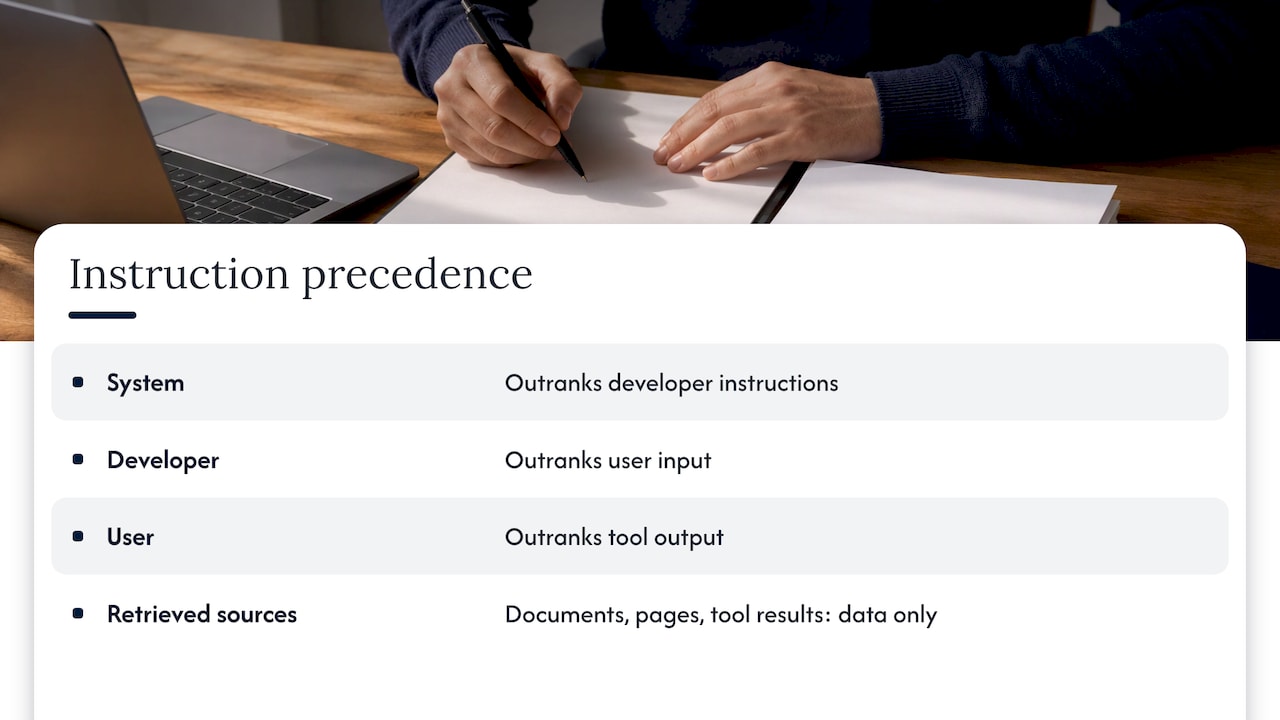
Define who outranks whom. A common pattern is a prompt hierarchy in which system instructions outrank developer instructions, which outrank user input, which outranks tool output, as described in the LLM safety handbook. Treat anything retrieved from a document, web page or tool result as data, never as instructions.
Prompt wording alone will not hold against a determined attacker. Its job is to set a clean baseline so the layers behind it have less to catch.
Layer 2: Input and output classifiers
Runtime detectors inspect what goes into the model and what comes out. The same handbook lists runtime jailbreak detectors such as Llama Guard as part of defense in depth. Anthropic’s published safeguards describe Constitutional Classifiers: LLMs that monitor inputs and outputs in real time and block information needed to carry out specified threats. Anthropic also vets some users manually before letting them use models without real-time classifier restrictions, which shows a useful principle: trust can be tiered by identity.
Output checks matter as much as input checks. A cleverly disguised request may pass the input filter, but the harmful content still has to appear in the response before it can hurt anyone.
Layer 3: Rate limits and access control
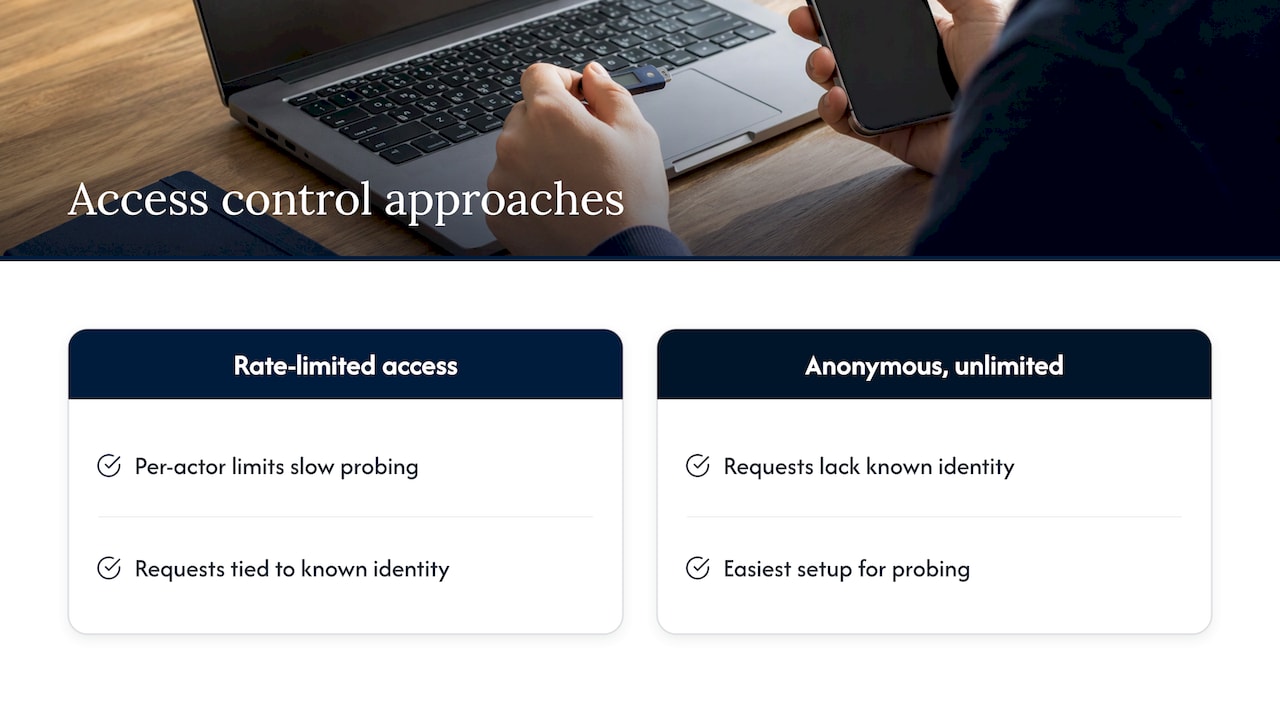
Most jailbreaks are found by trial and error. The OWASP AI Security and Privacy Guide recommends limiting access to the model per actor (user, API key or session) to severely slow down the experimentation behind many AI attacks, including prompt injection attempts and the search for adversarial samples.
Pair rate limits with strong authentication, so each request ties to a known identity. Anonymous, unlimited access is the easiest setup for an attacker to probe.
Layer 4: Scoped tools and identity-aware retrieval
A jailbroken model with no useful reach does little harm. A jailbroken model with broad tool access can do a lot. Three controls shrink the blast radius:
- Gate tool calls. Treat every tool invocation as gated, validated and auditable.
- Enforce permissions at retrieval. One practitioner write-up on RAG data exposure recommends identity-aware retrieval at the vector store before documents are fetched, with runner permissions bound to the caller instead of a global service role.
- Segment capabilities. The Cloud Security Alliance note advises narrow capability scopes with human approval for cross-capability actions, so one compromised agent cannot chain its way across systems.
Sensitive data deserves its own treatment. If personal or regulated data never reaches the model, a jailbreak cannot extract it. Our guide to PII redaction for LLMs covers masking data before it reaches a model, and our piece on LLM caching strategies covers how shared caches can leak tenant data.
Layer 5: Sandboxing
If the model can execute code or call external systems, run that execution in a sandbox with no standing credentials and no network path to anything it does not need. The handbook above lists sandboxed execution as part of the standard defense-in-depth stack.
How to test whether your defenses hold
A defense you have not attacked is an assumption. Testing should be repeatable, measured and tied to release decisions.
- Build an attack corpus. Include known jailbreak families (role-play, encoding tricks, multi-turn escalation, instruction override) and cases specific to your business, such as requests for restricted internal documents.
- Automate the sweep. Open benchmarking work shows this is feasible with local models: a standardized red-teaming pipeline in the adversarial robustness literature supports both cloud-based and locally loaded LLMs, so testing does not require sending prompts to an outside service.
- Add human red teamers. Automated suites find known patterns. People find the creative ones.
- Measure, don’t eyeball. Track attack success rate, false refusal rate on legitimate requests and time to detect. Our article on measurable red teaming in sovereign deployments goes deeper on scoring.
- Feed failures back. Practitioner guidance recommends sending adversarial-testing failures into training and refreshing thresholds and prompts, because defenses drift as threats evolve.
Re-run the suite whenever you change the model, the system prompt, the retrieval corpus or the toolset. Any of those can reopen a hole you closed last month.
What to monitor after launch
Jailbreak defense does not end at deployment. Log prompts, outputs, classifier verdicts, refusals, tool calls and rate-limit hits, tied to user identity. Look for repeated near-identical prompts from one account, sudden spikes in refusals and unusual tool-call sequences.
One framework argues for integrating LLM signals into your existing observability stack instead of building a separate monitoring silo. That makes practical sense: your security team already knows how to triage alerts, and AI events should land in the same queue. When an alert fires, a documented response path matters as much as the detection, and a clear incident response automation approach helps teams contain a problem quickly.
Private and air-gapped deployments: what changes and what doesn’t
Running a model on infrastructure you control changes the threat model in useful ways:
- No data egress. Prompts, documents and outputs stay inside your perimeter, so a successful jailbreak has no outside path to send data out.
- No third-party model changes. You decide when a model is updated, so your red-team results do not silently go stale because a vendor changed something.
- Full logging. You own the telemetry, which makes auditing and forensics simpler.
- A smaller attacker population. In an air-gapped network, the attackers are insiders and compromised accounts, not the open internet.
What does not change is the model itself. A locally hosted model can still be talked out of its rules, and insiders can still probe it. Rate limits, scoped permissions, identity-aware retrieval, classifiers and testing all still apply. The difference is that every classifier and monitoring tool must itself run locally. One practitioner guide on air-gapped agent security notes that open-source semantic checks and observability tools can run without a connection, though it reports local models detecting injection somewhat less well than cloud models. Plan to compensate with layered rules, tighter scopes and more human review for sensitive actions.
It also changes how you handle a knowledge-heavy use case. A tool that answers from a large technical library offline, with source-backed answers, gives you something to audit: each response can be traced to a document, which makes anomalous behavior easier to spot.
A practical checklist
| Control | What it addresses | Where it runs |
|---|---|---|
| Instruction hierarchy | Untrusted text acting as instructions | Application layer |
| Input classifier | Known jailbreak patterns before the model sees them | Gateway |
| Output classifier | Harmful content before the user sees it | Gateway |
| Per-user rate limits | Trial-and-error probing | API layer |
| Scoped tools, human approval | Damage after a successful jailbreak | Orchestration |
| Identity-aware retrieval | Data exposure through documents | Vector store |
| Red-team suite | Regressions and unknown gaps | CI and scheduled runs |
| Unified monitoring | Slow, patient attacks | Existing observability stack |
Our perspective
At Forge AI Deployment, we see the same pattern in every serious engagement: teams ask which filter will stop jailbreaks, and the better question is where the model sits and what it can reach.
We deploy and operate webAI’s local-first platform inside infrastructure our customers control, including data centers, edge sites and air-gapped networks. That architecture removes the largest class of consequences, because sensitive data does not leave the perimeter. It is the foundation we build the other layers on.
From there we treat jailbreak defense as operations, not a one-time setup: scoped AI Personas that only reach the knowledge they need, retrieval that respects who is asking, red teaming that gets re-run after every change, and monitoring that feeds the customer’s existing security workflow. Our leadership has spent more than 20 years in high-consequence and Fortune 100 environments, and that discipline is what we bring to AI.
We would rather tell a security team that residual risk is managed and measured than promise that a single control makes it vanish.
John
Deploying jailbreak-resistant AI inside your perimeter
If your organization needs private AI with these controls built in, Forge AI Deployment designs, deploys and operates sovereign systems on your own infrastructure, including air-gapped networks. As an official webAI systems integrator, we bring webAI’s platform into production, with specialized AI Personas, the Intelligence Delivery Network and webAI Frontline, which gives frontline teams fast, source-backed answers from large technical document libraries, fully offline on a single device. See our secure local and air-gapped deployment services or learn about the webAI platform behind our deployments.

Our work covers architecture, secure deployment, model integration, sovereign MLOps and ongoing operations, so the safeguards in this guide stay current after go-live.
FAQ
Can LLM jailbreaks ever be completely prevented?
No. Research argues that a perfect jailbreak classifier is not achievable, and security practitioners compare the problem to social engineering: reducible, not eliminable. The realistic aim is to raise the attacker’s cost and limit what a successful jailbreak can reach. Layered controls and regular testing are how teams get there.
What is the difference between a jailbreak and prompt injection?
A jailbreak subverts the safety rules built into the model. Prompt injection exploits an application that mixes untrusted input with trusted developer instructions. OWASP classes jailbreaking as a form of prompt injection, so the defenses overlap, but the controls sit in different places.
Does running an LLM on-premises or offline stop jailbreaks?
It does not stop them, but it limits the consequences. Data cannot leave through an external path, and you control model versions and logs. You still need classifiers, rate limits, scoped permissions and red teaming, all running locally.
How often should we red-team our LLM?
Run automated suites on every change to the model, prompts, retrieval corpus or tools, and on a regular schedule in between. Add human red-team exercises periodically. Feed every failure back into thresholds, prompts and training.
Sources
- LLM01:2025 Prompt Injection, OWASP Gen AI Security Project
- Prompt injection and jailbreaking are not the same thing, Simon Willison
- Prompt Injection vs. Jailbreaking: What’s the Difference?
- Jailbreak Paradox: The Achilles’ Heel of LLMs
- Jailbroken: How Does LLM Safety Training Fail?
- Agent Commander: Promptware C2 in Agentic AI, Cloud Security Alliance
- Agent Commander research note (PDF), Cloud Security Alliance
- LLM Safety and Guardrails
- ASL-3 Deployment Safeguards, Anthropic
- OWASP AI Security and Privacy Guide: threats through use
- Beyond the Jailbreak: Why Your RAG System Is a Data Breach Waiting to Happen
- Algorithms for Adversarially Robust Deep Learning
- Evaluation, Red-Teaming, and Monitoring, COMPEL Framework
- Sovereign AI Agent Security: Air-Gapped Deployments and Enterprise Integration
- Security First Incident Response Automation Playbook